
What to do when the stock market drops is simpler than the headlines make it sound: do not sell in a panic, confirm your cash and near-term spending are covered, keep contributing, and rebalance only if your allocation has drifted. The decisions that hurt people during a decline are almost always decisions made in the first forty-eight hours, before anyone has slept on it.
Here is the short version to act on, then the longer plan below.
- Do not sell in the first days of a decline, because selling turns a paper loss into a permanent one.
- Confirm your emergency cash still covers three to six months of essential expenses before anything else.
- Keep making your normal retirement contributions, since lower prices buy more shares for the same money.
- Check whether your portfolio still matches the allocation you chose, not the one you now wish you had.
- Write down any decision in advance, including the price level that would actually change your plan.
Table of Contents
- What You Need Before the Market Drops
- Step-by-Step: Your Plan for a Market Drop
- Step 1: Take a breath and confirm what actually happened
- Step 2: Check your time horizon and financial obligations
- Step 3: Review your portfolio instead of every headline
- Step 4: What to Do When the Stock Market Drops With Your Portfolio
- What changes by investor type
- Step 5: Use a written decision rule you set in calm weather
- Keep contributing to your 401k or IRA
- Step 6: Revisit the plan once conditions improve
- Common Mistakes When the Stock Market Drops
- Frequently Asked Questions
- Should I pull my money out of the stock market?
- Can I lose my 401k if the market crashes?
- What should I do with my 401k if the market crashes?
- How long does it take to recover from a stock market crash?
- What is the best investment if the stock market crashes?
- Should I stop investing during a downturn?
What You Need Before the Market Drops
The best time to prepare for a decline is before it starts, and the preparation is boring: a few documents and two honest conversations with yourself. Gather these first, and the decisions later become mechanical instead of emotional.
- Current account statements. Every investment account, with the dollar amount in each holding, so you can see allocation and cost basis rather than a single blended balance.
- Your written goals. The target amount for each account, the year you expect to use it, and whether it is a short-term bucket or a thirty-year bucket.
- An emergency fund statement. Three to six months of essential expenses in cash or a money market fund, sitting outside your investments.
- A list of near-term spending. A down payment, tuition, a car replacement, a planned surgery — anything with a date attached to it.
- Your tax picture. Cost basis per lot and your current marginal rate, because losses only help you if you know what they are worth.
- A written sell rule. One or two objective conditions, written while you are calm, that would genuinely change your plan.
- A schedule for checking accounts. Deciding in advance that you will look weekly or monthly is more useful than resolving to calm down.
Step-by-Step: Your Plan for a Market Drop
Step 1: Take a breath and confirm what actually happened
First, name the move correctly, because the words carry different weight. A pullback of roughly 10 to 20 percent from a recent high is a market correction. A decline of 20 percent or more is a bear market. A crash is an informal word people use for a very fast, very sharp drop, and the speed usually matters more to your stomach than the final number.
Then check the scope. If one company, one sector or one business you own took the hit, that is a company problem, not a market problem, and no broad index rule applies. If the decline is spread across many sectors and large indexes, it is a market move, and market moves are not personal statements about your decisions.
The headline percentage alone tells you very little. A 15 percent decline in a portfolio that was 100 percent stocks is a very different event from a 15 percent decline in a portfolio that was half bonds. Before you do anything, find out which of those you actually have.
Step 2: Check your time horizon and financial obligations
Sort every dollar you own into two buckets. Money you need within the next five years — a house, tuition, a car, a bridge to the next paycheck — does not belong in equities, and it certainly does not belong in a fund that is down 18 percent right now. Money you will not touch for a decade or more can ride out volatility that would ruin a short-term goal.
Most portfolio damage in a decline is not caused by bad investments. It is caused by a short-term goal funded by long-term money, which forces a sale at the worst possible moment. Fix that mismatch before the market does it for you.
Retirees face a variant of this that advisors call sequence-of-returns risk: a bad run of returns early in retirement is more damaging than the same run late, because withdrawals have to come out of a smaller balance and there is less time to recover. People in drawdown on that list often find the sequence of losses harder to sit through than the size of the drop.
Step 3: Review your portfolio instead of every headline
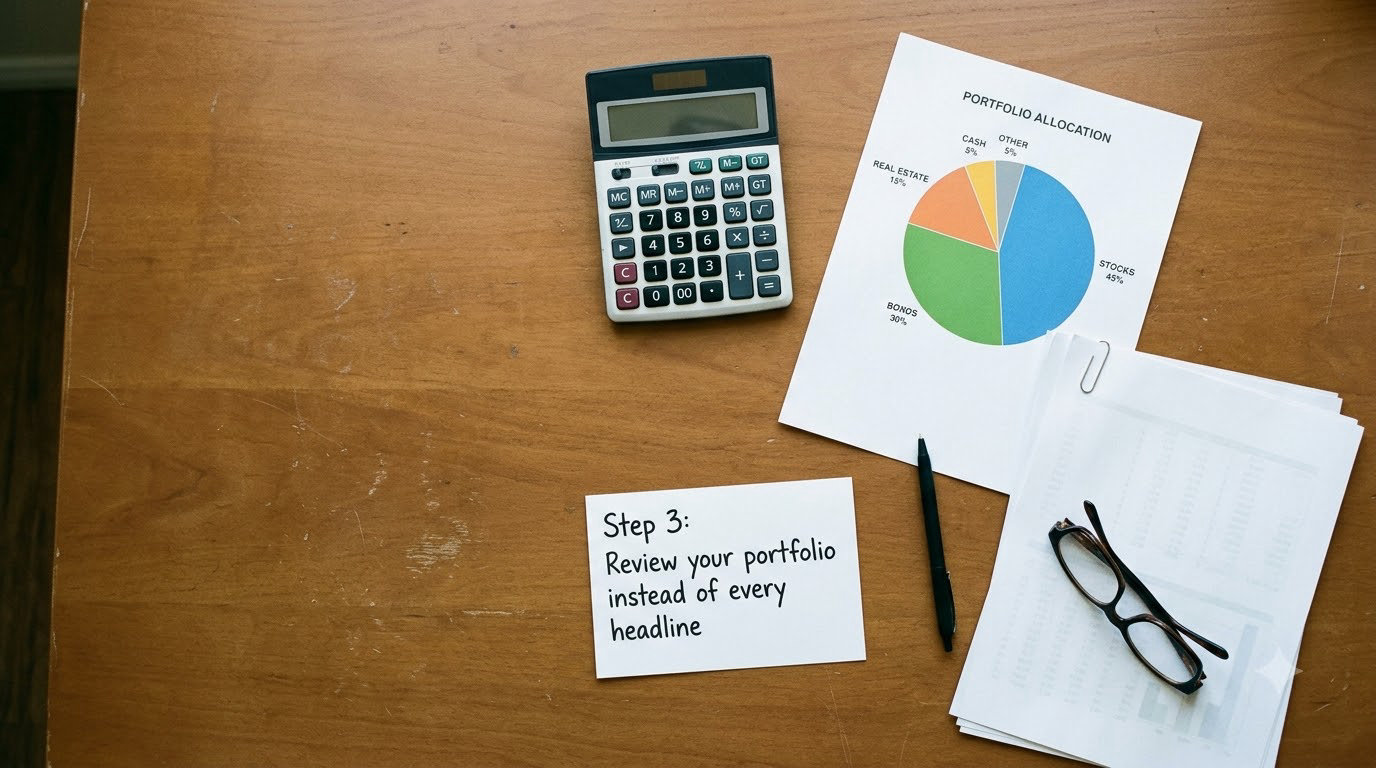
This is the step most people skip, and it is the one that produces real information. Pull up your allocation and check five things.
- Allocation. What share is in stocks, bonds, cash and anything else, and does that match the mix you chose for your goals?
- Concentration. Is more than a small slice tied to one employer, one sector or one region? Job risk plus portfolio risk is a bad combination.
- International share. A portfolio that is only domestic equities depends on one economy’s luck; adding non-US holdings is one of the simplest diversifiers available.
- Fees. Expense ratios do not spike during a decline, and trimming them quietly helps in every year, including this one.
- Drift. In a falling market, bonds and cash become a larger share of the total simply because stocks shrank. That is the signal to rebalance.
Step 4: What to Do When the Stock Market Drops With Your Portfolio
Once you know what you own and what you need, there are only five moves available. Each has a real trade-off, and the right one depends on your situation rather than on how the decline feels.
Hold steady. Keep your allocation and change nothing. This is the default for anyone with a diversified portfolio, a funded emergency fund and a timeline longer than the decline. The cost is that you will watch numbers fall for a while. The benefit is that you avoid turning a temporary loss into a permanent one, and you avoid the sequence of buying high and selling low that follows most panic decisions.
Rebalance back to your target. If bonds or cash have drifted up because stocks fell, sell some of what grew and buy what shrank, back to the percentages you already chose. This is mechanical, rule-driven, and about as close to emotion-free as investing gets. It also quietly sells your winners and buys your losers in small amounts, which is the opposite of what most people do under stress.
Buy with new contributions only. Keep your normal contributions running and, if you have spare cash earmarked for long-term goals, let dollar-cost averaging buy more shares at lower prices. This only works with money you already had a plan to invest. Deploying emergency savings or money needed in two years is not buying the dip; it is borrowing from your future self.
Reduce risk. Trim equity exposure or add short-duration bonds if your timeline shortened, your income dropped, or your tolerance was always lower than you claimed. Be honest about why. If the reason is that a headline made you nervous, you are reacting to noise rather than to new information about your goals.
Sell deliberately. Selling is occasionally correct — when a holding violates a rule you wrote, when the money has a date on it, or when the tax cost of holding exceeds the benefit. It is not correct as a reaction to a red number on a screen.
What changes by investor type
- Early career, long runway. Lowest risk of permanent loss. This is usually the best buying window most people ever get, so the strongest case is to keep or raise contributions.
- Mid-career, 10 to 20 years out. The main job is resisting a mid-career risk increase or a home purchase funded by retirement assets. Rebalance toward your target rather than shifting into cash.
- Near-retirement, five years or less. Sequence-of-returns risk is the live issue. Review income needs and consider moving a portion of planned withdrawals into cash or short-duration bonds for the first years.
- Retired and drawing income. Refill the cash bucket first, then cut discretionary withdrawals before selling assets. Selling into a decline often shortens the recovery and increases the odds of dipping into principal.
Step 5: Use a written decision rule you set in calm weather
Before volatility intensifies, write down three things: what would make you sell, what would make you rebalance, and what would make you buy. Use conditions you can observe rather than feelings you cannot. A rebalancing threshold, a specific goal date, or a rule about concentration are all testable. Feeling anxious is not a condition.
Two rules are worth keeping in writing. First, do not sell because of fear. Fear is the feeling that shows up right before the worst possible entry point, and it is a signal to wait a set period, not to act.
Second, look at taxes before you trade. Selling a position at a loss can offset a gain in a taxable account, and the offset can reduce this year’s tax bill and carry forward against future gains. Several of those losses in one year can wipe out capital gains taxes entirely. This is the one genuinely mechanical way to turn a downturn into a permanent improvement, and most people never touch it because they do not know their cost basis. Rules and rates vary by state and change, so confirm the details with a tax professional before you trade.
Keep contributing to your 401k or IRA
Nothing in a market decline changes your plan or your ability to contribute. If your paycheck still covers rent and groceries, keeping your workplace contributions and your IRA deposits running means you are buying more shares at lower prices, exactly when most people stop. The accounts may look smaller on screen while you quietly accumulate more units of ownership.
Two exceptions are real: if the contribution would force you to borrow, or if the match depends on a balance you no longer have. Otherwise, a pause is a decision made by fear, and it is the most expensive one on this list.
Step 6: Revisit the plan once conditions improve
A decline is temporary; the plan you set during it should not be permanent. When volatility fades, go back through what you wrote and check whether any assumption actually changed — income, timeline, risk capacity — rather than whether your mood changed.
Finish the rebalancing you started, rebuild the cash reserve you drew down, and return to your normal contribution schedule. If you moved to shorter bonds near retirement, decide whether that shift was structural or just a reaction to red numbers, because the cost of holding defensive positions through a recovery is real.
Finally, write down what you got wrong this time, while it still stings. That note is the most valuable thing you will own when the next decline arrives, because the next one will find you with money to invest and a calmer head, which is the combination that actually makes returns.
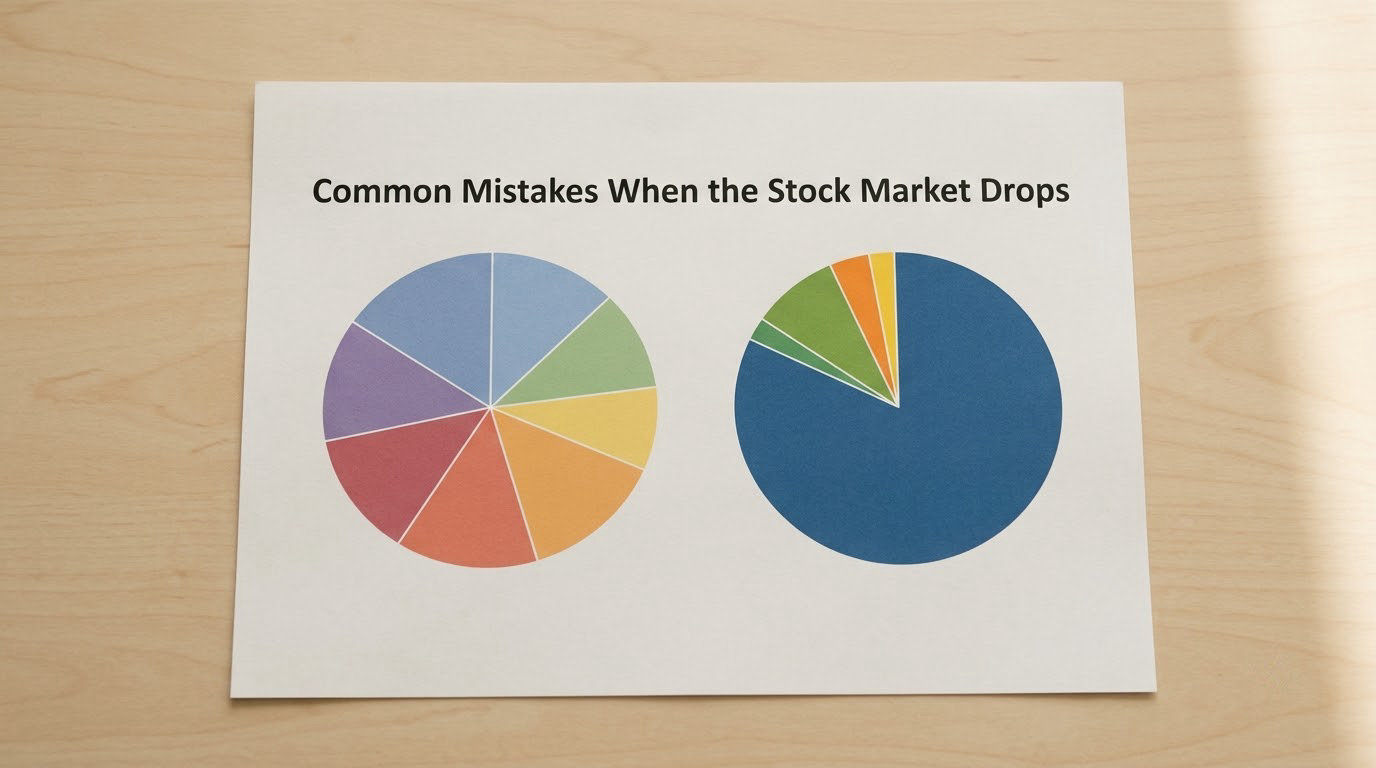
Common Mistakes When the Stock Market Drops
Panic selling at the bottom. This is the mistake that turns a recoverable decline into a permanent loss, because it sells low and often forces a buy-back higher. Fix it with a rule written in advance, plus a commitment to wait 48 hours before any trade over a set size.
Watching your balance every day. Daily checking turns every headline into a personal event and feeds action bias, the urge to do something rather than nothing. Fix it by scheduling check-ins, weekly or monthly, and doing the actual thinking on one fixed day.
Spending the emergency fund to buy the dip. Cash that covers three to six months of essential expenses is what stops you from being forced to sell at the worst time. Using it means the next setback — a job loss, a medical bill — forces a sale anyway.
Chasing the headlines. Coverage becomes loudest at the bottom of a decline, because fear is what drives clicks. Fix it by choosing your sources in advance and reading one of them a week instead of five a day.
Selling winners and holding losers. Loss aversion makes a small gain feel like giving money away and a large loss feel like it should recover. That combination guarantees you sell your good assets and keep the ones dragging you down.
Stopping retirement contributions. Lower prices mean more shares per paycheck, so pausing throws away the cheapest buying you will ever get. Keep going unless you would have to borrow.
Changing a long-term plan with no financial reason. If your goals, timeline and income are unchanged, a different allocation is a bet on the future, not a response to the present.
Frequently Asked Questions
Should I pull my money out of the stock market?
Usually not. Pulling money out during a decline converts a temporary paper loss into a permanent one and leaves you exposed to missing the recovery. Pull out only what you genuinely need within five years, or what sits in a fund that no longer matches your plan. Otherwise the better move is to keep your allocation, keep contributing, and check whether your emergency cash still covers three to six months of essential expenses.
Can I lose my 401k if the market crashes?
Yes, the balance you see can fall sharply in a downturn, and a 401k has no protection against a market decline. What it does offer is scale: a long horizon, automatic contributions, and employer matches. A drop inside a retirement account matters far less than the same drop in a fund you depend on next year, which is why timeline matters more than the percentage on the statement.
What should I do with my 401k if the market crashes?
Keep contributing at your normal rate if your paycheck covers living costs. Do not stop unless the contribution would require borrowing. Review your allocation once and rebalance back to your target if stocks have shrunk your equity share. Avoid switching to a new custodian or moving money out, because the transaction costs you and a year of employer match may outweigh a small tactical gain.
How long does it take to recover from a stock market crash?
Recovery varies widely and no one can promise a date. Broad US indexes have historically needed anywhere from a few months for a fast selloff to several years for the deepest bear markets, and the market often returns to its prior peak before it regains the peak after dividends. Anyone telling you they know the exact bottom or the exact recovery length is guessing, not forecasting.
What is the best investment if the stock market crashes?
There is no single best investment, but a diversified mix lowers the damage any one part can do. Broad index funds spread you across many companies, high-quality bonds and cash stabilise a portfolio, and non-US holdings add another economy. Gold and long-term government bonds have acted as diversifiers in some periods, though neither rises reliably. Keep the portion you need short term out of equities entirely.
Should I stop investing during a downturn?
No. Stopping is usually the most expensive response available, because lower prices mean each contribution buys more shares while the market recovers without you. If you want to buy more, use cash you had already earmarked for long-term goals, and fund it by pausing discretionary spending first. If a downturn genuinely changes your income or your timeline, adjust the amount rather than stopping entirely.
Start with the boring part: confirm your emergency cash, check the timeline on every account, and keep your contributions running. Everything else in this guide is optional; those three habits handle almost every market decline that ordinary investors face.
None of this is individual investment, tax or legal advice. Rules, rates and plan rules vary by state and change over time, so check the details that apply to you with a qualified professional before you trade.