Bond prices fall when yields rise because a bond’s coupon payment is locked in at issue, so the only way its return can compete with newly issued bonds paying more is for the market price to drop. Buy the same $50 of coupon income for $900 instead of $1,000, and the yield on that income jumps from 5% to about 5.6%.
That is the whole idea. Everything else in this guide is detail: why the drop can be small or enormous, why a 30-year bond suffers far more than a 2-year note, and why a bond fund can fall in value while you did nothing wrong. Rates and rules change over time, so treat this as a working explanation of mechanics rather than a forecast or a recommendation.
Table of Contents
- Why Bond Prices Fall When Yields Rise
- What Is a Bond Yield?
- What Happens to a Bond When Market Yields Change?
- Why Bond Prices Fall When Yields Rise: The Duration Effect
- Why bond prices fall when yields rise: reading the duration estimate
- How Coupon Size and Time to Maturity Affect the Price Change
- What Else Can Affect Bond Prices?
- What Does This Mean for Bond Funds and Investors?
- Four misconceptions worth dropping
- Frequently Asked Questions
- Do bond prices always fall when interest rates rise?
- Is yield to maturity the same as a bond’s interest rate?
- Why do longer-term bonds lose more value when yields rise?
- What happens to a bond ETF when bond yields rise?
- If a bond is trading below face value, can the issuer still pay its coupon?
Why Bond Prices Fall When Yields Rise
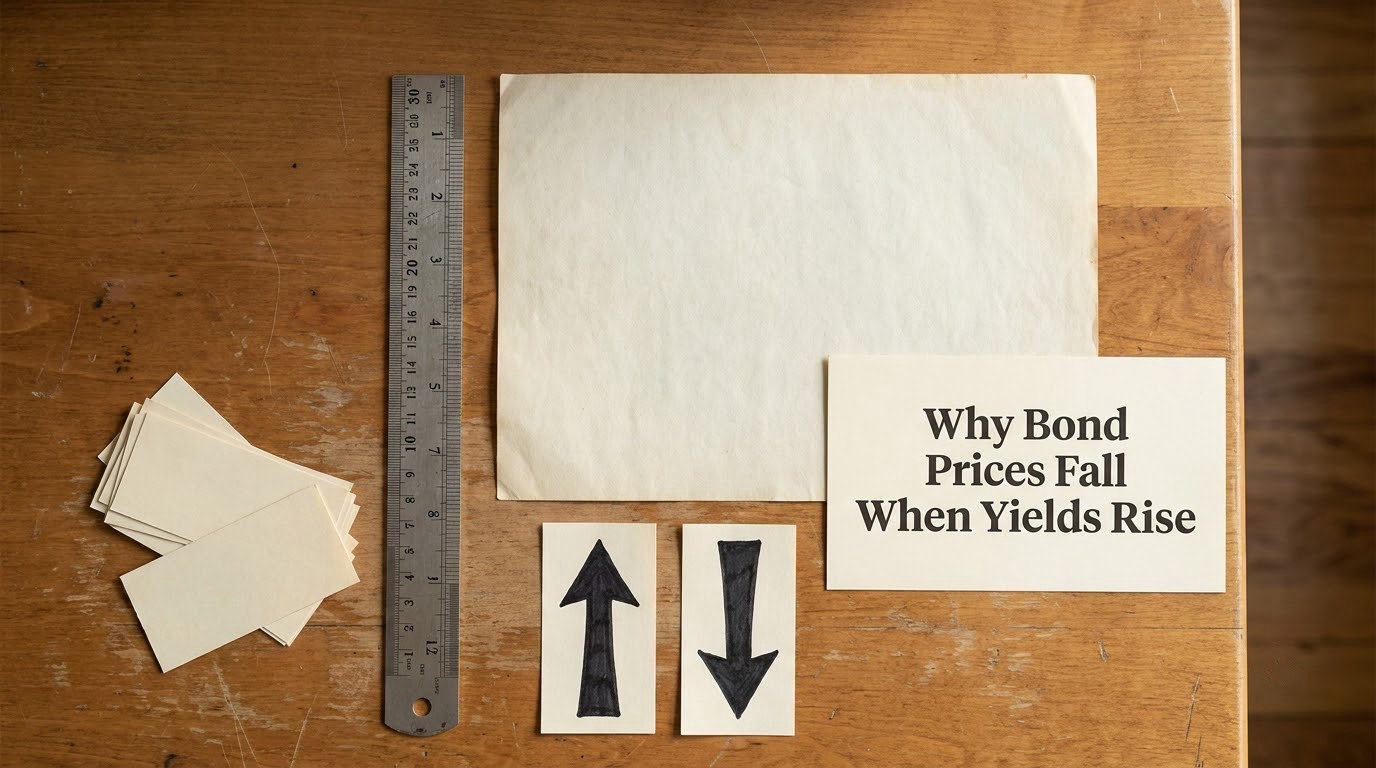
Here is the sequence, in the order it actually happens.
- The coupon payment was fixed when the bond was issued.
- Newly issued comparable bonds now pay a higher rate.
- Nobody will pay full face value for the older bond’s income.
- The older bond’s market price falls to create the same yield.
- At the lower price, the yield matches the new market rate again.
The last step is the one people miss. The price drop is not a penalty or a punishment for holding a losing position. It is the mechanism that keeps the older and newer bonds economically comparable. A $1,000 bond paying 5% and a $900 bond paying 5% deliver the same $50 a year, so the second one is the better buy at today’s rates, and that is exactly what the market says.
You may be wondering who is on the other side of the trade. Before you owned the bond, you bought it from an issuer or a dealer. After you own it, it trades between investors in the secondary market. Your gain or loss when rates move is the other party’s gain or loss, and nothing about the market’s total supply of cash changes when the Federal Reserve adjusts policy. Rates move because the price of every existing bond reprices against the next one.
The one thing that never changes: your coupon payment does not change. A bond paying 4% paid you $40 on a $1,000 face value when market yields were 2%, and it pays you $40 when market yields are 6%. The payment is a contract. The price is a market opinion.
What Is a Bond Yield?
A bond has three numbers that people routinely mix up, and almost every confusion about falling prices starts there. Face value is the amount the issuer promises to repay at maturity, typically $1,000. The coupon payment is the fixed dollar amount paid each year, based on that face value. The yield is whatever annual return the price you pay implies.
| Measure | How it is calculated | What it tells you |
|---|---|---|
| Coupon rate | Annual coupon payment divided by face value | The rate locked in at issue; it never changes |
| Current yield | Annual coupon payment divided by the market price | Income return if you hold it for exactly one year |
| Yield to maturity | The discount rate that makes all future cash flows equal today’s price | Annualized return if you hold to maturity and get paid on time |
All three measure the same bond, but they are answering different questions. Coupon rate is a fact about the contract. Current yield and yield to maturity are facts about the price. A bond bought below face value has a coupon rate lower than its yield to maturity, which is why its yield rises as its price falls. Nothing contradictory is happening; the denominator is shrinking while the numerator stays put.
Yield to maturity is the number the market treats as the benchmark. When journalists say yields rose, they almost always mean yields to maturity across a category of comparable bonds, most often Treasuries. Comparing your 3% coupon bond’s yield to maturity against the 10-year Treasury yield is comparing like with like.
What Happens to a Bond When Market Yields Change?
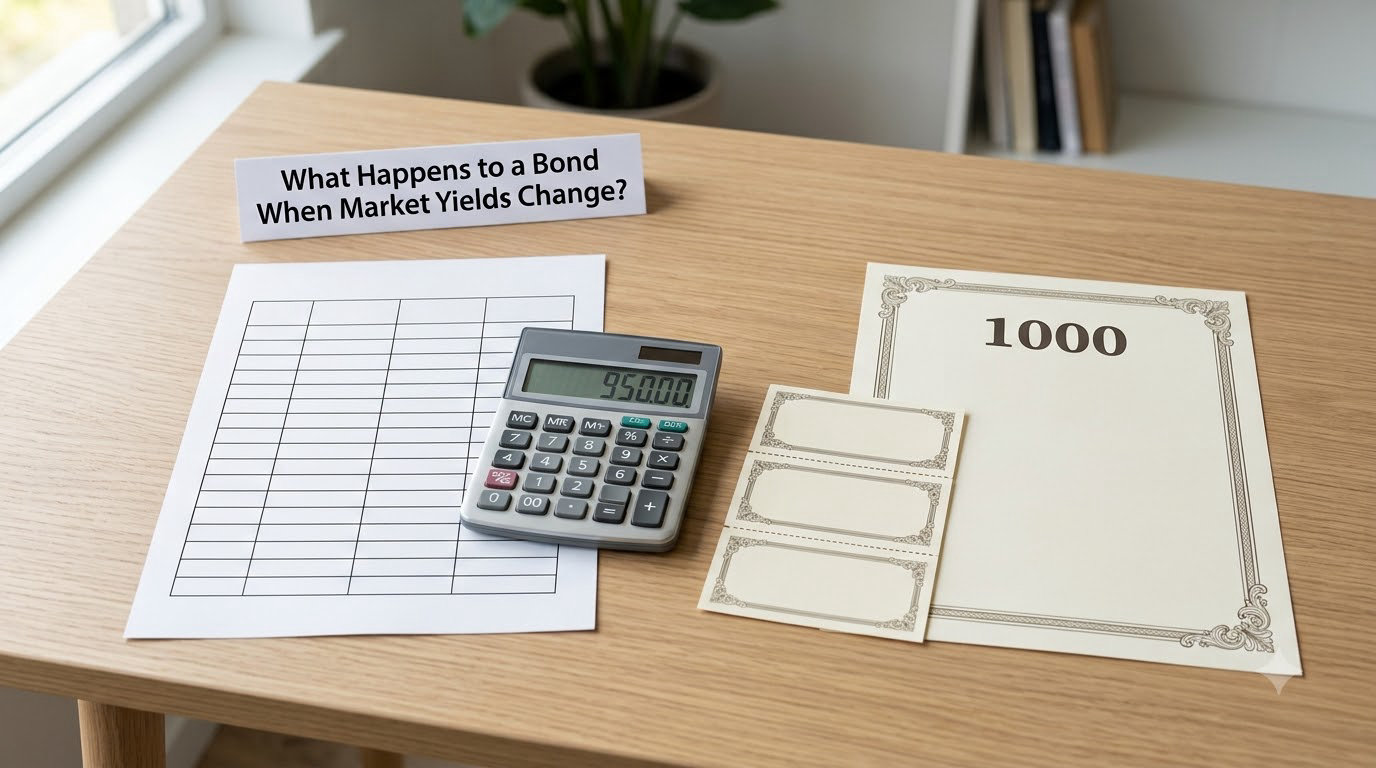
Consider a bond with $1,000 face value, a 4% annual coupon paid once a year, and three years left until maturity. It pays $40 a year, then $1,040 at the end of year three.
When comparable bonds yield 4%, this bond is worth exactly $1,000. Discount the cash flows at 4% and you get face value back, which is the definition of a bond trading at par.
When yields move to 5%, the same three payments discounted at 5% are worth about $972.80. The cash flows did not change by a single cent. The discount rate applied to them changed, and that is enough to move the price by more than $27. Each future payment is now worth less because you could earn 5% on money today instead of waiting for that payment.
Here is the same bond at a range of market yields, three years remaining in every case.
| Market yield | Price of the bond | Change from par | Current yield |
|---|---|---|---|
| 3% | $1,028.37 | +$28.37 | 3.89% |
| 4% | $1,000.00 | $0.00 | 4.00% |
| 5% | $972.80 | -$27.20 | 4.11% |
| 6% | $946.54 | -$53.46 | 4.23% |
| 7% | $921.27 | -$78.73 | 4.34% |
Notice the pattern. A one-point rise in yield cost about 2.7% of price, a two-point rise cost about 5.3%, and each additional point hurts a bit more than the last. That acceleration is not an anomaly, it is built into the arithmetic of discounting future payments, and it has a name.
Read the table upward and you see the mirror case: when yields fall, the price rises above face value. Buying at a premium feels like overpaying, but the buyer earns a higher yield than the coupon rate, and the premium is slowly returned as the bond pulls toward maturity. Rising prices are not a free lunch either. They are the same arithmetic pointing the other way.
Why Bond Prices Fall When Yields Rise: The Duration Effect
Duration is the number that lets you estimate a price change without redoing the discounting. Modified duration, the version investors actually use, is roughly the percentage the price moves for a one percentage point change in yield, with the opposite sign. A bond with a modified duration of 2.8 would be expected to fall about 2.8% for a one-point rise in yield, and rise about 2.8% for a one-point fall.
Why bond prices fall when yields rise: reading the duration estimate
Our 4% coupon bond with three years left has a modified duration of about 2.8 years. A one-point yield rise gives 2.8 × 1 = 2.8%, so $1,000 becomes roughly $972. The actual answer was $972.80, a 2.72% decline, so the estimate was slightly conservative. That gap is convexity, and it is worth a short explanation.
Duration is a straight-line approximation, but the real price-yield relationship is curved. Because of that curve, a bond gains a little more when yields fall and loses a little less when they rise than the duration estimate predicts. This asymmetry, called convexity, is a small tailwind for plain option-free bonds in both directions. It is not a guarantee, and it disappears or reverses for bonds with embedded options such as callables.
Duration grows mostly with time to maturity. A 2-year note has only a few future payments to reprice. A 30-year bond has sixty. Each one loses a little value when the discount rate rises, and the losses stack.
| Typical maturity | Approximate duration | Yield +1% | Yield +2% | Yield -1% |
|---|---|---|---|---|
| 2-year note | 1.8 years | about -1.8% | about -3.6% | about +1.8% |
| 10-year bond | 8 years | about -8% | about -16% | about +8% |
| 30-year bond | 17 years | about -17% | about -34% | about +17% |
These are estimates, not promises. Convexity cushions the two-point move a little, and no rate path happens in a straight line, but the shape is what matters: a 30-year bond losing value on a two-point rise is an ordinary outcome, not a malfunction.
One more piece of vocabulary worth keeping straight. A yield move of 0.01% is one basis point, so 100 basis points equals one percentage point. Headlines about bonds often quote basis points, which makes small moves sound dramatic. Ten basis points is a nudge, not a repricing.
How Coupon Size and Time to Maturity Affect the Price Change
A higher coupon is a shock absorber. Most of a high-coupon bond’s value arrives soon, and a payment you receive in two years needs very little discounting. Most of a low-coupon bond’s value sits far out at maturity, where discounting bites hardest.
Take two ten-year bonds, both issued at par. One pays 4% ($40 a year), the other pays 8% ($80 a year). The 4% bond has a modified duration of roughly 8, the 8% bond roughly 6.5. For the same one-point yield rise, the low-coupon bond gives back about 8% of price and the high-coupon bond about 6.5%.
So two bonds with the identical maturity date and the identical rating can lose noticeably different amounts, purely because of their coupon. If you want a bond that shrugs off rate moves, a bigger coupon is the lever, along with a shorter date to maturity.
Time to maturity is usually the bigger lever of the two. Cutting a maturity from 30 years to 5 years does more to reduce rate sensitivity than moving a coupon from 4% to 8%.
What Else Can Affect Bond Prices?
Rates are the dominant driver, but not the only one. Several things feed into the yield a bond is actually offered at.
Credit quality. A company that might not repay can only sell its bonds at a lower price, which is the same thing as a higher yield. Investors who buy that bond are paid extra to carry default risk. Corporate and municipal bonds are priced as government yields plus a spread, and that spread widens when investors get nervous, pushing prices down even if government rates are flat.
Inflation expectations. A 4% bond paying 2% inflation is a poor deal, so buyers demand a higher nominal rate. When expected inflation rises, nominal yields tend to rise with it, and prices fall.
Federal Reserve policy. Rate decisions move short-term rates directly and longer rates through expectations about future policy. A single decision is not destiny. Long rates can fall in the same month short rates rise, which is why “bonds” is never one single trade.
Liquidity and supply. A rarely traded bond sells at a discount because finding a buyer takes time. Heavy new issuance from the government can also push prices down as the market absorbs a larger supply at once.
Embedded options. A callable corporate bond can be redeemed by the issuer when rates fall, which caps its upside. A mortgage-backed security behaves differently again because borrowers can refinance. These features change the price response, and standard duration figures from a fund factsheet are averages across many such bonds.
Worth noting for anyone using a yield-curve argument: short bonds and long bonds do not always move together. They diverge, and that divergence is a normal part of the picture rather than a contradiction.
What Does This Mean for Bond Funds and Investors?
If you hold individual bonds, the choice is whether to sell before maturity or hold to maturity. Hold to maturity and collect every coupon plus face value, and rate moves along the way do not cost you anything in the end, as long as the issuer pays. You only realize a loss if you sell into a lower price. Sell early and the price move becomes a realized capital loss, which is why a bond’s price matters at the moment you sell and not one second before.
Bond funds and bond ETFs have no maturity date, so they never “mature into” face value. Their net asset value is the market value of the bonds inside, marked daily. When yields rise, that value falls, and your share price falls with it even though you never sold. The relevant number to look at is the fund’s duration, because that is the fund’s exposure to the whole basket.
There is a reinvestment risk on the other side. A short-term bond fund rolling into 1% Treasuries earns 1% on every new deposit while inflation runs higher, and rising yields that hurt long bonds are what make that reinvestment rate better. Higher rates are a loss on the bonds you hold and a gain on the ones you buy next. Which hurts more depends entirely on how long your money is committed and how much you need the account in the next few years.
Four misconceptions worth dropping
- “Bonds are safe, so they cannot fall in value.” Safe describes the promise of repayment, not the daily price. A 30-year Treasury can drop double digits in a year and still pay you every dollar promised.
- “Only the Federal Reserve moves rates.” Policy is one input. Inflation expectations, growth, credit spreads, and supply all move yields, and long rates sometimes move opposite to short ones.
- “Every bond falls the same amount.” Duration, coupon, credit quality, and embedded options all change the answer. A short high-coupon bond and a long low-coupon bond can face the same rate move and land in very different places.
- “A bond trading below $1,000 has had its coupon cut.” No. Coupons are calculated on face value. The price discount reflects rates, and the payment never changed.
For someone building a portfolio today, the practical takeaways are short. Match the maturity on your bonds to the date you will need the money, because that is what determines how much rate movement can reach you. Read the duration on any fund factsheet before buying, and remember that the number is an average, not a promise. This is general information about how bond pricing works, not individual investment advice, and your own situation deserves a conversation with a qualified professional.
Frequently Asked Questions
Do bond prices always fall when interest rates rise?
Almost always for a plain option-free bond, but not in every case. A rate move driven by fear of defaults can push prices up as investors buy the safety of a government bond. Callable bonds and mortgage-backed securities behave differently because embedded options change with rates. Check the fund’s duration before assuming any given rate move maps to a given loss.
Is yield to maturity the same as a bond’s interest rate?
No. The coupon rate is locked in at issue and paid on face value. Yield to maturity is the annualized return you would earn buying the bond at its current market price and holding it to maturity, assuming every coupon arrives on time. The two match only when a bond trades exactly at face value, which is why a bond bought below par shows a yield above its coupon rate.
Why do longer-term bonds lose more value when yields rise?
A 30-year bond has around sixty future payments to discount; a 2-year note has four. Each payment loses a little value when the discount rate rises, and the total loss scales with how many there are and how large they are. That is the intuition behind duration, the single number that estimates a price swing. Convexity makes the real outcome slightly better than the estimate.
What happens to a bond ETF when bond yields rise?
Its share price falls, because the fund holds the same bonds individual investors hold. Nobody sold anything because of the rate move; the market value of the bonds inside simply dropped. A short-duration fund falls noticeably less than a long-duration fund through the identical rate move, which is why the duration figure printed in a fund factsheet is worth reading before you buy.
If a bond is trading below face value, can the issuer still pay its coupon?
Yes. The coupon is calculated on face value, not on the price you paid or the price the bond currently trades at. A $1,000 face-value bond paying 4% sends $40 a year whether it trades at $1,028 or $921. Below-face pricing reflects interest rate changes, not a reduction to the promised payment.
Start with one habit: whenever you see a bond’s yield quoted, ask what price it is being quoted against. Once you can tell the difference between the coupon rate, the current yield, and the yield to maturity on the same bond, the inverse relationship stops being a puzzle and becomes arithmetic you can do yourself. Everything after that, duration, convexity, fund net asset value, is a detail built on top of that one rule.