A certificate of deposit (CD) is a savings product where you deposit a set amount of money for a fixed term, anywhere from a few months to five years, and the bank pays you a guaranteed interest rate for that whole term. Learning how certificates of deposit work for beginners is mostly about four things: your deposit amount, the term you pick, the rate you are locked into, and what happens on the maturity date.
The trade is simple. In exchange for a rate that is usually higher than a regular savings account pays, you agree not to touch the money until the term ends. If you break that agreement, the bank usually charges an early withdrawal penalty.
Below is the plain-English version: what a CD is, how interest is calculated, how to open one, and how to decide whether one fits your money. The APYs used in the examples are illustrative numbers, not current offers.
Table of Contents
- What Is a Certificate of Deposit?
- Key CD terms in plain English
- Certificate of deposit vs high-yield savings account
- How Certificates of Deposit Work for Beginners
- What CD Terms and Rates Mean
- How to Open a Certificate of Deposit
- How CD Interest Is Calculated
- What Happens at Maturity
- Can You Withdraw Money Before Maturity?
- How CD Interest Is Taxed
- How to Compare Certificates of Deposit
- How to Compare Certificates of Deposit for Beginners
- CD Risks and Common Mistakes
- Frequently Asked Questions
- Is a certificate of deposit better than a savings account?
- How much interest can I earn on a CD?
- Can I change the amount in a CD after opening it?
- What is the difference between a CD and a money market account?
- Are certificate-of-deposit deposits insured?
- What happens if I do nothing when my CD matures?
- Conclusion
What Is a Certificate of Deposit?
A certificate of deposit is a savings account where you deposit a lump sum for a fixed term in exchange for a guaranteed interest rate. It is a deposit, not an investment: your money is held by the bank and insured, and the return is known from the day you open it.
The rate a CD pays usually rises as the term gets longer. Six months might pay noticeably less than five years, because you are giving the bank more certainty about how long it can keep your cash.
CDs are built for money with a date attached. A down payment you need in eighteen months, a car you plan to buy next spring, tuition that comes due in a year. They are a poor fit for emergency savings, because an emergency never arrives on schedule.
- You choose three things: how much to deposit, how long to leave it, and at what rate.
- The rate is fixed for the entire term, so later Fed rate decisions do not change what you earn.
- The bank holds the money and pays interest until the maturity date.
- At maturity you get principal plus interest and decide what to do next.
- Deposits are insured by the FDIC at banks or the NCUA at credit unions, up to 250,000 per depositor, per insured bank, per ownership category.
That last line is the part beginners most often get wrong. The 250,000 limit is per bank, not across your whole portfolio, and it depends on how the account is titled. Joint accounts and certain retirement accounts get separate coverage. If you hold a large balance, ask the institution in writing how your accounts are classified before you rely on the insurance.
Key CD terms in plain English
Bank disclosures use jargon that makes a simple product sound complicated. These are the terms you will actually meet.
- Term — how long the money stays deposited, from one month to five years.
- Maturity date — the day the term ends and your money becomes available without a penalty.
- APY — annual percentage yield, the rate that already includes compounding. Always compare APY to APY.
- Principal — the money you deposited. Interest is what you earn on top of it.
- Roll over — moving principal and interest into a new CD at maturity.
- Share certificate — the credit union equivalent of a CD.
- FDIC / NCUA — the two federal agencies that back deposits at banks and credit unions.
Certificate of deposit vs high-yield savings account
This is the comparison beginners ask for most, and the honest answer is that a high-yield savings account wins on flexibility while a CD usually wins on rate. Neither is universally better.
| Factor | Certificate of deposit | High-yield savings account |
|---|---|---|
| Rate type | Fixed for the whole term | Variable, can change at any time |
| Typical rate relative to the other | Usually higher for the same bank | Usually lower |
| Access to money | Locked until maturity, penalty to leave early | Anytime, no penalty |
| Best for | A known future expense | Emergency fund and short-term cash |
| Insurance | FDIC or NCUA, same limit as savings | FDIC or NCUA, same limit as CDs |
How Certificates of Deposit Work for Beginners
The mechanics take about five minutes to understand. You deposit money, choose a term, and the bank credits interest to your account until the term ends. Nothing about your CD changes when interest rates move in the wider market, because your rate was locked in when you opened it.
Once you see a CD term ladder, the whole idea clicks. If you put 1,000 dollars into a one-year CD today and 1,000 dollars into a one-year CD twelve months from now, the second deposit locks in whatever the rate is then. Ladders are simply a way of spreading your deposits across different maturity dates instead of one big date.
What CD Terms and Rates Mean
The term is the lock-in period, and the maturity date is the day the lock ends. You open the account on an opening date, interest accrues during the term, and on the maturity date the account stops accruing and the balance becomes available.
APY and the interest rate are not the same thing. The interest rate is the raw percentage; the APY folds in how often interest compounds during the year, so it is the number that lets you compare two offers honestly. A bank quoting 4.00 percent with daily compounding might show a slightly higher APY than the same rate compounded monthly.
Most bank CDs are fixed-rate. A handful of brokerage CDs are variable, which means the rate can move during the term and your interest earnings can change with it. Beginners should default to a fixed rate.
Two more terms you will meet: the minimum balance, often 500 to 1,000 dollars at banks, and the compounding frequency, which is daily, monthly or at maturity. Money deposited above a maximum balance may sit in a separate non-interest-bearing account, so check whether the account has a cap.
How to Open a Certificate of Deposit
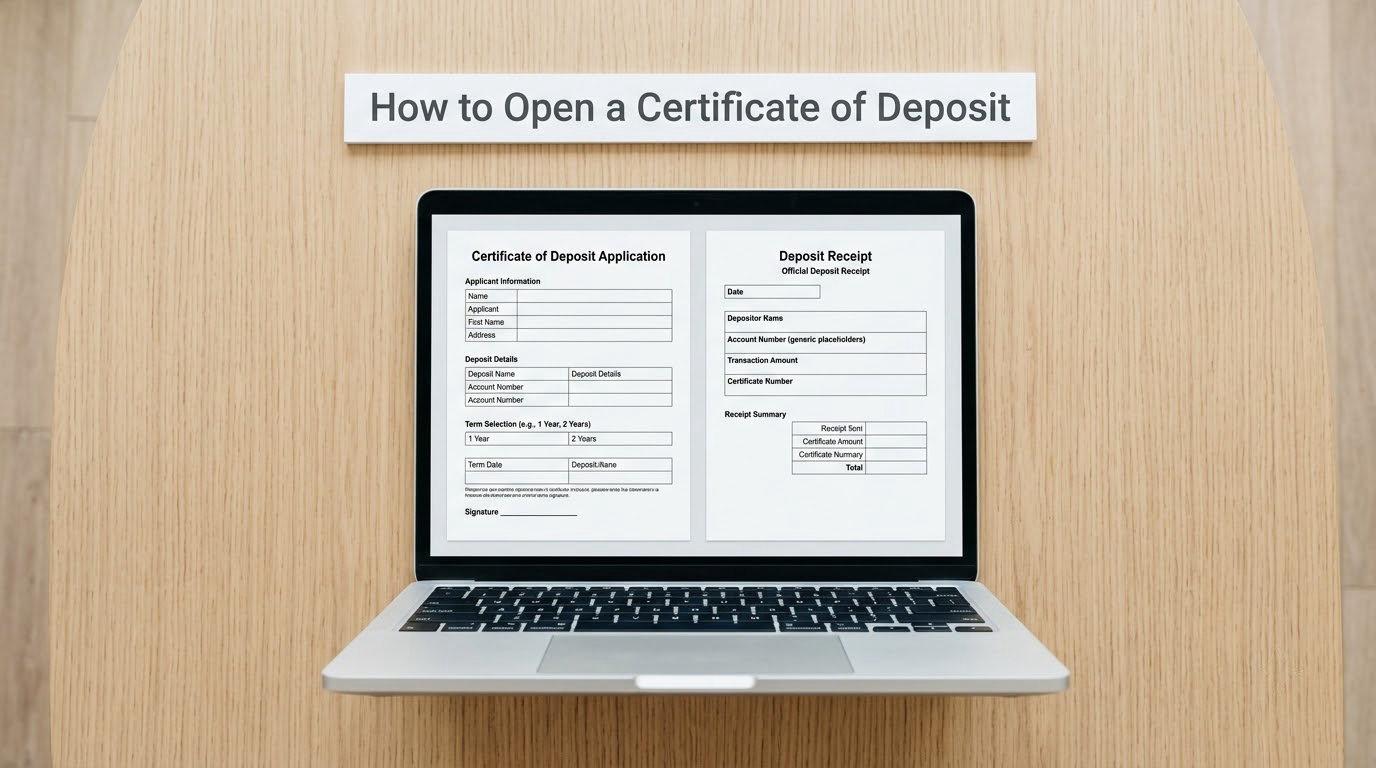
Opening a CD takes about fifteen minutes and can be done entirely online. The steps are the same whether you deal with a bank, a credit union or a brokerage.
- Pick the institution. Compare APY, minimum balance and early-withdrawal wording before you fall for a headline rate. You do not need to keep the CD at the same bank as your checking account.
- Compare terms at the same APY. Sort by term so you can see how much the bank pays for six months versus one year versus five years.
- Apply online or at a branch. Online-only banks usually offer the sharpest rates. You will need photo ID and your account or taxpayer identification number.
- Fund the account. Most banks let you transfer from an external account or write a check. Some credit unions require you be a member first, which may mean a small membership share.
- Confirm the dates. Write down the opening date, the maturity date and the exact APY. These three facts determine everything else.
- Read the early-withdrawal disclosure. Find the penalty section before you confirm, not after. It is usually one paragraph and it tells you how the penalty is calculated.
If you hold money at several banks, remember the insurance limit applies per bank. Opening two CDs at two institutions gives you two separate 250,000-dollar coverages, which is a legitimate reason to split a large balance.
How CD Interest Is Calculated
The basic formula is straightforward: interest equals your principal multiplied by the APY, multiplied by the fraction of a year the money is deposited.
So 10,000 dollars at an illustrative 4 percent APY for one year earns about 400 dollars. For six months it earns about 200 dollars. For five years, at an illustrative 4 percent, about 2,000 dollars if the bank compounds annually.
Here is what that looks like across common terms. These APYs are illustrative examples chosen to show the shape of the math, not a rate table you can shop from.
| Deposit | Term | Illustrative APY | Interest earned | Ending balance |
|---|---|---|---|---|
| 10,000 | 6 months | 3.60% | 180 | 10,180 |
| 10,000 | 1 year | 3.90% | 390 | 10,390 |
| 10,000 | 3 years | 4.00% | 1,200 | 11,200 |
| 10,000 | 5 years | 4.00% | 2,000 | 12,000 |
| 1,000 | 1 year | 3.90% | 39 | 1,039 |
| 500 | 3 years | 4.00% | 60 | 560 |
Two practical notes. Some banks pay interest at maturity rather than monthly, and a few credit unions credit interest monthly to a companion savings account. And the exact figure depends on the bank’s calculation method and compounding frequency, which is stated in your disclosure.
What Happens at Maturity
On the maturity date your money stops earning interest and becomes available. At that point you usually have three choices: withdraw it, renew it into a new term at the same bank, or move it somewhere else.
Here is the trap that catches beginners. If you give no instruction, many banks roll the balance automatically into a new CD at the same term, often at a lower rate than the one you had. Nothing is lost, but your money is locked again without you deciding to lock it. Set a calendar reminder two weeks before the maturity date and, if you do not want a renewal, tell the bank in writing before the date arrives.
Ask the institution in advance what its default maturity instruction is. Some default to reinvestment, some to transfer to a linked savings account, and each choice has different consequences for your access to the money.
Can You Withdraw Money Before Maturity?
Yes, but most banks charge an early withdrawal penalty, and the terms are harsher than most beginners expect. The typical arrangement is 30 days of interest on CDs with terms of 12 months or less, and 6 to 12 months of interest on longer CDs.
The penalty is calculated on the principal, not on the interest you have earned. On a one-year CD with 3.90 percent APY, 30 days of interest on a 10,000-dollar deposit is roughly 32 dollars. On a three-year CD the same formula multiplies into a much larger figure, which is why long CDs feel so unforgiving when something goes wrong.
Several things beginners get wrong here:
- A partial withdrawal usually triggers the full penalty. Many banks treat any early withdrawal as a breach, which is why a common rule reads that you must close the entire account early.
- Some banks deduct the penalty from accrued interest first, so you may see interest vanish before principal is touched. If your interest is smaller than the penalty, some institutions charge against principal.
- Exceptions exist and are limited. A commonly cited exception is the death of the owner or a beneficiary, and some banks waive penalties for early withdrawal in cases of severe financial hardship. Do not assume your situation qualifies.
- Brokerage CDs have no FDIC insurance and no penalty in the usual sense, but their price moves with interest rates, so you may sell at a loss. They are a different product, not a friendlier CD.
The practical protection is planning. Keep an emergency fund in a high-yield savings account, and only place money in a CD when the date you need it is already written down. If you know you might need the cash, a no-penalty CD or a savings account is the better tool.
How CD Interest Is Taxed
CD interest is taxable interest income in the United States. It is taxed as ordinary income at your federal marginal rate, and it may also be taxable at state level depending on where you live.
The bank reports the interest you earned during the calendar year on a Form 1099-INT, generally once the total reaches a small reporting threshold. Your tax software adds that figure to your income whether or not you withdrew it, which surprises people who never took the money out.
Because you are taxed on accrual, not withdrawal, an unused CD can still produce a tax bill in the year it earns interest. Keep the money available to pay or have it accounted for. Rules differ outside the US and in some states, so check locally or with a tax professional.
How to Compare Certificates of Deposit
Comparing CDs is mechanical once you know the nine things to check. Do them in this order and the choice makes itself.
- APY, never the headline interest rate.
- Term length against the date you need the money.
- Minimum and maximum balances, including whether extra funds earn nothing.
- Compounding frequency, since it changes what APY actually pays.
- Early-withdrawal penalty wording, copied verbatim for comparison.
- Maturity handling, especially the default instruction.
- Insurance, confirming the institution is FDIC- or NCUA-insured.
- Renewal behaviour, and whether you can turn auto-renewal off.
- Fees, which are rare on bank CDs but common at some brokerages.
How to Compare Certificates of Deposit for Beginners
Beginners should compare at least three institutions, including one credit union, before opening anything. Rate-shopping forums consistently raise the same worry, that a very high rate at an unfamiliar institution might be risky, and the fix is simple: check that the bank is FDIC- or NCUA-insured and read its published disclosures. An insured bank paying a high rate is not a red flag. An uninsured one offering a very high rate is.
It also helps to know where the rate comes from. Banks set CD rates in response to what the Federal Reserve does with short-term rates, and competition for deposits. Longer terms track long-term expectations, which is why a two-year and a five-year CD can move by different amounts after the same Fed meeting.
CD Risks and Common Mistakes
A CD is low risk, not risk free. Five things can still hurt you.
- Inflation. A 4 percent return in a year when prices rose faster buys you less at the end than at the start.
- Reinvestment rate. Your rate is fixed, but the rate you get when it matures is not. Locking for one year right before rates fall means rolling into a lower rate.
- Liquidity. The real cost is the penalty, which can exceed the interest you earned.
- Penalty misunderstanding. Signing without reading how the penalty is calculated is the single most common beginner mistake.
- Institution concentration. Holding everything at one bank risks the insurance limit if the balance exceeds it.
Other mistakes worth naming: opening a CD without a target date, forgetting to switch off auto-renewal, and treating a CD as an emergency fund. A no-penalty CD, a CD ladder or a plain high-yield savings account solves most of these.
Frequently Asked Questions
Is a certificate of deposit better than a savings account?
It depends on when you need the money. A CD usually pays a higher rate but locks your deposit until maturity, and taking it out early usually costs 30 days of interest or more. A high-yield savings account pays less but lets you withdraw anytime without a penalty. Keep emergency savings in savings and put money with a fixed date in a CD.
How much interest can I earn on a CD?
At an illustrative 4 percent APY, a 10,000 deposit earns about 400 dollars over one year and about 2,000 dollars over five years, assuming annual compounding. Real rates vary widely by bank, term and term length, and they change over time. Always compare APY to APY, since the raw interest rate does not show compounding.
Can I change the amount in a CD after opening it?
Usually not, not without consequences. Standard bank CDs do not accept added deposits, and a withdrawal before maturity usually triggers the full early-withdrawal penalty even if you leave most of the money in place. Add-on CDs are the exception, letting you contribute extra funds during a defined window. Check the disclosure before you assume either way.
What is the difference between a CD and a money market account?
A money market account is a transaction account you can withdraw from daily, and its rate is variable. A CD locks your money for a set term at a fixed rate, so it usually pays more but penalises early access. The interest is taxed the same way. For money you may need quickly, the money market account is the more flexible choice.
Are certificate-of-deposit deposits insured?
Yes. Deposits at FDIC-insured banks are insured by the Federal Deposit Insurance Corporation, and deposits at federally insured credit unions are backed by the NCUA. Coverage is 250,000 dollars per depositor, per insured bank, per ownership category, so the limit applies to each bank separately. Ownership categories such as joint and retirement accounts can carry their own coverage.
What happens if I do nothing when my CD matures?
The bank applies its default instruction, and for many accounts that means automatically renewing into a new CD at the same term, often at a lower rate. Some banks instead transfer the funds to a linked savings account. Either way you are not choosing, so set a reminder before the maturity date and submit your instruction in writing if you want to withdraw or move the money.
Conclusion
Start by writing down the date you need the money and the smallest balance that would be worth locking. Then compare APY at several institutions for that exact term, confirm the institution is FDIC- or NCUA-insured, and read the early-withdrawal paragraph before you confirm.
Keep your emergency fund in a high-yield savings account where it stays accessible. Use the CD for the goal with a fixed date, set a maturity reminder the moment you open it, and switch off auto-renewal if you do not want it rolling silently.
This is general educational information about how CDs work, not individual financial advice. Rates, tax treatment and insurance rules vary by country, state and institution, and they change. Check the current terms with the bank and confirm anything tax-specific with a qualified professional.