If you want the short version: understanding how credit utilization affects your score matters because the ratio of your reported balances to your credit limits counts for roughly 30% of a FICO score, and it is the one factor you can move quickly. Card issuers report to the credit bureaus every month, so a paid-down balance shows up faster than almost anything else you can do.
Last updated: October 2026
This guide covers the formula, the bands lenders like to see, which accounts actually count, and a practical calendar for paying down a balance before you apply for a mortgage, auto loan or a new card. Rules and lender criteria vary by country and state, so treat the ranges here as general information rather than a promise about your own score.
Table of Contents
- How Does Credit Utilization Affect Your Score?
- What Is a Good Credit Utilization Rate?
- How Is Credit Utilization Calculated?
- The calendar from purchase to score
- How Credit Utilization Affects Your Score by Reporting Model
- Which Accounts and Balances Count?
- Why Can My Score Change Even When My Balance Does Not?
- How Can You Lower Credit Utilization?
- Should You Pay Off My Balance Before the Due Date?
- Do I Need to Pay Off My Credit Card Every Month?
- Frequently Asked Questions
- How often is credit utilization reported?
- Does paying off a credit card before the due date lower utilization?
- Is 0% utilization better than 30% utilization?
- Should I close an old credit card to improve my utilization?
- Does credit utilization affect both FICO scores and VantageScore?
- How quickly can my credit score change after I pay down a balance?
- Conclusion
How Does Credit Utilization Affect Your Score?
Credit utilization is usually about 30% of your credit score, and both revolving balances and installment loan reporting can influence the result. Models look at how much of your available credit you are using, and lower relative balances generally score better than high ones.
It lands in the “amounts owed” bucket, the same category that includes installment balances. On a FICO score the five categories are payment history, amounts owed, length of credit history, credit mix and new credit, and utilization is the part of amounts owed you can influence this month without waiting years.
The reason lenders care is risk perception. A person using most of their available credit may be one bad month away from missing a payment, so a scoring model treats a maxed line as a warning sign.
What Is a Good Credit Utilization Rate?
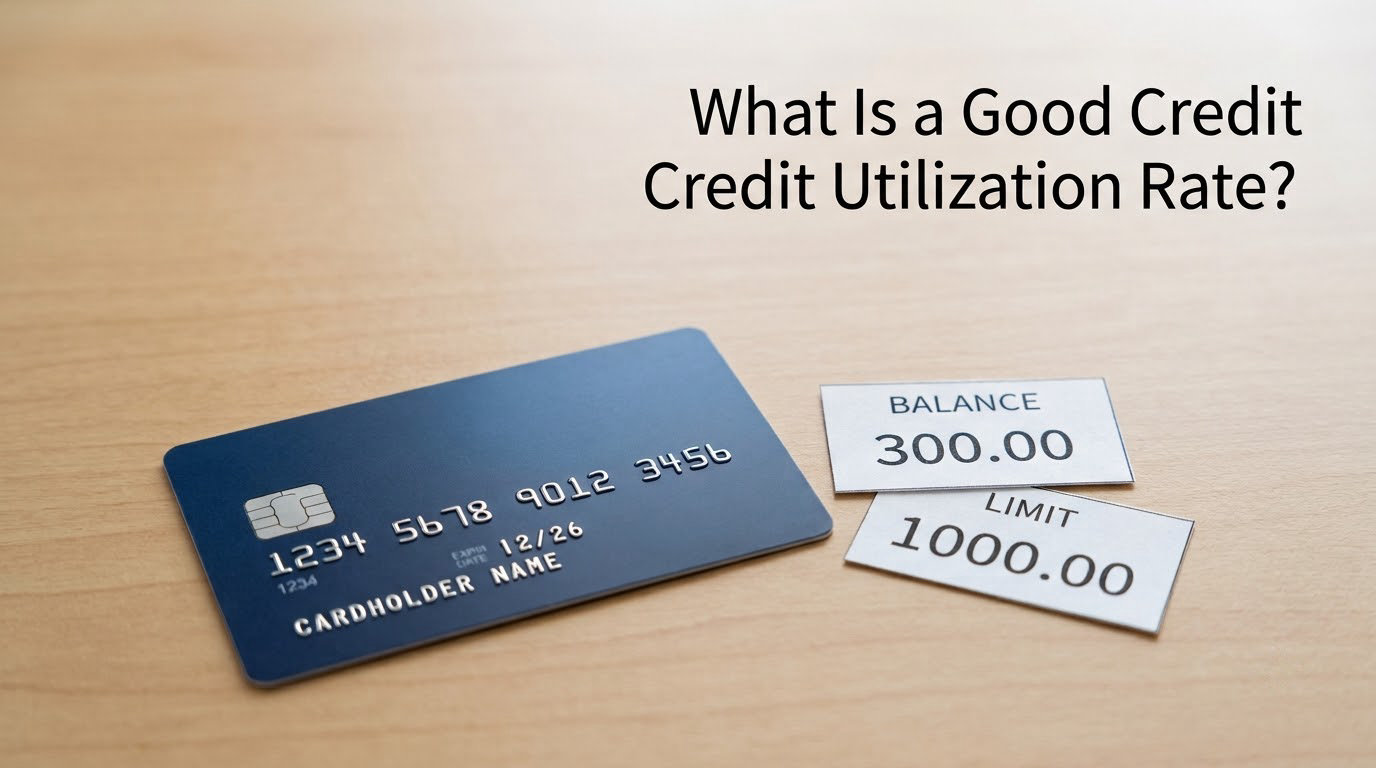
Scoring models generally reward balances that are low relative to your available credit, and the preferred target changes from model to model. Card issuers set their own thresholds too, and many look for reported balances under a certain share of the limit before they will approve a new account.
The 30% figure is a ceiling, not a target. Running right at 30% every month is a warning zone, not a place to sit.
- Under 10% overall: the range most commonly recommended for people applying for a mortgage soon.
- 10% to 29% overall: usually treated as acceptable, especially with a few years of clean payment history behind it.
- 30% to 49% overall: starts costing points on most models.
- 50% and above: a high-risk signal that many lenders treat as a decline on their own.
Zero is not automatically better than a small balance. A file with a history of running near 30% that suddenly reports 0% on every card can look unusual, and some models handle that oddly. Consistency at a low single-digit or low-double-digit number is the steadier approach.
How Is Credit Utilization Calculated?
There are two ratios in play, and the difference between them causes most of the confusion on this topic.
Statement-balance utilization is what appears on your credit report. Card issuers report the balance on your statement closing date, so this is the number a scoring model uses.
Current-balance utilization is what your issuer sees in its own system today. That is the number that matters when you apply for a card, and it can look completely different from your report.
Calculate the report version like this:
Total reported balances divided by total credit limits, multiplied by 100.
A worked example across four cards:
| Card | Limit | Reported balance | Per-card utilization |
|---|---|---|---|
| Card A | 5000 | 2500 | 50% |
| Card B | 2000 | 200 | 10% |
| Card C | 1000 | 0 | 0% |
| Card D | 3000 | 600 | 20% |
| Total | 11000 | 3300 | 30% overall |
That overall 30% looks unremarkable, but Card A is at 50% on its own. Models assess both the aggregate and individual cards, and r/personalfinance users reach the same conclusion in their own threads: a hot single card drags the score even when the overall number looks fine.
The calendar from purchase to score
Knowing when the number moves takes the guesswork out. Take a purchase made on the 3rd of the month on a card whose statement closes on the 20th.
- The 3rd: you make a charge. Nothing is reported yet.
- The 20th: the statement closes. This balance is what gets sent to the bureaus.
- The 7th of the next month: the payment is due. Interest accrues from the 3rd, and paying late lands a 30-day delinquency on your report.
- Late that month: the issuer’s report to the bureaus lands, and a score pulled after that point reflects the new balance.
Paying on the 7th lowers your current balance but not the balance already reported on the 20th. That gap is why people who pay in full every month still watch their score fall.
How Credit Utilization Affects Your Score by Reporting Model
Exact formulas are proprietary, so nobody outside the bureaus can give you a points-per-percentage-point conversion. What is public is which information each family of models leans on.
| Factor | FICO | VantageScore 4.0 |
|---|---|---|
| Category name | Amounts owed | Balance by utilization |
| Share of score | About 30% | Varies, typically treated as highly influential |
| Revolving credit emphasis | Both overall and per-card, plus the highest and lowest balances | Both overall and per-card |
| Installment balances | Counted in amounts owed, so paying one off can shift the picture | Tracked separately from revolving credit |
| Memory | Two years | About five years |
One r/CreditScore user reported a drop from 802 to 708 after running near the limit on their cards for five months. Utilization has no memory, so once lower balances are reported the old figure stops counting against them.
Which Accounts and Balances Count?
Revolving accounts are the core of the calculation. Credit cards, personal lines of credit and home equity lines of credit report a balance against a limit, and those balances are what feed the ratio.
Installment balances are treated differently by different models. A car loan or student loan has no revolving limit to divide by, so scoring models handle it as its own signal rather than folding it into a credit utilization percentage. Paying off a large installment loan can still move your score, just not through the utilization ratio.
One more wrinkle matters: credit card issuers are not required to report your current balance, only the balance from your most recent statement. Some report both. That is why a report can show 1200 on a card while you owe 300, and why a report taken right after a payment can look worse than the account actually is.
Why Can My Score Change Even When My Balance Does Not?
Because the reported figure, not your real-time balance, is what gets scored. Several ordinary events can shift it.
- Statement cycle timing: a purchase made after your statement closes sits in the next period, so a big buy shows up a month later than you expect.
- Closing a card: the balance goes to zero but so does that credit limit. If you paid off a 3000 limit card, your total available credit drops by 3000 and your ratio can rise. r/personalfinance threads describe this pattern repeatedly.
- Applying for new credit: a hard inquiry and a new account add to your file, and a new limit temporarily lowers your average account age.
- Different scoring models: a mortgage pull and a card application may not use the same model, so two scores on the same day can differ.
- Timing of the pull: checking your own report more than once a week is a good habit, and a lender pulling mid-cycle can catch a different balance than the one you expected.
None of that means a new card is bad news. It means a 40-point dip after opening one is normal and often self-corrects.
How Can You Lower Credit Utilization?
These steps are general information, not a plan built for your finances. If you are underwater or behind on payments, a nonprofit credit counselor is a better first call than a score-building strategy.
- Pay down the highest-percentage card first. If Card A sits at 50% and Card C sits at zero, Card A is where the damage is. Bringing it under 10% moves both the per-card and overall numbers.
- Pay before the statement closing date, not just the due date. Anything you pay before the statement closes is not in the reported balance. This is the single fastest lever most people have.
- Request a credit limit increase when your income and usage justify it. A higher limit lowers the ratio without you paying anything. On a card you use regularly, a modest increase can be reasonable; on a card you never touch, it just adds an account.
- Keep old accounts open if you still use them. Closing a card removes its limit and its contribution to your credit history. If you are not sure, pay a small amount on it each month to keep it active.
- Set utilization alerts through your issuer. Most banks will text you when you cross a threshold. It is a cheap way to catch a statement close you misjudged.
- Watch for promotional spikes. Balance transfers, 0% APR purchases and large medical bills can push a card to its limit. If you know one is coming, plan the payoff for the statement date before it closes.
Should You Pay Off My Balance Before the Due Date?
Paying earlier can reduce the balance your card issuer reports, provided you pay before the statement closes rather than merely before the due date. The closing date is usually 20 to 25 days before the due date, and it is printed on every statement.
Paying only the minimum is what keeps utilization high, because a minimum payment leaves most of the balance in place at the next closing date.
You can estimate what will be reported without spending anything: check your issuer’s app or use a low-balance alert, and treat the number shown mid-cycle as your target for the closing date. The goal is a lower reported balance, not a scramble with money you do not have.
Do I Need to Pay Off My Credit Card Every Month?
Paying in full every month is what keeps you out of revolving interest, and it is worth doing for that reason alone. Interest is not a scoring factor, so a balance carried for interest is pure cost with no score benefit.
But paying the due date alone may not lower reported utilization. If you pay in full on the 7th and charge the balance again before the statement closes on the 20th, the 20th balance is reported, not your payment.
There is a common piece of advice to carry a small balance to build credit. It does not help your score, and it costs you interest every month. What builds credit is on-time payments, accounts you actually use, and time.
Frequently Asked Questions
How often is credit utilization reported?
Card issuers report to the credit bureaus once a month, usually the balance on your statement closing date. That reported figure, not your live balance, is what feeds the utilization ratio. A payment made after the closing date does not change the number that was already sent, so the score may not improve until the following month.
Does paying off a credit card before the due date lower utilization?
Only if you pay before the statement closing date, which usually falls 20 to 25 days ahead of the due date. Paying early reduces your real balance and can lower what gets reported, but paying on the due date does not change the statement balance already sent to the bureaus. Check the closing date printed on your statement.
Is 0% utilization better than 30% utilization?
Zero is not automatically the best result. A file that consistently runs near 30% and suddenly reports 0% across every card can look unusual to some models, and a lender may have questions about it. A steady single-digit or low-double-digit ratio is usually treated as more normal and scores at least as well.
Should I close an old credit card to improve my utilization?
Closing a card usually makes your ratio worse in the short run. The balance goes to zero but so does the limit, so your total available credit shrinks and the remaining balances look larger against it. It also shortens your credit history. If the card is inactive, pay a small amount on it each month instead of closing it.
Does credit utilization affect both FICO scores and VantageScore?
Yes. Both families of models treat utilization as influential, though they group and weigh the information differently. FICO places it in the amounts owed category at roughly 30% of the score, while VantageScore 4.0 tracks balance by utilization as its own category. Exact formulas are proprietary, so nobody can convert a percentage into points precisely.
How quickly can my credit score change after I pay down a balance?
Faster than most people expect, because utilization has no memory. The payment itself does not update the report, but the lower balance appears when the next statement closes, and a score pulled after that report reflects it. In practice that is a few weeks to roughly 45 days from payment to a higher reported number, depending on where you are in your cycle.
Conclusion
Start with the number you can verify today. Pull your own report, list each revolving limit and the last reported balance, and calculate your overall ratio using the formula above. Then check each card individually and see whether one is running hot while the rest look fine.
If the reported figure is higher than you want, an extra payment before the statement closing date is usually the fastest correction, and it costs nothing to check where that date falls. If the math already looks good, a limit increase on a card you use regularly may be worth requesting. Give it one full reporting cycle, then look again.