
Yes, you can negotiate a lower credit card APR. Card issuers set the annual percentage rate (APR) on each account and will consider a reduction when you ask well. Learning how to negotiate credit card interest rates takes one phone call and about ten minutes of prep: call the number on the back of your card, make your case in a few sentences, and expect the first representative to hand you to a retention desk. A cut of roughly 3 to 5 percentage points is a realistic target for a cardholder with a solid score and an unbroken payment record.
Before that call, do four things:
- Know your current purchase APR and balance from the latest statement.
- Check your credit score. 700 or higher changes the whole conversation.
- Find one competitor offer at a lower rate so you can name a number.
- Call the number on the back of your card, not the chatbot.
Ten minutes of preparation separates a rep reading from a script and a rep opening an approval screen. The call itself usually takes five.
Table of Contents
- What You Need
- How to Negotiate Credit Card Interest Rates: Step-by-Step
- Check Your Current APR and Account Details
- Review Your Credit Profile and Timing
- Call the Issuer and Ask for a Rate Review
- Counteroffer and Emphasize the Value of Your Account
- Ask About a Promotional APR or Balance Transfer
- Get the New Terms in Writing and Decide
- Common Mistakes
- Frequently Asked Questions
- Can you negotiate down an interest rate on a credit card?
- Does asking for a lower APR hurt my credit score?
- How much of a rate reduction should I realistically expect?
- What should I do if the credit card company says no?
- Is a balance transfer better than negotiating with my current issuer?
- How do I write a letter to a credit card company for a lower interest rate?
- Conclusion
What You Need
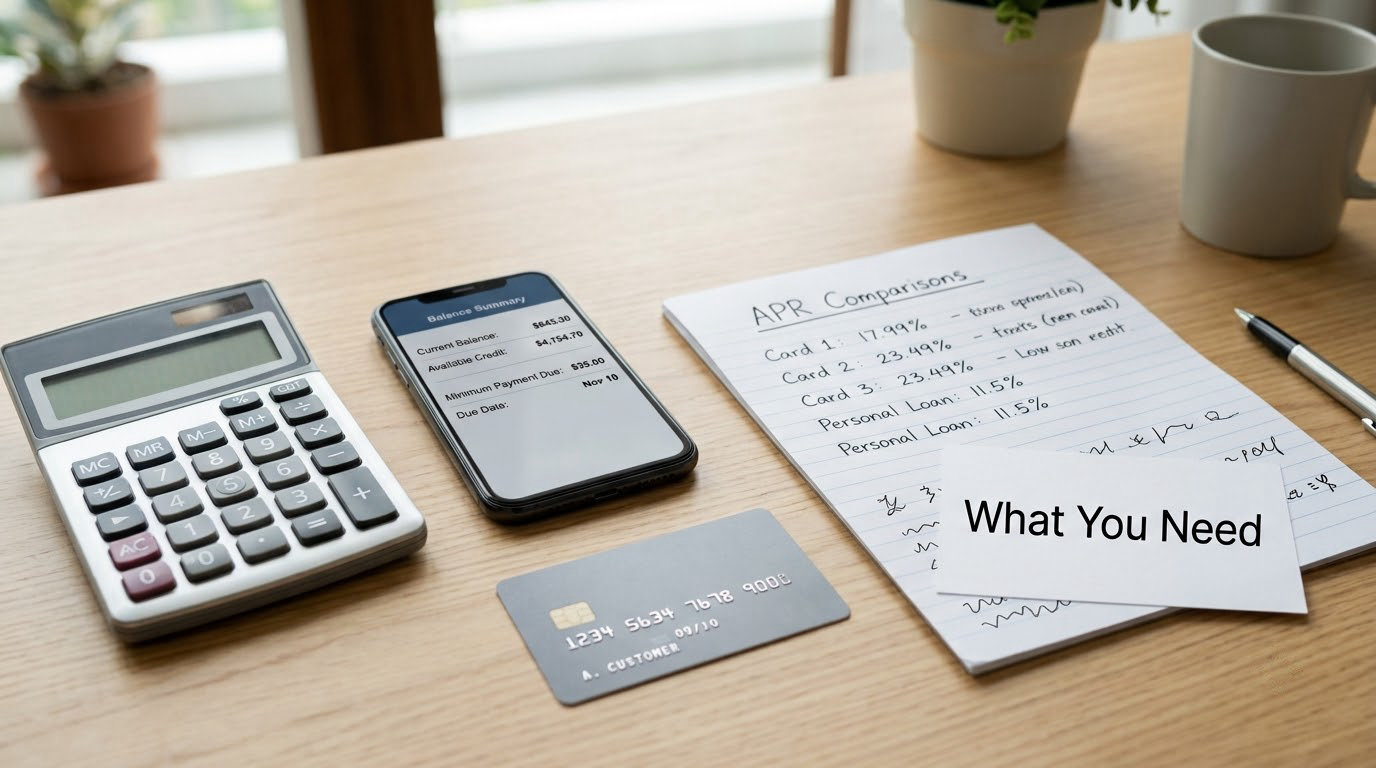
Bring the current APR and balance from your most recent statement. That single number decides the rest of the conversation, and a cardholder who cannot state it gets treated like a general enquiry rather than a specific request.
Also pull the terms that apply to the money you actually owe. Most cards carry a purchase APR, a higher cash advance APR, and sometimes a separate balance transfer rate, and only the rate attached to your existing balance is worth negotiating.
- The purchase APR, the cash advance APR, and any promotional rate still running.
- Every fee that applies: annual fee, cash advance fee, late fee, foreign transaction fee.
- Your credit limit and current balance, so you can calculate the utilization ratio.
- Your account opening date and how long you have paid on time without a miss.
- Any rewards, status perks or product benefits you would lose by leaving.
- Your most recent credit score, from your card issuer or your free report at AnnualCreditReport.com.
The report is worth checking the same week. Experian, Equifax and TransUnion each publish a free annual report, and a reporting error on one of them can block a good rate on all three.
Finally, find one competing offer. A preapproved letter that arrived in the mail, or a same-tier card from another issuer advertising a clearly lower rate, is the strongest card you can play. Forum regulars on r/personalfinance and the myfico forums describe the same pattern repeatedly: a tangible competitor offer gets results, an abstract threat to leave does not.
How to Negotiate Credit Card Interest Rates: Step-by-Step

Check Your Current APR and Account Details
Your statement lists the purchase APR, the APR range the card can charge, and the finance charge assessed last cycle. If the range moved with the federal funds rate, your rate rose on its own schedule and the issuer is not required to lower it again when rates fall.
Three details matter more than the rest. The purchase APR is what your existing balance actually pays. The grace period tells you how many days you can run a balance without interest at all. The average daily balance is what the issuer charges against, so paying a balance down before the statement closes does real work.
Note whether a promotional APR is still running. If a 0% intro period expires in the next two months, that deadline should frame the entire call.
Review Your Credit Profile and Timing
Two numbers do the work here: your credit score and your credit utilization ratio. A score of 700 or above is the threshold that appears repeatedly in cardholder reports because it is where retention desks have real authority to spend money. Utilization means your balance divided by your limit, and getting it under roughly 30 percent before you call costs you nothing except paying down a little.
Timing matters as much as the score. Good moments to call include the quarter after a Federal Reserve rate increase, the month your 0% promotional APR is about to expire, and the point at which you have just paid a balance down or completed six more months of on-time payments.
Do not wait for a perfect moment, though. The myfico forum crowd treats this as a recurring habit rather than a one-time event: ask every six months, escalate one rung further each time, and stop when the answer stops changing. The Federal Reserve’s data puts the average APR on interest-charging cards a little above 22 percent, which is why even a 3-point cut is worth real money.
Use this table as a starting target, then adjust for your own situation:
| Your current APR | Reasonable first ask | What usually happens |
|---|---|---|
| 26 percent and above | 20 to 22 percent, or a temporary cut | Partial reductions are more common than large ones; a 6 to 12 month promo often beats a permanent ask here |
| 22 to 25.99 percent | 17 to 19 percent | The band where a 2 to 5 point win is most often reported |
| 19 to 21.99 percent | 14 to 16 percent | Often declined in favour of a fee waiver or a credit limit increase |
| Below 19 percent | Ask anyway, briefly | You are probably better off moving the balance rather than negotiating in place |
These are negotiating targets, not entitlements. Issuers have discretion, and no one can promise you a result.
Call the Issuer and Ask for a Rate Review
Dial the number on the back of the card, not a general customer service line, and skip the automated prompts until a person answers. Then say this:
“Hi, I’m calling about the APR on my account. I’ve been a customer for [X] years, my credit score is around [Y], and I have never missed a payment. I’d like to ask whether a lower APR is available on this account.”
Then stop talking. The silence is uncomfortable and it works, because the representative has to go find something.
Here is where most people give up too early. The frontline representative you reach usually has no authority to change a rate at all. That is not personal and not a policy against you; the authority sits one desk over. On r/CRedit and r/debtfree, cardholders describe the same wall repeatedly: a polite rep who says “let me check on that,” transfers you, and the second person has the actual authority.
When the first answer is no, ask for the escalation rather than arguing:
“I understand that’s outside what you can approve. Could you transfer me to the retention department or a supervisor who can review a rate reduction on this account?”
That sentence works because it gives the rep a reason to transfer you without implying they failed. The ladder runs: frontline representative, then retention department, then a supervisor, then account or manual review, and finally the hardship team if money is genuinely tight.
Counteroffer and Emphasize the Value of Your Account
Retention desks almost never meet your opening number, and they rarely meet the second one either. A partial offer is still a partial offer. When you get one, do three things: thank them, name your real target, and remind them what they keep.
“That helps, but I was hoping to get closer to 16 percent. I have been with you for six years, I pay in full most months, and I have about [amount] in rewards on this card that I would not get elsewhere.”
Tenure and spending are the two arguments that actually move people. A cardholder with a long relationship and real annual spend is a customer worth retaining, and retention budgets exist to keep exactly that person.
Expect a counter-move. Retention desks like to offer you something other than what you asked for: an annual fee waiver, a product upgrade with a chip and a new card number, a credit limit increase, or a one-time courtesy credit. Some of those are worth taking. None of them lower the rate.
If they push you toward closing the account, decline without threatening. Saying “I would rather stay with you and lower the rate” is harder to argue with than a cancellation warning, and it keeps the relationship intact. The issuer holds the balance, not you, so a threat rarely buys anything.
Ask About a Promotional APR or Balance Transfer
When a permanent cut is refused, ask for a temporary promotional APR instead. Six, nine or twelve months at a lower rate is much easier to authorize than a permanent repricing, and it costs the issuer almost nothing once it expires.
Ask the questions that decide whether the offer is real:
- How long does the promotional rate last, and what is the date it ends?
- What APR applies to my balance after the promotion expires?
- Does the promotional rate apply to my existing balance or only to new purchases?
- If a 0% intro period is expiring on the card, can it be extended instead of requiring a new application?
That last one matters. A new balance transfer card usually means a hard credit inquiry, which is exactly what most cardholders are trying to avoid. Some issuers will extend an expiring promotion for a good customer; it costs you nothing to ask.
The same reasoning applies to balance transfers in general. A 0% intro offer typically runs 15 to 21 months and usually costs a transfer fee in the range of 3 to 5 percent of the amount moved. Compare that fee against the interest you would pay during the promo, and read the rate that applies afterward, because the transfer only postpones the problem if you pay the balance down before the promotion ends.
Get the New Terms in Writing and Decide
Never end a call on a verbal yes. Before you hang up, confirm the exact APR, whether it covers your existing balance as well as new purchases, any fee attached to it, the expiration date, and what happens to your credit limit. Then ask for it in writing, by secure message or letter, so there is a record.
A phone call works best for the first request, because a live representative can escalate while you are on the line. A secure message creates the paper trail, but it is slower and easier to bury. Use the phone for the ask and the message for the confirmation.
If you would rather start in writing, keep it short and factual:
“I am a cardholder in good standing with an account open since [year], a current APR of [X] percent, and no late payments. A comparable offer from another issuer is at [Y] percent. I am requesting a reduction to [Z] percent on this account. Please confirm the new rate, its effective date, and whether it applies to my current balance in writing.”
Then check the next statement to confirm the rate actually applied. If the issuer promised a reduction and then charges the old rate, that is a disagreement you can take to the Consumer Financial Protection Bureau. Rules and rates vary by state and by issuer, and everything above is general information rather than individual financial advice.
Common Mistakes
Negotiating before you know your current APR. A caller who cannot state the rate and the balance is negotiating blind, and the rep knows it. Read the latest statement first.
Opening with a threat to close the account. Leading with a cancellation in the first thirty seconds turns a rate conversation into a retention script. You are more likely to be offered a transfer fee than a lower rate, and the balance does not leave just because you threaten it.
Talking to the chatbot. Automated chat systems have no authority to reprice an account and will repeat a script until you ask for a person. Ask for a representative and, if needed, a supervisor.
Applying for new cards before the call. A hard inquiry lowers your score for a few months and weakens the very bargaining power you are trying to use. Research is fine; applying is not.
Accepting a trade without reading the fee schedule. A lower rate paired with a new annual fee, or a rate cut that requires autopay, may cost more than it saves. Ask for the total annual cost before you say yes.
Declining the substitute offer without hearing it. Fee waivers, courtesy credits and limit increases are real money, and a limit increase can improve your utilization ratio. Hear the offer, then decide.
Forgetting to document the agreement. A rate you agreed to but cannot prove is a rate that quietly reverts. Get the confirmation in writing every time.
There are also two moments when negotiating is the wrong move. If you are struggling to make minimum payments at all, ask for a hardship program instead; issuers can reduce your rate, waive fees, and temporarily lower or pause payments under those plans, and a nonprofit credit counselling agency can help you apply without being a debt-relief company. And if your balance is large relative to what you can pay, a rate cut alone will not rescue the plan. Lowering the rate helps most when you are also paying the balance down, which is the pattern r/personalfinance readers describe over and over: call, ask, and then actually pay.
Frequently Asked Questions
Can you negotiate down an interest rate on a credit card?
Yes. Card issuers set the APR on each account and can change it at their discretion, so a polite request is a normal customer service call rather than an unusual request. Call the number on the back of your card, state your score, tenure and payment record, and ask directly. A reduction of 3 to 5 percentage points is a realistic target, though the issuer can always decline.
Does asking for a lower APR hurt my credit score?
No. A rate request is not a credit application. The call itself does not trigger a hard inquiry, and most issuers perform at most a soft review of your profile, which does not affect your score. Ask for the confirmation in a secure message rather than mailing a new application, and your credit file stays untouched throughout.
How much of a rate reduction should I realistically expect?
Cardholders with a score of 700 or above, a long tenure and a strong payment record most often report 2 to 5 point reductions, and a temporary promotional rate is easier to get than a permanent cut. Below 700, expect less, and expect the first offer to be something else entirely, such as a fee waiver or a credit limit increase.
What should I do if the credit card company says no?
Ask for the retention department rather than arguing with the frontline representative, who usually cannot approve a change. If retention declines too, ask for a supervisor, then for an account review. Accepting a temporary promotional APR, a fee waiver or a credit limit increase is a better outcome than nothing, and a hardship program is the right route if you cannot make minimum payments.
Is a balance transfer better than negotiating with my current issuer?
A transfer can be better when your current APR is very high, because a 0% intro offer for 15 to 21 months pauses interest entirely. It usually costs a transfer fee of roughly 3 to 5 percent of the balance and requires a hard inquiry, and the rate after the promotion ends is often high. Negotiating in place costs nothing and keeps your account history intact.
How do I write a letter to a credit card company for a lower interest rate?
Keep it short and factual: your account open date, current APR, payment history, a competitor rate you can name, and the specific rate you are requesting. Ask for the new rate, its effective date and whether it applies to your current balance to be confirmed in writing. A phone call usually gets a faster answer; the letter creates the record.
Conclusion
Start by opening your latest statement and writing down your current purchase APR, your balance and your credit limit. Then call the number on the back of your card, ask for a specific reduction in the range your situation supports, and ask for the confirmation in writing before you hang up. If the first answer is no, ask for the retention desk and try again in six months.