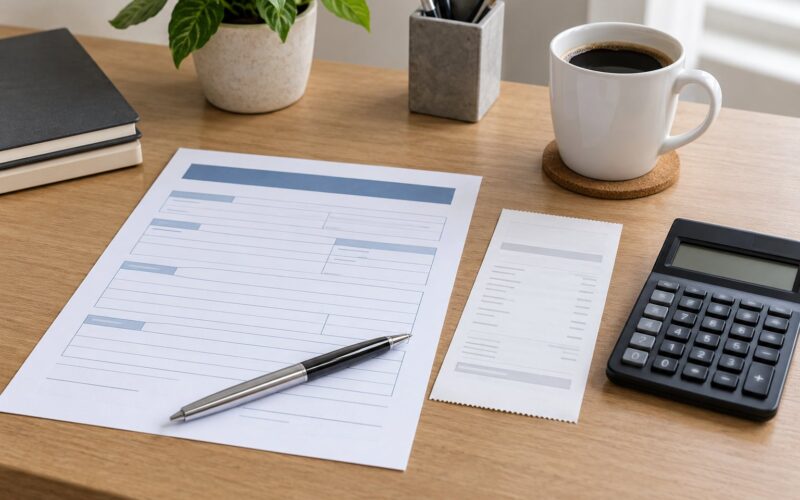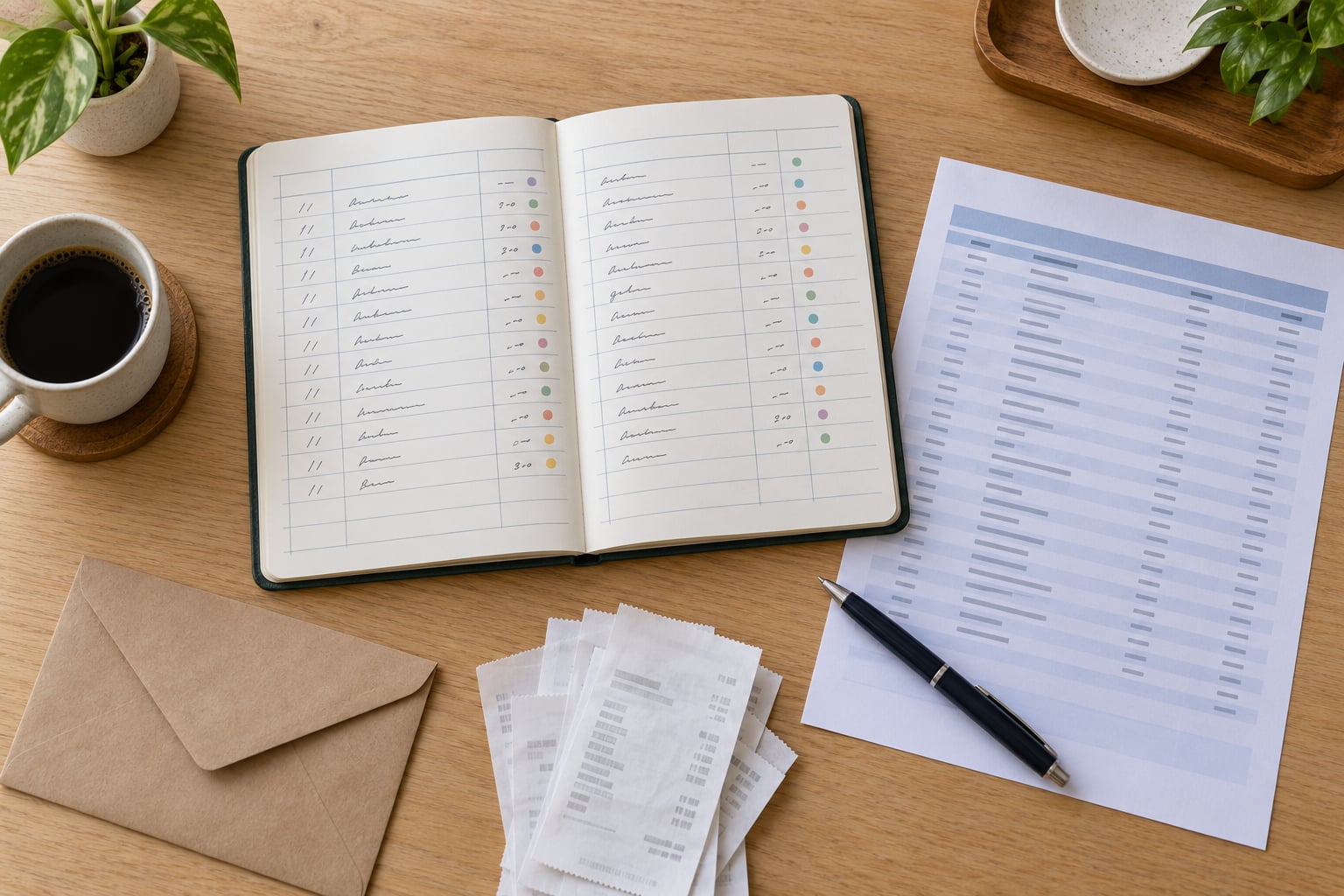
To track spending without an app, write each purchase into a paper or spreadsheet ledger the day you make it, then reconcile that ledger against your bank and credit card statements once a week. Budget about five minutes a day, one longer session at the end of the month, and a small notebook. Most of the work is deciding where a purchase belongs, not recording the amount.
The reason people search for this is usually frustration. They downloaded a tracker, entered purchases by hand for two weeks, and quit when the data felt wrong. Bank auto-categorization puts a hardware store charge in the wrong bucket, cash never shows up in the feed at all, and the total drifts away from what the bank statement says. Low-tech methods fail differently: they are slower, but you decide what counts, and the numbers are yours.
Rules and accounts differ by country and bank, so treat the figures below as realistic US ranges rather than fixed amounts. Nothing here is individual financial advice.
Table of Contents
- What You Need
- Step-by-Step: How to Track Spending Without an App
- Set Up a Simple Spending Ledger
- Record Purchases as They Happen
- Use Bank and Credit Card Records to Fill Gaps
- Separate Needs, Wants, and Financial Commitments
- Review the First 30 Days
- Common Mistakes
- Frequently Asked Questions
- Can I track spending using only my bank statements?
- What is the easiest way to track cash spending without an app?
- Should I use a spreadsheet or a paper ledger?
- How do I avoid double-counting credit card payments?
- How often should I review my spending records?
- How do I handle purchases split with a partner or roommate?
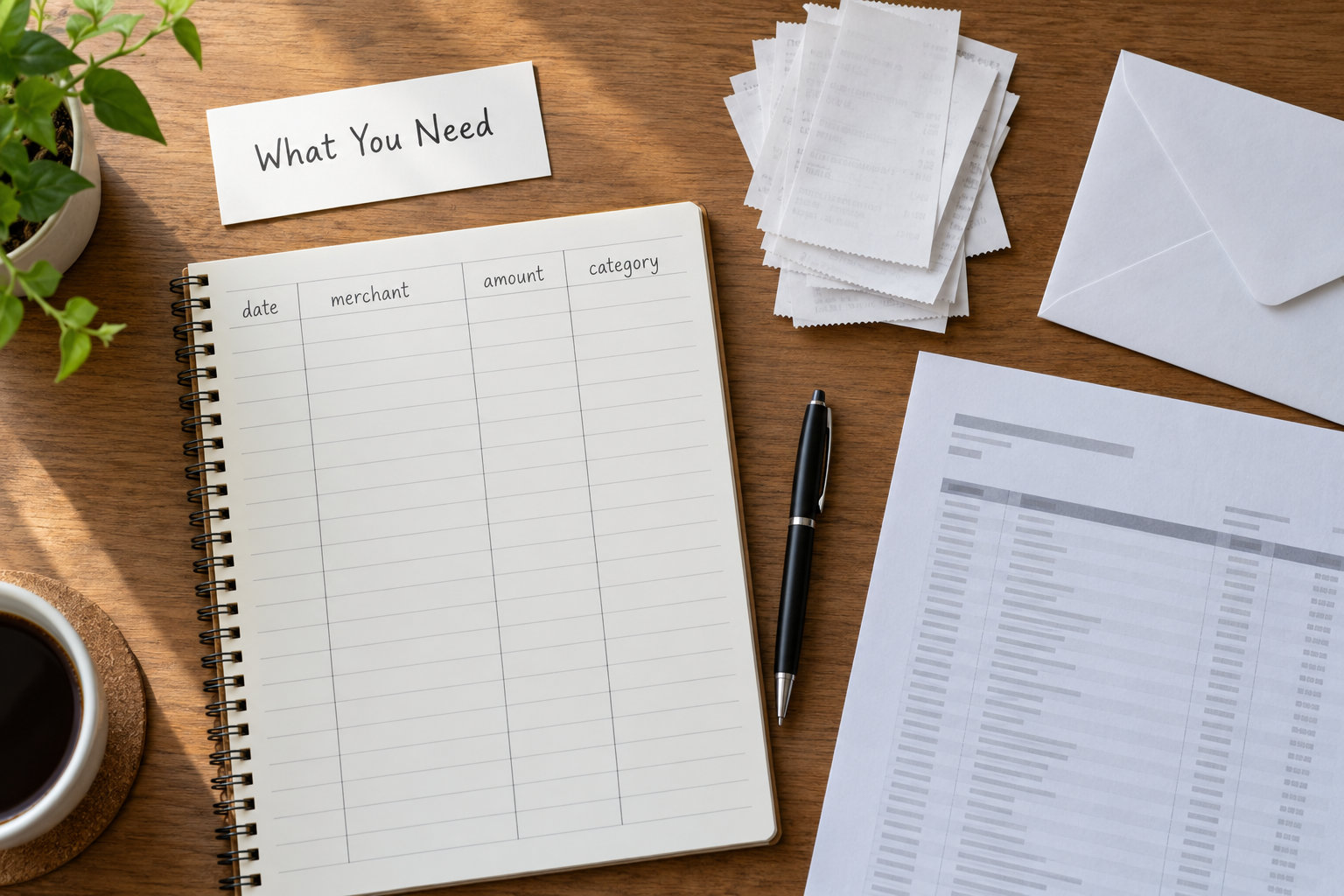
What You Need
You need five things, and four of them are probably already in a drawer somewhere.
- Recent bank and card statements. Most banks offer a downloadable PDF or CSV for the last 12 months, and some have an automatic monthly email. That file is the raw material for the whole system.
- A notebook, index cards, or a spreadsheet. A cheap 100-page composition book with a date column down the left margin works better than a fancy planner.
- A pen. For cash transactions and any moment your hands are already full.
- An envelope or a receipt folder. This matters more than people expect. A receipt you cannot find is a transaction you will have to guess at later.
- A calendar. You need the dates when irregular bills hit, especially property tax, car insurance premiums paid twice a year, and annual subscriptions.
You do not need a budgeting app, a cash-counting machine, or any paid financial software. Free features your bank already provides do more work than most people realize: low balance alerts, transaction alerts by text or email, monthly statement PDFs, and in many cases a spending breakdown by merchant category.
Step-by-Step: How to Track Spending Without an App
The process runs for one full month, then repeats. Five steps, each with a clear signal that it worked. If a step does not produce that signal by the end of the week, adjust the method rather than pushing harder.
Set Up a Simple Spending Ledger
Draw or build six columns: date, merchant or description, amount, payment method, category, and notes. That is the whole schema. A paper ledger with more columns than this stops being used within about two weeks.
One real entry looks like this: March 4, Corner Grocery, 62 dollars and change, debit card, groceries. The payment method column is what makes cash spending visible later, and the notes column catches anything that needs context, like a split dinner or a return.
You know the ledger is set up correctly when you can find any single purchase in under a minute and when a stranger could read it and understand where the money went. On a spreadsheet, add a running total column and freeze the header row.
Record Purchases as They Happen
Capture the transaction the same day, whether it is cash or card. Same day is the only rule that matters here; everything else is negotiable. People running a paper ledger for years report the same habit, and it is not about discipline. It is that a receipt written down in the parking lot takes fifteen seconds and a transaction reconstructed three weeks later takes fifteen minutes and produces a number you do not trust.
Three cases need a specific handling. For small purchases under about ten dollars, log the amount and a two-word description instead of the full detail. For recurring charges, log the charge and check it against the statement rather than writing the entry twice. For split payments, log the full amount once and note who covered the rest in the notes column.
If there is no receipt, write down the merchant, the approximate amount and the category, then mark it with a small question mark. When the statement arrives, replace the guess with the real figure. The step worked if at the end of the week you have almost no question marks left, because you verified them against real records.
Use Bank and Credit Card Records to Fill Gaps
Set a weekly check-in, ten minutes on a fixed day. Pull the statement or transaction export, line it up beside the ledger, and mark every charge the ledger missed.
Three things cause double counting, and all three are avoidable. Card payments show up in a checking account as outgoing transfers to the card issuer, which are not new spending. Transfers between your own accounts are not spending at all. Pending card charges can appear twice, once as pending and once as posted, so count the posted version only.
Cash is the real blind spot here. Every cash withdrawal is a single line on your statement, and it tells you nothing about what the money bought. Two habits close that gap. Withdraw a known amount for the week, write one ledger entry labeled cash withdrawal, and treat the whole amount as a single spending category if you cannot break it down. Or keep spending categories in separate labeled envelopes, so the withdrawal is already sorted before it leaves your hands. The step worked if your ledger total and your statement total are within a small tolerance rather than wildly different.
Separate Needs, Wants, and Financial Commitments
Use a small number of buckets. Households that last more than a month typically use somewhere between six and ten, and people who build twenty abandon the system entirely.
A workable set: housing and utilities, groceries, transportation, insurance and medical, debt payments, subscriptions, saving, and everything else you treat as discretionary. Debt payments and saving are not spending categories in the usual sense, but they belong in the ledger so you can see whether they actually happened each month rather than assuming they did.
Do not build the 50/30/20 rule into the categories themselves. It works as a monthly check on how the buckets turned out, roughly half on needs, 30 percent on wants, and 20 percent on saving and debt. Using it as a set of rigid category caps turns every purchase into a compliance question, which is exactly the friction that kills these systems.
Categories should be useful for decisions. If no decision ever changes based on a bucket, merge it. The step worked if you can name one category from the month that you would change next month.
Review the First 30 Days
At the end of the month, total each column. Then compare planned and actual, and look at the two categories that moved most. One often reveals something you would not have noticed live: a subscription you forgot you had, or a category where you spent forty percent more than you planned on four weekends.
Check your accuracy before you draw conclusions from the numbers. Search the ledger for question marks, confirm your cash withdrawals are counted once, and make sure no card payment landed in a spending bucket. Concluding you overspent when your ledger double-counted transfers is the most common way people abandon the system in month two.
Then pick one or two adjustments, not ten. Cutting one recurring charge of thirty dollars a month beats a plan that assumes you will never eat out again. The step worked if you can state one specific change for next month in a sentence.
Common Mistakes
Recording purchases too late. The fix is a capture rule tied to a physical moment, like writing the entry before you put the keys away. The tip: keep a pen in the car and one in your bag, so a stop on the way home still counts as same-day.
Counting transfers as spending. A card payment, a savings transfer and a refund all distort the total. The fix is a rule that money moving between your own accounts never gets a category. The tip: total your spending from the card and checking activity only, and treat savings transfers as a separate line.
Letting cash disappear. This is the number one complaint in forum threads about manual tracking, and it is solvable rather than unavoidable. The fix is to log the withdrawal as its own entry on the day you make it. The tip: if you take out cash more than twice a week, pull it in labeled envelope amounts instead.
Building too many categories. Fine-grained categories feel precise and produce bookkeeping fatigue within a month. The fix is a hard cap of ten, reviewed at the end of every third month. The tip: if a category has not changed a single decision in three months, merge it into the one next to it.
Reacting to one unusual week. A wedding, a car repair or a medical bill will distort any month. The fix is a three-month rolling average before you change anything. The tip: annotate large one-off entries in the notes column so you can filter them out later instead of rediscovering them.
Trying to track every dollar of cash perfectly. Perfection is the standard that ends the habit. The fix is an accuracy target instead, such as staying within ten percent of the statement. The tip: one unknown withdrawal of twenty dollars does not invalidate the month.
Frequently Asked Questions
Can I track spending using only my bank statements?
Yes, and many people do it in about five minutes a month. Read the statement, total your outgoing payments and cash withdrawals, note the month-end carryforward balance, and compare it to the month before. Statements alone will not tell you which category to blame, so pair them with a short handwritten list if you want to see where the money actually went.
What is the easiest way to track cash spending without an app?
Withdraw cash in category-sized amounts, write each withdrawal as one ledger entry the same day, and spend from labeled envelopes. If you withdraw at an ATM, write the amount and category on the receipt stub before you put it away. Cash-heavy spending is the blind spot of every account-based system, so the rule is simply that no cash leaves your hands unrecorded.
Should I use a spreadsheet or a paper ledger?
Use paper if you are disciplined about writing at the point of purchase, since paper cannot be checked by a phone during a shop. Use a spreadsheet if you want automatic totals, sorting by category and a running balance. A paper calendar ledger with a column per category works well for people who think visually, and many long-term users start on paper before moving.
How do I avoid double-counting credit card payments?
Never log the payment from your checking account to the card issuer as a purchase. Record spending once, when the charge is made, and treat the payment as a transfer between your own accounts. Count posted charges only, since a pending charge often reappears as a posted charge with the same amount and date.
How often should I review my spending records?
Check the ledger against your statements once a week for about ten minutes, and do a full category review at the end of each month. Weekly checks catch missing entries while they are still recoverable. The monthly review is where you compare planned and actual spending and choose one or two adjustments for the month ahead.
How do I handle purchases split with a partner or roommate?
Log the full amount once in the ledger and note the split in the notes column, such as half shared with a roommate. If you keep entirely separate accounts, agree on a single shared sheet or notebook for recurring and large shared costs, and settle by a fixed weekly transfer rather than tracking every coffee run. Keep individual spending in your own record.
Start tonight: draw the six columns, write today’s three most recent purchases, and set a low balance alert on the account you spend from. Tomorrow morning, log the first purchase before you leave the house. The first month will be imperfect, and that is fine; the version of this system that survives is the one you can keep for a year, not the most accurate one you can build in a weekend.