
ETF creation and redemption is the primary-market process that lets a fund’s share supply grow or shrink on demand. Authorized participants trade a basket of securities or cash with an ETF sponsor to mint new shares or retire existing ones, and that two-way flow is what keeps the trading price close to net asset value.
Below is how ETF creation and redemption works in plain English: who takes part, what changes hands in each direction, why the price stays near the value of the holdings, and what it all means for someone buying a fund with a few hundred dollars. If you take one thing away, make it this: retail investors never do any of this. You buy and sell ETF shares on an exchange, and the plumbing happens behind your order.
Table of Contents
- What Is ETF Creation and Redemption?
- Who Creates and Redeems ETF Shares?
- How ETF Creation and Redemption Works Step by Step
- Why most days look uneventful from your account
- What Happens During an In-Kind ETF Creation?
- In-kind or cash: what the table does not show
- What Happens During an ETF Redemption?
- Why Creation and Redemption Keep ETF Prices Near Net Asset Value
- A premium, worked through
- A discount, the same way round
- What Fees and Costs Are Involved?
- How Creation and Redemption Affect ETF Investors
- Frequently Asked Questions
- Do I need to create or redeem ETF shares myself?
- Can an individual investor submit an ETF creation unit?
- What does an authorized participant do in an ETF?
- Why do ETF market prices usually stay close to net asset value?
- What is the difference between cash creation and in-kind creation?
- Are ETF creation and redemption fees charged to investors?
- Conclusion: Start With the Fund’s Investment Purpose
What Is ETF Creation and Redemption?
Creation is the act of bringing new ETF shares into existence. An authorized participant delivers securities or cash to the fund and receives newly issued shares in return, usually delivered electronically the same day.
Redemption runs the other way. An authorized participant hands ETF shares back to the fund and receives the corresponding securities or cash. The fund retires those shares, which shrinks the supply.
The important structural point is that this happens on the primary market, between the AP and the fund sponsor, while the buying and selling you do as an investor happens on the secondary market, between one investor and another through an exchange. The two markets are connected by the AP, and that connection is the entire engine.
Without it, an ETF would be stuck with a fixed share count. Fixed supply means the price wanders away from the value of the underlying holdings whenever demand spikes or fades. Elastic supply is why you can usually buy a broad index fund and sell it minutes later at a price that reflects its holdings.
Who Creates and Redeems ETF Shares?
Only authorized participants, or APs, can transact directly with an ETF fund. An AP is a large brokerage or trading firm with the capital, systems and balance sheet to handle a block of securities worth many millions of dollars in a single transaction. Sponsor names vary by fund, and sponsors publish their list.
The other roles are worth separating, because they get blurred together in most explainers.
- The ETF sponsor designs the fund, holds the securities, calculates net asset value, appoints APs and issues or retires shares.
- The AP does the actual creating and redeeming. It decides when to act, usually to profit from a price difference or to manage a large client order.
- The custodian holds the fund’s securities and processes the delivery side of each transaction.
- The transfer agent keeps the record of who owns how many shares and handles issuance and retirement on the fund’s books.
- The index provider calculates the index the fund tracks, which is what a passively run fund copies.
- Your broker fills your order. If your order is large, the broker may handle the execution directly or route it to one of its AP relationships.
Ordinary investors sit entirely outside the primary market. You cannot hand a basket of securities to a fund and receive ETF shares at net asset value, no matter how much you hold or how long you have owned them. Forum discussions on this topic circle the same point repeatedly: the redemption right belongs to the AP, not to you.
That one sentence fixes most of the confusion people bring to this subject.
How ETF Creation and Redemption Works Step by Step
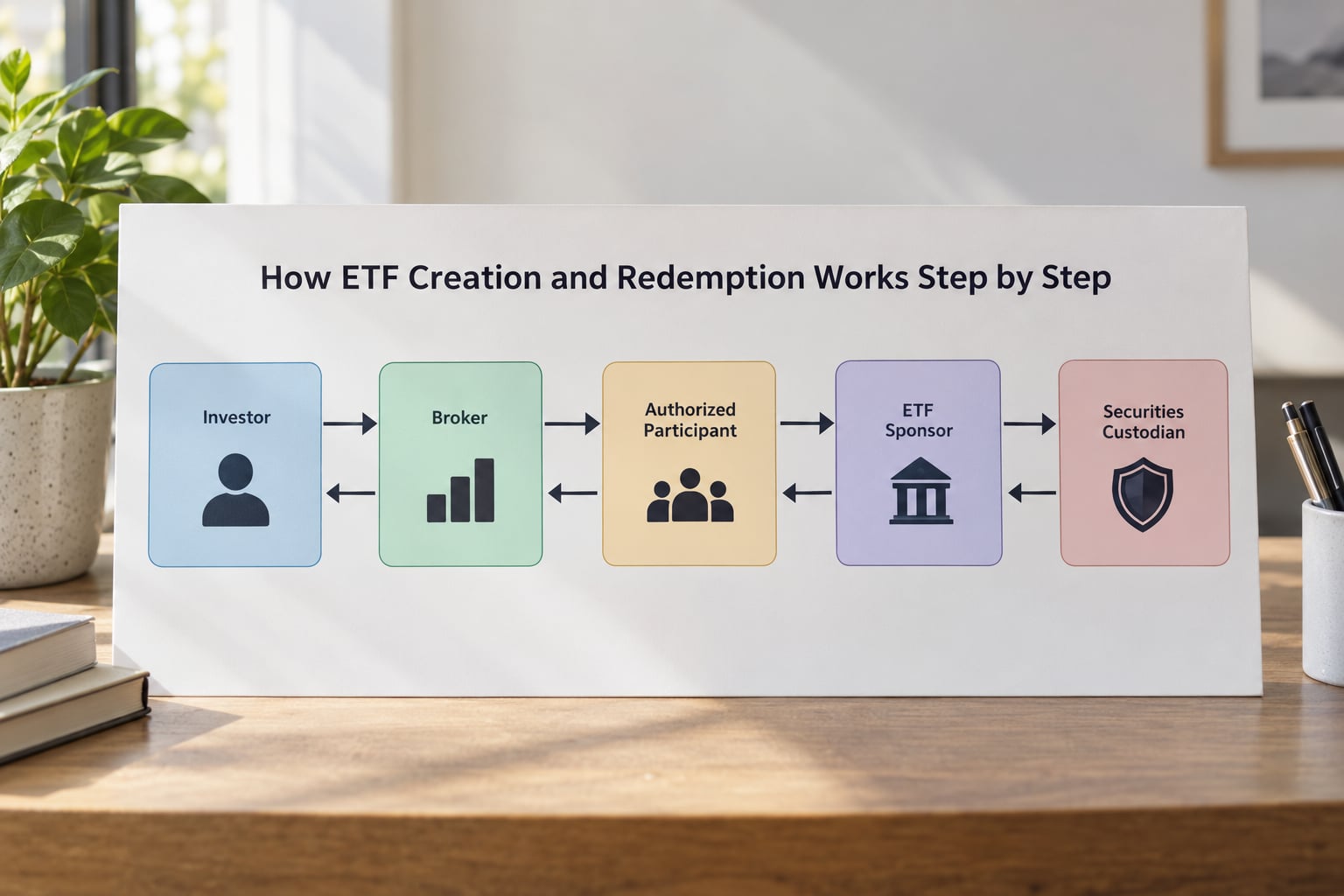
Here is the full transaction flow, start to finish. It happens in either direction, and the steps reverse cleanly when the AP is redeeming instead of creating.
- Demand appears in the secondary market. Investors buy ETF shares, and the fund’s share count stays fixed for now.
- The price drifts away from net asset value. If buying pushes the market price above the value of the underlying holdings, the ETF trades at a premium. Heavy selling does the opposite and creates a discount.
- The AP acts. It buys the underlying securities in the market, or already holds them from earlier activity, and delivers them to the fund. In the other direction, it buys ETF shares in the market and sends them to the fund.
- The sponsor issues or retires shares. New ETF shares are created against the delivered basket and credited to the AP. On redemption, the shares are cancelled and the matching securities are released.
- The custodian and transfer agent do the plumbing. Securities move between the AP’s account and the fund’s custody account, while the transfer agent updates the share register and the fund’s total shares outstanding.
- The AP unwinds the other side. It sells the newly issued ETF shares into the market, or sells the securities it received on redemption, closing out its position.
- The price returns toward the value of the holdings. The extra supply absorbs the buying pressure, and the gap between market price and net asset value narrows.
Why most days look uneventful from your account
A practitioner will tell you the same thing from the trading side: for an AP, creation and redemption is a routine end-of-day position-flattening exercise. It is less dramatic than it sounds, because it runs dozens of times a day across thousands of funds. You see none of it.
Settlement follows the standard cycle, so a creation agreed intraday generally has securities and shares changing hands on a T+1 basis. The economics work because the AP is not guessing about value. It delivers the portfolio composition the fund published, so the fund receives precisely what its NAV calculation assumes.
What Happens During an In-Kind ETF Creation?
In-kind simply means the AP pays with securities rather than money. That is the normal case for equity ETFs.
Take a broad index fund whose shares trade at 50 dollars and whose creation unit contains 25,000 shares, roughly 1.25 million dollars of value. An AP wanting to create that unit does not write a cheque. It delivers the portfolio of holdings the sponsor specified: the right quantities of each of the several hundred securities the fund tracks, adjusted for any corporate actions since the prior day’s basket.
In return the fund issues 25,000 new ETF shares to the AP, which are credited through the transfer agent and typically sold into the market the same day. Because the AP bought those same securities in the open market, the round trip is economically neutral apart from bid-ask spreads, commissions and taxes.
The AP cannot substitute. Handing over a handful of unrelated securities would leave the fund holding something other than what its NAV is calculated on, which would break the link between price and value. The basket is a fixed recipe, and that restriction is what makes the mechanism trustworthy.
In-kind or cash: what the table does not show
| Mechanism | What the AP delivers | When it is used |
|---|---|---|
| In-kind creation | The published basket of securities | Standard case for equity funds where holdings are easy to buy and deliver |
| Cash creation | Cash equal to the value of the basket | Funds holding securities that are hard to borrow or deliver, such as many emerging-market and some corporate bond issues |
| Cash-in-lieu component | Cash for specific securities inside an otherwise in-kind basket | A single problematic holding inside an otherwise deliverable portfolio |
| Custom basket | A negotiated set of securities rather than the standard one | Portfolio transitions, index changes and corporate actions such as mergers |
| In-kind redemption | ETF shares returned, securities released | The mirror image of creation; avoids selling fund holdings |
| Cash redemption | ETF shares returned, cash paid out | Used where delivering securities would create tax or settlement friction |
The cost of cash creation sits with the AP, not with fund shareholders, and it is one of the reasons bond and foreign-asset ETFs carry higher expense ratios than broad equity funds. The fund has to pay a broker to acquire the basket instead of receiving it for free.
What Happens During an ETF Redemption?
Redemption starts when the ETF trades below the value of its holdings, or when an AP is unwinding a position. The AP delivers ETF shares back to the fund, either a full creation unit or a custom number of shares depending on the fund and the current rules.
The fund then does three things. It cancels the shares, releasing the matching securities or cash from custody, and reduces shares outstanding by the same amount. The AP receives those securities and sells them, or delivers them into a client order it was hedging.
Where the ETF had been trading cheap, that removal of supply and the resulting buying interest from the AP’s sale of the underlying securities pushes the price back up toward NAV.
Redemption is also the tax engine inside an ETF. When an investor sells ETF shares in the secondary market, the seller’s own gain is a taxable event, and the fund itself has not sold anything. The securities move out of the fund without triggering a capital gain inside it, so there is no forced capital gains distribution passed on to holders the way there can be in a mutual fund.
That is a genuine advantage and not an absolute one. In-kind redemptions involving securities the fund holds at a large unrealized gain can still create tax consequences for the AP, and the AP prices that cost into the bid-ask spread. In stressed markets, when securities are difficult to sell or are suspended, those spreads widen visibly.
Why Creation and Redemption Keep ETF Prices Near Net Asset Value
Arbitrage is the reason the mechanism exists. If the ETF trades above the value of its holdings, an AP can buy the basket cheaply, create shares and sell them at the higher price. If the ETF trades below, the AP buys the ETF cheap, redeems it for the basket and sells the securities.
A premium, worked through
An ETF has a NAV of 50 dollars per share and starts trading at 50.75 dollars, a premium of 1.5 percent. A creation unit is 25,000 shares, so the AP delivers about 1.25 million dollars of securities and receives 25,000 shares it can immediately sell for about 1.27 million dollars. The 1.5 percent gap is far more than the transaction costs, so the trade gets done, and the flood of newly created shares caps the price.
A discount, the same way round
Now suppose the ETF falls to 49.25 dollars while the holdings are still worth 50. The AP buys 25,000 shares for about 1.23 million dollars, redeems them and receives the 1.25 million dollars of securities, which it sells at market. The ETF shares it bought are retired, so the float shrinks, and the price recovers.
This is why you will see the words premium and discount described as self-correcting. Usually they are. Three caveats are worth carrying.
Arbitrage is not guaranteed. Spreads widen, fees rise and the trade can be less profitable than it looks in a fast market. A halt in one underlying security can freeze a basket. When a foreign market is closed for a holiday, the ETF can trade while a large part of its portfolio is not, and the gap lingers until both sides reopen. Investors on r/LETFs and other trading forums point out that intraday premiums and discounts widen most in exactly those moments.
Published NAV is also a lagging number. The intraday indicative value, or IOPV, is calculated throughout the day to give an estimate of where NAV should be. When your screen shows the ETF price differing from the official NAV, the IOPV is usually the fairer comparison.
What Fees and Costs Are Involved?
Investors do not pay a creation or redemption fee. The costs that reach you are the ones you already know about, plus a few effects of the structure that are easy to overlook.
- Fund expenses. The expense ratio is taken from fund assets, not charged per transaction. It is the largest ongoing cost in most cases.
- Bid-ask spread. This is where AP costs surface. Creating costs the AP real money in spreads and commissions, and that shows up in the spread you pay.
- Your brokerage commission. Charged on what you trade, on top of the fund’s expenses.
- Tracking difference. The gap between the fund’s return and its index. Cash drag, fees and sampling all widen it, and cash creations widen it most.
- Taxes. Selling ETF shares in your account is a taxable event for you. In-kind delivery is what keeps the fund from forcing a distribution on everyone else.
There is also a creation and redemption transaction fee the fund charges the AP for handling the order. It is not passed to shareholders, but funds with expensive baskets charge more of it, and that shows up in a higher expense ratio.
Rules and rates here differ by country and change over time, so treat this as the general shape of the mechanics rather than a set of figures to plan around. In 2026, the reliable sources for any single fund are its prospectus and its website.
How Creation and Redemption Affect ETF Investors
The mechanism reaches you in four concrete ways. Lower costs, because fund shares trade without forced trading inside the fund. Tighter tracking, because the fund holds its index rather than trying to trade its way toward it. Tax efficiency, because in-kind delivery avoids the forced capital gains distributions a mutual fund can hand you. And liquidity, because APs stand ready to create or redeem and keep a two-sided market alive.
Not every fund uses the same mechanics, and the differences are not cosmetic.
| ETF type | Typical creation and redemption mechanics |
|---|---|
| Broad equity | Fully in-kind, large creation units, cash-in-lieu available for individual holdings |
| Bond | Frequently cash creation or cash redemption, because bonds are hard to borrow and deliver; many funds also accept custom baskets at index changes |
| Commodity | Mixed, with futures, cash flows or in-kind delivery depending on whether the fund holds physical assets or derivatives |
| Foreign and emerging market | Cash creation is common where local settlement or foreign ownership rules make in-kind delivery impractical |
| Leveraged and inverse | Usually fully in-kind, rebuilt daily so the fund can reset its exposure to its stated multiple of the daily index move; the daily reset is the defining feature, not the creation mechanics |
If you want to see the basket yourself rather than take it on faith, the daily portfolio composition file is published by the fund and disseminated to the clearing system, and prospectus and website disclosures spell out the rest. Quant researchers asking on forums where to find that data usually get pointed to the sponsor’s site first.
Knowing the mechanics also keeps you honest about what they do not decide. Creation and redemption say nothing about whether a fund is a good investment. That question is about holdings, expense ratio, liquidity, tracking and whether the strategy fits your plan, and no amount of market-structure knowledge changes it.
Frequently Asked Questions
Do I need to create or redeem ETF shares myself?
No. ETF creation and redemption is reserved for authorized participants, the large brokerages and trading firms appointed by the fund sponsor. You buy and sell ETF shares on the exchange like any other listed security, and the AP handles anything involving the fund’s holdings. Only firms meeting the sponsor’s capital and operational requirements can bring securities in or take shares out.
Can an individual investor submit an ETF creation unit?
Not directly. A creation unit is a large block of ETF shares, usually at least 25,000 shares in US funds, and the fund will only accept one from an authorized participant working to the published basket. Some brokers handle institutional flows on your behalf, but the transaction belongs to the AP, and you receive ordinary ETF shares rather than shares created against a basket.
What does an authorized participant do in an ETF?
An AP is the counterparty that creates and redeems ETF shares. It buys or holds the fund’s underlying securities, delivers them to the fund and receives newly issued shares, then sells those shares to whoever demanded them. In the other direction it delivers shares back and takes out the basket. Its profit comes from that arbitrage, and it is also what supplies the spreads you trade against.
Why do ETF market prices usually stay close to net asset value?
Because any gap invites a risk-free-looking trade. When an ETF trades above its net asset value, an authorized participant can create shares by delivering the basket and sell them at the higher price. When it trades below, the AP buys the ETF, redeems it for the underlying securities and sells those. Both trades pull the price back toward NAV, though spreads and costs can leave small gaps, especially when markets are stressed or partially closed.
What is the difference between cash creation and in-kind creation?
In-kind creation delivers securities. Cash creation delivers money equal to the value of the basket, and the fund buys the holdings itself. In-kind is cheaper and is the norm for equity ETFs, while cash is used when securities are difficult to borrow or deliver, which is common in bond, emerging-market and some international funds. The extra trading cost of a cash creation is paid by the AP and shows up in the fund’s expense ratio.
Are ETF creation and redemption fees charged to investors?
No creation or redemption fee is charged to shareholders. The fund does charge the authorized participant a transaction fee for handling each order, and that is absorbed into the fund’s cost structure. What you pay is the usual set: the expense ratio, the bid-ask spread, and any commission your broker charges on your own trades. Tracking difference is the quiet additional cost worth comparing across similar funds.
Conclusion: Start With the Fund’s Investment Purpose
ETF creation and redemption is institutional plumbing. Authorized participants swap baskets for shares so that supply flexes with demand, which keeps prices near net asset value, holds fees down and avoids the forced capital gains distributions a mutual fund can pass on to you.
Your first step is simple and worth doing before anything else: open a fund’s prospectus or its website page, read what it holds and what it charges, and check the bid-ask spread. Understand the plumbing above when you need it, but choose the fund on purpose, cost and fit. That is the part the mechanism cannot decide for you.