To invest in farmland and timber you either buy the land yourself and manage it, or you buy into a vehicle that owns it for you: farmland REITs, timber equities, private funds, limited partnerships and fractional ownership platforms. The direct route gives you control and the full gain or loss; the indirect routes trade that control for a lower entry cost and easier access.
The honest version is that both asset classes are real property with a small buyer pool, uneven income and years where you may receive nothing at all. They have earned their place in some portfolios because they behave differently from equities and bonds, not because the returns are predictable. This guide walks through the decision in six steps, then lists the mistakes that cost people the most money.
This is general information, not investment or tax advice. Rules and rates vary by state and country and change over time.
Table of Contents
- What You Need
- How to Invest in Farmland and Timber: Step-by-Step
- Step 1 — Set Your Goals, Horizon, and Risk Limits
- Step 2 — Choose the Right Investment Structure
- Step 3 — Check Location, Land Use, and Market Conditions
- Step 4 — Analyze Cash Flow, Costs, and Return Drivers
- Step 5 — Complete Due Diligence and Choose a Provider
- Step 6 — Invest, Diversify, and Monitor
- Common Mistakes
- Practical Tips
- Frequently Asked Questions
- How much money do I need to invest in farmland or timberland?
- Do farmland and timber investments pay regular income?
- Can I invest in farmland or timber without buying land directly?
- Are farmland and timber REITs liquid investments?
- How are farmland and timberland investments taxed?
- Is farmland or timber a better long-term investment?
- Conclusion
What You Need
Land investing punishes people who start with a parcel and work backward from it. Work forward instead. Before you look at a single listing, get five things lined up.
Financial readiness. Farmland purchases want higher down payments than residential property, often 20% to 30% or more, and some lenders want more on raw timberland. Separate money you will not need for at least a decade from money you might need. Timberland in particular can sit for five to ten years or longer between harvests while carrying taxes, insurance and interest the whole time.
Investment criteria on paper. Write down your target region, acreage range, income versus appreciation focus, holding period and the maximum annual cash contribution you can fund from outside income. Investors who skip this step tend to fall for whatever a salesperson shows them first.
Research tools. USDA Farm Service Agency and USDA Economic Research Service publications cover crop, price and land-use data. County tax assessor records give you parcel history, assessed values and building details. County recorder offices hold deeds, liens and easements. Land exchange and farm service agency offices list programs with lower down payment terms. Every number in this field is public if you know where to look, and most people never look.
Professional help. For farmland, a local appraiser, a soil testing lab and, in irrigated regions, someone who understands water rights. For timberland, a consulting forester who writes a timber cruise. For either one, a real estate attorney and a tax adviser who works with rural property. You are paying a few hundred dollars to avoid a mistake that costs tens of thousands.
Documents. Prior surveys, title policy, existing leases and their payment history, soil test results, timber cruise reports, phase one environmental assessments, irrigation or timber harvest records, and the current property tax bill. If a seller cannot produce these, that tells you something.
How to Invest in Farmland and Timber: Step-by-Step
Step 1 — Set Your Goals, Horizon, and Risk Limits
Decide what you are actually buying before you decide what you are buying it with. Four goals show up repeatedly: current income, long-term appreciation, portfolio diversification, or conservation and legacy transfer. They lead to completely different parcels.
Income pushes you toward row-crop ground with a farmer who pays cash rent, or toward timberland already partway through a harvest cycle. Appreciation points you at ground with rezoning optionality or timberland near expanding population centers. Diversification pushes you toward anything uncorrelated with your day job, and in that case a fund handles the hard parts better than you will.
Then set a holding period you can actually live with. Ten years minimum for farmland, longer for timber. Write down the largest annual loss you could stomach without selling, and the share of your net worth this allocation should never exceed. Most people who get hurt here have no written limit, which is why they hold through a bad year out of stubbornness.
Step 2 — Choose the Right Investment Structure
Six routes exist. They differ most on minimum size, how quickly you can get out, and how much of the land’s behavior you control. Farmland and timberland are not the same investment, and the table below shows why the choice matters more than the ticker.
| Structure | Minimum | Liquidity | Control | Main Cost |
|---|---|---|---|---|
| Direct farmland ownership | Full purchase price plus closing, often financed | Very low; months to years to sell | Full | Property tax, insurance, management or lease negotiation |
| Direct timberland ownership | Full purchase price, frequently cash or land financing | Very low | Full | Negative carry for years before a harvest |
| Farmland REIT | A single listed share | Daily, on an exchange | None | Expense ratio inside the fund |
| Timber REIT or timber equity | A single listed share | Daily | None | Expense ratio; holdings concentrate in a few firms |
| Private fund or limited partnership | Often six figures and commonly accredited-only | Locked up, quarterly windows at best | None | Management fee, acquisition fee, sometimes a performance fee |
| Fractional or crowdfunding platform | Low thousands, with accreditation rules by platform | Secondary markets are narrow or absent | None | Platform and management fees layered on management fees |
Two comparisons worth keeping in mind. A farmland REIT behaves more like a listed property company than like a farm: you get a dividend and an interest rate exposure, not soil. And a public timber vehicle holds mostly managed plantation timber in a handful of companies, which is a different exposure from owning a specific tract of Appalachian hardwood with recreational lease income on the side.
Whoever manages the asset should be able to name every parcel, the acreage, the harvest plan and the exit route. Forum discussion among retail investors keeps circling the same worry: private structures make it hard to verify what you actually own. If a manager will not open the file, the fee stack is not the real problem.
Step 3 — Check Location, Land Use, and Market Conditions
For farmland, the physical attributes decide the rent you can charge. Pull a soil test for pH, nutrients, organic matter and drainage; check whether the ground is tile-drained or irrigation-dependent; confirm water rights in irrigated regions, since those rights can move separately from the land in some states. Look at road access and whether a legal easement reaches the parcel, not just a gravel track across a neighbor. Review zoning for any secondary use, and check comparable sales from the county assessor rather than the listing.
For timberland, the questions shift. Get a timber cruise that estimates standing volume in board feet by species and diameter class, and note the site index, which predicts growth rate. Ask when the parcel was last harvested and what the prior owner removed. Walk the access road, because a road that cannot carry a loaded logging truck turns a timber parcel into a tree plantation you can never realize on. Check wildfire exposure, fuel load and whether the county has fuel reduction requirements that cut into your harvest cycle.
On regional conditions, read local demand signals rather than national headlines. Who is buying nearby ground, what is leasing, and what has recently changed hands. Farmland that attracts institutional buyers may be priced on scarcity rather than soil. Timberland near a growing metro area can carry development optionality that has nothing to do with trees, which is a different investment thesis and should be stated honestly.
Step 4 — Analyze Cash Flow, Costs, and Return Drivers
Farmland income arrives as cash rent at a fixed rate per acre, or under a crop share lease where you and the operator split the crop and split the risk. Cash rent gives you predictable income and no operational exposure. Crop share gives you upside when yields and prices are good and a bill when they are not. Operating expenses include property tax, insurance, water and drainage costs, repairs, and any management you hire. Whatever the operator pays you, your return is that figure minus your costs and financing.
Timberland income works differently. Trees add volume every year, a biological gain that accrues whether or not anything is harvested. When a selective harvest happens, you sell the board feet harvested and the remaining trees gain value because they now have more room. Land appreciation underneath adds a third layer, and non-timber income such as hunting, recreational or conservation leases can cover carrying costs in the gap years. That gap is the part beginners miss: a young stand of trees generates close to nothing for half a decade or more, then everything at once.
The practical implication is financing. Investors bridge the gap with the cash from other income, seller financing, land loans with balloon terms, or by buying a parcel near enough to its harvest date that the cycle is shorter. A monthly payment you cannot make during a no-income stretch forces you to sell at the worst possible moment, which is the main way people lose money in timberland.
Step 5 — Complete Due Diligence and Choose a Provider
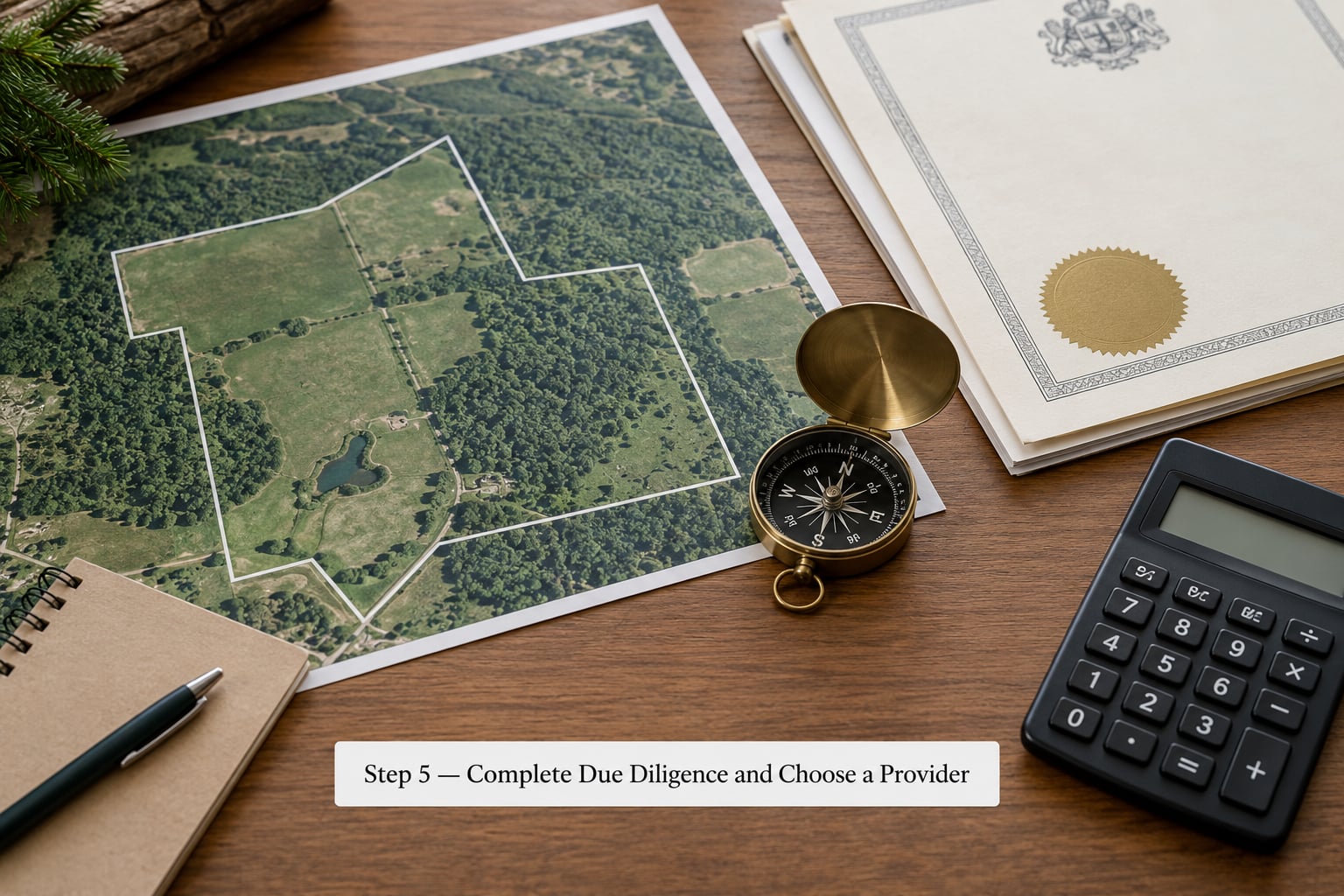
Due diligence is where a good deal becomes a bad outcome. For farmland, work through title and lien searches, the soil test, water rights documentation, access easements, zoning for your intended use, comparable sales, the environmental assessment, and the lease terms with their payment history. For timberland, add the forest management plan, the timber cruise with its volume estimate, road condition, harvest feasibility, and the wildfire history.
When you are evaluating a fund, REIT or partner instead of a parcel, ask a narrower set of questions. What is the fee stack, itemized: management fee, acquisition fee, performance fee, and whether the performance fee applies to unrealized appreciation. What is the audited net asset value, and when was it last independently appraised. What is the realized track record through a full cycle rather than a good decade. Does the manager put personal money into the fund. What is the exit path, and how long has anyone actually exited. How concentrated is the portfolio, and would a single drought, fire or mill closure hurt you disproportionately.
There are also things to walk away from. Any offer with a guaranteed or fixed annual return. Any structure sold to non-accredited buyers with pressure to decide quickly. Stale appraisals that never get refreshed. A lock-up with no exception. Forum threads about farmland and timber deals repeat the same red-flag list, and every item on it is a reason to pause rather than to negotiate harder.
Step 6 — Invest, Diversify, and Monitor
Size the position so a bad year does not force a sale. Then spread it. Owning three parcels in one county during a drought is concentration wearing a diversification label. Different regions, different tree ages or crop mixes, and a mix of structures, reduce the chance that one weather event or one harvest schedule defines your year.
Keep every document. Deeds, leases, cruise reports, soil tests, appraisals, management reports and tax filings. When something goes wrong, and it sometimes does, the file is what turns an argument into a remedy.
Review on a schedule rather than on emotion: income reconciliation once a year, a full look at valuation and operating conditions every two or three years, and an immediate review if drought, fire, a new tenant, a zoning change or a rate move materially alters the economics. Adjust when the reason you bought no longer holds.
Common Mistakes
Expecting a fixed return. Farmland income moves with lease rates, crop prices and weather. Timber income arrives in lumps. Treat any projection that shows a steady monthly number as a sales pitch, not a forecast.
Concentrating in one county. Regional drought, a single fire season, or one dominant buyer can wipe out a local position that looked diversified on a brokerage statement. Owning ground in several regions and structures is the fix.
Ignoring fees in a pooled vehicle. Management, acquisition and performance fees compound against you, and a performance fee on paper gains is worse than one on realized gains. Ask for the all-in figure.
Failing to plan for liquidity. The realistic buyer pool for a 200-acre parcel or a timber tract is small. Investors who assume they can exit on their own timeline get the worst possible price when they need to sell.
Skipping location analysis. Poor access, unreliable water, thin soils or an unharvestable timber road quietly cap what the land can ever earn. Every one of those was visible before the purchase at a modest cost.
Overlevering the land. Borrowing heavily against land with no current cash flow means a rate move or a drought forces a sale. Negative carry already requires outside income; adding a heavy loan load on top is how a patient holding turns into a distressed one.
Not doing due diligence. No cruise report on timberland, no soil test on farmland, no title search, no environmental review. The savings on the front end are dwarfed by one problem found later.
Practical Tips
Start with a liquid vehicle. A listed farmland REIT or a timber equity gets you exposure in an afternoon, costs almost nothing to test the thesis, and teaches you how the income cycle behaves before you commit to a parcel.
Compare total cost rather than yield. A farmland parcel yielding more rent but carrying higher property tax, insurance and management may net less than a simpler one. Build the net number, not the headline.
Use licensed professionals for anything you cannot verify yourself. Attorneys, appraisers, foresters and tax advisers are cheap relative to the parcels involved.
Understand what a distribution actually is. A REIT dividend is often substantially a return of capital. Timber fund distributions may reflect a partial liquidation of trees rather than sustainable yield.
Review on a calendar. Set a date each year to reconcile income, check lease or harvest performance and confirm the thesis still holds, so decisions are not made during a crisis.
Frequently Asked Questions
How much money do I need to invest in farmland or timberland?
Direct ownership requires the full purchase price plus closing costs, and farmland lenders commonly want 20% to 30% down, sometimes more on raw timberland. Listed farmland REITs and timber equities have share-price minimums of a few tens of dollars. Private funds and limited partnerships usually start in the six figures and often require accredited investor status. Fractional platforms lower the entry point into the low thousands, with platform-specific accreditation rules.
Do farmland and timber investments pay regular income?
Farmland often does, through cash rent paid by an operator or a share of the crop under a crop share lease. Timberland rarely does on a schedule: trees grow value each year, but cash arrives only at a harvest, so five to ten years can pass with nothing coming in except leases or cost-sharing. That gap has to be financed from other income, which is the single biggest practical difference between the two.
Can I invest in farmland or timber without buying land directly?
Yes. Farmland and timber REITs, listed timber companies, private funds, limited partnerships and fractional ownership platforms all pool investors and hold the land on your behalf. You give up control over the specific parcel, the lease decisions and the harvest timing in exchange for a lower minimum, daily liquidity in the listed cases and professional management. Always confirm what you actually own and how fees are charged.
Are farmland and timber REITs liquid investments?
The shares trade daily on an exchange, so selling is easy. What is hard is the underlying asset. A farmland REIT must sell land eventually, and farmland transactions take months and involve a limited pool of buyers. Timber vehicles hold fewer properties, so their valuations rely on appraisals that update slowly. Treat the shares as liquid and the property behind them as illiquid.
How are farmland and timberland investments taxed?
Tax treatment varies by state and country and changes often, so check current rules with an adviser. Generally, land held long term may qualify for long-term capital gains treatment, many states offer agricultural or forestland property tax exemptions, and depreciation or cost recovery may apply in some cases. A like-kind exchange can defer gains on qualifying sales for investors who meet the requirements. None of this is universal.
Is farmland or timber a better long-term investment?
Neither is reliably better, because they fail in different ways. Farmland produces income that depends on a tenant’s crop and a region’s weather, and its value is sensitive to interest rates. Timberland carries years of negative cash flow, wildfire exposure and mill demand risk, but some of its growth is biological rather than market-driven. Choose based on whether you can fund the dry years and whether you want income now or growth later.
Conclusion
Start by writing down your goal, your holding period and the largest loss you can sit through without selling. That answer usually rules out half the options immediately. Then compare direct ownership against funds, REITs and partnerships on minimum size, liquidity, fees and control, and check the historical record for whichever route fits.
If you are buying land directly, budget for a soil test, a timber cruise where relevant, a title search and an environmental review before you commit, and take the timberland cash-flow gap seriously before you sign anything. Being able to fund the quiet years is what separates this from a holding that has to be sold at the worst possible time.
Historical index figures describe past periods and are not a forecast of what you will earn. Nothing here is investment, legal or tax advice, and rules vary by state and country.