
Short answer: a hospital bill you never pay usually does not touch your credit. Medical debt affects your credit only after an unpaid balance is turned over to a collection agency, passes a one-year waiting period, and is reported with an initial balance of 500 dollars or more. Here is how that process works, what actually shows up on your file, and what you can do about it in 2026.
One thing confuses people more than anything else in this topic. They assume a bill sitting in a stack at home is already hurting them, so they avoid opening the envelope. Then months later a collection notice arrives and the damage finally starts. The bill was never the problem. The handoff to a collection agency is.
Rules here apply to US credit reporting. Credit bureaus, debt collectors and the models that turn your file into a score all follow the Fair Credit Reporting Act, and the treatment of medical debt has changed more in the last few years than in the previous decade.
Table of Contents
- Does Medical Debt Affect Your Credit Score?
- When Does Medical Debt Appear on a Credit Report?
- Unpaid Medical Bills vs. Medical Collections
- How Medical Debt Affects Credit Reports
- Does Paying Medical Debt Improve Your Score?
- Can Medical Debt Lower a Credit Score?
- What Can You Do About Medical Debt on Your Report?
- Frequently Asked Questions
- Can medical debt hurt my credit if I have not paid it?
- Does the three-year medical collection reporting limit apply to every credit bureau?
- Can a hospital put me in collections if I have insurance?
- Is a medical bill in collections the same as a collection on my credit report?
- Can medical debt stop me from buying a house or car?
- Should I use a medical credit card or installment plan to rebuild my credit?
- What to Do First
Does Medical Debt Affect Your Credit Score?
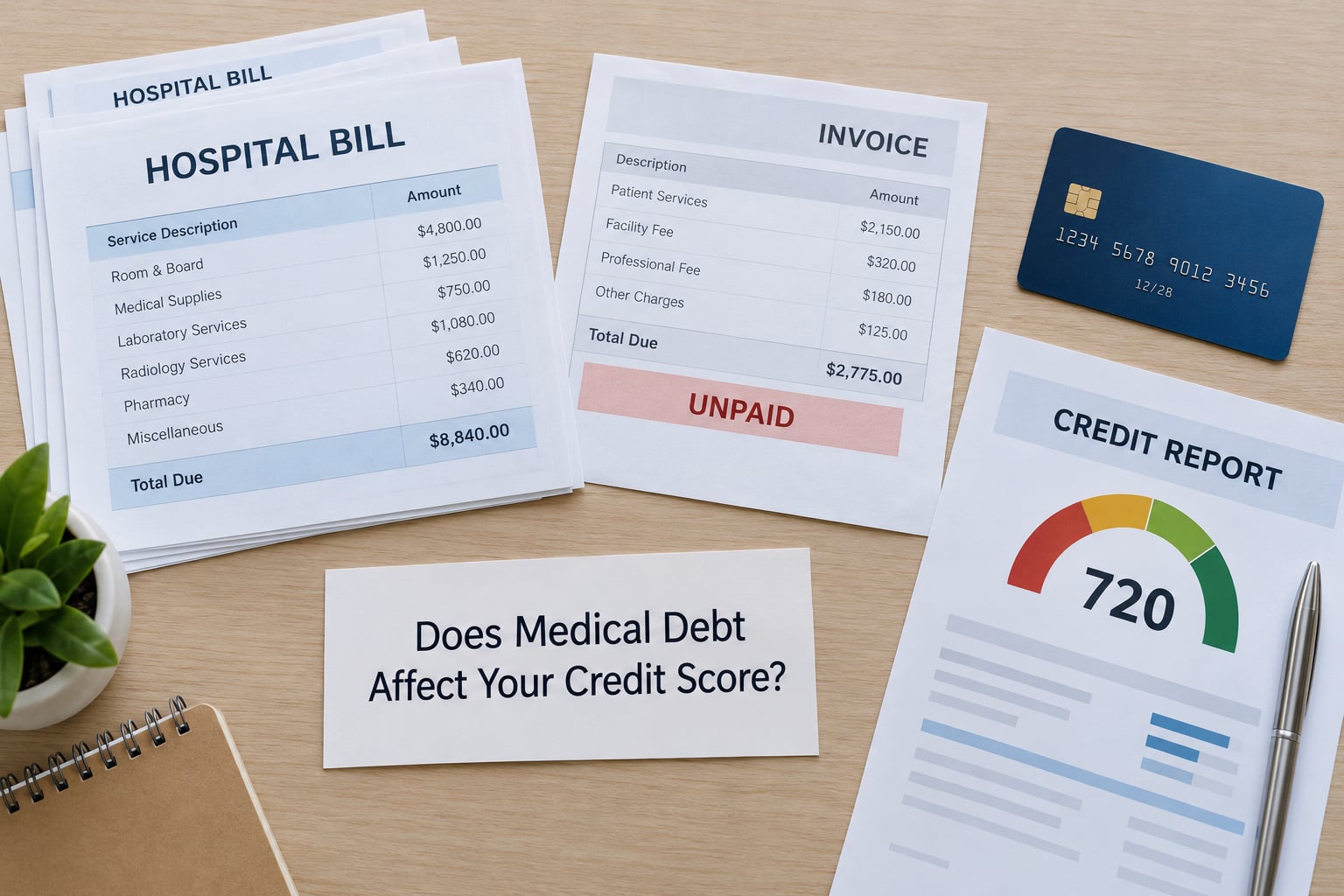
Medical debt affects your credit score in most cases through one route only: a collection account that a credit bureau reports. Not the bill. The collection.
Here is the short version:
- Direct-to-provider bills: hospitals, doctors and labs almost never report you to Equifax, Experian or TransUnion themselves. While you owe the provider, there is generally nothing on your report.
- Collections under 500 dollars: unpaid medical collection accounts with an initial reported balance below 500 dollars are not reported. This threshold took effect for the three nationwide bureaus in 2023.
- The one-year waiting period: after a provider hands a debt to a collection agency, the agency must generally wait 365 days before the account can show on your report. Most wait longer, which is why people rarely see a collection the first year.
- Paid collections: a paid medical collection account is supposed to come off your report. Pay it and the bureau should update the entry, not simply mark it paid and keep it.
- State law: a small number of states restrict or prohibit medical debt reporting altogether, so the same bill can be treated completely differently depending on where you live.
The useful mental model is a funnel. Your bill starts at the top with a provider, moves to a collection agency, waits out a year, and then possibly becomes a tradeline that scoring models can weigh. Most of the damage happens at the last step, and you have leverage at the first one.
When Does Medical Debt Appear on a Credit Report?
A medical account reaches your credit report in stages, and each stage gives you a different amount of control. Knowing which stage you are in tells you whether to negotiate, wait or dispute.
Unpaid Medical Bills vs. Medical Collections
An unpaid medical bill is money you owe a healthcare provider directly. Because providers usually do not furnish to credit bureaus, this debt ordinarily produces no entry on your credit report and no direct effect on your score. The risk is what happens next, not what is happening now.
A medical collection is that same debt after it has been sold or assigned to a collection agency. Agencies do report to the bureaus, and once an account meets the waiting period and the balance threshold, it can appear as a tradeline and influence how lenders read your credit. This is the distinction that matters: a collection can be the most damaging form of a debt you have not paid, and it is the form that requires action.
Not every provider sells debt, and the ones that do usually try billing, payment plans and financial assistance first. A patient who never receives a single bill and hears nothing for two years is not in the same position as someone fielding weekly collection calls.
How Medical Debt Affects Credit Reports
When an account does reach a bureau, several things about the tradeline drive how lenders see it:
- Balance and initial reported balance: the number the agency first submits is what the bureau keeps on file, even if your actual balance differs. A paid-in-full account that still shows an old large balance is a common error worth disputing.
- Creditor and furnisher information: the name shown may be the collection agency rather than the hospital, which is why people fail to recognize entries they have never seen.
- Status and delinquency date: unpaid, paid, settled and written-off are different statuses, and the delinquency date sets the seven-year clock.
- Tradeline versus score: a tradeline is a line item. A score is a calculation. Removing an entry changes the input, not the output directly, so a single collection rarely moves a number the way people fear, and its weight depends on what surrounds it.
Negative information generally stays reportable for seven years from the delinquency date. Paid medical collections should come off sooner, and the sub-500-dollar exclusion can remove an entry that never should have been reported at all.
Does Paying Medical Debt Improve Your Score?
Paying medical debt helps your credit, but not in the way most people expect. It stops the harm rather than reversing it. A collection you leave open keeps working against you; one you pay stops accruing and may be deleted, yet the past delinquency history does not erase simply because a balance reached zero.
That is why people who pay a collection and see no change in their score are not imagining things. The account status updates, the entry may be removed, and the score still has to rebuild around the remaining history.
It also helps to separate two very different products. Paying a hospital balance with your own money and paying it through a medical credit card are not the same decision. A medical credit card is issued by a lender, which means the debt is now a credit card balance that gets reported, accrues interest if you miss a payment, and can produce a late payment that damages your credit far more seriously than the original bill would have.
For the same reason, a hospital payment plan that the provider reports to a bureau is a trade: you convert an unreported bill into a reported account. It buys predictability, not a better score. If the plan is interest-free, has no reporting, and lets you avoid collections, it is usually the safer path.
Can Medical Debt Lower a Credit Score?
Yes, but through specific mechanisms rather than through the bill simply existing. Understanding which one applies to you tells you where to focus.
Collections. A reported medical collection is treated as an adverse account. It can add to delinquency history, and lenders that use it as a risk signal may price loans more carefully. Forum users on r/CRedit and r/povertyfinance frequently describe score drops of 20 to 100 points, though the range depends heavily on the starting score and everything else on the file.
Credit card balances used to pay care. Putting a large bill on a card can push utilization up, and utilization is a meaningful share of most scoring formulas. On a score with thin credit, a high balance can hurt more than the collections would have.
Missed card payments. This is the most damaging way for medical debt to reach your credit, because a 30-day late is a late payment on an account you chose, with no medical explanation available to a scoring model.
Bankruptcy. Filing for bankruptcy removes the underlying debts from your credit history after discharge, but the filing itself is reported and stays on record for years, affecting score and interest rates for a long time afterward.
Scoring models disagree, and that disagreement is worth knowing. FICO versions used by mortgage lenders have repeatedly reduced how much a medical collection counts, and a paid medical collection can be excluded entirely in some vintages. VantageScore 4.0, used by many personal loan and card issuers, does not include paid medical collections in its calculations at all. So the same file can produce different numbers depending on which model a lender runs.
The practical takeaway is that the surrounding accounts matter more than the hospital bill. Utilization, payment history and age of accounts are the levers you can still move.
What Can You Do About Medical Debt on Your Report?

Work through these in order. The first two are free, and both catch real errors more often than people expect.
- Pull all three reports. Use AnnualCreditReport.com, which is the only federally authorized site, and request reports from all three bureaus in one session. You are entitled to a free report from each roughly every 12 months. Read them side by side, because collections frequently appear on one bureau and not the others. Forum users describe debts that vanished from Experian while remaining on Equifax and TransUnion.
- Compare each bill with your explanation of benefits. The explanation of benefits from your insurer shows what the provider actually billed and what your plan covered. Line-item mismatches, duplicate charges and services your insurer paid for are among the most common billing mistakes, and they are also the easiest to get corrected before a collector ever sees the account.
- Dispute inaccurate information. Send a written dispute to the bureau listing the account, what is wrong and the documentation you are attaching. Federal law requires an investigation, usually within 30 days. Consumers who dispute rather than pay often see results.
- Ask the collection agency for a pay-for-delete in writing. Settling for less than the balance is common, and users report negotiating reductions of 50 to 70 percent. Get any deletion agreement in writing before you send money, and confirm the deletion in writing afterward. If a paid collection reappears as unpaid on one bureau, that is a new dispute about a specific tradeline.
- Check your state law. New York, Massachusetts, Minnesota, Vermont and several others restrict or ban medical debt reporting. If you live in a protected state, tell the agency in writing before it reports, and send the statute with your dispute.
- Ask the hospital about assistance before you borrow. Financial assistance, charity care and Medicaid eligibility are routinely available to people with insurance who never thought to ask. A medical billing advocate handles the bill review for a fee and is worth it on large or complicated balances.
Two things to avoid. Do not pay a debt you do not recognize without verifying it, since fraudulent medical bills do exist. And do not assume a charity write-off is tax-free; some forgiven balances produce a 1099-C, so ask about it before accepting a settlement.
If collections are calling aggressively, remember that federal debt collection rules limit contact times and protect you from threats. A nonprofit credit counselor can help you build a payment plan, and legal aid organizations handle medical debt disputes at no cost in many areas.
Frequently Asked Questions
Can medical debt hurt my credit if I have not paid it?
Only in specific circumstances. While you owe a hospital or doctor directly, that balance is normally not reported to Equifax, Experian or TransUnion. Medical debt reaches your credit report after a provider hands it to a collection agency, the account passes a 365-day waiting period, and the initial reported balance is 500 dollars or more. Unpaid balances below 500 dollars are not reported at all. Check annually to see whether anything has actually landed on your file.
Does the three-year medical collection reporting limit apply to every credit bureau?
The 365-day waiting period applies to all three nationwide credit reporting agencies under the federal no-wait rule, so a collection should not appear before roughly a year has passed. But treatment after that is not identical across bureaus. One bureau may remove an account while another still shows it, and some entries persist because the initial reported balance was recorded before an update. That inconsistency is why reading all three reports matters more than trusting a single score.
Can a hospital put me in collections if I have insurance?
Yes. Insurance pays only a share of a bill, and deductibles, copays, out-of-network charges and denied claims remain your responsibility. Being insured does not prevent collection activity. What it does change is that your explanation of benefits gives you a document to compare against the bill, which is how many billing errors get caught. Providers are also more likely to try payment plans and financial assistance with insured patients before selling the debt.
Is a medical bill in collections the same as a collection on my credit report?
No, and the difference is the whole point. A medical bill sent to collections is a private matter between you, the provider and the agency. A collection on your credit report means a bureau has received that account, confirmed it is reportable and published it as a tradeline. Collection activity can exist for months without appearing anywhere in your file. The step you cannot see, and the only one that affects your score, is the reporting itself.
Can medical debt stop me from buying a house or car?
Rarely on its own. Mortgage underwriting weighs payment history, debt-to-income ratio, reserves and credit history together, and lenders cannot deny a qualified applicant purely because of one collection account. A medical collection can raise the score a lender sees, and the bigger risk is secondary: high balances tied up in medical bills reduce available reserves and hurt your debt-to-income ratio. People with strong scores are sometimes blindsided by a collection they did not know existed, so pull your reports before applying.
Should I use a medical credit card or installment plan to rebuild my credit?
Neither will rebuild your credit, and one can quietly damage it. A medical credit card is a real credit card account, so a missed payment can produce a 30-day late that hurts far more than the original bill would have. A provider payment plan that gets reported to a bureau also converts an unreported bill into a reported account. Prefer a plan that is interest-free and does not report, pay the provider directly when you can, and use a secured card or small installment loan for actual credit building.
What to Do First
Start by pulling your reports from all three bureaus at AnnualCreditReport.com and reading them side by side. For every medical entry you find, decide which of three situations you are in: a bill still owed to a provider, a collection account sitting out its waiting period, or a reported collection that may be paid, settled or simply wrong.
That first step costs nothing and tells you everything. Fix anything factually incorrect before you send a dollar, then work the balance with the provider or the agency, in writing, with a written pay-for-delete if a deletion helps. Most of the fear around this topic comes from not knowing which category an account sits in, and ten minutes with your own report settles that faster than any advice you will read.