
Debt consolidation pros and cons come down to one number: does the interest you save beat the fees you pay? Consolidation rolls several balances into one loan or card with a single monthly payment, usually at a lower rate. The upside is simpler payments and less interest. The downside is fees, a longer payoff timeline, a credit score dip, and the risk of rebuilding the same debt. Rates and rules vary by state and change over time, so run the arithmetic on your own balances before you sign anything.
I am not a financial adviser, and nothing here is personal advice. What follows is the framework I would want before moving my own debt: how each method works, what it costs in total, and where the fine print does the damage.
Table of Contents
- Debt Consolidation at a Glance
- What Is Debt Consolidation?
- How Debt Consolidation Affects Your Credit
- Debt Consolidation Pros: When It Can Help
- Debt Consolidation Cons: Risks and Hidden Costs
- How to Compare a Consolidation Offer
- Debt Consolidation vs. Other Debt Payoff Options
- Is Debt Consolidation Right for You?
- Frequently Asked Questions
- What are the negative effects of debt consolidation?
- Is it a good idea to consolidate debt?
- Do debt consolidation loans negatively impact credit score?
- How much will I pay monthly on a 50,000 dollar debt consolidation loan?
- Does a 401(k) loan affect my credit score?
- What is the difference between debt consolidation and debt settlement?
- Conclusion
Debt Consolidation at a Glance

Debt consolidation is any arrangement that turns two or more debts into one balance you repay on one schedule. Most often that means a personal loan or a balance transfer card pays off your credit cards, then you make a single fixed monthly payment until the balance hits zero.
The parts worth knowing before you compare offers:
- Types: balance transfer card, unsecured personal loan, credit union loan, home equity line or loan, 401(k) loan, debt management plan, and credit counseling.
- Typical costs: an origination or transfer fee in the 3% to 5% range, plus whatever interest the new rate charges over the term.
- Credit impact: a short dip from the hard inquiry and the new account, usually followed by a slow recovery as on-time payments build history.
- Questions to ask: what is the APR after any promotional period, what happens at the end of it, is there a prepayment penalty, and what collateral is at risk.
| The pro | The con | What it means for your wallet |
|---|---|---|
| One payment instead of six | Fewer automatic late fees | Fewer chances to miss one, but the single payment is usually smaller, which hides the real term |
| Lower rate on the balance | Origination fee of 3% to 5% | The fee is charged up front, so it must be compared against interest saved over the full term |
| Fixed payoff date | Longer payoff timeline than paying it off yourself | A 36-month plan can cost more total interest than a 24-month one even at a lower APR |
| Lower monthly minimum | Easy to rebuild balances you just paid off | Behavioral relapse is the most common reason consolidation fails |
| One creditor relationship | Credit score dip for several months | Affects mortgage and auto qualification timing more than the score itself |
| Borrowing may be cheaper than secured debt | Collateral risk with HELOC and 401(k) loans | A missed payment on a secured loan can cost you the house or the retirement account |
What Is Debt Consolidation?
Three steps, every time. You apply for a new line of credit or loan, pay off the old balances with it, then make one payment to the new lender for a set number of months. That last part is where most of the analysis happens, because the term is chosen for you by the payment you tell the lender you can afford.
Not every product on the market is really consolidation. Debt settlement promises to remove balances; it is forgiveness, not a new loan, and it carries tax consequences. A debt management plan changes what a nonprofit counselor negotiates with your card issuers. A consolidation loan simply repackages your existing debt.
The ranges below are typical US figures. They vary by region, credit profile and lender, and they change over time, so treat them as a starting point rather than a quote.
| Method | Typical fee | Credit impact | Rough rate range |
|---|---|---|---|
| Balance transfer card | 3% to 5% of the transferred balance | Hard inquiry plus a new account; utilization usually drops sharply | 0% promotional, then a high variable rate near 20% to 30% |
| Unsecured personal loan | 1% to 8% origination fee | Hard inquiry, no collateral, older accounts stay open if you want them to | 7% to 15% fixed depending on credit |
| Credit union personal loan | Low or no origination fee | Same as any unsecured loan, sometimes with relationship-based underwriting | Often the lowest offers for moderate credit |
| HELOC or home equity loan | Closing costs on the home | Home-secured; reported to the bureaus | Typically variable, often prime-plus tiers |
| 401(k) loan | Admin fee, sometimes waived | Not reported to the bureaus, but not reported as repayment either | Typically variable, often prime-plus tiers |
| Debt management plan | Monthly service fee set by the counselor | Accounts stay open and are usually reported as current once enrolled | Negotiated rate cuts on the existing cards |
One negotiating detail that matters more than people expect: ask to consolidate only your high-rate balances. Borrowers who leave a low-rate balance out have reported that lenders push back and then quote worse terms, so price two or three lenders on the same balance before you settle.
How Debt Consolidation Affects Your Credit
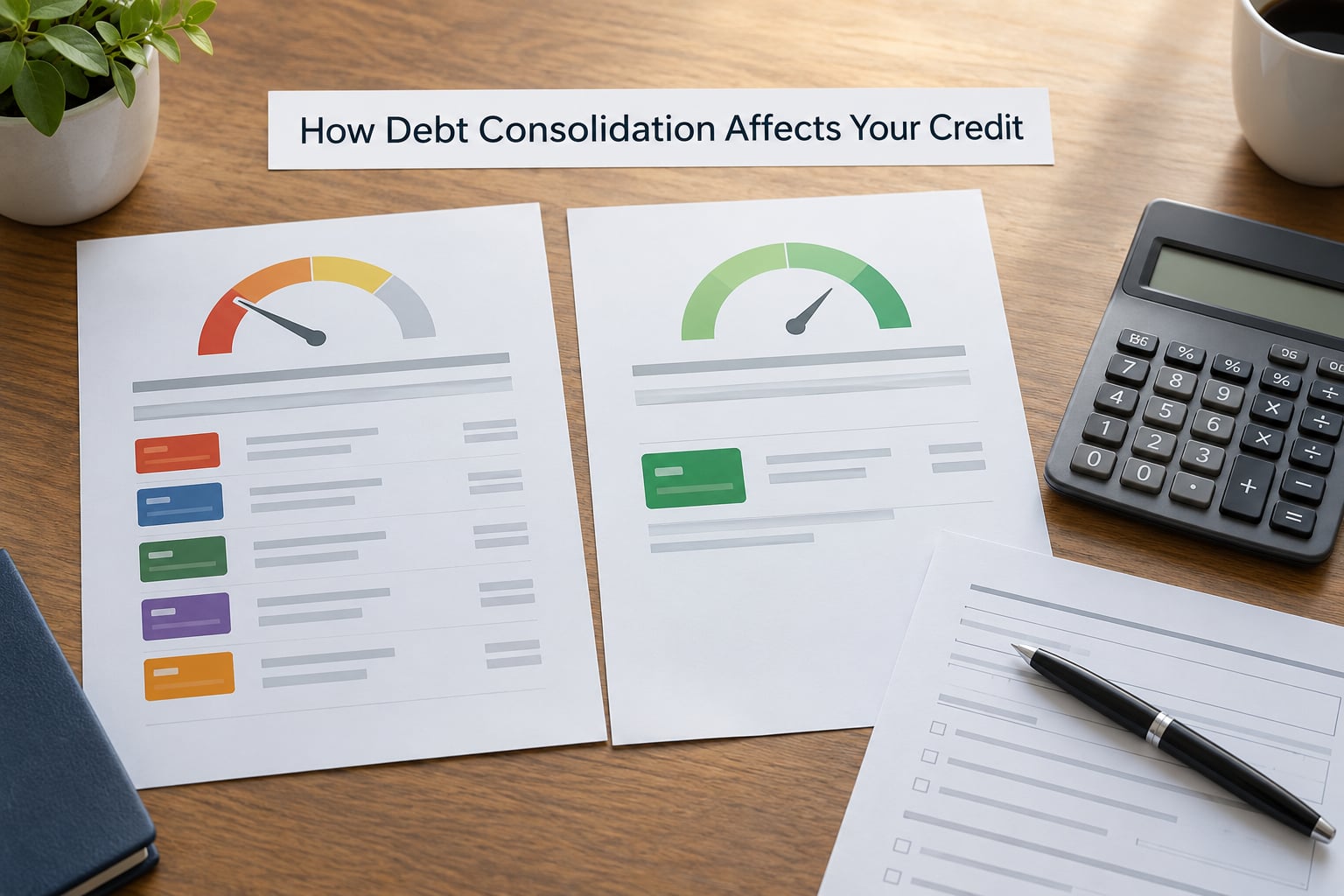
Short term it usually dips, and the dip has three sources. The application causes a hard inquiry, a new account lowers the average age of your accounts, and paying off the cards changes your credit utilization ratio in a good way that takes a reporting cycle or two to show up.
Then there is the part people get wrong. Closing the old cards after paying them off removes available credit and can pull the average age back down. Card issuers will often leave a paid account open with a zero balance, or freeze it so it reports as frozen rather than closed. Either way, paying the balance off matters more than the account status.
Longer term the score usually improves, because what the lenders weigh most heavily is a history of on-time payments on a new account plus lower utilization. That takes time, which is why a reader planning to apply for a mortgage within a year should expect the dip and the recovery to matter more than the headline number at signing.
Borrowers on personal finance forums ask this question constantly, and the useful answer is timing rather than degree. Apply when you want the debt gone, not the week before a mortgage application.
Debt Consolidation Pros: When It Can Help
- One payment replaces many. Six minimums become one, which cuts the late-fee risk that quietly raises the cost of high-rate cards.
- Interest savings, when the rate gap is real. Moving a 24% card balance to an 11% loan is the clearest case where consolidation wins on pure math.
- A fixed end date. A fixed-rate loan has a last payment, which a credit card balance never does. Borrowers who set the goal as a payoff date rather than a lower payment tend to do better.
- One credit line to manage. For people who have lost track of accounts, a single statement with a single lender is genuinely easier to monitor.
- Lower minimums as a bridge. Right after the new loan funds, the freed-up cash is the best moment to build an emergency fund so the next shock does not go back on a card.
Each of those depends on one behavior: not running the freed-up room back up. A consolidation loan does the arithmetic for you in reverse if the balances come right back.
Debt Consolidation Cons: Risks and Hidden Costs
- Fees that eat the savings. On small balances and modest rate gaps, a 5% origination fee can exceed the interest you would have saved. The math section below shows a case where it does.
- A longer payoff timeline. A 36-month term is friendlier to the monthly budget and worse for the total bill. Stretching debt out costs money even at a lower rate.
- The promotional rate cliff. A 0% balance transfer period ends, and the balance often jumps to a high variable rate. Borrowers who have not paid the balance down by then get a surprise payment.
- A credit score dip. The inquiry, the new account and the closure of old accounts all land at once, which complicates mortgage or auto borrowing in the near term.
- Collateral loss. HELOCs and 401(k) loans are secured. A missed payment can put the house or the retirement account at risk, which unsecured debt never does.
- Relapse, the risk nobody prices in. Borrowers on debt forums describe getting approved at a good rate, then spending the freed-up space and owing a similar balance later, with the fees already spent.
Settlement deserves its own warning. Companies that tell you to stop paying your creditors while they negotiate are using your missed payments as leverage, and the result is usually worse credit plus a tax bill on forgiven balances. The Consumer Financial Protection Bureau and the IRS both publish guidance on how these pitches work.
How to Compare a Consolidation Offer
Compare offers on total cost, not monthly payment. Two lines on a page are enough: current weighted average APR, and the new APR with all fees included. From there work down this list.
- Your current weighted average APR across every balance you plan to move.
- The new APR after any promotional period ends, not the headline rate.
- Origination or transfer fees, in dollars and as a percentage of the balance.
- The term in months, and the resulting monthly payment.
- Total repayment: payment times months, plus fees. That is the number to compare against your own plan.
- Whether the rate is fixed or variable, and what the variable rate can climb to.
- Any collateral, prepayment penalty, or requirement to keep the account open.
- What happens to the old accounts, and whether the new account reports the same way.
Here is the break-even case. A 10,000 balance carried at 24% APR and paid over 36 months costs about 14,120 in total payments, roughly 4,120 of it interest. The same balance at 11% over 36 months costs about 11,790, roughly 1,790 of interest. Interest saved is around 2,330, so a 4% fee of 400 still leaves consolidation ahead by about 1,900.
Now shrink the rate gap. A 5,000 balance at 15% over 24 months costs about 5,820, and the same balance at 11% over 24 months costs about 5,590. Interest saved is roughly 230, and a 5% fee is 250. Here consolidation costs more than paying the cards off yourself. The size of the balance and the size of the rate gap decide the answer, which is why the arithmetic is worth an afternoon.
For larger balances the picture shifts again. A 50,000 balance at 11% over 60 months is about 1,090 a month, roughly 65,300 in total payments and about 15,300 in interest before fees. At 9% over the same 60 months it is closer to 1,040 a month and about 12,300 in interest. A 4% fee of 2,000 is small against a 3,000 interest saving, though the 60-month timeline is long enough that a relapse has plenty of room to happen.
Debt Consolidation vs. Other Debt Payoff Options
The debt avalanche method is the honest comparison point, because it costs nothing. You order balances by rate, pay the minimum on everything else, and put every extra dollar at the highest rate first. That gets you the smallest possible interest total for the same monthly budget, which is exactly what a good consolidation loan is supposed to do.
Where it wins and where it does not:
- Avalanche method: cheapest overall, no fees, no credit impact. It demands discipline every month and it does not lower the minimums, which is why it is hard when cash is tight.
- Snowball method: same mechanics, but you attack the smallest balance first. It costs slightly more interest and finishes psychologically easier for many people.
- Balance transfer card: cheapest if you clear the balance inside the promotional period. Most expensive if you do not, because the post-promo variable rate is brutal.
- Unsecured personal loan: predictable and fixed, with no collateral at risk. You need a credit score in the 680 range or better for competitive terms.
- HELOC: the lowest rate in the table, and the highest risk in the table. It converts unsecured debt into debt secured on your home.
- Debt management plan through a nonprofit counselor: no transfer fee, no new application, lower rates negotiated on the cards themselves. Accounts stay open and are generally reported as current once enrolled.
- Credit union hardship loan: often available when a bank declines you, at a far lower rate than a card.
- Chapter 7 or Chapter 13: the legal backstop, not a money-saving tool. Liquidation is fast; Chapter 13 repays over three to five years. Filing damages credit for years, so it is a decision made with a lawyer.
One alternative that costs nothing and works regularly: call each card issuer and ask for a rate reduction, citing that you are paying on time and intend to stay. Borrowers report issuers cutting their rates after that single conversation. Some issuers also offer hardship programs with a temporary rate cut or a paused minimum. Ask before you borrow.
Is Debt Consolidation Right for You?
Use the numbers first. Consolidation tends to make sense when your weighted average APR sits above roughly 15%, when a fixed-rate loan can bring it under about 8% to 10%, when your credit is around 680 or higher, when your debt-to-income ratio sits below 40%, and when the unsecured balance is under roughly 50,000. Those are thresholds, not laws; lenders vary, and so does everyone’s situation.
It makes less sense when your card rates are already under 10%, when you cannot cover the new monthly payment plus your existing obligations, when your credit is too damaged to qualify for a reasonable rate, or when you have no plan for what you will stop spending.
Signs you should not consolidate at all: debts already in collections or charged off, IRS tax debt, medical bills still in active billing, or student loans you are already paying under an income-driven plan. Those need a different conversation entirely, and consolidating unsecured cards will not touch any of them.
Red flags that mean walk away: pressure to sign today, a request to stop paying your creditors, a fee quoted only after you submit documents, a company that will not tell you its legal name, and any promise of guaranteed removal of debt. Nonprofit credit counselors are listed by state, and the National Foundation for Credit Counseling is a reasonable place to start looking for one.
And build a small cash buffer before you sign. Borrowers who freed up room and immediately spent it on a new balance ended up back where they started, with the fee already gone.
Frequently Asked Questions
What are the negative effects of debt consolidation?
The main drawbacks are upfront origination or transfer fees of roughly 3% to 5%, a payoff timeline that is longer than paying the debt off yourself, and a short-term credit score dip from the hard inquiry and new account. If you consolidate with a home equity or 401(k) loan, your home or retirement account becomes collateral. The most common failure is behavioral: freed-up room gets spent and the balances rebuild.
Is it a good idea to consolidate debt?
It makes sense when your weighted average APR is above about 15%, a fixed-rate loan can bring it under 8% to 10%, and the fee plus the extra interest from a longer term stays well below the interest you would have paid. It does not make sense on small balances, at low existing rates, or without a written plan to stop adding balances. Compare total cost, not monthly payment.
Do debt consolidation loans negatively impact credit score?
Usually yes, for a few months. The application causes a hard inquiry and the new account lowers your average account age, while paying off the cards should drop your utilization within a reporting cycle or two. Scores typically recover within six to twelve months as on-time payments build history. If you are applying for a mortgage soon, time the consolidation earlier and leave months of recovery.
How much will I pay monthly on a 50,000 dollar debt consolidation loan?
At 11% over 60 months, expect roughly 1,090 a month, about 65,300 in total payments including around 15,300 of interest before fees. At 9% over 60 months it drops to about 1,040 a month with roughly 12,300 of interest. Shorter terms cost far more per month, so ask for 36 and 60 month quotes side by side and compare the totals, not the payments.
Does a 401(k) loan affect my credit score?
Usually not directly, because 401(k) loans are not reported to the credit bureaus, so the repayment history gives no positive credit history either. The real risk is not the score. Your retirement savings are collateral, most plans permit only one outstanding loan, and a missed payment can trigger taxes or forced withdrawal. Treat it as a last resort after cheaper options.
What is the difference between debt consolidation and debt settlement?
Consolidation repackages your debt into a new loan or card and you repay all of it, usually with a lower rate. Settlement asks a company to negotiate with creditors for a reduced balance, usually charging a percentage of what is forgiven. Settled amounts are treated as taxable income by the IRS, and stopping payments during negotiation can push accounts into collections.
Conclusion
Debt consolidation pros and cons stop being abstract once you put a total cost on both sides of the equation. Ask for the fee-inclusive total, write down what your own avalanche plan would cost, and take the consolidation only if the difference is clearly in its favor.
Start with the free moves first: ask your card issuers for a rate cut, set up autopay on the new payment, and keep a small cash buffer. If the numbers work, treat a fixed payoff date as the goal rather than a smaller monthly bill. Last updated October 2026; rates and rules change, so verify current terms with each lender before you apply.