
The fastest way to choose benefits during open enrollment is to compare plans on total annual cost, not on the monthly premium alone. Gather the plan documents, estimate the care you expect to use over the next year, and total up the premium plus what you would likely pay in deductibles, copays and coinsurance. The whole process takes an evening of focused work if you start with the right paperwork.
Most people pick a plan in about twenty minutes, which is why so many of them end up paying more than they needed to. Elections lock in for a full plan year, and premiums, deductible amounts and provider networks all shift from one year to the next, so last year’s choice is rarely automatically the right one this year. When people say their old plan worked fine, they are usually describing a year with very little care, which is exactly the year that flatters a high-deductible plan.
Table of Contents
- What You Need
- Step-by-Step
- 1. Estimate the Care You Expect to Use
- 2. Compare Premiums, Deductibles, and Out-of-Pocket Limits
- 3. Check the Provider Network and Prescription Coverage
- 4. Review the Benefits That Matter Most to You
- 5. Compare the Employer’s Options Side by Side
- 6. Choose a Plan and Enroll Before the Deadline
- Common Mistakes
- Frequently Asked Questions
- Can I change benefits during open enrollment?
- Why can I only change benefits during open enrollment?
- What happens if I miss open enrollment?
- Can I enroll in benefits after open enrollment?
- Can I have both an HSA and an FSA?
- Is 500 dollars a month normal for health insurance?
- Conclusion
What You Need
You cannot compare plans you have not read. Before you open the enrollment portal, pull together five things.
- The employer’s enrollment guide. This is the document that lists every plan on the menu, with premiums, deductibles, out-of-pocket maximums and employer contributions. It also has the deadline.
- Plan summaries or summary plan descriptions. These spell out copays, coinsurance, prior authorization rules and what the plan does and does not cover.
- The provider directory and drug formulary. You need to know whether your doctors, hospitals and pharmacies are in-network, and whether your prescriptions are covered and at what tier.
- Last year’s spending. Pull your explanation-of-benefit statements or check your insurer’s claims history. This is the single most useful input for estimating what you will spend next year.
- Your current elections and account balances. Note what you elected last year, what you have left in any health savings account or flexible spending account, and who your beneficiaries are.
Add to that list the personal details only you know: your expected income next year, how much you can put aside for a deductible, whether anyone in your household is planning surgery, starting pregnancy, changing doctors or adding prescriptions.
Step-by-Step
How to choose benefits during open enrollment comes down to about eight smaller decisions. They follow a rough order: work out what you will use, work out what it will cost, check that the plan actually covers it, then fill in the worksheet and submit. Most plans on a menu are variations on the same design, so the difference between them usually comes down to four or five numbers.
1. Estimate the Care You Expect to Use
Start from real usage, not from a chart of percentages. Look at last year’s claims and count the visits, the prescriptions, the lab work and any imaging. A year with a planned surgery or a specialist follow-up looks nothing like a year of routine checkups, and that difference drives the whole calculation.
Add the things you already know are coming: a pregnancy, a new diagnosis, a child who will start braces, a parent who may need more care. Then write down which doctors and facilities you expect to use. The recurring question in every benefits forum is exactly this one: how do you estimate what you would actually spend before you have to use the plan?
2. Compare Premiums, Deductibles, and Out-of-Pocket Limits
Every medical plan has the same four moving parts, and you have to hold all four in your head at once.
- Premium is what leaves your paycheck each month, whether you use the plan or not.
- Deductible is what you pay out of pocket before the plan starts sharing costs. A high-deductible health plan, or HDHP, has a legally defined minimum, and it qualifies you to contribute to a health savings account.
- Copay is a flat amount for a specific service, like a primary care visit. Coinsurance is a percentage of the bill, typically 10% to 30%, which applies more often on HDHP plans.
- Out-of-pocket maximum is the most you will pay in a year for in-network care. Once you hit it, the plan covers the rest.
Then run two scenarios against each plan. Your best case is the premium plus a few copays for a healthy year. Your worst case is the premium plus the out-of-pocket maximum, which is the number that tells you how bad a bad year can get.
On family plans, the deductible and out-of-pocket maximum are usually embedded, meaning one large claim can push the whole household to the limit. Check whether your plan offers an individual deductible that is embedded in the family figure, because that changes how much a single event can cost you.
One more framing question comes up constantly: is my premium normal? For a single employee with a modest plan, a few hundred dollars a month is high but not unusual, and an employer with a rich package or a union agreement often pays a large share. For family coverage, a few hundred dollars a month is on the low side of normal. The useful comparison is your plan against the other plans on your own menu, plus what the employer is paying on your behalf, since that contribution is part of your compensation whether you see it or not.
3. Check the Provider Network and Prescription Coverage
A plan that looks cheap on paper is worthless if your oncologist or your child’s pediatrician is out-of-network. Look up every doctor, hospital and pharmacy you use in the plan’s directory, and check the drug formulary for each prescription you take, including the tier and whether prior authorization is required.
Out-of-network care usually has no out-of-pocket protection at all, so a single out-of-network MRI can cost more than a year of premiums. Prescription coverage deserves the same attention, because a brand-name drug on a higher tier can add hundreds a year, and some plans exclude specific medications entirely.
4. Review the Benefits That Matter Most to You
Beyond the medical plan, most employers offer dental, vision, life insurance, disability coverage, retirement contributions and sometimes an employee assistance program. Some benefits are worth more than their price, others are pure noise.
Mental health coverage matters more than it used to, so check copays for therapy and the number of sessions covered. Maternity coverage matters if children are in the picture, including whether your deductible resets after delivery. Preventive care is usually covered at no cost, but confirm that annual physicals, screenings and immunizations are in-network.
A health savings account works with an HDHP and offers three tax advantages: contributions reduce taxable income, growth is untaxed, and qualified medical withdrawals are untaxed. An employer seed goes in regardless of what you contribute. A flexible spending account is funded with pre-tax dollars but has no rollover, so unspent money is forfeited at the end of the plan year. You can hold both, but the FSA must be a limited-purpose one that only covers dental and vision expenses.
Life insurance through an employer is usually cheap per month and often makes dependents eligible at no cost. Disability coverage is worth reading carefully: short-term policies cover an injury or illness for a few months, long-term policies usually kick in after six months, and the premiums are typically paid with after-tax dollars. Retirement contributions are usually separate from health elections, but the employer match is one of the highest-return benefits on the menu, so it deserves a decision during enrollment.
5. Compare the Employer’s Options Side by Side
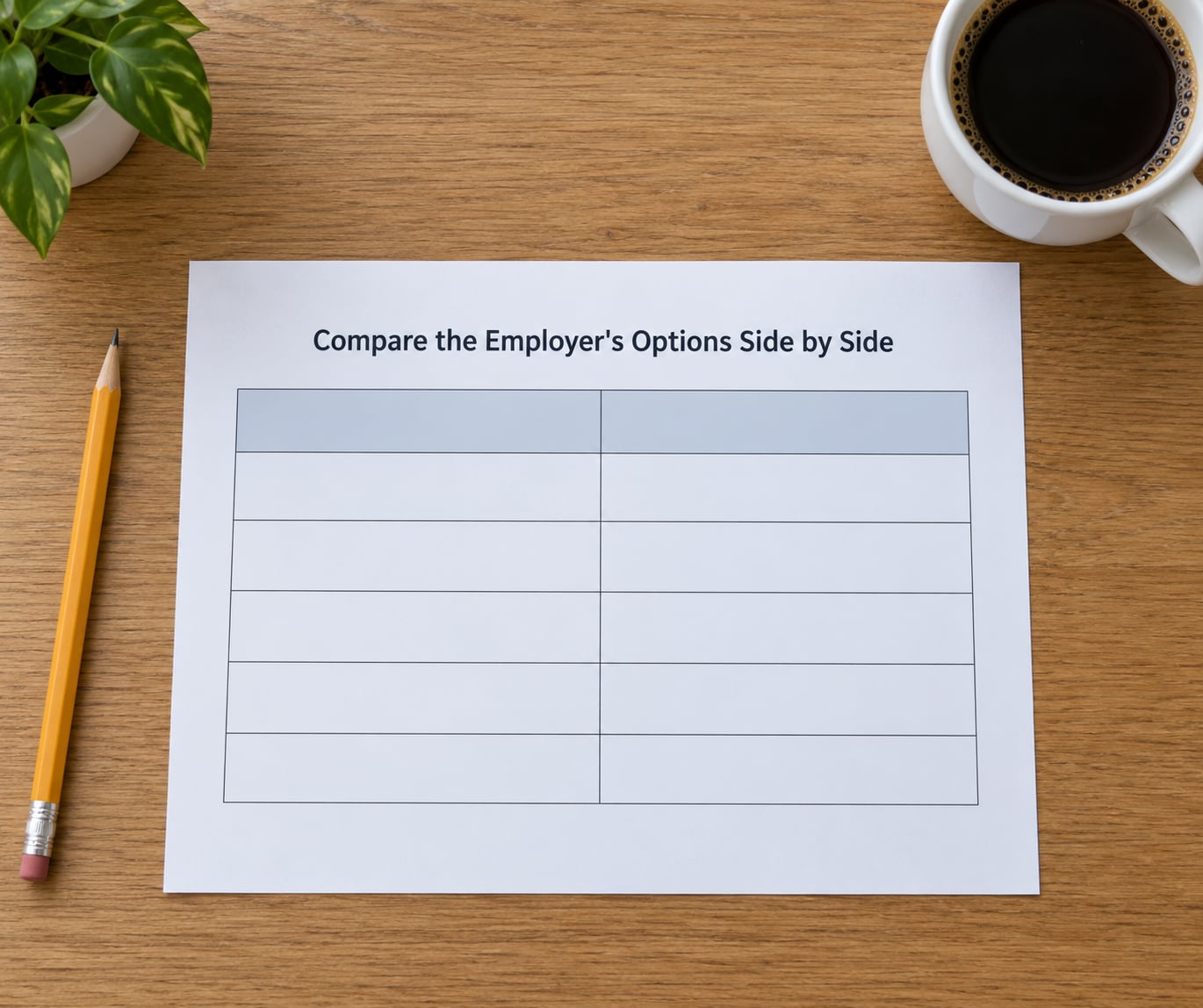
Most guides tell you to build a comparison chart. Here is one, ready to fill in. Put one plan per column and work down the rows.
| What to compare | Plan A | Plan B | Plan C |
|---|---|---|---|
| Monthly premium (employee only) | |||
| Employer contribution | |||
| Deductible, individual | |||
| Deductible, family | |||
| Out-of-pocket maximum | |||
| Primary care / specialist copay | |||
| Coinsurance rate | |||
| HSA eligible (yes or no) | |||
| Employer HSA contribution | |||
| My doctors and drugs in-network | |||
| Best-case annual total | |||
| Worst-case annual total |
The last two rows are the ones that matter. If a plan wins on best case by a hundred dollars a year but is five thousand dollars better in the worst case, and you have an emergency fund that could cover the difference, take the safer plan. If you have no cushion, the higher-deductible plan is a real gamble.
One warning about the employer HSA seed: it is not the same as being able to fund the deductible. A family deductible can run well above what you can put aside in a year, so treat the seed as a bonus, not as the plan.
6. Choose a Plan and Enroll Before the Deadline
Make the call, then submit it early. Enrollment systems get slow in the final days, and most employers do not confirm until the deadline has passed.
Confirm every dependent’s eligibility, upload supporting documents for anyone added, and check that your beneficiaries are current. Save the confirmation email or screenshot, and put a calendar reminder for the plan year start so you can review your deductible, your account balances and your provider network again. Outside the annual window you generally cannot change anything unless you have a qualifying life event such as marriage, divorce, a birth or adoption, or a loss of other coverage.
Common Mistakes
- Comparing premiums only. A plan with a lower premium and a high deductible can cost more in a year with any real usage. Fix: total the premium plus your realistic out-of-pocket cost for each plan.
- Ignoring the provider network. Fix: look up every doctor and hospital you plan to use before you decide, and check the plan directory rather than trusting a provider’s website.
- Overlooking prescription coverage. Fix: check the tier of every drug you take, and whether the plan requires step therapy or prior authorization.
- Misreading the deductible. Fix: remember it applies to what the plan pays, not to copays, and check whether the family deductible is embedded.
- Picking a plan that does not fit expected care. Fix: if you know you will have surgery, pregnancy or ongoing chronic care this year, weight the out-of-pocket maximum more heavily than the premium.
- Missing the deadline. Fix: set a personal deadline a week before the employer’s, and submit then.
Two more that trip people up: enrolling in an FSA you do not use, and forgetting that health elections and retirement elections often have different deadlines.
Frequently Asked Questions
Can I change benefits during open enrollment?
Yes, and this is the only time you can. During the annual enrollment period you can switch medical plans, change your coverage level, add or remove dependents, and make HSA, FSA, dental, vision, life and disability elections. Many employers allow a spouse to be dropped mid-year if they enroll in their own coverage, but only within the window. Outside it, changes require a qualifying life event.
Why can I only change benefits during open enrollment?
Because employer group contracts are annual. Your employer buys a block of coverage for a plan year and has to tell insurers who is enrolled, so elections lock in on a set date and stay fixed until the next window. That is also why premiums, deductibles and provider networks change each year. A qualifying life event is the usual exception that opens a special enrollment period mid-year.
What happens if I miss open enrollment?
Most often nothing changes: your current medical elections auto-renew for another year and you keep paying the same premium. Coverage on voluntary benefits such as dental, vision, life and disability usually lapses because those elections do not carry over. You cannot shop the menu mid-year, so if you overpaid last year, you are locked in until the next window unless a qualifying life event applies.
Can I enroll in benefits after open enrollment?
Only after a qualifying life event, usually within 30 days of the event. Marriage, divorce, a birth or adoption, a dependent aging out at 26, or a loss of other coverage all qualify, and you need proof such as a marriage certificate or a letter from the previous insurer. If you miss that 30-day window you have to wait for the next annual enrollment period. Self-employed people have a separate annual federal window.
Can I have both an HSA and an FSA?
You can hold both, but only if the FSA is a limited-purpose FSA that covers dental and vision expenses. A standard medical FSA would make you ineligible for HSA contributions for the months it is in force. An HSA is yours, rolls over and can be invested; an FSA has a small employer-set carryover limit and forfeits the rest. Neither can reimburse anything incurred before the account was funded.
Is 500 dollars a month normal for health insurance?
For a single employee with employer coverage, several hundred dollars a month is high but well within the normal range, and a well-funded employer absorbs much of the cost. For family coverage, that amount is toward the low end of normal. The more useful benchmark is your own menu and the employer contribution, which is part of your compensation even though it never hits your paycheck.
Conclusion
Knowing how to choose benefits during open enrollment comes down to a couple of hours with your plan documents. Put them and last year’s claims on the same table, write down the care you expect to use, fill in the worksheet for every plan on the menu, and total each one under a best case and a worst case. Then submit your elections, dependents and beneficiaries a week before the deadline, and check your deductible and network again in the new plan year.
Limits and rules on employer benefits change every year and vary by employer and by state, so treat any specific figure in a plan document as the one that applies to you. Talk to a benefits administrator or an insurance broker before switching a plan mid-year, and run any decision that affects your own coverage by your own numbers.