To combine bank accounts after marriage, you open one joint account for shared bills and savings, move both of your direct deposits and recurring payments to it, then close the individual accounts once nothing is still clearing through them. The whole switch usually takes two to four weeks, and it costs nothing but an afternoon of paperwork. You do not have to merge everything, though. Plenty of couples run a three-account setup instead, and that option works just as well if you pick it on purpose.
I have watched a lot of couples handle this badly, and it almost never comes down to banking mechanics. It comes down to skipping the conversation about what each account is for, then discovering three months later that the grocery money and the house deposit fund have been sitting in the same place.
This guide walks through the preparation, the six steps of the actual switch, and the handful of mistakes that cost people real money. Rules and account terms vary by bank and by state, so treat the mechanics here as a template rather than bank-specific policy.
Table of Contents
- What You Need to Combine Bank Accounts After Marriage
- Step-by-Step: Combining Bank Accounts After Marriage
- 1. Decide What Each Account Is For
- 2. Compare Joint, Individual, and Shared-Access Accounts
- 3. Gather Documents and Confirm Current Balances
- 4. Open or Convert the Chosen Account
- 5. Move Money and Update Payments Gradually
- 6. Verify Access, Records, and the Old Account
- Common Mistakes to Avoid
- Transition Tips That Smooth the Switch
- Frequently Asked Questions
- Do I have to combine our bank accounts after marriage?
- Can one spouse remove all the money from a joint account?
- Who is responsible for overdraft fees on a joint account?
- How long does it take to merge bank accounts after marriage?
- What documents do I need to open a joint bank account?
- Does combining bank accounts affect your credit or taxes?
- Conclusion
What You Need to Combine Bank Accounts After Marriage
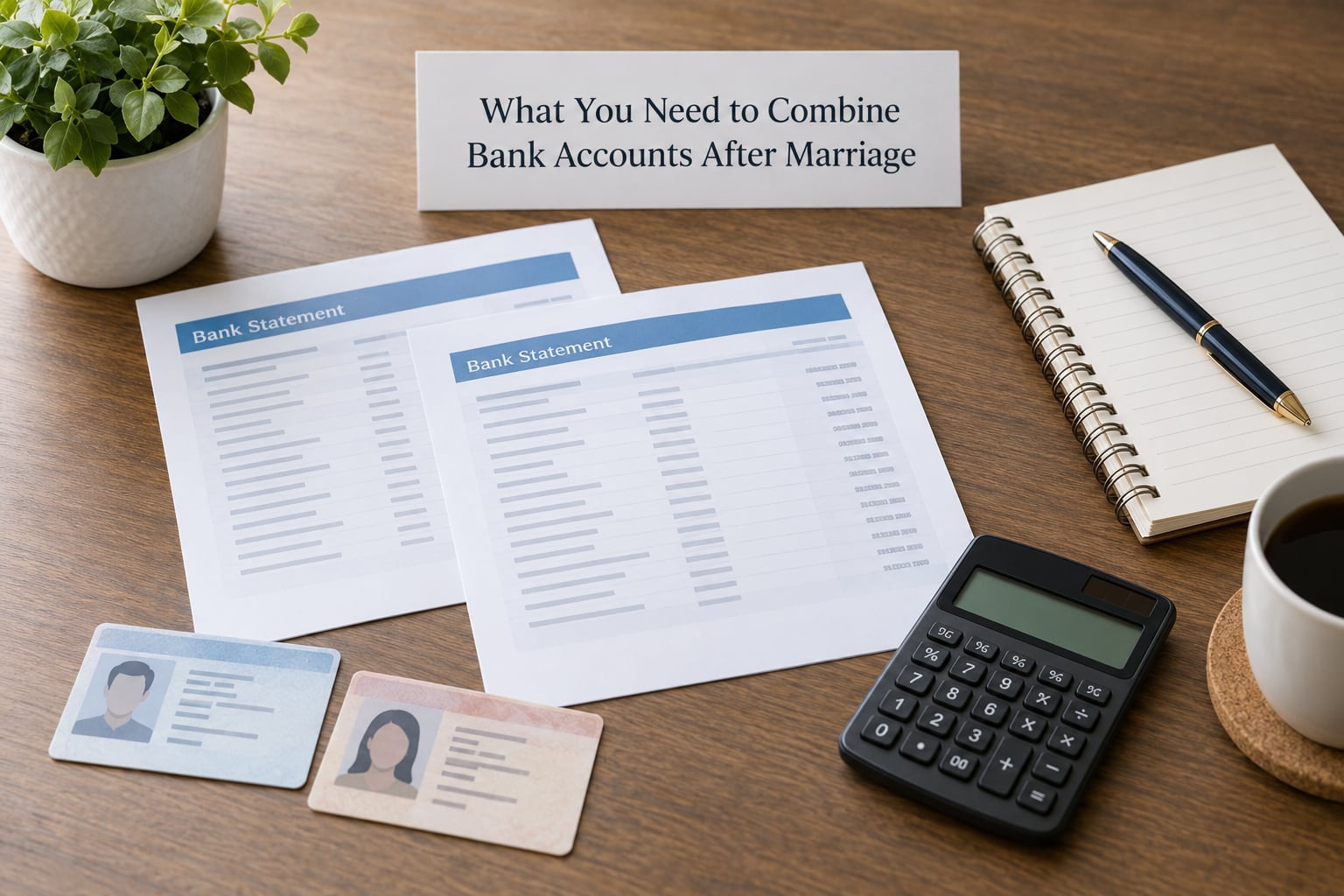
Gather everything below before you open anything, because banks ask for most of it during the application and a missing document means a second trip.
- Government identification for both of you. A driver’s license, state ID, or passport. Some online banks accept a passport plus a selfie verification instead.
- Social Security numbers for both spouses, and your date of birth.
- Account numbers and routing numbers for every account you plan to move, whether or not it is at the same bank.
- Login or statement access to each current account, so you can check pending transactions and direct deposit splits.
- A written list of recurring payments. Rent or mortgage, utilities, insurance, subscriptions, loan payments, and any payment taken from a card that is about to be closed.
- Proof of address, such as a lease or utility bill, if you have recently moved.
- A marriage certificate if a name change is in progress or the bank asks for it. Most banks do not require one to open a joint account.
- A starting number for your shared balance, plus your agreed emergency fund target and how much personal spending money each of you wants.
The last item is the one people skip. Deciding how much goes into the everyday account and how much stays as individual money in advance prevents the fairness argument from resurfacing every payday.
Step-by-Step: Combining Bank Accounts After Marriage
1. Decide What Each Account Is For
Write down what each existing account actually does before you merge anything. Most households end up with four jobs to cover: everyday spending, emergency savings, long-term savings, and money each person wants to control alone.
Combining accounts is optional, and skipping it is a legitimate choice rather than a failure. If one of you keeps a full separate set of finances and that works, a joint account for the mortgage and groceries is still a reasonable middle path.
Sort each account into the job it does now, not the job you wish it did. That list becomes the blueprint for the new structure in the next step.
2. Compare Joint, Individual, and Shared-Access Accounts
Three structures cover nearly every situation, and they differ on one question above all: who can see and move the money.
- Joint account. Both names are on the title. Either person can deposit, withdraw, view every transaction, and close the account. Deposits are typically insured up to the FDIC or NCUA limit across all accounts held at the same bank under the same ownership category.
- Individual account in one name. The other spouse has no access at all. Transfers in from a joint account are treated as gifts for tax purposes, and the account stays outside marital property in many states.
- Shared-access account. One person owns the account and the other has limited access, such as a debit card or an authorized signer role with no withdrawal rights. The owner still controls everything.
That last category is genuinely different from joint ownership. An authorized signer can usually spend from the account but cannot add an owner, close it, or see balances beyond what the owner shares. A power of attorney is broader still and can act on your behalf while you are alive.
Banks frequently title joint accounts as joint tenants with right of survivorship, meaning the balance passes automatically to the surviving owner rather than going through probate. The title also affects how deposits are insured, so ask your bank to confirm how your accounts are grouped.
Survivorship works both ways, and that is the detail people argue about later. If one spouse adds the other as a joint owner, that owner can withdraw the entire balance at any time without the account holder’s permission. There is no mechanism for a bank to sort out a disagreement between two owners.
3. Gather Documents and Confirm Current Balances
Inventory every account: current balance, pending card authorizations, paper checks written but not yet deposited, and any scheduled transfers. A card authorization can hold funds for several business days, so an account that looks empty in the app can still show a negative balance later.
Call the bank before the appointment if either of you is not the primary owner of an existing account you plan to convert. Converting an individual account to joint ownership usually requires both owners to sign new account documents, and some banks require the account to be reopened rather than edited.
4. Open or Convert the Chosen Account
Compare fees, minimum balance requirements, and overdraft settings before you sign, not after. The differences between checking accounts matter less than the overdraft policy, because that is what decides whether a mistake costs you a fee or a small fortune.
Ask three questions directly: what is the monthly maintenance fee and the minimum balance to avoid it, does the account offer overdraft transfer from savings, and what happens to joint accounts on death. Read the account agreement and signature card before signing, and confirm the ownership title and beneficiary designations on the new account.
If a name change is in progress, open the account under the name on your current identification and ask the bank how to add the other name later. Changing a title mid-application trips more paperwork than waiting does.
5. Move Money and Update Payments Gradually
Do not transfer balances until pending items have cleared. Start by moving only the amount the new account needs to cover the first full billing cycle, which protects you from an overdraft while the old payments are still draining.
Then work through the redirect list one payment at a time: payroll direct deposit, rent or mortgage, utilities, insurance premiums, loan payments, subscriptions, and any app that holds a card you plan to cancel. For payroll, give the new account details to your employer and confirm the change took effect by watching two consecutive paychecks, since split deposits can persist for a cycle or two.
Keep the old account open during the transition. It costs nothing to maintain a checking account for a month or two, and it gives you somewhere for a late refund or a misrouted payment to land. Most of the friction in this switch comes from closing too early.
6. Verify Access, Records, and the Old Account
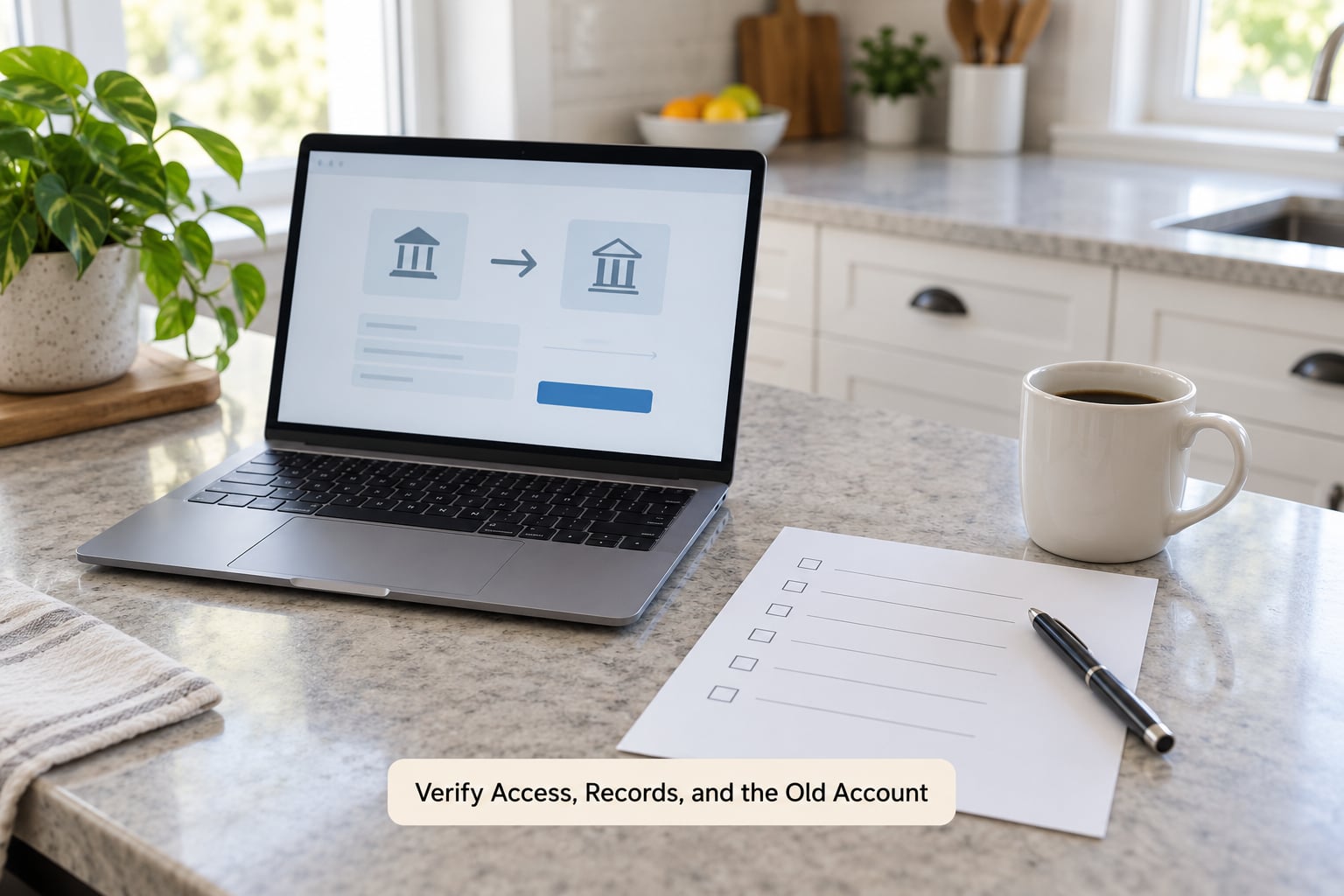
Run this final checklist before you close anything:
- Both spouses can log in, view balances, and see the full transaction history.
- The debit card and online banking credentials are set up on the new account for both of you.
- Every transfer is recorded with its date, source account, and amount.
- All recurring payments have been redirected and confirmed on a real statement.
- Beneficiaries are updated on retirement accounts, life insurance, and any account with a payable-on-death designation.
- Two full billing cycles have passed with no deposits or withdrawals on the old account, including direct deposit.
Then request the closure in writing and keep the confirmation. Download or print a final statement covering the period after closure, because closed-account statements often disappear from online banking within a year.
Common Mistakes to Avoid
Closing the old account too early. A payroll deposit that arrives two days after closure gets refunded to the old bank, and the money can take weeks to come back. Wait for two full billing cycles with no activity at all.
Forgetting pending transfers. Scheduled ACH debits and unprocessed paper checks keep clearing for weeks. Search for any automatic withdrawal before you request closure, and call the bank rather than assuming a zero balance means a closed account.
Assuming two names mean equal control. Joint owners have identical rights. Neither spouse’s transactions are hidden from the other, and neither can be blocked without going to court first.
Ignoring overdraft liability. Either joint owner can overdraw the account, and both are generally responsible for the fees and any negative balance. This is the single most cited worry in online discussions about merging, and it is the one reason people keep a personal account.
Overlooking deposit insurance limits. Coverage is per depositor, per insured bank, per ownership category. Balances held jointly are combined for the limit calculation, which usually puts a large joint balance in the same category rather than doubling the coverage.
Mixing tax records. Keep separate the accounts tied to premarital money or inherited assets, and note the dates. A prenuptial agreement or documentation of when an asset arrived matters far more once the money is sitting in a shared account.
Failing to update beneficiaries. A marriage is a qualifying life event for most insurance policies, and beneficiary designations outrank almost anything else in a will. Review every account with a named beneficiary, not just the bank ones.
Moving emergency savings into a spending account. Combine the accounts, but keep the fund itself somewhere it is inconvenient to tap. A high-yield savings account that requires a transfer is the simplest safety valve in this whole plan.
Transition Tips That Smooth the Switch
Review spending together weekly for the first month, then settle into a monthly rhythm. Couples who keep that appointment report the merge sticks; the ones who skip it drift back into confusion within a few months.
Move a fixed personal amount to each person’s individual account on payday, and make that transfer automatic. That gives you the transparency of a joint account without turning every purchase into a negotiation.
If one income is variable, such as tips or freelance work, set the personal transfer in dollars rather than percentages. A percentage of an unpredictable paycheck produces unpredictable arguments.
If you are in a second marriage, or money from a prior marriage, a child support order, or a business is involved, talk to a family law attorney before opening the joint account rather than after. Property treatment differs between community property states and equitable distribution states, and an account title is an easy place to create a problem that is expensive to unwind.
Frequently Asked Questions
Do I have to combine our bank accounts after marriage?
No. Plenty of couples never merge anything and manage shared bills by reimbursing each other. Combining accounts only helps when it removes real friction, like one shared account for rent and groceries plus a personal account each. What you must do is update beneficiaries and name whoever needs access on insurance and retirement accounts.
Can one spouse remove all the money from a joint account?
Yes. Either joint owner can withdraw the entire balance at any time without the other’s permission, and the bank will not step in to resolve a disagreement between two owners. That is why many couples keep a separate personal account for spending and keep savings in a different account type.
Who is responsible for overdraft fees on a joint account?
Both joint owners. Either person can overdraw the account with a debit purchase, a check, or an automatic payment, and both are typically liable for any negative balance plus the fees. Ask your bank about overdraft transfers from savings, or switch off overdraft coverage on the account and rely on your emergency fund instead.
How long does it take to merge bank accounts after marriage?
Opening the joint account takes one visit or one online session. Redirecting payroll takes one or two pay cycles to confirm, and recurring payments need a full billing cycle or two. Budget two to four weeks for the switch, and closer to 60 to 90 days for everything to fully settle.
What documents do I need to open a joint bank account?
Most banks ask for government photo identification, Social Security numbers, and a date of birth for both applicants. Some want proof of address, and some accept a marriage certificate if a name change is in progress. Bring the routing and account numbers for the accounts you plan to move so you can set up transfers in the same visit.
Does combining bank accounts affect your credit or taxes?
Bank account balances are not part of your credit report, so merging itself does not change either spouse’s credit score. Adding the lower-earning spouse as an authorized user on a credit card does build credit history over time. On taxes, you can file jointly even with separate accounts, and gifts between spouses are generally not taxable.
Conclusion
To combine bank accounts after marriage, start by writing down what each account is for, then pick the structure that matches your plan: one joint account for shared bills and savings, a personal account each for spending money, or a fully separate setup if that genuinely works better. Move the money in stages, redirect every recurring payment, and confirm both of you can see everything before you close a single account.
The first action takes twenty minutes and no bank visit. List your accounts, their balances, and who is on each one, and the rest of the process gets obvious from there.