
A credit card rewards program pays you back a small rebate or a points-per-dollar rate on the purchases you charge to the card, then lets you redeem that balance for statement credits, merchandise, gift cards or travel. How credit card rewards programs work comes down to four things: how you earn, what your balance is really worth, where you redeem it, and when it disappears.
That last part is where most people get stuck. The account page shows a number, never a dollar figure, so you have no idea whether 40,000 points is a win or a rounding error. On r/personalfinance and r/explainlikeimfive the same question keeps coming up: is the points system intentionally confusing? Mostly it’s simpler than it looks, but the value really does depend on choices you make at redemption time.
Here’s the short version of the whole system before the detail:
- Earn. Every eligible purchase posts a base rate, plus a bonus rate on some categories.
- Wait. Rewards usually don’t appear until the transaction settles.
- Value it. The same balance is worth different amounts depending on where you spend it.
- Redeem. Cash, gift cards, merchandise, travel portals or partner programs.
- Watch the clock. Points can expire, get capped, or vanish when an account changes.
Programs and terms vary by issuer, and rules in the US change often enough that anything here is a starting point rather than a promise. Check your own card’s terms before you make a decision with real money.
Table of Contents
- What Are Credit Card Rewards Programs?
- How Credit Card Rewards Programs Work: The Basic Cycle
- 1. You open an account and get enrolled
- 2. You meet any welcome offer requirement
- 3. Purchases earn rewards
- 4. Rewards post to your account
- 5. You choose a redemption
- What Kinds of Rewards Can You Earn?
- Why Do Points Have Different Values?
- How Much Are Credit Card Points Really Worth?
- What Happens When You Redeem Rewards?
- How Do Welcome Offers and Bonuses Work?
- How Can You Get More Value Without Overspending?
- How Do Credit Card Rewards Programs Work in One Example?
- What Are the Main Rewards Program Downsides?
- Frequently Asked Questions
- Do credit card points expire?
- Are credit card rewards taxable?
- Is it better to redeem points for travel or statement credit?
- Do credit card rewards affect your credit score?
- Can I earn rewards without paying the annual fee?
- What happens if I close a rewards card?
- Conclusion
What Are Credit Card Rewards Programs?
A rewards program is a loyalty arrangement between you and a card issuer. The issuer is the bank that issued the card. The network (Visa, Mastercard, American Express) handles the transaction itself but sets almost none of the reward rules.
When you make an eligible purchase, the issuer credits your account with a reward: a percentage of the amount as cash back, or a number of points or miles per dollar. You accumulate that balance and later trade it for something. Rewards are a rebate on spending you were already doing, which is why they work best on your routine costs rather than on purchases you would not have made anyway.
Some programs pay straight cash back and stay there. Others issue points that can be transferred to airline and hotel loyalty programs, or to a partner store. A third group issues store credit usable only at one retailer. The label matters less than the redemption rules.
How Credit Card Rewards Programs Work: The Basic Cycle
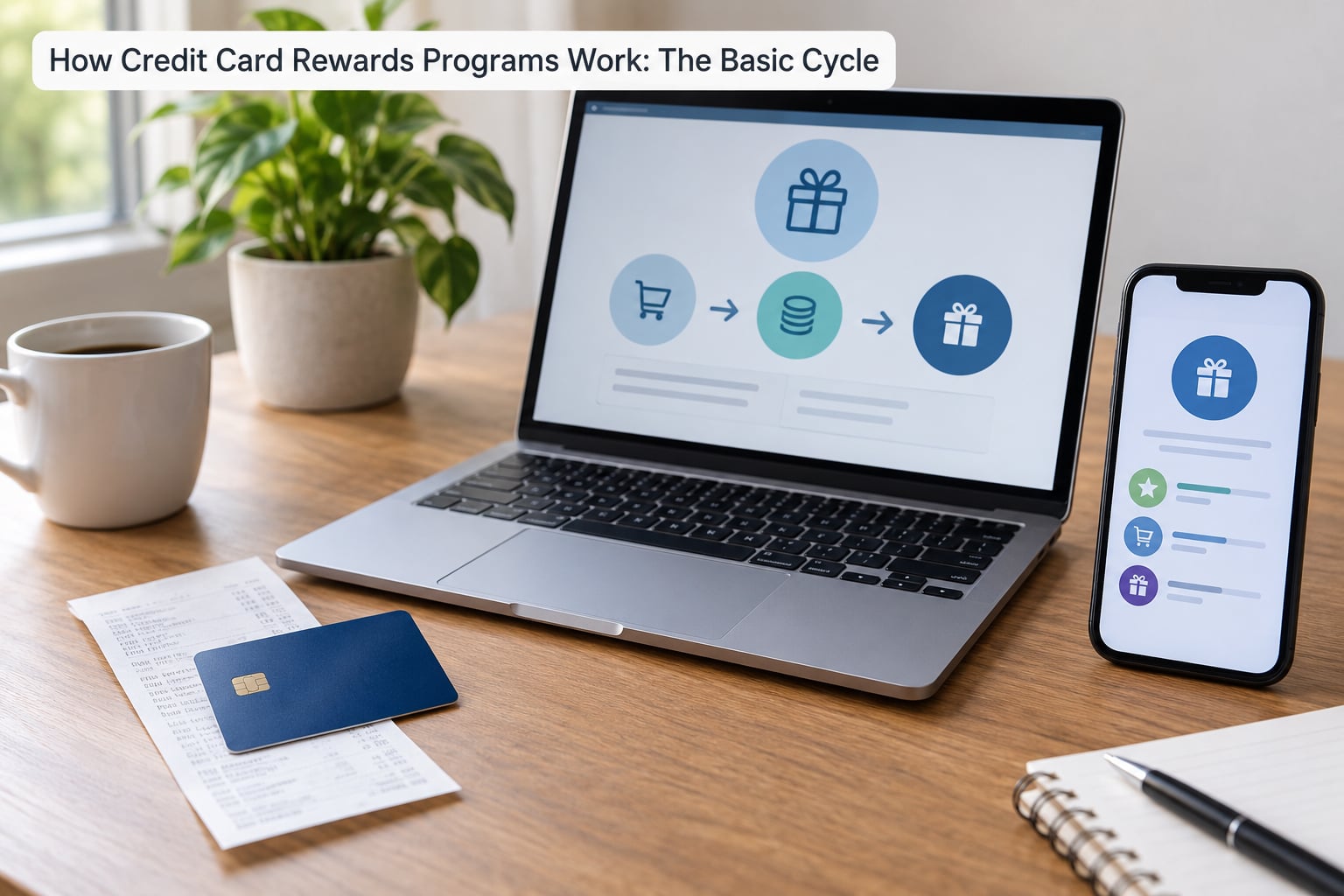
Understanding how credit card rewards programs work means following one cycle from application to last redemption. It runs in five moves, and most misunderstandings come from skipping ahead to step four.
1. You open an account and get enrolled
Most cards enroll you in the rewards program automatically at issuance. Some require you to opt in or accept terms in the app, and a handful need a separate enrollment for bonus categories each quarter.
2. You meet any welcome offer requirement
Sign-up bonuses usually demand a minimum spend within a set window, often the first three to six statement cycles. The bonus typically appears after the purchase posts, sometimes as a statement credit or as points. Some issuers pay part of it immediately and the rest on a schedule.
3. Purchases earn rewards
Each transaction earns at a base rate, often one point or one percent per dollar, times a category multiplier if that spending qualifies. Points accrue by transaction, so they show up as small increments rather than a single tidy number.
4. Rewards post to your account
This is where people get impatient. A purchase charged Monday may not post until the merchant batch closes, and pending transactions frequently earn nothing until they settle. Rewards on some cards are withheld until the balance is paid. Cash back is not always cash in hand: some issuers treat it as a rebate applied later, or as points with a transfer option attached.
5. You choose a redemption
You redeem through the issuer’s app or website, and the destination decides the value. Same balance, same card, wildly different payoff depending on the choice.
What Kinds of Rewards Can You Earn?
Four reward types cover nearly everything. The differences are worth knowing because two of them are fixed value and two are not.
| Reward type | Typical earning | How value is set | Best for | Common trap |
|---|---|---|---|---|
| Cash back | 1 to 2 percent, sometimes more by category | Fixed, printed in your terms | Anyone who wants a predictable payoff | Expecting the balance to appear as deposit cash |
| Issuer points | 1 to 5 points per dollar | Issuer sets redemption rates and can change them | People who want options and will plan ahead | Assuming one point equals one cent |
| Airline or hotel miles | 1 to 3 miles per dollar, more on some spend | Set by the partner program, varies by award | Frequent travelers and people who book early | Chasing an award seat that costs far more in miles |
| Store credit | Points usable at one retailer | Fixed, but tied to one merchant | Customers already spending heavily with that store | Redeeming at the worst possible time for a sale you missed |
Not every purchase earns. Balance transfers, payments from one card to another, cash advances, and often rent, utilities, insurance, taxes and school tuition don’t qualify, because merchants coded them as something other than a normal purchase. Those exclusions sit in the fine print of every program.
Why Do Points Have Different Values?
Points aren’t money. They’re a claim on something, and what that something is worth depends on supply and demand at the moment you redeem.
- Issuer pricing. The bank decides what a point is worth when you redeem for cash, merchandise or its own travel portal. Those rates are usually the floor.
- Partner demand. Travel redemptions cost the issuer real money to fulfill, so they’re priced higher. An award seat with twelve business seats left can be worth several times a seat with forty open.
- Fees and surcharges. Some redemptions add a fee per booking or per traveler, quietly cutting your cents-per-point figure.
- Promotion rules. Many programs cap how many points you can earn in a category each year, or exclude purchases made through third-party sellers and resale sites.
- Issuer changes. Programs periodically devalue rewards or reprice a partner relationship. Your balance is a promise with no fixed dollar amount attached.
That last point is why experienced cardholders in forum threads tend to say cash back is the only fixed-value option. They’re right, and it’s also why the same balance can be a great deal for one person and a disappointment for the next.
How Much Are Credit Card Points Really Worth?

You work it out in cents per point: take the dollar cost of the thing you get, divide by the points you spent, multiply by 100. A 40,000-point balance covering a 400-dollar flight is 1.0 cents per point. The same 40,000 points covering an 800-dollar flight is 2.0.
Here’s the spread people usually run into on the same balance of points:
| Redemption option | Typical value on 40,000 points | Cents per point |
|---|---|---|
| Statement credit or cash back | About 400 dollars | 1.0 |
| Gift card at a partner retailer | Around 450 to 500 dollars | 1.1 to 1.25 |
| Issuer’s own travel portal | Around 600 dollars, varies by fare | 1.5 |
| Transfer partner booking | 700 dollars and up when an award is cheap | 1.75 and up |
Two deductions usually shrink the headline number. First, the IRS treats rewards as a rebate on spending rather than income, so they’re generally not taxable, but a large sign-up bonus or a promotional payment can be treated as taxable income. Second, minimum redemption thresholds block small redemptions: one survey of card terms found a majority of cards required a floor amount before cash back could be claimed at all, so a small balance can sit unusable.
Before you plan a redemption, subtract what you’ll pay in interest or in fees from what you’ll gain. Rewards only pay off if you pay the balance in full, because interest on a carried balance runs several times higher than any realistic rewards rate.
What Happens When You Redeem Rewards?
Redeeming means telling the issuer what to do with your balance. Here’s what each option actually involves.
- Statement credit. The issuer reduces what you owe. Fast, simple, and usually the lowest value per point.
- Account rebate or deposit. Some programs pay cash to a linked bank account once you hit a threshold.
- Gift cards. Works through partner retailers. Values often beat statement credits, but the cards are limited to what those stores sell.
- Merchandise. Points buy products through the issuer’s own store, usually at the worst rate in the program.
- Travel through the issuer. Easier to use than transfers, with fewer available seats and sometimes a per-booking fee.
- Transfer to a partner. Points move to an airline or hotel program, where award pricing is dynamic. Best value, most planning required.
Timing runs from a few business days for a statement credit to as much as a couple of weeks for a mailed gift card or a points transfer. Transfers can be reversed if a partner rejects the booking, and the points return to your account after the dust settles.
How Do Welcome Offers and Bonuses Work?
Welcome offers are the loudest part of any rewards program and the easiest to misjudge. A typical offer pays a set bonus if you hit a spending minimum inside the first few billing cycles.
A few things trip people up. The deadline counts statement cycles, not days, and the purchase has to post before the window shuts. Some issuers now require that the account have been open a minimum number of days before you can close it and keep the bonus, and a paid-off balance is sometimes needed at the end of the offer period. If you close the account during that period, or pay the card down early and miss the minimum, the issuer can claw the bonus back and leave you owing.
The number to compare is total cost, not the bonus size. A 95-dollar annual fee needs about 4,750 dollars of annual spending at two percent back just to break even. A 25-dollar fee needs roughly 1,250. Then the harder question: would you have spent that money without the offer?
How Can You Get More Value Without Overspending?
Real value comes from redeeming what you already earn, not from spending more to chase it. A few habits do most of the work.
- Put recurring bills on the card. Rent when it qualifies, insurance, subscriptions, groceries and gas. These are predictable amounts you can plan around.
- Activate rotating categories. A card earning five percent on quarterly bonus categories usually earns little on those categories until you opt in. Nothing earns more than you forget to switch on.
- Watch the caps. A five percent rate on dining capped at 50 dollars a month is worth 50 dollars, not the headline number. Five percent of everything else at one percent is usually better.
- Pool transferable points. Two cards in the same program let you combine balances, which clears minimum redemption thresholds and unlocks higher-value partner bookings.
- Set an annual target. Decide what a good reward is worth to you and redeem toward it. People who leave points sitting for years get almost nothing; value is only realized at redemption.
- Match rates before applying. A few banks match rotating-category rewards from other cards. Confirm current terms on the issuer’s own site, since these offers change.
How Do Credit Card Rewards Programs Work in One Example?
Here is a realistic month. The card pays one percent on everything, three percent on groceries and fuel, and two percent on travel, with no foreign transaction fee.
| Spending | Amount | Rate | Points earned |
|---|---|---|---|
| Groceries and fuel | 700 dollars | 3x | 2,100 |
| Online shopping | 400 dollars | 1x | 400 |
| A hotel in Portugal | 900 dollars | 2x | 1,800 |
| Utilities and rent | 1,900 dollars | Not eligible | 0 |
| Monthly total | 3,900 dollars | Mix | 4,300 |
Now take 40,000 points, roughly nine months of that pattern, and redeem them three ways. As a statement credit they cover about 400 dollars. As gift cards they cover around 480. Transferred to an airline program for a booked transatlantic fare priced at 720 dollars, they’re worth 1.8 cents per point. Same points, same earning history, a spread of about 320 dollars with no change in behavior.
The comparison only works if the balance was paid off each month. Carrying 1,900 dollars of rent on that card at a rate near 22 percent costs far more than the rewards earn, and no redemption choice fixes that.
What Are the Main Rewards Program Downsides?
Rewards programs are honest marketing dressed up as savings, and the way how credit card rewards programs work can trip up careful people. The main problems are these.
- Annual fees that only pay off above a certain annual spend.
- Interest that quietly eats the rewards, plus penalty fees for late payments.
- Foreign transaction fees of two to three percent on overseas purchases, which no bonus category covers.
- Category caps and activation rules that shrink the advertised rate without much warning.
- Changing program values. Issuers devalue points or reprice partners, and there’s no fixed dollar promise attached to your balance.
- Valuation complexity, which is most people’s real reason for giving up on the math.
- Overspending, the most expensive downside, because rewards make spending feel productive.
- Chasing temporary promotions, which produces a lot of card-opening paperwork and very little net gain.
None of that means rewards are a scam. It means they’re a rebate tool for people who already pay their balances in full, and a distraction for everyone else.
Frequently Asked Questions
Do credit card points expire?
Some do. Most major card programs keep points indefinitely as long as your account stays open, but airline and hotel currencies usually expire after a set period of inactivity, often 18 to 24 months. Small programs and store credit are the most likely to carry expiration dates. Check the terms page for your specific program, and set a calendar reminder if you hold a balance you are not actively redeeming.
Are credit card rewards taxable?
Generally no. The IRS treats rewards as a rebate that reduces the cost of a purchase, so regular cash back and points aren’t taxable. A large sign-up bonus or a promotional payment can be treated as taxable income, and some employers add card rewards to taxable wages through a perk. If you received a substantial bonus, check with a tax professional before filing.
Is it better to redeem points for travel or statement credit?
Travel is usually worth more per point, sometimes one and a half to two cents compared with one cent for a statement credit, but only when you have a specific booking in mind and enough flexibility on dates. A statement credit is fixed value and instant. If you do not travel, or your points expire soon, take the credit rather than holding out for an award that may never be cheap.
Do credit card rewards affect your credit score?
No, rewards themselves do not. What affects your score is the underlying behavior: how much you owe, whether you pay on time, how much available credit you use, and how long your accounts have been open. A card with a large annual fee can hurt indirectly if the fee makes you less likely to use it and it sits with low balances and no annual fee. The rewards balance is irrelevant.
Can I earn rewards without paying the annual fee?
Yes, plenty of programs have no annual fee at all, and most issue one to two percent back on everything. Fee-free cards tend to have lower category rates and no sign-up bonus, so they suit light or occasional spenders. A fee-based card usually needs meaningful annual spending before the fee pays for itself, which is why fee-free is the sensible default until you know your own numbers.
What happens if I close a rewards card?
It depends on the program. Many card issuers let you keep and redeem points earned on a closed card, sometimes for a set period afterward. Several airline and hotel programs treat closing the earning card as activity that starts or preserves an expiration countdown, and some state-issued or credit-union programs convert the balance to a small cash payout instead. Redeem first, then close, and confirm the rule before you cancel anything.
Conclusion
How credit card rewards programs work is a simple loop: spend, earn at a rate that depends on category and caps, wait for the rewards to post, then redeem them somewhere that gives you the most value. Everything else is detail, and the detail is where the money leaks.
Start by comparing total annual cost against realistic annual spending, check the redemption values for the places you’d actually use, and confirm the expiration and forfeiture rules before you accumulate a large balance. Whatever you do, pay the balance in full. The rewards are a bonus on spending you’d do anyway, and interest is not.