
Stock indexes are weighted by a rule that decides how strongly each company moves the published index number. Most large indexes, including the S&P 500, the Nasdaq-100 and the FTSE 100, are float-adjusted market-cap weighted, so influence follows the size of a company rather than its share price.
That is the short version. Once you see how the weighting arithmetic works, the number on the screen stops being mysterious, and you can tell at a glance whether a fund is built around the biggest companies or something else entirely.
This is an educational explanation of index construction, not investment advice. Index rules and fund details change over time, so check the current methodology before you rely on any of it.
Table of Contents
- What Does It Mean When a Stock Index Is Weighted?
- How Do Index Providers Decide Which Stocks Matter Most?
- Why the weighting drifts toward winners without anyone buying
- What Are the Main Stock Index Weighting Methods?
- How a price-weighted index keeps its number comparable
- How Does Market-Cap Weighting Work?
- Why providers use free float instead of the full share count
- Is cap weighting just performance chasing?
- What Is the Difference Between Cap-Weighted and Equal-Weighted Indexes?
- Why Does Index Weighting Matter for Investors?
- How Do Investors Read an Index’s Weighting Method?
- Where to find how stock indexes are weighted
- Frequently Asked Questions
- Which indexes are price-weighted?
- Is the Nasdaq a price-weighted index?
- What is the difference between a price-weighted index and a market-cap weighted index?
- How does S and P 500 weighting work?
- Is cap weighting just performance chasing?
- What is the 7% rule in stocks?
- Conclusion: Start With the Methodology
What Does It Mean When a Stock Index Is Weighted?
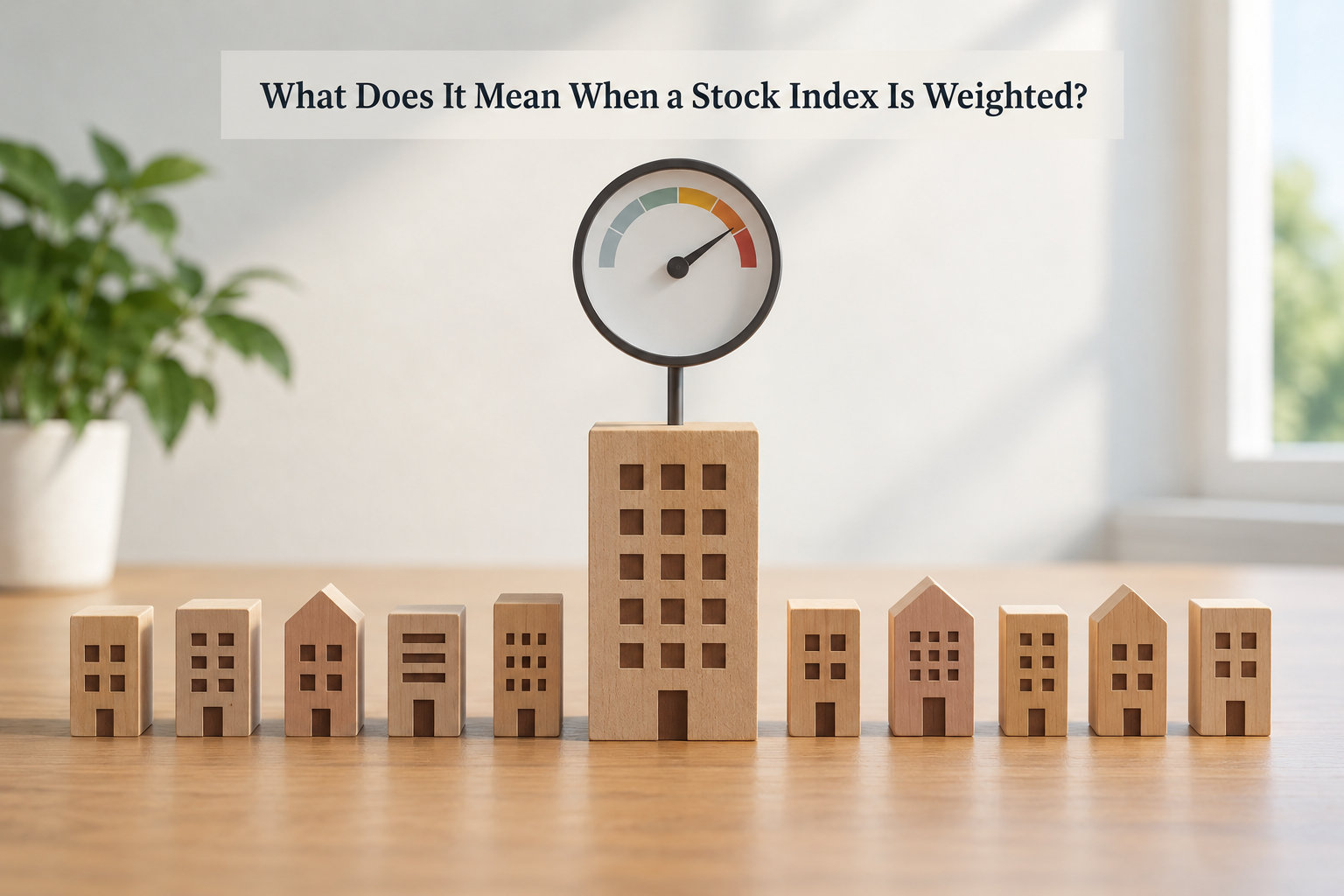
Weighting is the answer to a simple question: when a company moves, how much does the index move with it?
A stock index is a basket of companies with a number attached to it. The number, called the index level, is a weighted average of the prices of everything in the basket. The weighting scheme is the rule that says how much each price counts.
Think of a group photo where everyone stands on a scale and the total is read out. One person might be a 60 kilogram adult and another a 12 kilogram child. If both count equally, the average tells you very little about the group. Index weighting is the instruction about who counts for more.
The index level and the performance of the individual companies are different statements. An index can finish a day higher even when most of the stocks inside it finished lower, because the companies that fell might carry small weights while the few that rose carry large ones.
That is the part that catches people out. Plenty of investors have stared at a green index quote and an account that lost money, and the explanation is almost always weighting rather than a broken feed.
How Do Index Providers Decide Which Stocks Matter Most?
Index providers do not decide that one company matters more than another. They publish a methodology, and the weighting falls out of that methodology every day.
A provider such as S&P Dow Jones Indices, MSCI, FTSE Russell or Nasdaq applies written selection rules to choose constituents. The rules usually cover things like listing venue, market capitalisation, liquidity, trading history and profitability. An index committee reviews additions, deletions and sector representation on a set schedule, and that scheduled review is called a reconstitution.
A stock’s weight inside the index changes for exactly three kinds of reason. Its share price moves and takes its market value with it. The company issues or buys back shares, changing shares outstanding. Or the provider changes its own rules, for example by tightening a size or liquidity screen.
The first two happen every single trading day without anyone deciding anything. That is the self-rebalancing behaviour that surprises most new investors, and it is worth sitting with for a moment before moving on.
Why the weighting drifts toward winners without anyone buying
Imagine three companies in a small cap-weighted index, each worth 100. One of them rises 10 percent while the other two sit still. It is now worth 110, the total is 310, and its weight has moved from 33.3 percent to about 35.5 percent without a single trade.
Read that again carefully, because it is the whole argument. Nothing was bought and nothing was sold. The index now holds proportionally more of the company that went up, simply because that company is worth more.
What Are the Main Stock Index Weighting Methods?
Five schemes cover almost everything retail investors hold. Market-cap weighting uses total market value, price weighting uses the share price alone, equal weighting splits the index evenly, fundamental weighting uses financial figures such as revenue or book value, and float-adjusted weighting modifies market cap by excluding shares the public cannot easily trade.
| Weighting method | What drives the weight | What it tends to favour | Main trade-off |
|---|---|---|---|
| Market cap | Share price multiplied by shares outstanding | The largest companies, whatever sector they sit in | Concentration rises as a few names grow |
| Price | Share price only | High-priced shares regardless of company size | A share split changes the index unless the divisor is reset |
| Equal | Nothing. Every constituent gets the same slice | The average constituent rather than the biggest one | Higher turnover and more trading cost |
| Fundamental | Revenue, cash flow, dividends or book value | Cheap or productive companies on a fundamental measure | Figures are reported slowly, so the index reacts late |
| Factor | Rules on value, momentum, quality, size or volatility | One investment style at a time | Style tilts cut both ways and can lag for years |
Float adjustment is not really a separate scheme. It is a filter applied on top of market-cap weighting, and almost every mainstream cap-weighted index uses it. More on that below.
How a price-weighted index keeps its number comparable
Price-weighted indexes need one extra mechanism: the index divisor. The divisor is the number that converts the sum of the prices into the published index level.
Take the same three companies from earlier, trading at 45, 150 and 75. The sum is 270. With a divisor of 3 the index level is 90.
Now the middle company does a two-for-one split. Its price moves from 150 to 75, and the sum falls to 195. If the divisor stayed at 3 the index would print 65 and a pure bookkeeping event would look like a 28 percent crash.
So the divisor is recalculated: 195 divided by 90 equals 2.1667. With the new divisor the index still prints 90, and the split leaves no mark on the chart.
Cap-weighted indexes do not need this fix. A two-for-one split changes the share price and the share count by the same factor, so the market value of the company does not move at all.
How Does Market-Cap Weighting Work?
Market-cap weighting means each company’s influence is proportional to its market capitalisation, calculated as share price multiplied by shares outstanding.
Three companies make the point better than any definition. Company A trades at 45 a share with 20 billion shares outstanding, so its market cap is 900 billion. Company B trades at 150 with 2 billion shares, so its market cap is 300 billion. Company C trades at 75 with 4 billion shares, also 300 billion.
Total market value across the three is 1,500 billion. Company A carries 60 percent of the index, Company B carries 20 percent and Company C carries 20 percent.
Now run the same basket on a price-weighted basis. Total price is 270. Company A is 16.7 percent, Company B is 55.6 percent and Company C is 27.8 percent. The weighting flips almost completely, because the most valuable company is not the one with the highest share price.
Why providers use free float instead of the full share count
Using all shares outstanding can overstate how much of a company the public can actually buy. Founders, executives and early investors often hold large stakes that cannot be sold quickly.
Say a company has 10 billion shares outstanding but 3 billion of them sit with insiders and a locked-up venture capital stake. Full market cap counts all 10 billion. Float-adjusted market cap counts only the 7 billion that realistically float, which lowers that company’s weight and the index’s reliance on it.
This is why an S&P 500 weight is smaller than a naive calculation on shares outstanding would suggest, and why provider factsheets describe the scheme as float-adjusted rather than simply capitalisation weighted.
Is cap weighting just performance chasing?
This question comes up constantly on investing forums, usually from someone who worries that buying more of a company after it has risen is chasing performance. It is a fair worry that deserves a straight answer.
Cap weighting is the absence of discretion rather than the exercise of it. No manager is deciding that Amazon deserves a bigger position. The weight rises because the price rose, which is arithmetic rather than opinion. The mirror image matters just as much. When a company falls, its weight shrinks on its own and the fund’s exposure to it shrinks with it, with no sale required.
That is the part that answers the guilt people feel about holding a concentrated-looking portfolio. The concentration is self-correcting, and it corrects downward automatically when the big names fall.
What Is the Difference Between Cap-Weighted and Equal-Weighted Indexes?
Cap weighting lets company size decide influence while equal weighting gives every constituent the same slice, and the practical difference shows up in turnover, sector tilt and how much of the day is decided by a handful of stocks.
| Point of comparison | Market-cap weighted | Equal weighted |
|---|---|---|
| Influence of one stock | Proportional to market value | Identical for every constituent |
| Rebalancing | Continuous, automatic, no trades needed | Periodic, when the gap drifts too far |
| Sector exposure | Follows whichever sectors hold the biggest companies | Held much closer to the economy as a whole |
| Concentration | Rises as leading companies grow | Stays low by design |
| Turnover and cost | Very low, so running costs stay low | Higher, since laggards are sold and winners bought back up |
| Typical use | Core long-term holding for most investors | A deliberate tilt toward the average company |
Equal weighting is not free. Every rebalance means selling whatever has run ahead and buying whatever has fallen behind, and that turnover shows up in trading costs, in the expense ratio and, in a taxable account, in realised gains. That is the honest trade, and it is the main reason equal-weighted versions usually carry a slightly higher ongoing cost.
Neither approach promises better future returns. Equal weighting is a bet that the average company will catch up, not a rule that guarantees it, and it can lag for long stretches when a handful of mega-cap names carry the whole market higher.
Why Does Index Weighting Matter for Investors?
The weighting scheme is the difference between owning the market and owning the largest slice of it. It shapes concentration risk, sector exposure, trading costs and how closely a fund actually follows its benchmark.
Concentration is the first thing most people notice. When a handful of companies carry a large share of a cap-weighted index, their earnings season or a single news headline can move the whole benchmark. Newcomers read that as the index being fragile, when in practice it reflects how the market is currently valued.
Market breadth is the second thing. Breadth describes how many stocks are participating in a move rather than how heavy the biggest names are. A cap-weighted index can climb on the back of a handful of constituents while the majority of the index sits flat or falls, which is exactly the hollow rally people describe. An equal-weighted version of the same market will usually tell a different story.
Third, the fund you own does not perfectly mirror the headline index. Fund expenses, cash held for inflows and outflows, sampling when a fund holds a representative slice rather than every constituent, and trading around reconstitutions all nudge weights a little. That difference shows up as tracking error, and the fund factsheet reports it.
Fourth, weighting decides what you pay in costs. A cap-weighted index barely trades, so the fund runs cheaply. A weighting scheme that rebalances has to trade, and the bill arrives in the expense ratio and in your tax return.
How Do Investors Read an Index’s Weighting Method?
Read the methodology document rather than the marketing name. Every provider publishes one, and the weighting rule is stated in the first few paragraphs along with the rebalance schedule.
Where to find how stock indexes are weighted
The provider’s index factsheet is usually a one or two page document, and it carries the weighting method, the number of constituents, the top holdings and their weights, sector breakdown and rebalance dates. That single page answers most of the questions people email brokerages about.
From there, work through these six checks before you buy anything that tracks an index.
Identify the weighting basis. Look for the phrase market-cap weighted, float-adjusted market-cap weighted, equal weighted, price weighted or price return versus total return. Nasdaq’s headline composite and the Nasdaq-100 are cap weighted, which is a common point of confusion.
Check whether it is float adjusted. If the provider does not say, it is usually full market cap, and the weights will look larger than you might expect.
Find the rebalance schedule. Cap-weighted indexes drift continuously and rarely need a reset. Equal-weighted and many factor indexes rebalance on fixed dates, usually quarterly, and the date matters for turnover.
Separate price return from total return. A price return index excludes dividends, so it will always look worse than a total return index over a long window. Comparing one against the other is an apples-to-oranges error.
Compare the fund holdings to the index. Open the fund and look at its top ten positions and their weights. Differences from the index are usually small, but a large gap tells you the fund is sampling or has drifted.
Read the concentration numbers. Look at the top ten weight as a share of the fund. That single figure tells you more about your real exposure than the constituent count does.
Worked example. You are choosing between two broad funds and you assume they are interchangeable. Fund A tracks a float-adjusted cap-weighted index and its top ten holdings make up roughly a quarter of the fund. Fund B tracks an equal-weighted version of the same market, so its top ten are near a tenth of it. If your concern is that a handful of earnings reports should not decide your year, Fund B fits better and you now know exactly why, at a slightly higher running cost.
Frequently Asked Questions
Which indexes are price-weighted?
The Dow Jones Industrial Average is the main widely followed price-weighted equity index, and it is essentially the only one most investors encounter. A handful of price-weighted versions of the Nikkei and of gold and commodity baskets also exist, but they sit outside the mainstream. The widely traded Nasdaq composite and Nasdaq-100 are market-cap weighted, not price weighted, which trips up a lot of readers.
Is the Nasdaq a price-weighted index?
No. Both the Nasdaq composite and the Nasdaq-100 are market-cap weighted, so the weight of each company follows its size rather than its share price. Nasdaq publishes a few price-weighted constructs, but those are not the indexes retail investors hold. The confusion is understandable because the Dow is the price-weighted one people learn about first.
What is the difference between a price-weighted index and a market-cap weighted index?
A price-weighted index weights each company by its share price alone, so a 150 dollar share counts far more than a 45 dollar share regardless of how large either company is. A market-cap weighted index multiplies share price by shares outstanding, so influence tracks the total value of the company. That is why the price-weighted Dow can behave very differently from the cap-weighted S and P 500 in the same week.
How does S and P 500 weighting work?
The S and P 500 is float-adjusted market-cap weighted. Each constituent’s weight equals its float-adjusted market capitalisation divided by the total float-adjusted market capitalisation of all 500 companies. The weights are recalculated every trading day as prices and share counts move, and the index committee changes the membership at scheduled quarterly reviews. Individual weights are published in the provider factsheet.
Is cap weighting just performance chasing?
No, because no one is making the decision. A company’s weight rises when its share price rises, which is arithmetic rather than a judgement about future returns, and there is no trade to execute. The reverse also holds automatically: when a leading company falls, its weight shrinks without the fund selling anything. This is the single most common question on investing forums, and the answer is consistently the same.
What is the 7% rule in stocks?
The 7% rule is a retail take-profit and target-setting heuristic, not an index construction concept. It has no relationship to how an index is built or weighted. If you are deciding what to hold, the weighting scheme of your index matters far more than any fixed percentage rule, because it determines concentration, sector exposure and cost.
Conclusion: Start With the Methodology
Weighting is the rule that decides how much each company matters inside an index, and knowing which rule your index uses tells you most of what you need to know about your exposure.
Start with three things. Read the index methodology to confirm the weighting basis and the rebalance schedule. Look at the current concentration in the factsheet, especially the top ten weight. Then compare the fund’s actual holdings and running cost against the index it claims to track.
If a headline index quote and your own account disagree on the same day, the weighting scheme is the first explanation to check. Index rules, constituent lists and fund details all change over time, so treat what you have read here as a starting point rather than a reason to buy, sell or hold anything.