You can start investing with as little as one dollar. Open a brokerage account with no minimum deposit, buy fractional shares of a low-cost broad index fund, and set a small recurring transfer to run automatically from your bank. The amount changes almost nothing about how the money grows, because time does the work.
Last reviewed in October 2026. Everything below is general education, not personalised investment advice. Investing involves risk, including the loss of what you put in, and tax rules and account limits change, so check current figures with the IRS and your broker before you act.
Table of Contents
- What You Need to Start Investing with Little Money
- Step-by-Step
- 1. Set a Small, Specific Investing Goal
- 2. Choose the Right Account for Your Money
- 3. Pick a Simple, Diversified Investment
- 4. Invest an Amount You Can Genuinely Afford
- 5. Make Investing a Repeatable Habit
- Common Mistakes
- Frequently Asked Questions
- How much money do I need to start investing?
- Can I invest $10, $25, or another very small amount?
- What is the best account for a beginner investor?
- Should I wait for the market to go down before investing?
- Is investing a small amount of money risky?
- How can I automate investing when I have a limited budget?
What You Need to Start Investing with Little Money
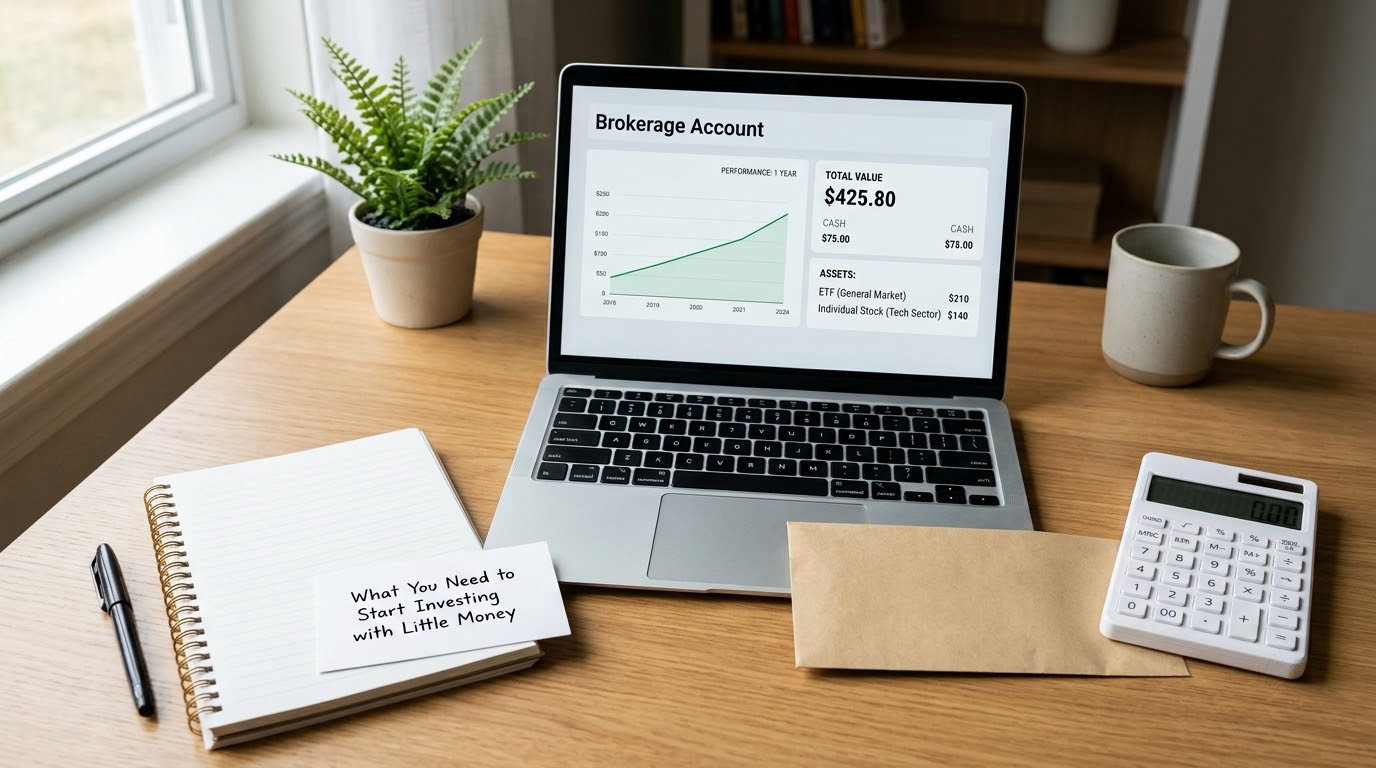
Very little, as it turns out. There is no minimum amount of money that unlocks investing any more. What you need is a short checklist, and each item on it is a reason not to rush.
A cushion for surprises sits at the top of the list. Mainstream guidance from the SEC and FINRA is three to six months of essential expenses in a savings account, and a smaller starter version is fine while you build it. Without that buffer, a flat tire becomes a credit card balance, and paying interest on debt is a certain loss while a market return is not certain at all.
Next, check whether you carry high-interest debt. Card rates often run into double digits, and paying one down is a return you keep rather than one you hope for. You do not have to clear every balance first, but money going to interest payments is money not compounding for you.
After that you need three things: a small amount of money you genuinely do not need soon, an account that suits the purpose, and a reason the money is being invested. The reason decides how long the money stays put, and how much a rough month in the market can unsettle you.
One last thing before you start: a working sense of fees. A percentage sounds trivial, and on a small balance it is not. On a 500 dollar balance growing for ten years, a fund charging 1.0% instead of 0.03% leaves you roughly 85 dollars short. On 5,000 dollars it is close to 850 dollars. The expense ratio is the one cost you control completely.
Step-by-Step
1. Set a Small, Specific Investing Goal
“I should invest more” is not a goal, because it tells you nothing about when to stop or what to buy. Write one sentence instead: retire, build a deposit for a flat, or grow a buffer that replaces three months of expenses. Specific goals change which account you open and how patient you can afford to be.
Then sort your money into two piles. The near pile covers the next two years — a car, a course, rent on a different place. The far pile is money you will not touch for a decade or more. Only the far pile gets invested, and this split is the fastest way beginners lose more than they should.
The time horizon also sets your risk tolerance honestly. Money you need in 2028 does not belong in a fund that might be down 30% in a bad year, because you would be forced to sell at the worst possible moment. Money untouched until 2045 has years of recovery time in front of it.
2. Choose the Right Account for Your Money
Choosing how to start investing with little money comes down to the wrapper, not the investment. Three options cover most people in the US: a taxable brokerage account, a traditional IRA, and a Roth IRA. Employer plans come first if you have access to one.
A taxable brokerage account has no contribution limit and no income limit, and you can withdraw whenever you like. Dividends and gains are taxed annually even if you do not sell. For someone who needs access to the money or has too much income for a Roth, it is the flexible default.
A traditional IRA deducts contributions from taxable income now and taxes withdrawals in retirement. A Roth IRA does the opposite: no deduction now, qualified withdrawals tax-free in retirement. Both have annual contribution limits that the IRS sets each year, around 7,000 dollars for someone under 50, with extra room for catch-up contributions later. A Roth also requires earned income, which matters if you are between jobs.
Here is the short version side by side.
| Account type | Minimum to open | Fractional shares | Tax treatment | Best for |
|---|---|---|---|---|
| Taxable brokerage | Often zero | Widely offered | Taxable dividends and gains each year | Flexible access, no income limit |
| Roth IRA | Often zero | Widely offered | Tax-free qualified withdrawals in retirement | Long horizons and lower taxes later |
| Traditional IRA | Often zero | Widely offered | Deduction now, taxed on withdrawal | Taxable income you want to reduce now |
| Employer 401(k) | Often zero | Varies by plan | Pre-tax or Roth depending on the plan | Capturing the full employer match |
| Micro-investing app | Often zero | Built in | Varies with the underlying account | Round-ups and spare change |
Brokers such as Fidelity, Schwab, Vanguard, Robinhood and Acorns all handle fractional shares, though the rules differ by account type and some retirement accounts restrict them. If your employer matches contributions, capture the full match before you put a single dollar anywhere else. It is an immediate return on your money that nothing else on this list comes close to.
Your cash is also protected depending on where it sits. SIPC covers brokerage accounts up to 500,000 dollars per customer if a broker fails, and FDIC covers bank deposits up to 250,000 dollars per depositor per bank. Neither protects you from market losses, and neither is a reason to pick a particular broker — it is simply what sits behind the account.
3. Pick a Simple, Diversified Investment
Yes, you can buy half a share. Fractional shares let your broker purchase a slice of one share on your behalf, so a share costing 40 dollars becomes investable with five dollars or even one. Most major brokers support them for individual shares and most ETFs, and recurring fractional purchases usually execute automatically on the scheduled date.
What you buy with that small amount matters more. A broad, low-cost index fund holds hundreds of companies at once, which is what diversification means in practice. An S&P 500 index fund, for example, tracks the 500 largest US companies, so buying one piece of it spreads a single amount across all of them.
An ETF, or exchange-traded fund, is a fund that trades like a single share during market hours. Many broad index funds are structured as ETFs, and for a small regular investment the two terms describe nearly the same thing.
Picking individual shares is not required to begin, and concentrating a small balance in one company puts the entire amount on an outcome you cannot control. A passive index fund does the opposite: it holds everything at once and charges a fraction of a percent for doing it. As your balance grows, rebalancing once or twice a year keeps the mix from drifting.
4. Invest an Amount You Can Genuinely Afford
Spend the surplus you actually have, not the surplus you wish you had. If your budget leaves 25 dollars a week after everything above, 25 dollars a week is the right number. A larger contribution you have to abandon in February teaches you nothing except that investing is stressful.
Do not fund an investment account with money you are using to cover a credit card bill in the same month. Interest you pay is a certain cost, and the market owes you nothing on the other side of that comparison.
Small contributions are easier to keep than large ones. Ten dollars a week is not a rounding error across thirty years, and it survives a bad quarter without you touching it.
5. Make Investing a Repeatable Habit
Dollar-cost averaging means adding the same amount on a schedule regardless of what markets are doing that week, which removes both the timing decision and most of the temptation to sell in a panic. Set the transfer for a day after your pay lands, then leave it alone.
Round-ups are a related trick: spend 14.30 dollars and the app invests the spare 70 cents. They add up and they feel almost effortless, though on their own they usually total less than a deliberate monthly transfer. Use them as a floor and add a real transfer on top.
Here is what a weekly contribution becomes at a 7% average annual return, before tax and fees. It is an illustration of compounding, not a prediction.
| Weekly amount | After 10 years | After 20 years | After 30 years |
|---|---|---|---|
| 10 dollars a week | About 7,200 dollars | About 21,300 dollars | About 49,100 dollars |
| 25 dollars a week | About 18,000 dollars | About 53,300 dollars | About 122,800 dollars |
| 50 dollars a week | About 35,900 dollars | About 106,600 dollars | About 245,600 dollars |
The gaps widen over time because growth comes mostly from the balance you have already built, not from the newest deposit. That is the argument for starting now with an amount that feels too small, and for raising it whenever your income rises.
People also ask the reverse question: how much would it take to live off investments? Earning 1,000 dollars a month sustainably needs roughly 300,000 dollars at a 4% average return, 200,000 dollars at 6%, and 171,000 dollars at 7%. In practice you would need more, because fixed withdrawals shrink as inflation rises and a real return below 7% is what most savers should plan around.
Working toward a larger target from the same habit, roughly 880 dollars a month invested for thirty years at 7% approaches 1,000,000 dollars before tax. Set a new contribution amount each time your pay goes up and let the schedule carry the remainder.
Common Mistakes
Investing the emergency fund. Money meant for a flat tire ends up in the market, then gets sold on the way to the mechanic. Keep the near pile in savings and invest the far pile.
Chasing whatever just went up. Putting a small balance into one hot share, a leveraged or inverse ETF, options, or crypto turns one modest mistake into the whole account. The argument that a fund or vehicle is “not for beginners” is usually correct.
Paying fees you did not notice. A 1% expense ratio looks harmless until you multiply it by the balance you hope to reach. Check the expense ratio first; the cheapest broad fund is nearly always the right beginner choice.
Ignoring taxes. In a taxable account, dividends and realised gains are taxed each year whether you sell or not. A Roth IRA keeps that tax out of the way for money you will not touch for years, which is the whole point of the account.
Checking the balance daily. Looking every day turns normal volatility into a feeling you will act on. Pick one review a quarter, ideally alongside a contribution increase.
Investing money you will need soon. A fund that drops 30% in a rough quarter is survivable over thirty years and painful over eighteen months. Short-horizon money belongs in savings.
A red flag worth naming. Anyone promising to turn 100 dollars into 1,000 dollars in a month is selling something, and no reliable method exists for it. Steady contributions and a low fee are the entire honest answer.
If you take one thing from this: automate a small transfer, put it in a broad low-cost index fund, and raise the amount every year your income rises.
Frequently Asked Questions
How much money do I need to start investing?
As little as one dollar at most major brokers, using fractional shares. Many no-minimum brokerages let you open an account free and buy a fraction of a share for a few dollars, with zero-commission trades. The practical minimum is whatever you can add regularly without touching your emergency savings or your ability to pay bills.
Can I invest $10, $25, or another very small amount?
Yes. Fractional shares let your broker buy a slice of one share, so a 10 or 25 dollar transfer buys a piece of an expensive fund instead of nothing. Put it into a low-cost broad index fund, set it to repeat weekly or monthly, and the amount matters far less than the number of years you keep it going.
What is the best account for a beginner investor?
Start with your employer 401(k) if one is offered and capture the full match. After that, a Roth IRA suits long-term money because qualified withdrawals are tax-free, while a taxable brokerage account suits money you may need sooner and anyone over the Roth income limit. Choose by purpose, not by headlines.
Should I wait for the market to go down before investing?
No. Timing the market reliably is not something most people can do, and waiting means missing the returns on the days the market rises. Money you plan to leave invested for years is generally better invested gradually now, through scheduled contributions, than held in cash in case of a dip.
Is investing a small amount of money risky?
Yes, every investment carries risk, including loss of principal, and a small balance does not reduce it. What a small balance changes is the damage, which is why starting early has an advantage: a 20 a week habit at 25 has decades of compounding, while the same habit at 45 does not. Keep only money you can leave alone.
How can I automate investing when I have a limited budget?
Set a recurring electronic transfer from your bank to the brokerage a day or two after payday, usually the minimum is around 5 or 25 dollars depending on the broker. Many brokers also offer round-ups that invest spare change automatically. Once the transfer exists, you can ignore it and raise the amount at your next pay rise.
Start by writing down the one sentence that says what the money is for, then open the account type that matches it. Pick a broad, low-cost index fund, turn on a small automatic transfer, and let it run. Everything beyond that is a matter of raising the amount as your life gets more expensive in the good way.