An emergency fund is cash you set aside for the bills you did not plan for, and you build one the same way whether your balance is zero or a few hundred dollars: work out what you actually spend each month, open a separate high-yield savings account, and automate a transfer on every payday. This guide shows how to build an emergency fund from scratch in seven steps, with real dollar targets and honest timelines.
The quick version, if you want to skip ahead:
- Target: $1,000 as your first win, then one month of essential expenses, then three to six months.
- Where it lives: a separate high-yield savings account you do not use for daily spending.
- How it grows: an automatic transfer on payday plus every windfall you can redirect.
- How long: at $150 a month, about 7 months to $1,000 and roughly 5 and a half years to $10,000.
Products, rates, and tax rules change, and this is general information rather than personal financial advice. Work from your own numbers.
Table of Contents
- What You Need
- Step-by-Step
- Step 1: Calculate Your Minimum Monthly Expenses to Start From Scratch
- Step 2: Open a Separate High-Yield Savings Account
- Step 3: Set a Small Starter Goal
- Step 4: Automate Contributions You Can Afford
- Step 5: Redirect Windfalls and Unused Budget Money
- Step 6: Build Toward One Full Month, Then Three to Six Months
- Step 7: Review and Adjust the Fund Regularly
- Common Mistakes
- Frequently Asked Questions
- What is the 3 6 9 rule for emergency fund?
- Is $10,000 enough for an emergency fund?
- What is the fastest way to build an emergency fund?
- Where should I keep my emergency fund?
- Should I pay off debt or build an emergency fund first?
- Can I build an emergency fund without a steady paycheck?
- Conclusion
What You Need
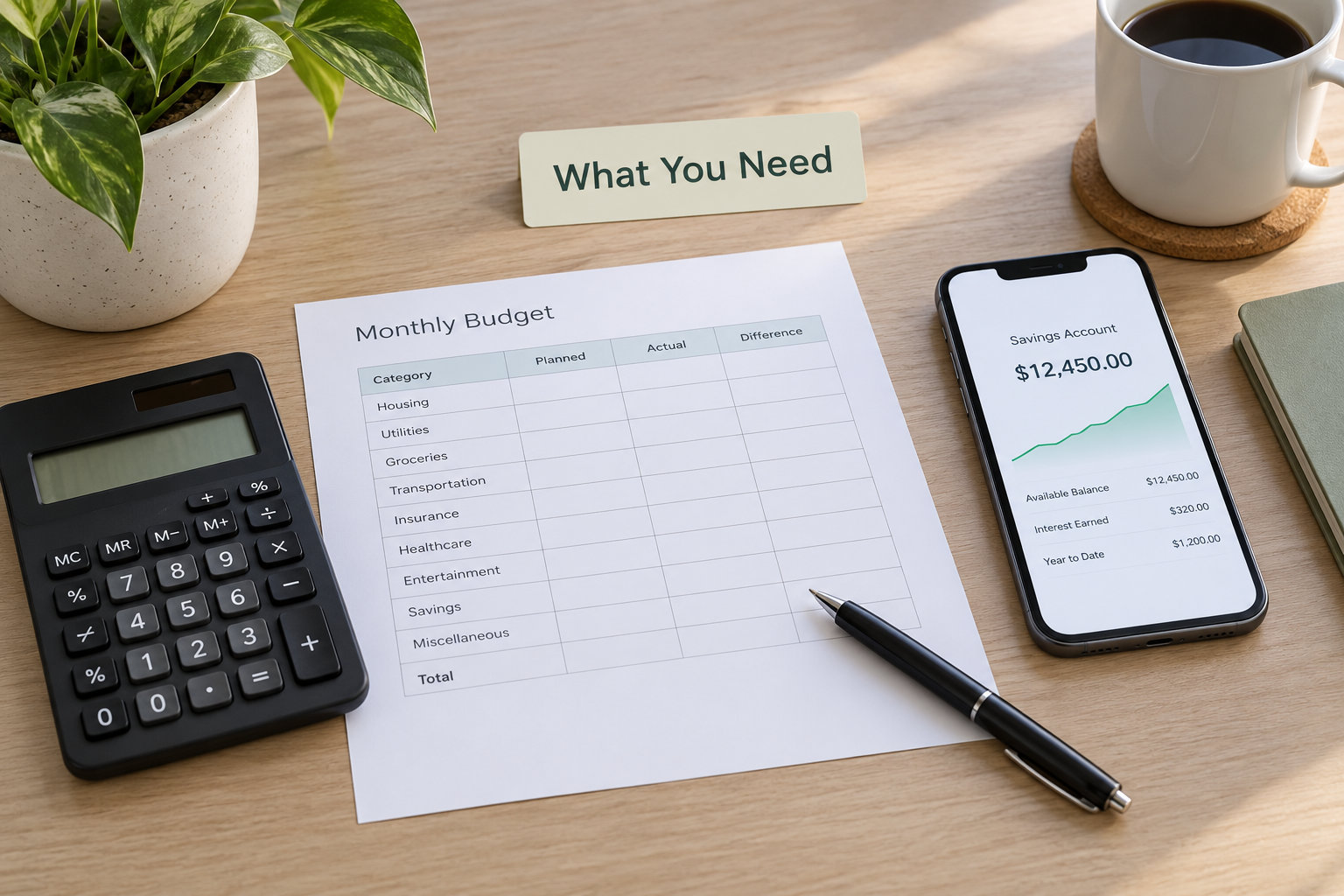
You need less than most people think: your spending history, your bills, and somewhere to put the money. Everything else is detail.
- Three months of spending records. Log into your bank and pull the last 90 days of transactions, or grab your last three statements. Three months smooths out the odd month where the car needed new tires and the same month your flight was cancelled.
- A list of essential monthly bills. Rent or mortgage, utilities, groceries, insurance, minimum debt payments, medications, child costs, transport. This is the number the whole plan hangs on.
- Your take-home pay. The amount that actually lands in your account, not your gross paycheck. That is the number your budget has to survive on.
- Your current balances. What is in checking, what is on credit cards, and what you owe. If a card balance is large, it changes the order you do things in.
- Photo ID and a bank relationship. Opening a savings account usually takes the same identification you used to open checking. If you have no relationship at all, see the fallback in Step 2.
Check that any savings account you open is insured by the FDIC or NCUA. Deposits are insured up to $250,000 per depositor, per insured bank, per ownership category, so spreading money across institutions protects more than piling it into one.
Step-by-Step
Step 1: Calculate Your Minimum Monthly Expenses to Start From Scratch
Divide your expenses into what you cannot avoid and what you can choose. Rent, groceries, utilities, insurance, medications, and minimum debt payments go in the first group. Dining out, subscriptions, and travel go in the second.
Add up only the first group. Round the number up to the next fifty dollars. That total is your “essential monthly expenses,” and it is the multiplier for every target that follows.
Here is a worked example. A household in a medium-cost city tracks these essentials each month:
| Essential expense | Monthly |
|---|---|
| Rent | $1,350 |
| Utilities | $180 |
| Groceries | $450 |
| Car insurance and fuel | $320 |
| Phone and internet | $110 |
| Health and prescriptions | $90 |
| Essential monthly expenses | $2,500 |
One month of essentials is $2,500. Three months is $7,500. Six months is $15,000. That is your entire plan expressed as multiplication, and no competitor-style article will hand you a better number for your household than this one.
If your last three months included something unusual, use the median month rather than the average. A single $1,400 car repair should not become your permanent baseline.
Step 2: Open a Separate High-Yield Savings Account
The account exists for one reason: to make the money slightly annoying to reach. Money sitting in the checking account you swipe a card against every day is money you will spend, and people who move a balance to its own account consistently report pulling from it less often.
When you compare high-yield savings accounts, look at these, in this order:
- Insurance. FDIC or NCUA coverage, and whether the bank is a member of an FDIC-backed pass-through network.
- Monthly and minimum balance fees. A fee for falling below a balance threshold quietly eats your interest.
- Posted APY. Rates move with the federal funds rate, so read the current number rather than a remembered one.
- Transfer speed. Same-day internal transfers beat three-day ones when you need the money at 4pm on a Friday.
- Access. Debit card, mobile check deposit, number of free withdrawals, and whether a human answers the phone.
Name the account something you will not want to raid. “Emergency Fund – Job Loss” does more work than “Savings 2,” and it costs nothing.
| Option | Access | Yield | Best use |
|---|---|---|---|
| Checking account | Instant, with a debit card | Near zero | One month of bills at most, for float and small surprises |
| High-yield savings account | Same day to a few days | Well above checking, tracks policy rates | The default home for a starter fund up to a full emergency fund |
| Money market account | Usually same day, may cap transfers or withdrawals per month | Competitive, often with a higher minimum | Larger balances where the withdrawal limits will not bite |
| Certificate of deposit | Locked until the term ends, early withdrawal penalties apply | Fixed for the term | Money you will not need, not an emergency fund |
This is the common recommendation: keep one month of bills in checking so a bad week does not trigger an overdraft, and put everything above that in a separate high-yield savings account. Ramsey-style advice points the same way, and adds that money market accounts work for the portion above about $10,000.
No bank relationship or a blemished credit history? Ask a local credit union about membership, which is often available to anyone in the surrounding area regardless of employer. Prepaid cards and starter accounts work as a holding spot, but check whether they deposit federal insurance before you park real money there.
Step 3: Set a Small Starter Goal
Start at $1,000, or one full month of essentials if that is smaller. Not three months. The first milestone exists so you can see the number move, because a person staring at $15,000 from zero tends to quit and a person staring at $1,000 tends not to.
This is the goal gradient effect doing real work. Progress accelerates as you get closer to a visible finish line, so put the finish line where you can actually reach it.
What $1,000 unlocks: most flat tires, most emergency room copays, a deposit to hold a car at a shop, the first emergency-room bill after insurance, and most appliance repair bills that would otherwise go on a card at 22% APR.
Step 4: Automate Contributions You Can Afford
Automation beats willpower because it removes the decision. Ask your bank to split your direct deposit, or set a recurring transfer for the day after payday. Ten days after you get paid feels completely different than ten days before.
Start with a number that will not hurt: 2% of take-home pay, $25, or whatever your last good month proved you can spare. Bump it later. A transfer that fails twice gets cancelled, and a cancelled transfer saves nothing.
Other low-effort accelerators:
- Round your card purchases up to the next dollar or five and sweep the difference weekly.
- Give raises and bonuses a split, such as half to the fund, half to spending.
- Set a low balance alert so you notice a missing transfer before it becomes a pattern.
- Pay yourself first on any irregular payment, before paying anyone else.
Step 5: Redirect Windfalls and Unused Budget Money
Windfalls are how most people skip a milestone, but they cannot be the plan. They are irregular by definition, so treat them as a bonus track running alongside your automatic transfer.
Where the money usually comes from:
- Tax refunds. If you get a refund, decide the split before you file, not after it lands.
- Bonuses, commissions, and overtime.
- Gifts and family support.
- Refunds and rebates from the state, your insurer, or a retailer.
- Freelance or side income. Send a fixed percentage the day the payment clears.
- Money you did not spend. Whatever you budgeted for a month and did not use goes to the fund before the budget resets.
Here is how long the monthly amount actually takes, ignoring interest, so you can plan in real months rather than vibes.
| Monthly amount | To reach $1,000 | To reach $10,000 |
|---|---|---|
| $50 | 20 months | 16 years 8 months |
| $100 | 10 months | 8 years 4 months |
| $200 | 5 months | 4 years 2 months |
| $300 | 4 months | 2 years 10 months |
Saving $10,000 in three months needs roughly $3,300 a month across every source. If that is not your situation, the honest route is a tax refund plus a raise in your automatic transfer plus four to six months of $200, which lands you there in about 27 months.
Step 6: Build Toward One Full Month, Then Three to Six Months
Once you pass $1,000, move to one full month of essential expenses. After that, the range widens because the right number depends on your specific risk.
- Income stability. A salaried job with tenure and a single income household points toward six months. Two incomes in the same household can sit lower.
- Job market for your field. A field with few openings for your skills should push you up the range, not down.
- Dependents. Anyone who depends on your income, including a parent without other support, raises the target.
- Fixed costs and deductibles. Rent near a quarter of your expenses and an insurance deductible you could not pay out of pocket both add weight.
Keep sinking funds separate from this money. A sinking fund covers a known future cost such as new tires, annual insurance, or school supplies. An emergency fund covers the genuinely unknown. Mixing them is how people end up with zero and a car repair.
Insurance is the other half of preparedness. Renters or homeowners cover on the big disasters, and a proper umbrella policy handles gaps. Your fund covers deductibles, uninsured losses, and everything policy does not touch.
Step 7: Review and Adjust the Fund Regularly
Put a recurring 20-minute calendar check on the first of each month and answer four questions: what is the balance, did the automated transfer run, did anything leak out, and does your expense number still hold.
Recalculate your essentials twice a year. Rent rose, a car payment ended, a second income disappeared. Your target should move with them rather than staying anchored to a number from last spring.
After a withdrawal, decide immediately whether it was a real emergency. If it was, replace it before you restart lifestyle spending, and start a simple rule for yourself: every future windfall goes to the fund until the balance is back where it was.
Common Mistakes
Choosing a target you cannot see progress toward. Aiming straight at $15,000 from zero feels like failure every month. Start at $1,000, claim it, then move up the ladder.
Keeping the fund in checking or merged with your other savings. Everyday spending reaches it first. Move it to its own account with its own name and its own alert.
Treating it as an investment. The fund is a safety rail, not a return-seeking asset. People who hold large funds and index portfolios together tend to hold their safe asset in cash specifically so a market drop does not force a sale at the worst moment.
Using it for planned purchases. A vacation, a down payment, a new laptop, and a concert are not emergencies. Fund them separately or wait, or you will restart from zero with a spending habit that caused the problem.
Relying on windfalls to do the work. One good refund will not build a fund. Automatic transfers do; windfalls shorten the timeline.
Paying off a high-rate card before you have any buffer. Here is the rule that resolves the argument most people have. Compare the APR on your worst debt against the yield on the fund. If the card charges around 20% or more, paying it off first beats holding cash, so pay the minimums on everything, skim a starter fund, then attack the balance. Once high-rate debt is gone, pause and build toward three to six months before investing heavily.
Dipping in every few months without a plan. Decide in advance what counts: job loss, a medical bill, a needed repair, a storm, an insurance deductible. Write it down. Everyone gets the occasional concert, and a rule you can bend is a rule that breaks.
Setting the transfer and forgetting it exists. Check the account monthly. Transfers fail after a card change or a bank merge more often than people expect.
Frequently Asked Questions
What is the 3 6 9 rule for emergency fund?
The 3-6-9 rule scales your target to income stability: three months of essential expenses for a stable salary, six for variable or commission income, and nine for freelance or self-employed work where income can vanish for long stretches. All three are measured on essentials only, never on your full spending, so the number stays smaller and more reachable than it looks.
Is $10,000 enough for an emergency fund?
It is a solid middle milestone, not a finish line. It covers most flat emergencies and car repairs in a lower-cost area, but it is thin in a high-rent city with dependents or an insurance deductible that eats it. Many people treat $1,000 as the first win, $10,000 as the point where investing becomes sensible, and three to six months of their own essentials as the real target.
What is the fastest way to build an emergency fund?
Three things work together: automate a transfer that lands right after payday, redirect every windfall such as refunds and bonuses, and cut expenses you did not budget for rather than squeezing an already-tight plan. At $200 a month you reach $1,000 in five months and $10,000 in a little over four years, before any interest. Raising the amount at each pay increase beats waiting for a bigger number to feel achievable.
Where should I keep my emergency fund?
In a separate high-yield savings account you do not use for daily spending. Compare FDIC or NCUA insurance, monthly fees, minimum balance thresholds, the current APY, transfer speed, and withdrawal access. Keep one month of bills in checking for float, put the rest in the high-yield account, and name it something like Emergency Fund so the label does the resisting for you.
Should I pay off debt or build an emergency fund first?
Compare the interest rate on your worst debt with the yield on your savings. At credit card rates of 20% or more, paying the balance off first wins, so keep minimum payments on everything and skim a small starter fund as protection, then attack the balance. Once high-rate debt is gone, save toward three to six months of essentials before investing more heavily.
Can I build an emergency fund without a steady paycheck?
Yes, by saving a percentage of every payment rather than a fixed amount from each paycheck. Freelancers and gig workers often send 10 to 20 percent of each invoice to savings the day it clears, then treat what remains as their paycheck. Buffer your essential expenses for the slow months up front, since irregular income means two or three months with little or nothing coming in.
Conclusion
Open your banking app tonight and pull 90 days of transactions. That single action gives you the one number the whole plan depends on: your essential monthly expenses.
Tomorrow, open a separate high-yield savings account and set a transfer for an amount you will not miss. Small and automatic beats large and heroic, because large and heroic usually lasts two months.
Put 30 minutes on your calendar for the first of next month to check the balance and adjust the transfer. Do the same the month after that. That is how you build an emergency fund from scratch without it feeling like building anything at all.