Choosing a high yield savings account comes down to six things: the annual percentage yield, the fees, the minimum balance requirements, deposit insurance through the FDIC or NCUA, how fast you can get your money out, and whether the account supports separate savings goals. Get those right and the choice is usually easy. This guide walks through how to choose a high yield savings account, step by step, in about half an hour.
Here is the short version. A high yield savings account pays a competitive rate on your balance, commonly in the 4% to 5% range, charges no monthly maintenance fee, and keeps your deposit insured up to 250,000 dollars per depositor, per insured bank, per ownership category. Banks that operate online can afford to pay more because they carry far lower overhead than a branch network.
The national average savings rate sits at roughly 1.62% APY, according to rate data compiled by Curinos LLC as of October 2, 2026. That gap is why people move money. But rates are variable, they change, and the highest headline number is rarely the whole story.
Table of Contents
- Key Factors to Evaluate
- What You Need
- 1. The goal for the money
- 2. The amount, and how it will get there
- 3. The current account’s actual rate
- 4. The rate and fee schedule for each candidate
- 5. The insurance status
- 6. Your access needs
- 7. Your tax bracket
- Step-by-Step: How to Choose a High Yield Savings Account
- Step 1: Name the job the money is doing
- Step 2: Work out the return you can actually use
- Step 3: Compare APYs on the same basis
- Step 4: Read the fees and the minimums, not just the headline
- Step 5: Verify the deposit insurance and count your ownership categories
- Step 6: Test the access before you commit
- Step 7: Read the Truth in Savings disclosure before you open
- Step 8: Set a review date and a transfer plan
- Common Mistakes
- Chasing only the headline APY
- Missing a promotional rate expiry
- Confusing a savings account with a checking account
- Ignoring withdrawal conditions
- Skipping the insurance check
- Opening once and never looking again
- Frequently Asked Questions
- What does APY mean on a savings account?
- How much interest would 1,000 dollars make in a savings account in one year?
- How much will I earn if I put 10,000 dollars in a high interest savings account?
- Are high yield savings account deposits insured?
- Do high yield savings account rates change?
- What is the downside of a high yield savings account?
- Conclusion
Key Factors to Evaluate
- Annual Percentage Yield (APY): Compare the posted rate at a realistic balance, and check whether it is variable, promotional, or tiered. APY already includes compounding, so it is the only number you need to compare.
- Fees: Look for zero monthly maintenance fees, no excess withdrawal fees, no out-of-network ATM charges, and no paper statement fee. A 5% rate means nothing if a 10 dollar monthly fee eats a small balance.
- Minimum Balance Requirements: Find the minimum opening deposit and the ongoing minimum daily or monthly balance. Some accounts waive fees only if you keep a threshold such as 10,000 dollars, which makes them poor fits for emergency funds.
- Safety and Security: Confirm the institution is a member of the FDIC (banks and savings banks) or the NCUA (credit unions), and that coverage is at least 250,000 dollars per depositor, per bank, per ownership category.
- Accessibility and Transfers: Check transfer speed to and from your checking account, whether internal transfers are instant, how long a mobile check deposit holds funds, and whether a physical debit card or ATM access is included.
- Organizational Features: Sub-accounts or goal buckets, automatic scheduled transfers, a usable mobile app, two-factor authentication, and real human support on the phone are the features savers actually use.
What You Need
Before you open five browser tabs and start reading rate tables, gather seven things. Ten focused minutes now saves an afternoon of back-and-forth later.
1. The goal for the money
Write down what the balance is for and when you might need it. An emergency fund, a down payment eighteen months out, and a wedding fund next summer are three different jobs, and they point at different account types.
Money you could need within a week lives somewhere liquid. Money you will not touch for three years can afford a certificate of deposit with an early withdrawal penalty. Fixing the goal first stops you comparing accounts on criteria that do not matter.
2. The amount, and how it will get there
Know the deposit amount and how you will fund it: an internal transfer, an ACH transfer from another bank, a wire, or a direct deposit. If the money is sitting at a different institution, transfer speed becomes a real criterion rather than a footnote.
3. The current account’s actual rate
Find your existing account’s APY, its monthly fee, and its minimum. Most people do not know the number, and the gap between it and a competitive rate is the entire reason to switch. A 0.40% account paying 5 dollars a year on 1,000 dollars is the baseline you are trying to beat.
4. The rate and fee schedule for each candidate
Every bank publishes a rate and fee schedule, often on the same page as the Truth in Savings disclosure. That document tells you the APY, the variable rate, any promotional period, the minimum opening deposit, the minimum balance, and every fee that can apply. Collect it for each bank you are considering before you compare anything.
5. The insurance status
Look up the institution in the FDIC’s BankFind or the NCUA’s credit union locator. Deposit insurance is the reason a savings account is low risk, so this check takes two minutes and is not optional if you hold more than 250,000 dollars.
6. Your access needs
Decide how you will actually reach the money. Do you need a debit card for purchases, cash at an ATM, instant transfers to checking, mobile check deposit for paper checks, or scheduled automatic transfers to build the balance? Write down the two or three that matter. Anything you do not need, ignore.
7. Your tax bracket
Interest is ordinary taxable income, and the bank reports it on a Form 1099-INT in January. A saver in a 24% bracket pays tax on the interest even though it never left the account. Knowing your bracket tells you whether to leave the gain in the account or move it into a tax-advantaged space.
One more item: the date you last shopped. Rate moves on savings accounts are not a surprise, and re-checking twice a year is normal practice.
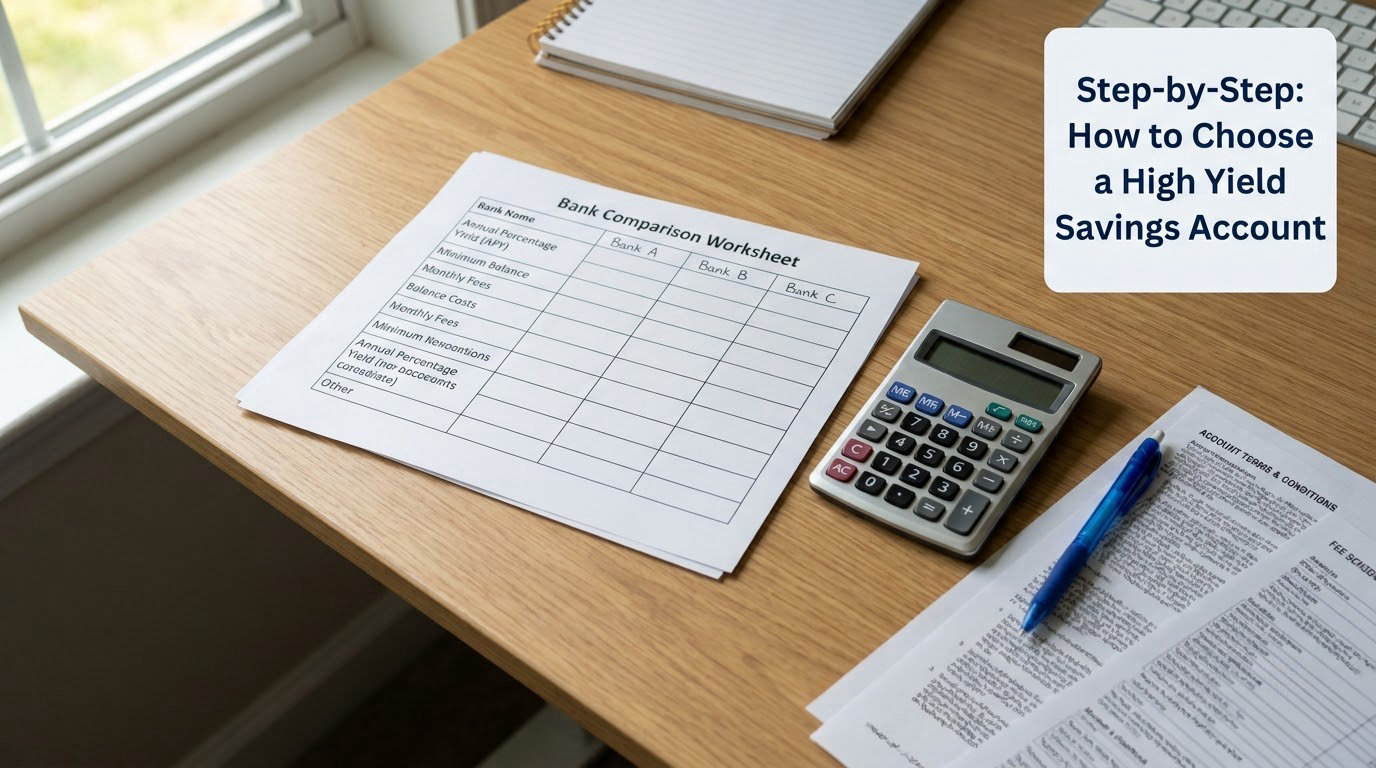
Step-by-Step: How to Choose a High Yield Savings Account
Step 1: Name the job the money is doing
Write one sentence: this money covers my emergency fund for six months, or this money is a house deposit due in March. That sentence sets your access requirement before any rate does.
Most savers split their cash into two or three jobs. An emergency fund wants immediate access and no withdrawal penalty. A goal fund a year out wants the best rate it can get without locking the money up. Keeping both in one account makes it harder to resist dipping into the emergency money for a goal expense.
Step 2: Work out the return you can actually use
Do not compare a rate on paper. Compare it on the balance you will actually hold, for the period you will actually hold it.
A 5.00% APY on 2,000 dollars earns 100 dollars in the first year, before tax. Whether that is worth switching banks for is your call, and the honest answer is usually no. The same 5.00% APY on 40,000 dollars earns 2,000 dollars, which is worth an afternoon of paperwork.
This is the single most useful step, and the one most comparison articles skip. A rate is only a percentage until you attach an amount.
Step 3: Compare APYs on the same basis
APY is the annual percentage yield, the effective return after compounding. A bank quoting 4.80% with daily compounding and one quoting 4.80% with monthly compounding land in nearly the same place, which is exactly why APY exists. Compare APY to APY and nothing else.
Here is what the same balance earns in one year at four different rates. Figures are illustrative, before tax, and rates are variable.
| Balance | At 0.50% APY | At 1.62% APY | At 4.00% APY | At 5.00% APY |
|---|---|---|---|---|
| 1,000 dollars | 5 dollars | 16 dollars | 40 dollars | 50 dollars |
| 10,000 dollars | 50 dollars | 162 dollars | 400 dollars | 500 dollars |
| 100,000 dollars | 500 dollars | 1,620 dollars | 4,000 dollars | 5,000 dollars |
The 1.62% column is the national average. On 100,000 dollars, moving from the average to 4.00% is a difference of 2,380 dollars in one year. On 1,000 dollars the same move is 24 dollars. This table is why the amount you deposit drives the whole decision.
One more check on the same basis: is the rate variable or fixed? A variable rate moves with the federal funds rate, which the Federal Reserve adjusts as conditions change. High yield savings rates across the industry rise and fall together, usually with a lag of weeks. A fixed or promotional rate holds for a stated period and then resets to the standard rate, often much lower.
Step 4: Read the fees and the minimums, not just the headline
The rate is one line in the rate and fee schedule. The lines that cost you money are usually further down.
- Monthly maintenance fee: Look for zero. Some banks charge 5 to 12 dollars a month, which on a small balance can wipe out the interest.
- Minimum opening deposit: The amount needed to open, which may be as low as 1 dollar or as high as 25,000 dollars.
- Minimum daily balance: The ongoing balance you must keep to avoid a fee. Waived entirely at many online banks.
- Tiered APY: The rate steps up only if you cross a balance threshold, such as 2.00% below 10,000 dollars and 4.00% above it. The advertised rate is the top tier and rarely yours.
- Promotional rate: A teaser APY valid for a stated number of months. Savers on r/personalfinance treat this as the main trap, and they are right. A 5.00% headline that drops to 0.50% in seven months is a worse deal than a flat 4.00%.
- Excess withdrawal fee: Some accounts still charge a per-transaction fee after a certain number of withdrawals, or if your balance falls below a threshold.
How to choose a high yield savings account really comes down to this step. Two accounts quoting 4.75% can behave very differently once you see that one requires a 25,000 dollar minimum and the other requires 1 dollar.
Step 5: Verify the deposit insurance and count your ownership categories
The FDIC insures bank and savings bank deposits. The NCUA insures credit union deposits. Both cover 250,000 dollars per depositor, per insured institution, per ownership category.
That third phrase does the work. Single accounts held alone count as one category. Joint accounts count as one category shared by both owners. Retirement accounts, trust accounts, and certain employee benefit accounts each count separately under their own rules. Money in a brokerage cash-management sweep is also treated separately from your bank deposits, which is useful for balances above the limit.
If your total is under 250,000 dollars at one bank, the arithmetic is simple and you are covered. If it is above, the way you spread the money across ownership categories, or across two separate banks, determines what is actually insured. The FDIC publishes a coverage calculator for exactly this.
Nobody can lose a deposit balance to market losses the way they can in investments. The risks here are fraud and identity theft, which is why two-factor authentication, a real fraud team, and a working customer service number belong on your criteria list.
Step 6: Test the access before you commit
Open the account with a small amount first if you can, and try a transfer out. Time it. That one test answers most access questions faster than any feature list.
Ask these five questions, and the answers are all usually published somewhere on the bank’s site:
- How fast is an ACH transfer to an outside bank? Two or three business days is common for outbound ACH, while an internal transfer between your own accounts is usually instant.
- How long do funds from a mobile check deposit or an inbound ACH stay unavailable? Holds of several days are standard and legal.
- Is there a debit card, and can it be used at other institutions’ ATMs, and for what fee?
- Does the app support scheduled automatic transfers, sub-accounts or goal buckets, and real-time balance updates?
- Can you reach a human on the phone, and what hours?
The most common complaint from savers is not the rate, it is moving money between a savings account at one bank and a checking account at another. If your checking is elsewhere, prioritize internal transfer speed and reasonable ACH timing, or open the account at the bank you already use.
On the six-withdrawal rule: federal regulators removed the requirement that savings accounts limit convenient withdrawals to six per month back in 2020, and most banks no longer enforce one. Individual banks can still impose their own limits, so the Truth in Savings disclosure is where you confirm it. Some accounts will convert to checking status if you repeatedly overdraw, which the disclosure also explains.
Step 7: Read the Truth in Savings disclosure before you open
This document is required, standardized, and the single most useful page on any bank’s site. It usually sits in the disclosures section at the bottom of the account page.
Look for these lines:
- Account type: Does it say savings, and is it a demand deposit account?
- Annual percentage yield: The current APY, and whether it is variable or fixed.
- Interest and compounding: How often interest is credited and compounded, and on what basis.
- Minimum balance and fees: The exact thresholds, and how the maintenance fee is calculated.
- Transaction limits: Any limit on transfers or withdrawals per statement cycle.
- Coverage: FDIC or NCUA membership, and the insurance language.
- Balance method: The method used to calculate interest on your account.
Also read the rate and fee schedule rather than the marketing page. Marketing pages show the best rate a customer can get. Schedules show the rate for your balance, which is the number you will actually earn.
Step 8: Set a review date and a transfer plan
When you open the account, decide when you will look again. Rates move, and a rate you accepted in January can be well off the market by September. Twice a year is a reasonable cadence, and moving an existing balance at a higher posted rate usually takes under an hour.
Check your interest credit and any 1099-INT at tax time. Savings interest above 10 dollars in a year gets reported to the IRS, so make sure your address with the bank is current.
Common Mistakes
Almost every wrong choice in this category traces back to one of six mistakes. Each has a simple correction.
Chasing only the headline APY
The advertised rate is frequently the rate for the largest tier, the biggest balance, or the first twelve months. The correction is to read the tier structure in the rate and fee schedule and find the row that matches your actual balance. Compare that row across banks, not the marketing headline.
Missing a promotional rate expiry
Teaser rates are the single most common regret in personal finance forums. The account advertises an attractive rate, it looks good for eleven months, and then it resets to a standard rate well below the market. The correction is to find the expiration date in the schedule and treat that standard rate as the real rate when you compare.
Confusing a savings account with a checking account
High yield checking accounts exist, and they often pay competitive interest while adding a debit card, bill pay, and no-fee ATM access. They are a different product with a different regulatory classification. A checking account is built for spending; a savings account is built for growth. The correction is to pick one job per account, which is also what lets the emergency fund stay untouched.
Ignoring withdrawal conditions
Some accounts advertise unlimited transfers, while others restrict convenience withdrawals per cycle or convert to checking if you go negative. The correction is to read the transaction limits line in the disclosure before you depend on the account for an emergency.
Skipping the insurance check
Every legitimate account at a US bank or credit union is insured. The failure is assuming rather than verifying, especially with a new institution or a fintech. The correction is two minutes in the FDIC’s BankFind Suite or the NCUA’s locator, and if you cannot confirm membership, do not deposit.
Opening once and never looking again
Savings rates are set in response to the federal funds rate, and they fall when that rate falls. An account chosen two years ago at 4.60% may now be well below the market. The correction is a calendar reminder, twice a year, to check the current rate and your bank’s rate.
One more worth naming: trying to outsmart the rate with a web of accounts. A savings calculator is a useful sanity check, not a strategy, and the tax treatment does not get friendlier with more accounts.
Frequently Asked Questions
What does APY mean on a savings account?
APY stands for annual percentage yield. It is the effective yearly return on your balance after compounding is included, which is why it is higher than the headline interest rate a bank quotes. Because every APY already accounts for how often interest compounds, it is the only rate figure you need when comparing accounts. A 4.00% APY means about 40 dollars on 1,000 dollars over a year.
How much interest would 1,000 dollars make in a savings account in one year?
Multiply the balance by the APY for a simple first-year estimate. At 1.62% APY, 1,000 dollars earns about 16 dollars. At 4.00% it earns about 40 dollars, and at 5.00% about 50 dollars. The exact figure shifts with daily compounding and the number of days in the year, and interest is taxable ordinary income reported on a Form 1099-INT.
How much will I earn if I put 10,000 dollars in a high interest savings account?
On 10,000 dollars, a 1.62% national average APY produces roughly 162 dollars in the first year, 4.00% produces about 400 dollars, and 5.00% produces about 500 dollars. That is before federal and state income tax on the interest. Rates are variable, so the APY you are offered today may be different by the end of the year.
Are high yield savings account deposits insured?
Yes, when the institution is a member of the FDIC for banks or the NCUA for credit unions. Coverage is 250,000 dollars per depositor, per insured bank, per ownership category, so single, joint, retirement, and trust balances each count under their own rules. Verify membership yourself in the FDIC BankFind Suite or the NCUA locator before depositing.
Do high yield savings account rates change?
They do. Most high yield savings accounts carry a variable APY that moves with the federal funds rate set by the Federal Reserve, usually with a lag of weeks. Some accounts offer a fixed or promotional rate for a stated period, then reset to the standard rate. Check the rate and fee schedule for the rate change terms, and review your rate twice a year.
What is the downside of a high yield savings account?
The main downsides are that the APY is variable and can fall, a promotional rate eventually expires, the interest is taxable, and money held in savings typically returns less over long periods than invested assets. Access can also be slower when your checking account is at a different bank. These are trade-offs, not losses, because the deposit itself remains insured.
Conclusion
Start tonight with the one number you have been avoiding: the APY on your current savings account. Write it next to the best rate you can find today, run both through the same math on your actual balance, and the decision usually makes itself. If the difference is not worth an hour of work, keep your money where it is and check again in six months.
These figures are illustrative rates as of October 2, 2026 and change with Federal Reserve policy. Savings interest is taxable and may be reported on a Form 1099-INT. This article is general information, not individual financial advice, and account terms vary by institution and state.