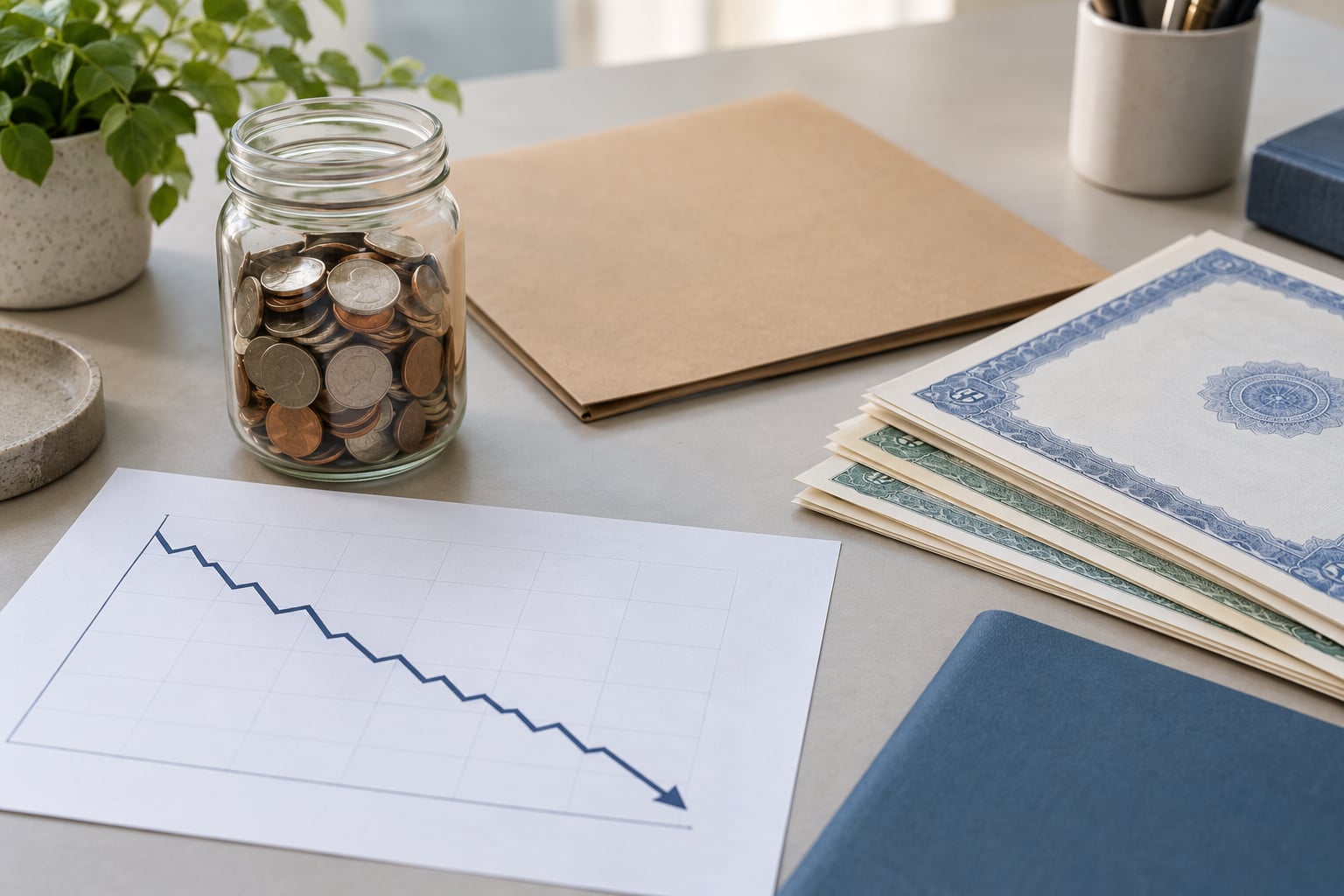
When the Federal Reserve cuts the federal funds rate, savings rates usually fall with it, but not one for one and not on the same day. The Federal Open Market Committee’s decision changes what banks earn on reserve balances, and high-yield savings accounts follow within weeks at online banks, within months at many credit unions and branch banks, and not at all on a certificate of deposit you opened before the cut. Here is the mechanism, the timing and the dollar impact.
Rates as of October 2026: the federal funds target range has sat at 3.75% to 4.00% since the Fed’s September 2026 increase, the first hike since 2023. For comparison, the FDIC’s national average savings rate was about 0.38% as of September 2025, while DepositAccounts.com’s tracker had the top high-yield savings account near 4.6% and 12-month CDs above 4%. Rates move constantly, so check the current figure before you act on anything below.
Table of Contents
- What Happens to Savings Rates When the Fed Cuts Rates?
- How the Fed Rate Affects Different Parts of Your Savings
- How a Fed rate decision reaches your APY in four steps
- Why Savings Rates May Fall Faster—or More Slowly
- What Happens to HYSA and CD Rates During a Rate-Cutting Cycle?
- Do Treasury Bonds Always Pay More When the Fed Cuts?
- What Happens to Interest on Existing Accounts?
- How Long Does It Take for Rates to Reach Savers?
- What to Do When the Fed Cuts Rates and Your Savings Rates Fall
- Frequently Asked Questions
- Will my savings account interest rate drop immediately when the Fed cuts rates?
- Is a money market account the same as a Federal Reserve money market fund?
- Should I lock money in a CD before the Fed cuts rates?
- Do existing Treasury bond holders lose money when the Fed cuts rates?
- How can I compare savings accounts fairly before rates change?
- Key Takeaway for Savers
What Happens to Savings Rates When the Fed Cuts Rates?
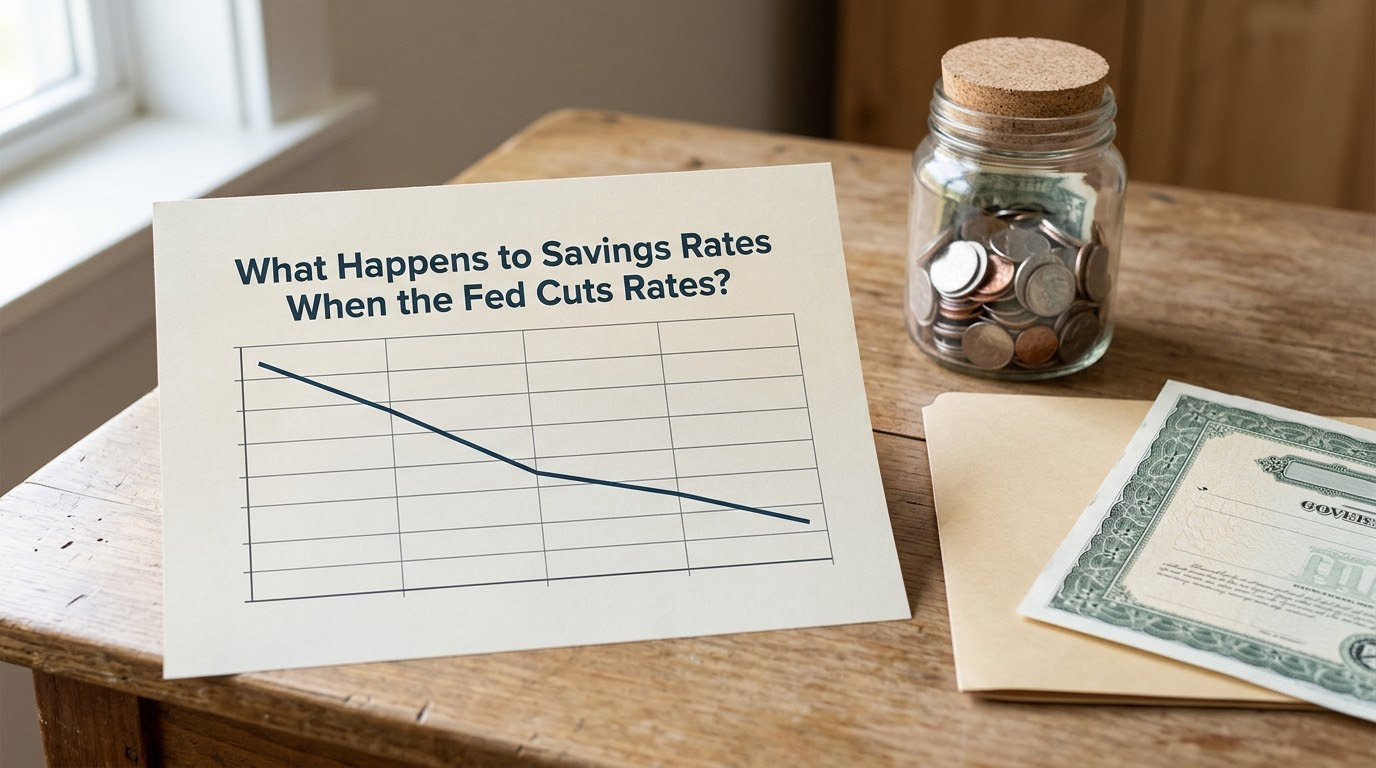
A cut lowers the price banks pay each other for overnight money, which lowers the floor on what a bank can earn while holding your deposits. Most of that saving gets competed away and shows up as a lower annual percentage yield on your account, usually within weeks. The size of the drop is set by competition rather than by the Fed, so a quarter-point cut can produce a half-point drop at one bank and no change at another.
Two things never happen automatically. Your rate is not reset the day of the announcement, and a cut does not reach money already locked in a certificate of deposit until that certificate matures. If you are wondering what happens to savings rates when the Fed cuts rates, the short version is: your APY drifts down, at a pace nobody publishes in advance.
How the Fed Rate Affects Different Parts of Your Savings
Most confusion comes from treating every yield as the same number. A bank savings account, a bank money market account, a brokerage money market fund and a 10-year Treasury note all react to Fed policy differently, because each has a different owner setting the price.
| Account or security | What sets its yield | Usual response to a Fed cut |
|---|---|---|
| High-yield savings account | The bank, using its cost of funds as a floor | Falls within days to weeks at online banks, months at branch banks |
| Bank money market account | The bank, same mechanism as savings | Falls, usually on the same schedule as that bank’s savings account |
| Brokerage money market fund | The short-term paper the fund holds | Falls within days, often faster than a bank account |
| Certificate of deposit | The rate fixed when you opened it | No change until maturity, then a new rate at renewal |
| Treasury bill | Market demand for short-term government debt | Yields usually drift lower as investors expect more cuts |
| Treasury note or bond | Longer-run inflation and growth expectations | Price usually rises as yields fall, but not always |
| Brokerage cash sweep | The balance in the account above it | Can change daily and is separate from your brokerage’s policy |
How a Fed rate decision reaches your APY in four steps
Nobody announces your new rate, so it helps to see the chain. Each link takes a little time and each is set by someone other than the Fed.
1. The FOMC moves the target range. The Fed sets the range that banks charge each other overnight, and it can move in quarter-point steps or, in stress, larger ones.
2. The Fed moves interest on reserve balances. This is the rate the Fed pays banks for reserves they park at the central bank, and it is the anchor most deposit pricing hangs from.
3. Banks reprice their funding cost. A bank that gathers deposits has to pay enough to keep those deposits from leaving. Cheaper overnight money lowers that price, so the bank has room to pay savers less.
4. Banks cut advertised APYs. Most savings accounts are variable rate, meaning the bank can change the rate at any time under the account terms. That is where you see it.
Why Savings Rates May Fall Faster—or More Slowly
Pass-through is asymmetric, and that is the part almost every explanation gets wrong. When rates rise, deposit APYs tend to climb quickly but stop short of the Fed move. When rates fall, deposit APYs tend to fall faster than the Fed cut. Online banks pass most of the change through because they compete on rate, while large banks keep more of the difference as margin.
There is a second reason for the asymmetry: nobody notices a rate that stays put. A bank that holds steady loses no customers in the short term, so it has no reason to cut first. Once competitors move, though, the bank that follows late usually has to cut more than the market did.
| What is driving the change | Effect on your savings rate |
|---|---|
| Bank funding costs fall after a Fed cut | APY falls, usually on the bank’s own schedule |
| Rivals cut rates and you notice | Pressure builds to switch, and your bank may follow without a Fed move |
| Depositors leave for higher yields elsewhere | The bank raises rates to stop the outflow, even if the Fed did nothing |
| The spread gets squeezed on loans | APY can be trimmed to protect the bank’s margin |
| Inflation expectations fall | Longer rates fall, pulling down CD and Treasury pricing |
| The cut signals weakening demand | Often the reason rates were cut, which is a separate story from your APY |
That last row matters. A cut is usually a response to softer activity, which means the Fed expects growth or employment to slow. Savers sometimes read a cut as neutral news because they assume the economy is strong. The APY on your account is the direct effect; the economic backdrop is the reason, and they can pull in different directions.
Regulators also matter. Deposit insurance assessments, liquidity requirements and capital rules all sit in the cost stack, so a bank cutting for regulatory reasons can move independently of the Fed for several quarters.
What Happens to HYSA and CD Rates During a Rate-Cutting Cycle?
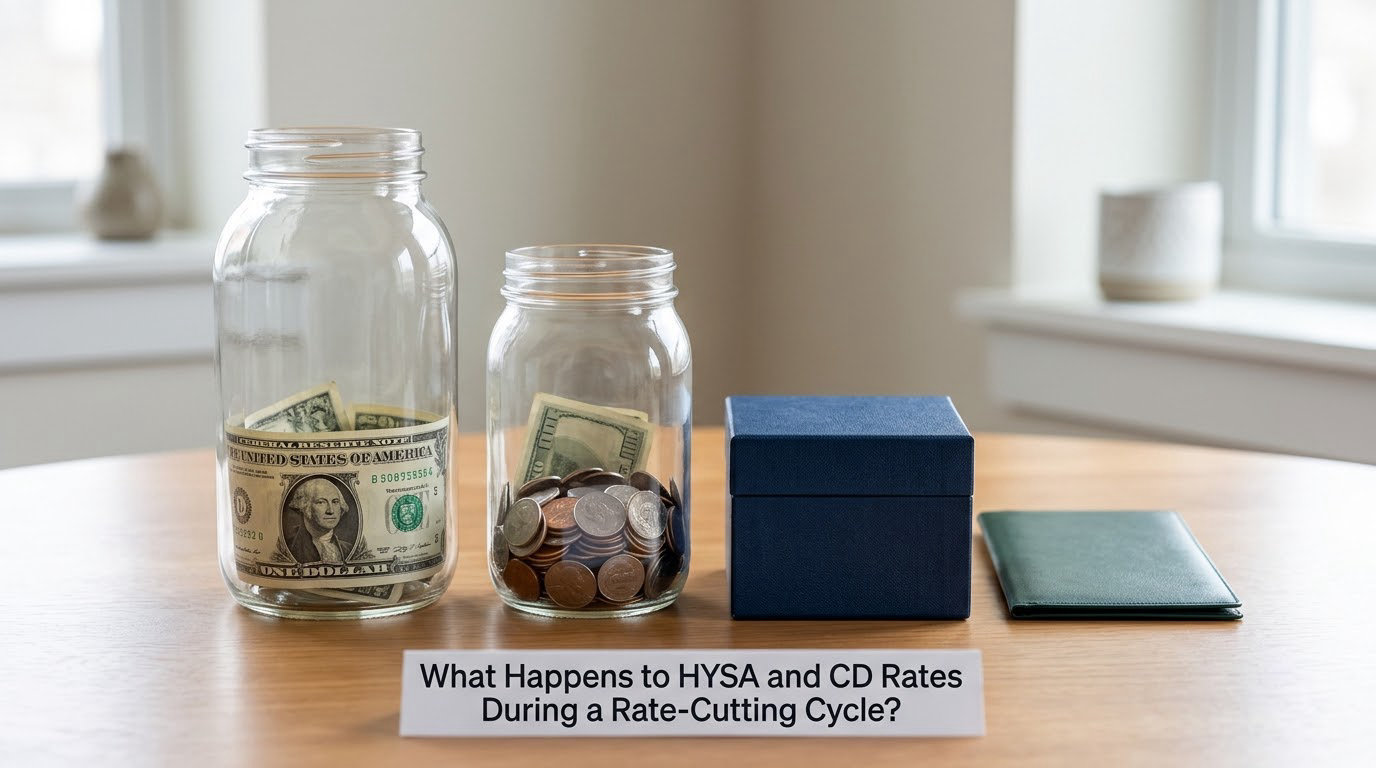
A high-yield savings account is the piece that moves fastest, because its rate is variable and its pricing is public. A certificate of deposit is the piece that moves slowest, because nothing can change until maturity. In between sit bank money market accounts and short-term Treasuries, which reprice on their own schedules.
Compare annual percentage yield rather than the headline rate. The advertised number on a savings account may be a promotional rate that reverts to a much lower standard rate after a set number of months, and only the APY tells you what you will actually keep for the year.
Introductory CD rates are also not renewal rates. The rate you lock in today is unaffected by any Fed move, but when that certificate matures, the bank prices the new term against where rates are then. In a cutting cycle that usually means a lower renewal rate, which is the trade-off you accepted for the lock-in.
A CD ladder spreads the risk of that renewal date. Instead of putting a balance into one 12-month certificate, split it across 3-month, 6-month and 12-month rungs. Each rung matures at a different point, so you always have part of the money free to move into whatever rates exist when it comes due.
The FDIC insures deposits up to 250,000 US dollars per depositor, per insured bank, per ownership category, and NCUA insurance does the same job at federally insured credit unions. If a balance sits above that line, splitting it across separate banks keeps every portion inside coverage.
Do Treasury Bonds Always Pay More When the Fed Cuts?
No, and the reason is that price and yield move in opposite directions. When a bond pays more than the market wants, its price falls until the yield matches demand, and when the Fed cuts and buyers push into longer bonds, the price rises and the yield falls. Existing coupon payments do not change. A bond bought at 4% keeps paying 4% until it matures or is sold.
New money is where the question matters. A yield curve is not one number, so a cut at the short end does not guarantee that the 5-year, 10-year or 30-year yield drops with it. Longer yields follow expected future rates, and if markets already priced in the cuts, little changes on the day of the announcement.
For an individual investor buying bonds to hold, a rate cut cycle is a decent environment. The danger is selling a long bond after yields fall, because the lower yield is baked into the price you recover. Holding to maturity removes that risk, at the cost of locking cash up.
What Happens to Interest on Existing Accounts?
Most savings and money market accounts are variable rate, so the bank can change the APY at any time, subject to the account terms. The posted rate is not a promise for the life of the balance. Banks often review deposit pricing on a monthly or quarterly cycle, which is why the visible change tends to land in clusters rather than immediately after an FOMC meeting.
Check the account agreement for two things: how often the rate can change, and whether any notice is required. A promotional rate has its own end date that has nothing to do with the Fed, and it can expire whether rates are falling or rising.
Brokerage accounts add a wrinkle. A brokerage money market fund reprices daily with the paper it holds, and an uninvested cash balance may earn nothing at all unless it sits in a sweep arrangement. That is worth checking before you assume a brokerage account is earning something.
The same distinction applies to savings calculators and rate tables: they project at a fixed APY, so the projection is only as good as the rate you plug in. Savers who model a high-yield account at today’s advertised rate usually overstate the next full year.
How Long Does It Take for Rates to Reach Savers?
| Account type | Typical time to reflect a Fed cut | Why |
|---|---|---|
| Online bank high-yield savings | Days to a few weeks | Rate shopping happens daily and pricing is public |
| Brokerage money market fund | One to a few business days | Yield is set by the fund’s holdings each day |
| Large national bank savings | Weeks to a few months | Deposit pricing is reviewed on a set cycle |
| Regional or community bank | Months, or not at all | Relationship pricing and margin considerations |
| Credit union | Months | Board-set rates and a different cost structure |
| Certificate of deposit already open | Not until maturity | The rate is fixed for the term you bought |
The pattern people describe on forums, where a screenshot of a lower APY shows up days after an FOMC decision, is the online-bank end of that table. On the other end, credit union members often report that nothing changed for months, which is not a glitch.
What to Do When the Fed Cuts Rates and Your Savings Rates Fall
Start by finding out where you actually stand. Write down your current APY, your balance and what the money is for, then compare that APY against what comparable accounts are paying right now.
Keep the emergency fund first. Cash for three to six months of expenses belongs in an account you can reach the same day, and chasing an extra quarter-point is not worth a late fee on a car payment.
Split by horizon after that. Money needed within a year does not belong in a certificate of deposit, because the early withdrawal penalty can wipe out months of interest. Money with a fixed date suits a ladder, which captures today’s rates on part of the balance without locking everything.
Watch reinvestment risk, not just today’s rate. A two-year certificate bought at today’s yield locks in income that stays worth something even if rates fall, but reinvesting at a lower rate in two years is the trade you accept.
Move up the ladder only when the extra yield is worth the extra risk and complexity. Treasury bills held to maturity and brokerage money market funds are the usual next step, and both come with their own trade-offs around liquidity and protection.
Finally, treat a single Fed move as a data point, not a forecast. Markets price expectations ahead of decisions, and one meeting rarely sets the direction for a full cycle. This is general information about how rates and deposits work, not individual financial advice.
Frequently Asked Questions
Will my savings account interest rate drop immediately when the Fed cuts rates?
Usually not on the day of the announcement. Online banks often reprice within days to a few weeks of a cut, branch-based banks and credit unions frequently take a month or two, and a promotional rate can expire on its own schedule regardless of Fed policy. Money already in a certificate of deposit keeps its rate until maturity, and a savings rate can also fall in a month when the Fed made no move at all.
Is a money market account the same as a Federal Reserve money market fund?
No, and the difference matters. A bank money market account is a deposit, so it is FDIC-insured up to 250,000 US dollars per depositor per ownership category and carries a variable APY set by the bank. A brokerage money market fund holds short-term government and corporate paper, is not FDIC-insured, and typically yields a little more. Both are cash-like, but the protections and the pricing are not the same.
Should I lock money in a CD before the Fed cuts rates?
It depends on when you need the cash. A certificate of deposit fixes the rate for the whole term, so a cut cannot touch what you already parked there, but withdrawing early usually costs several months of interest as a penalty. Money that might be needed within a year generally belongs in a savings account instead. A ladder, splitting a balance across 3-month, 6-month and 12-month rungs, captures part of today’s rate without locking everything.
Do existing Treasury bond holders lose money when the Fed cuts rates?
They can, if they sell after the cut. Bond prices and yields move in opposite directions, so when a cut pushes yields down the price of an existing long bond rises, and a holder who sells then recovers less than one who sold before. Holding to maturity is different: you get principal back plus the coupon. The move also depends on what markets expected, not on the announcement itself.
How can I compare savings accounts fairly before rates change?
Compare annual percentage yield rather than a headline rate or a sign-up bonus, and read the fine print for the date a promotional rate reverts to a lower standard APY. Then check the monthly maintenance fee, the minimum balance, the compounding frequency and the insurance coverage. Finally, compare the account against a Treasury bill held to maturity, since a slightly higher yield is not worth surrendering daily access to your money.
Key Takeaway for Savers
If you want the answer to what happens to savings rates when the Fed cuts rates in one line: they fall, at a pace set by your bank rather than by the Fed, and usually with a lag of weeks to months. Check whether your current APY still matches what comparable accounts pay, keep an emergency reserve of three to six months of expenses somewhere you can reach immediately, and decide deliberately how much of the rest you want locked into a fixed rate.
Then come back in three months and run the same check. Rates move on a schedule nobody publishes, and the saver who reviews on a fixed cadence ends up ahead of the one who reacts to a headline.