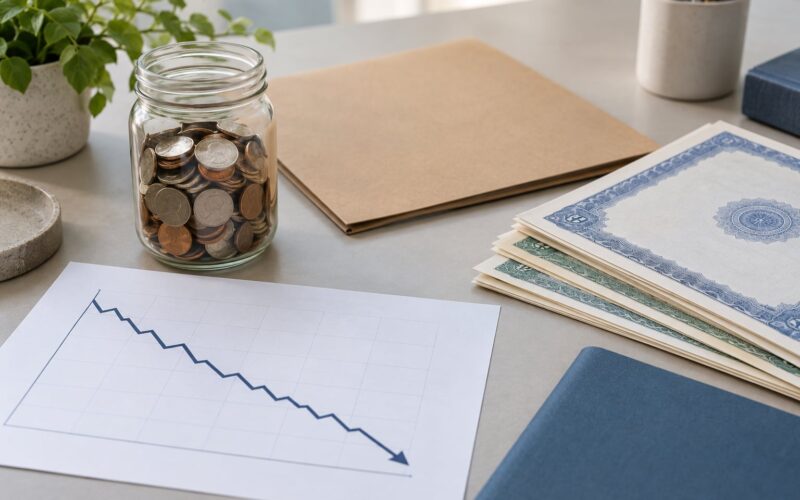
Inflation shrinks what your money can buy, so a savings balance that sits in a low-yield account quietly loses purchasing power even though the number on your statement never changes. Whether you are actually losing ground depends on one comparison: the interest rate you earn against the inflation rate you face. Get that gap right and the rest is arithmetic you can do yourself.
That is the whole mechanism behind how inflation affects your savings, and it is worth understanding before you move a dollar anywhere. This guide walks through what inflation is, which accounts are most exposed, how to calculate your real return, and what to do about it depending on when you need the money.
Everything here is educational information about how interest, inflation and taxes interact, not personal financial advice. Rates, tax rules and product terms change, so check current figures with your bank, broker or the issuing institution before acting.
Last updated: October 2026. Reviewed by the mapness.net editorial team.
Table of Contents
- How Inflation Affects Your Savings
- What the real interest rate means
- What Inflation Is and Why It Matters
- Demand-pull, cost-push, and shrinkflation
- How Inflation Affects Cash, Bank Accounts, and Emergency Funds
- The trade-off you are actually making
- Should your emergency fund beat inflation? Usually not
- How Inflation Affects CDs, Treasury Bonds, and I Bonds
- TIPS and I Bonds: what the protection actually covers
- How Inflation Affects Stocks and Investment Portfolios
- How to Calculate the Real Return on Your Savings
- Practical Ways to Protect Your Purchasing Power
- Your savings rate matters as much as your return
- Debt is the other side of the same coin
- Where not to keep money during inflation
- Frequently Asked Questions
- What happens to my savings if inflation increases?
- Can high-yield savings accounts beat inflation?
- Do TIPS really protect against inflation?
- How do I protect my savings from inflation?
- Should my emergency fund earn more than inflation?
- Who is most vulnerable to inflation?
- Conclusion: What to Do First
How Inflation Affects Your Savings
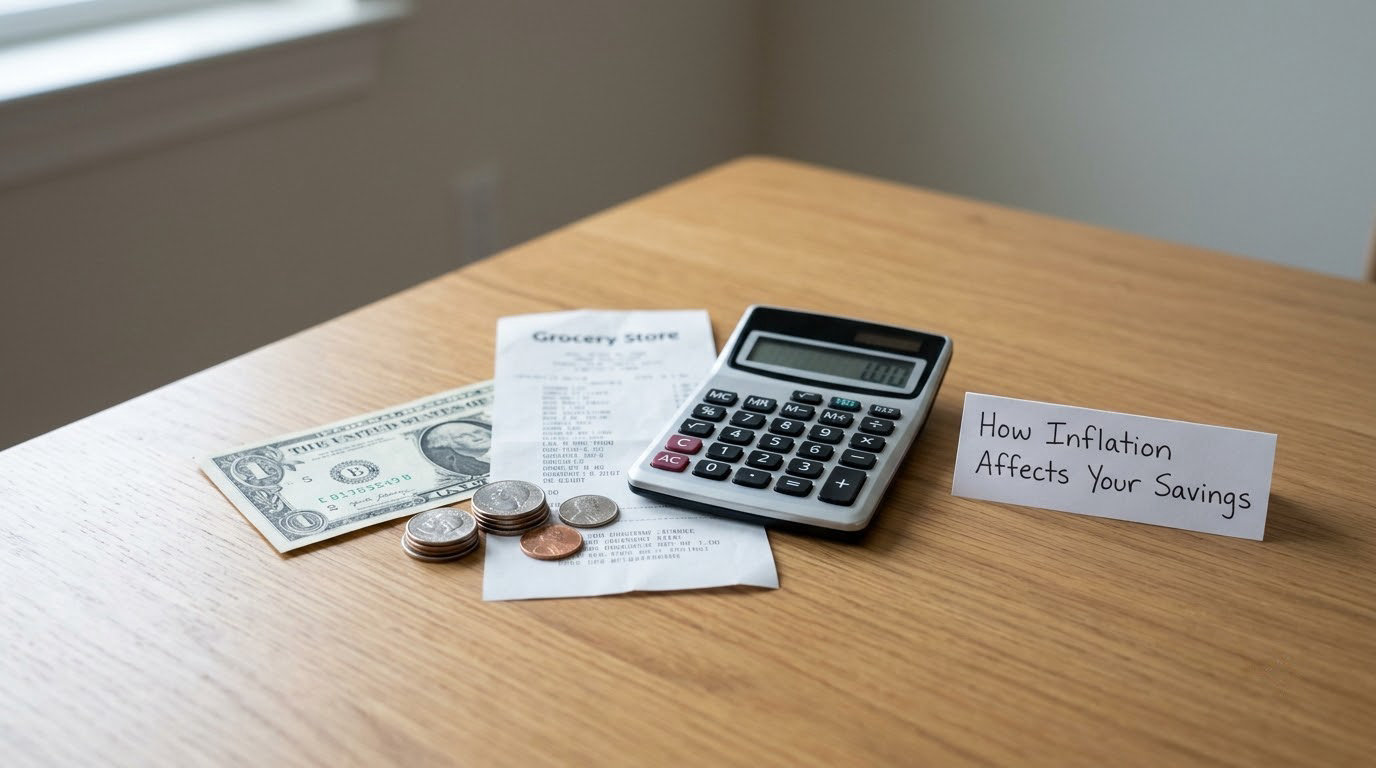
Inflation erodes savings whenever the interest rate on your account is lower than the inflation rate. Your balance stays the same in nominal terms and shrinks in real terms, so the same money buys fewer groceries, a smaller tank of gas and a shorter list at the checkout. Investments can offset some of that loss over long periods, but cash cannot.
Two numbers matter here, and confusing them is the most common reason savers misread their own statements. They are also the two numbers that decide how inflation affects your savings for almost every household.
- Nominal return is what your account actually paid you. This is the APY printed on the account page.
- Real return is what that APY is worth after inflation. This is the number that decides whether you came out ahead.
Here is the quick version with real numbers. If a savings account pays 1% while inflation runs at 3%, your money grows by about 1% and prices grow by 3%, so your real return is roughly minus 2% a year. On a 20,000-dollar balance, that is about 400 dollars of purchasing power gone each year even though your statement shows a gain every single month.
What the real interest rate means
The real interest rate is simply your interest rate minus inflation. Positive means your money kept pace and then some. Negative means your money lost ground, and no amount of compounding rescues it, because compounding a shrinking balance just produces a smaller shrinking balance faster.
There is an important exception to keep in mind. Over very short windows, markets can hand you a good year. Over ten or twenty years, a diversified mix of stocks and bonds has historically had a better shot at outrunning inflation than cash, though no year is guaranteed and some stretches are ugly.
What Inflation Is and Why It Matters
Inflation is the rate at which the general price level rises over time, measured most often by the Consumer Price Index the Bureau of Labor Statistics publishes each month. The CPI tracks what a basket of everyday goods and services costs, and the Fed also watches the PCE price index, which covers a wider range of spending and tends to run a little lower.
Two related terms show up constantly. Headline inflation includes everything, while core inflation strips out food and energy, which is the figure the Fed pays more attention to when it moves interest rates. Savers often feel a number closer to their own grocery bill than the headline suggests, and we will come back to that.
Purchasing power is what one dollar can buy. When inflation runs at 3% for a decade, that dollar buys roughly three tenths less than it did ten years earlier. Nothing has to go wrong for this to happen.
The table below shows what a 10,000-dollar balance still buys after sitting idle while prices rise. Read the 3% row and the 20-year column together and you get the number that surprises most people.
| Inflation rate | After 1 year | After 5 years | After 10 years | After 20 years |
|---|---|---|---|---|
| 2% a year | 9,803 dollars | 9,057 dollars | 8,203 dollars | 6,730 dollars |
| 3% a year | 9,709 dollars | 8,626 dollars | 7,441 dollars | 5,537 dollars |
| 5% a year | 9,524 dollars | 7,835 dollars | 6,139 dollars | 3,769 dollars |
These are straight projections at a constant rate, which is a simplification. Actual inflation and actual returns both move year to year, sometimes quickly. The 2021 to 2023 stretch, when the CPI peaked around 9%, is a good reminder that a smooth 3% assumption is a planning tool rather than a promise.
Demand-pull, cost-push, and shrinkflation
Inflation usually arrives through one of two doors. Demand-pull inflation happens when spending outruns the supply of goods, which is what a hot economy or heavy government spending can produce. Cost-push inflation happens when input costs rise and get passed along, as with energy, shipping or wage pressure.
Shrinkflation is the quieter version. The price on the box stays the same while the package gets smaller, so the CPI barely notices even though your household budget feels the squeeze. It is one reason a saver’s own experience of cost of living can run well ahead of the official number.
How Inflation Affects Cash, Bank Accounts, and Emergency Funds
Checking and savings accounts are the most exposed because their rates adjust slowly. A bank reprices its deposits at its own pace, so when inflation jumps, the rate on your account can lag by a year or more while your grocery bill moves immediately.
Here is a worked example worth sitting with. Take a 20,000-dollar balance in a savings account paying 1%. After ten years it grows to about 22,090 dollars in nominal terms, which looks like progress. If inflation averaged 3% a year over that decade, the real value of that balance is closer to 16,400 dollars in today’s money. The account gained 2,090 dollars and the saver lost roughly 3,600 dollars of buying power.
That gap is why an unopened account statement feels misleading. Nothing failed. The deposit is still there, it is still federally insured up to the standard FDIC limit, and no money vanished. What changed is what the balance purchases.
The trade-off you are actually making
Holding cash buys three things: access, stability and certainty. A checking balance has no penalty for withdrawal, no market risk and a known value tomorrow. That is genuinely valuable, and it is the reason cash belongs in the part of your money you will spend in the next two years.
What cash does not buy is growth. Over a five-year horizon you will probably get a better real result from a diversified portfolio, and over a single month you could get a worse one. Matching the asset to the date you need the money is the entire game.
Should your emergency fund beat inflation? Usually not
This comes up constantly in personal finance forums, and the consensus answer surprises people who assume they should be chasing yield. On r/financialindependence and in the Bogleheads community, the repeated argument is that an emergency fund exists for liquidity and access, not for returns. Inflation-proofing it by moving it into something volatile means risking the job it was hired to do.
There is a second reason cash is the right answer there. Every dollar in an emergency fund is a dollar not invested for your future. Leaving it in a plain high-yield account keeps the return decent without adding risk to money you might need in three weeks to cover a car repair.
The one exception worth considering is a small slice held somewhere genuinely safe and liquid for very short-term spending, where an inflation-linked instrument matures before prices matter. For a typical three-to-six-month fund, plain cash is fine. Several readers put it more bluntly: living below your income insulates you from inflation better than any product ever could.
How Inflation Affects CDs, Treasury Bonds, and I Bonds
Fixed-rate products lock in a known return, which sounds safe and can feel like a trap. If you commit to a 12-month CD in a 4.5% rate environment and inflation runs hotter, your real return shrinks below what a flexible account would have delivered. The lock-in is the price you pay for the certainty.
Indexed products work differently. Treasury Inflation-Protected Securities adjust their principal by the CPI every year, so the inflation adjustment compounds for as long as you hold them. When you sell, you receive the adjusted principal. The return you actually keep is the real yield the auction set, and that yield can be negative in a high-inflation environment even when inflation itself is being fully tracked.
I Bonds work on the same indexed principle through a savings window at TreasuryDirect, with a composite rate combining a fixed rate and an inflation-linked rate that resets every six months. They carry federal tax and are exempt from state and local income tax. Annual purchase limits apply.
Here is how the common vehicles compare. Terms, rates and tax treatment change, so confirm current details with the institution holding your money.
| Vehicle | Inflation protection | Liquidity | Tax treatment | Best fit |
|---|---|---|---|---|
| High-yield savings account | None beyond the rate | Immediate | Federal and state taxable | Emergency fund, short goals |
| Money market account | None beyond the rate | Immediate | Federal and state taxable | Short goals, cash parking |
| CD ladder | None beyond the rate | Limited, staggered | Federal and state taxable | 1 to 5 year goals |
| Treasury bonds | Fixed rate, set at auction | Sell before maturity | Federal taxable, state exempt | Long-horizon fixed income |
| TIPS | Direct, principal indexed to CPI | Sell before maturity | Federal taxable, state exempt | Money needed beyond 5 years |
| I Bonds | Composite rate, resets twice yearly | One year penalty before 5 years | Federal taxable, state exempt | Long-horizon savings |
TIPS and I Bonds: what the protection actually covers
The honest version: TIPS do protect against inflation. They adjust principal by CPI semi-annually, and the Department of the Treasury uses the three-month average of the index with a lag, so the adjustment never lands in exactly the month you paid for. Hold them to maturity and you receive at least the inflation-adjusted principal plus the real yield you were offered.
The catch is what that protection costs. Investors pay for it with lower real yields, so buying TIPS after a big inflation spike can lock in a negative real return for years. The Bogleheads view that comes up most often is that TIPS are a purchase when real yields look attractive and inflation is contained, not a panic purchase during a spike.
How Inflation Affects Stocks and Investment Portfolios
Companies have some ability to raise prices, and over long stretches a diversified stock portfolio has outpaced inflation more often than cash has. That is the honest case for equities: they are the main tool most households have for growing real purchasing power over decades.
Over short periods the picture is different. Equity prices can fall 20% or more in a quarter, and inflation and markets do not move in lockstep. A rate hike designed to cool inflation often pressures valuations at the same time, so the period when you most want your money to keep pace is frequently the period it drops hardest.
Three risks deserve specific attention. Valuation risk means you are paying a high multiple for earnings that may grow slowly. Concentration risk comes from too much in one sector or a handful of names, so a single bad quarter does most of the damage. Sequence-of-returns risk matters most for someone five years from retirement, where a poor stretch early can force selling low to cover withdrawals.
Dividends matter because they are how productive businesses return cash to shareholders, and dividend growth has historically outpaced inflation over long windows. But any single company can cut its dividend, and a sector can stagnate for a decade. Nothing here should be read as a forecast or a promise of returns.
How to Calculate the Real Return on Your Savings
The approximation almost everyone uses is real return equals nominal return minus inflation. If your account pays 4% and inflation is 3%, your real return is about 1%. Simple, and accurate enough for a quick check.
For sharper numbers, the Fisher equation divides by one plus the inflation rate rather than subtracting outright. With 7% nominal and 3% inflation, subtraction gives 4% while the exact figure is about 3.88%. The gap is small at low rates and grows at high ones, which is exactly when you want accuracy.
Now account for tax, because savings interest is taxed as ordinary income in the US. A 4% APY at a 24% marginal rate nets roughly 3.04%. Against 3% inflation, the approximate real return is zero, and the exact version is barely above zero. That is the after-tax hurdle most savers forget.
Here are three balances carried for ten years at 3% annual inflation, all starting with 10,000 dollars.
| Scenario | Nominal rate | Balance after 10 years | Real value in today’s dollars | Real change |
|---|---|---|---|---|
| High-yield savings, 24% tax rate | 3.04% after tax | 13,420 dollars | 9,986 dollars | Flat |
| Five-year CD reinvested twice at 4.5% | 4.5% before tax | 15,560 dollars | 11,578 dollars | Plus 1,578 dollars |
| Diversified portfolio, 7% a year | 7% before tax | 19,670 dollars | 14,636 dollars | Plus 4,636 dollars |
Two things stand out. The savings account earned about 3,420 dollars over ten years and finished exactly where it started in real terms, because tax took the entire edge. And the portfolio figure is an illustration of how a return works, not a promise that any particular year will deliver 7%.
Run the same math with your own numbers using a spreadsheet or any online real return calculator. Replacing the assumed rate with your actual APY turns a generic example into a personal answer, which is the only version that matters.
Practical Ways to Protect Your Purchasing Power
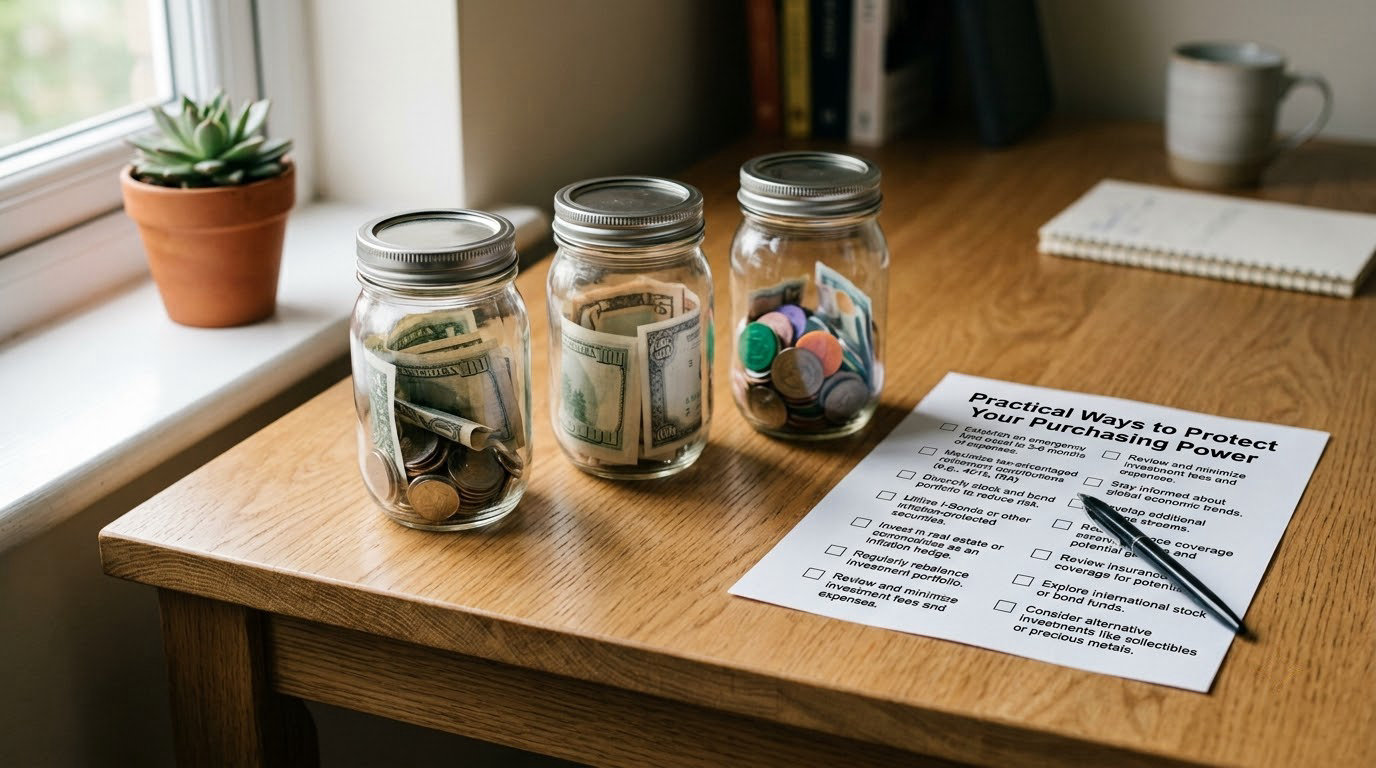
No single move fixes this, and any promise that one does is selling something. What works is a set of small decisions matched to the date you will need each dollar. Here is the order I would work through it.
- Split your money by horizon before you optimize anything. Money needed within two years belongs in cash. Money needed in three to five can sit in short fixed deposits. Money needed in ten or more belongs in a diversified portfolio. You cannot fix a mismatch you have not measured.
- Size your emergency reserve honestly. Three to six months of expenses for a steady income, closer to twelve for variable income or a household with one earner. Keep it liquid, then stop thinking about it.
- Compare deposit rates like a shopper. Rates move often, and online banks frequently pay more than the branch you walk into. Check what your current account pays against what comparable accounts offer before assuming you are stuck.
- Add inflation protection only to money you will not touch soon. TIPS and I Bonds make sense for funds with a horizon beyond five years, and less sense for anything closer.
- Strip out fees. A one percent annual fee on a large balance quietly consumes a meaningful chunk of a modest real return. Check expense ratios, account charges and advisory costs.
- Diversify rather than concentrate. Broad index funds spread your exposure across thousands of companies and remove the temptation to pick a single inflation winner.
- Track your own inflation rate. Pick six or seven categories you spend heavily on, record what you paid each month, and compare the change against CPI over a year. Rent, insurance and childcare behave very differently from the national average.
Your savings rate matters as much as your return
The return you earn is only half the equation, and the other half is behavioral. Lifestyle inflation is what happens when a raise lands and the extra income quietly becomes a larger subscription, a bigger car payment and more dining out. You end up earning more and saving the same amount, which leaves you exactly where inflation put you.
A widely repeated rule on r/MiddleClassFinance is that living below your means is the most reliable defense against inflation, because it protects your contribution rate rather than chasing a better yield. It is not glamorous, but the arithmetic is stubborn.
Debt is the other side of the same coin
Fixed-rate debt is the one large asset that inflation quietly helps. If you owe 3% on a car loan and prices rise 3%, that debt is being repaid with dollars that buy less, so your real burden falls without a single extra payment.
This is where honest inflation advice gets uncomfortable. If you hold cheap fixed-rate debt and meaningful cash, paying down the debt can be a better real return than parking that cash in savings. The reverse holds too: if you are carrying high-interest credit card debt, nothing matters more than clearing it, since that rate is almost certainly well above any inflation-protected investment you could buy.
Where not to keep money during inflation
A few placements are consistently poor. Long stretches of idle cash earning well below inflation. Long-term certificates of deposit locked at rates set before a jump, when you will be earning below inflation for the entire term. Long-duration bonds bought when real yields were thin, since they lose purchasing power faster as inflation runs. And single-stock positions in a company chosen for its inflation exposure, which adds company risk to a problem that needs diversification.
Frequently Asked Questions
What happens to my savings if inflation increases?
Your balance stays the same on paper but buys less each year. If your account pays 1% while inflation runs at 3%, your money loses about 2% of its purchasing power annually, roughly 400 dollars a year on a 20,000-dollar balance. Over 20 years at 3% inflation, a 10,000-dollar cash pile keeps the buying power of about 5,500 dollars.
Can high-yield savings accounts beat inflation?
Sometimes, and it depends on the spread between the rate and inflation rather than on either number alone. A 4% APY against 3% inflation is positive before tax, but at a 24% marginal rate the interest drops to roughly 3% and the real return lands near zero. High-yield savings work best for short horizons, not as a long-term wealth engine.
Do TIPS really protect against inflation?
Yes, the principal of a TIPS is indexed to the consumer price index and adjusts semi-annually, so holding to maturity returns at least inflation-adjusted principal plus the real yield set at auction. The catch is cost: real yields on TIPS are often low or negative, so buying after an inflation spike can mean accepting a negative real return for years.
How do I protect my savings from inflation?
Start by splitting your money by when you need it: cash for two years or less, short deposits for three to five years, and a diversified portfolio for ten years or more. Then compare deposit rates, keep fees low, add inflation-indexed government securities only for long-horizon funds, and track your own spending so you know your personal inflation rate rather than relying on the headline figure alone.
Should my emergency fund earn more than inflation?
Usually not. An emergency fund exists for immediate access, and moving it into anything volatile risks the purpose it was built for. Most finance communities hold the same view: keep three to six months of expenses in a plain high-yield savings account and treat it as insurance rather than an investment. Chasing yield on that money is a poor trade for the security it provides.
Who is most vulnerable to inflation?
Savers holding large cash balances at low rates feel it most directly, along with households on fixed or slow-growing incomes and anyone drawing down savings in the five years before retirement. Lower-income households have less room in the budget to absorb price increases. Younger savers are hit differently, since inflation eats the contributions they would otherwise be compounding.
Conclusion: What to Do First
How inflation affects your savings comes down to one comparison you can make today: the rate you earn against the rate prices are rising. When the second is higher, your money is shrinking in real terms even though your balance looks healthy, and no amount of patience changes that arithmetic.
Start with three things. Calculate the real return on your cash by subtracting inflation from your APY, then subtracting tax if the account is taxable. Write down how much of your balance you need within two years, because that portion has no business being invested for growth. After that, look at everything else for fees, concentration and time horizon mismatches.
None of this needs to be urgent or clever. It needs to be honest about what each dollar is for and when you will spend it. Rates, tax treatment and product terms change, so verify current figures with your bank, broker or the issuing institution, and talk with a qualified financial professional about decisions specific to your situation.