
How to protect your portfolio from inflation is mostly an asset allocation problem, not a prediction problem. No single holding can do the whole job, so the practical answer is a mix: broad equities for long-run growth, a slice of inflation-protected bonds such as TIPS, real assets that respond to rising input costs, and just enough cash to cover near-term spending without dragging on your returns. The rest is discipline, costing you almost nothing to implement.
I’ll walk through the framework step by step, including the arithmetic that shows how much purchasing power actually erodes and which hedges have quietly failed in recent years. This is general education, not individualized investment advice.
Table of Contents
- How to Protect Your Portfolio From Inflation: A Practical Guide
- Key takeaways
- The eight-step plan
- What Does Inflation Do to Your Portfolio?
- What inflation does to cash, bonds and equities
- What 100,000 dollars is worth after 10, 20 and 30 years of inflation
- How to Choose the Right Asset Mix
- How equities, real assets and inflation-linked bonds respond
- How to protect your portfolio from inflation across time horizons
- How to Use Inflation-Protected Bonds and Cash Effectively
- How TIPS actually work
- Why TIPS are long-run protection, not a short-term hedge
- Where cash and I bonds fit
- How to Keep Dividends and Interest Ahead of Rising Prices
- How to Consider Taxes, Fees, and Inflation Expectations
- How Often Should You Review and Rebalance?
- What Mistakes Can Make Your Portfolio More Vulnerable?
- Frequently Asked Questions
- Can I protect my entire portfolio from inflation?
- How does inflation affect stocks and bonds?
- Are inflation-protected bonds better than regular bonds?
- Should I keep more cash when inflation is high?
- How much of my portfolio should be in TIPS?
- How often should I rebalance an inflation-conscious portfolio?
- Conclusion: Start With Your Purchasing-Power Plan
How to Protect Your Portfolio From Inflation: A Practical Guide
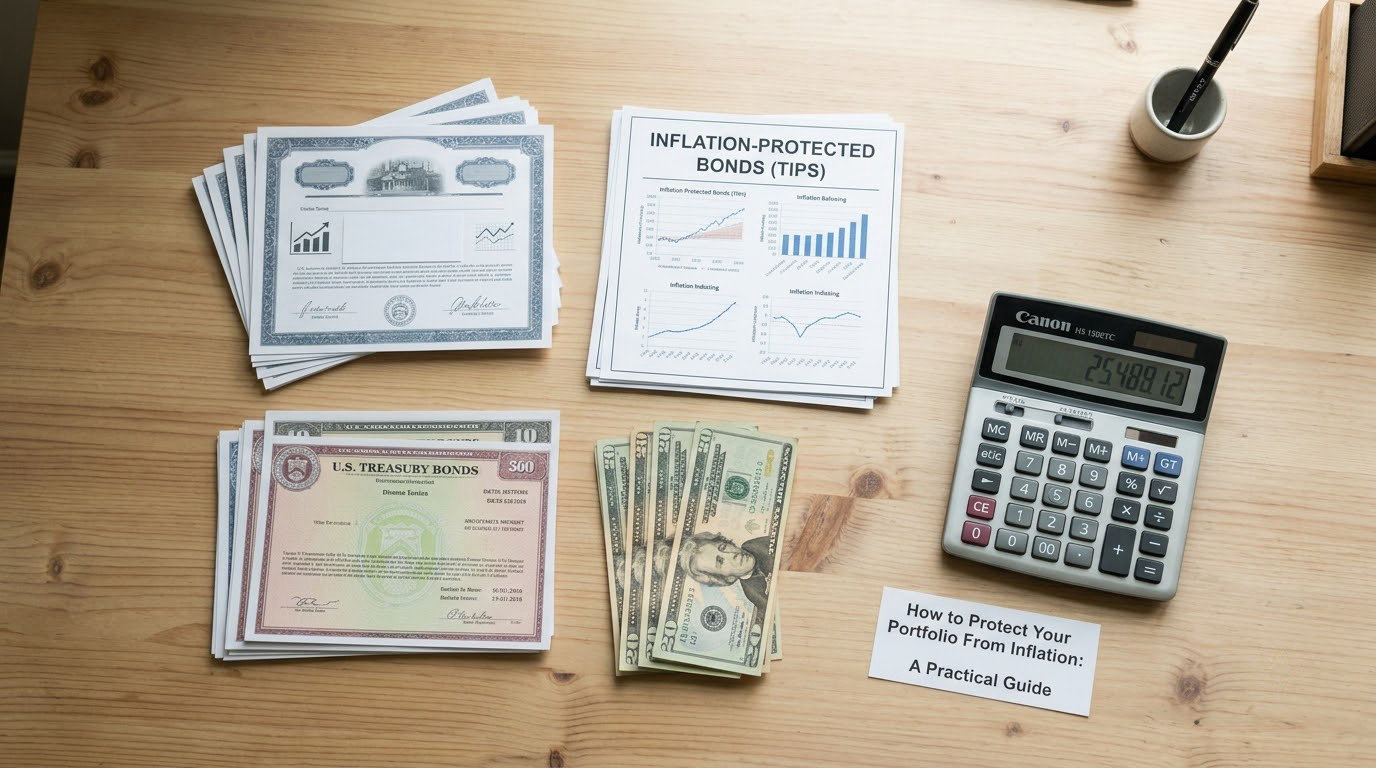
Here is the short version. Match your holdings and your income to the inflation you expect, not the inflation you fear. Add a deliberate allocation to assets whose cash flows rise with prices, keep the fixed-income portion short enough that you are not locked into low coupons, hold equity in broad low-cost funds rather than a handful of names, and fix the small leaks: fees, taxes, and spending creep.
The order matters. Structure first, products second, behaviour last. Investors who reverse that order tend to buy the loudest hedge of the year and then sit on a 30% drawdown wondering why their “protection” was the most volatile thing they own.
Key takeaways
- Real return, not nominal return, is the only number that matters. A 4% yield during 3.5% inflation is a 0.5% loss per year in purchasing power, and it compounds.
- TIPS adjust principal with the Consumer Price Index and pay coupons on the higher principal. They are long-run protection, not a short-term hedge, and broad TIPS indexes posted negative total returns during the 2021-2022 inflation spike.
- Equities are the primary long-run defense because companies reprice goods higher. Pricing power and dividend growth matter more than the headline yield.
- Cash is a tool with a job, not a parking lot. Idle balances lose purchasing power quietly, every single year.
- Expected inflation and unexpected inflation are different problems, and each hedge only addresses one of them.
- Fees, taxes and spending decide more of your outcome than any asset pick. A 0.03% fund and a 1.00% fund diverge more over decades than most investors expect.
The eight-step plan
Step 1: Write down your real goal in today’s money. Decide what the money is for and when you will need it. A goal fifteen years out can absorb equity volatility. A goal in three years cannot.
Step 2: Set a target asset allocation and write it down. Pick a stock, bond and cash split you can hold through a bad year, then check that you actually hold it. Most people lose money to drift, not to picking the wrong fund.
Step 3: Add inflation-protected bonds to the fixed-income sleeve. Size it to the part of your portfolio that must be available in a specific year, and accept that the coupon rate will disappoint you. The principal adjustment is the point.
Step 4: Own the equity market, not a theme. Broad index exposure across many sectors captures the pricing power of profitable businesses without betting on one industry call.
Step 5: Keep a deliberate, small diversifier sleeve. A few percent in real assets, precious metals or non-US exposure can soften a single-country shock. Small, not heroic, and rebalanced on a schedule.
Step 6: Shrink idle cash and shorten the money you do not need soon. Move surplus balances out of low-yield accounts into short-dated instruments, and match the maturity of each holding to the date you will spend it.
Step 7: Cut the leaks. Expense ratios, turnover taxes, and account location. A one-tenth of a percent fee difference is worth more than most people’s best investment idea.
Step 8: Put the schedule in the calendar. One review a year, plus a trigger after any life change. Rebalance back to target, preferably with new money and tax-aware trades.
What Does Inflation Do to Your Portfolio?
Inflation is a tax on holding currency, and the bill arrives quietly. A savings balance of 25,000 USD keeps its number on the statement while buying measurably less every year, and nothing on the statement tells you that.
What inflation does to cash, bonds and equities
Cash is hit hardest in the short run, because the principal is fixed and the yield is locked. A certificate of deposit paying 3% while inflation runs at 4% loses a point of buying power a year, and you cannot do anything about it until maturity.
Fixed coupon bonds take the damage in two ways. The payments are worth less, and the market price falls when inflation pushes real yields up, which is exactly what happened to long-duration bonds in 2022.
Equities behave differently. Companies sell products and services, so a broad equity index has historically been able to raise prices and grow earnings in step with the cost of living. The pain arrives as volatility instead: multiples compress, and growth-heavy segments like software and consumer discretionary can fall hard even as inflation cools. Over long horizons equities have outpaced inflation; over a two-year window, that comfort is no help at all.
The arithmetic is simple. Real return equals nominal return minus inflation, roughly. A 7% portfolio return during 3% inflation is about a 3.9% real gain, and a 2% portfolio return during 3% inflation is a real loss of about 1%. Tracking the second number is what tells you whether your purchasing power survived the year.
What 100,000 dollars is worth after 10, 20 and 30 years of inflation
This table shows what a 100,000 USD balance still buys after sustained inflation, expressed in today’s money. Read the 3% column as a moderate environment and the 6% column as the tail risk that keeps people up at night.
| Starting balance | Years | Worth today at 3% inflation | Worth today at 6% inflation |
|---|---|---|---|
| 100,000 USD | 10 | 74,418 | 55,839 |
| 100,000 USD | 20 | 55,378 | 31,180 |
| 100,000 USD | 30 | 41,200 | 17,411 |
At 3% inflation, a quarter of the purchasing power is gone after ten years and well over half is gone after twenty. At 6%, more than four fifths disappears over the same twenty years. This is the single most useful calculation an investor can make, and it takes about a minute with any inflation calculator.
Now the flip side. Cash drag works the same way. A 10,000 USD balance earning 1% while inflation runs at 3% is worth 8,626 in today’s money after five years, against 9,514 at the 3% rate. Roughly 890 USD of buying power, with no dramatic market event required.
How to Choose the Right Asset Mix
There is no universal split that protects a portfolio from inflation, and anyone selling you one is selling something. What matters is that each part of your mix has a job, and that the job matches the money’s time horizon.
How equities, real assets and inflation-linked bonds respond
The table below compares the main asset groups by how they behave when prices rise, the role each one plays, how much volatility to expect, and how most people implement it.
| Asset group | How it responds to inflation | Typical role | Volatility | How to implement |
|---|---|---|---|---|
| Broad global equities | Raise prices and grow earnings over time; short-term multiples compress | Primary long-run growth engine | High | Low-cost total-market index fund or ETF |
| Dividend growth stocks | Pricing power plus a distribution that can be raised | Income that tracks inflation | Medium to high | Broad dividend growth index, periodically rebalanced |
| TIPS | Principal rises with CPI; coupons paid on the higher principal | Protection for money needed in a known year | Low to medium | Individual bonds held to maturity, or a TIPS fund or ETF |
| Series I savings bonds | Composite rate set from CPI with a six-month lag | Tax-advantaged emergency savings | Very low | Annual purchase limit, redeem after a year |
| Real estate and REITs | Rents and land values often rise with costs, but rates drive prices too | Real-asset diversifier and income | Medium to high | Diversified REIT index fund, or a property you actually understand |
| Commodities and precious metals | Respond quickly to supply shocks and unexpected inflation | Small hedge, portfolio insurance | Very high | A few percent in a broad commodity or metals allocation |
| Cash, money markets, CDs | Yields eventually reset upward, with a lag; purchasing power erodes meanwhile | Near-term goals and emergency buffer | Very low | Match maturity to the spending date |
Two patterns show up here. Real assets hedge unexpected inflation, the kind nobody forecast, and they are volatile enough that they can cost you if you hold them through a demand scare. Inflation-linked bonds hedge expected inflation and the gap between them, but only after an index adjustment, and they carry real rate risk.
How to protect your portfolio from inflation across time horizons
Split your money by when you need it, then defend each bucket separately. Money needed within three years belongs in cash, short-term bills and CDs, because a market decline right before you withdraw is the expensive kind of loss. Inflation protection is not worth a broken plan.
Money needed in three to ten years is the awkward middle. This is where short-maturity TIPS earn their place, because holding them to maturity keeps the inflation adjustment you earned and avoids duration losses from rising real rates.
Money needed beyond ten years belongs mostly in equities, where the pricing power of profitable businesses has historically done the work. Adding a small real-asset sleeve to this bucket is reasonable. Adding a large one, or making a big bet on a single commodity, is where portfolios get into trouble.
Diversification is the part people underrate. It is not a slogan, it is the reason you can hold something volatile without losing sleep. A single-stock portfolio can be wiped out by one bad earnings report, and a real-estate-only portfolio can be wiped out by interest rates no matter what rents do. Spread the risk, then decide what to tilt.
How to Use Inflation-Protected Bonds and Cash Effectively
TIPS are the most misunderstood tool in personal finance. Both halves of that sentence are the fault of the marketing, so here is the mechanism without the pitch.
How TIPS actually work
A TIPS is a Treasury bond whose principal is adjusted by the change in the Consumer Price Index. When CPI rises, the principal rises by the same percentage, and the coupon is calculated on the adjusted principal. The index ratio, which is simply the current CPI divided by the CPI at issuance, is how the Treasury tracks the adjustment. The Department of the Treasury recalculates principal at maturity and pays the difference.
Two numbers matter more than the coupon. The real yield is the adjusted yield after inflation, and it can be negative even when the coupon looks respectable. The breakeven inflation rate is the gap between a TIPS yield and the yield on a comparable nominal Treasury, and it is the market’s rough price for expected inflation over the life of the bond. Read breakevens as information about expectations, never as a forecast you trade on.
Why TIPS are long-run protection, not a short-term hedge
This is the part that surprises people most. During the 2021-2022 inflation spike, when the annual CPI rate reached 9.1%, broad TIPS indexes posted negative total returns. The reason is that TIPS prices respond to real yields, and real yields rose sharply as the Federal Reserve tightened. The principal adjustment arrived, but the market price fell by more.
So TIPS behave in two different time frames. Over the full life to maturity, the inflation adjustment does its job. Over a quarter or two, they are bonds, and bonds move with interest rates. Investors who bought TIPS in late 2021 and sold in early 2022 were right about inflation and wrong about the instrument.
A second limitation: the CPI measures consumer prices, not the cost of everything in a portfolio, and the index is applied with a lag, since the adjustment is based on CPI published three months before issuance. A portfolio of energy equities or industrial commodities can surge during a quarter when your TIPS have not adjusted at all.
Holding individual TIPS to maturity is the simplest way to keep the adjustment and drop the price noise. Funds and ETFs give you diversification and daily liquidity, at the cost of never quite knowing the exact principal you will hold. For long-horizon money that you will not touch, held-to-maturity individual bonds are cleaner. For a bond sleeve you rebalance, a fund is easier.
Where cash and I bonds fit
Series I savings bonds pay a combined rate of fixed and inflation components, set from CPI with a six-month lag. They are exempt from state and local income tax, which is a meaningful edge for someone in a high-tax state, and they carry an annual purchase limit plus a one-year penalty for cashing out early. That makes them a strong home for emergency savings and a poor one for large balances.
For everything else, compare the yield across the cash menu: high-yield savings accounts, money market funds, and certificates of deposit. The interest is the same kind of interest, so look at how quickly the rate resets, whether the account is FDIC-insured, and whether the money is available without penalty on the day you need it. Laddering CDs across maturities is a simple way to keep some liquidity while locking the yield on the rest.
Keep the cash bucket sized to real needs. Three to six months of essential expenses is the common starting point, higher if your income is variable and lower if you have other reliable sources. The mistake is not holding cash. The mistake is holding cash that is quietly funding retirement.
How to Keep Dividends and Interest Ahead of Rising Prices
A dividend of 2% tells you almost nothing. A dividend of 2% that has grown 7% a year for a decade tells you a great deal, because a fixed dollar distribution buys less every year and a growing one buys more.
That is the whole argument for dividend growth over dividend yield. A high yield can be a warning that the price has fallen, that the payout has been stretched, or that the business is in trouble. Look instead at the record: how long the dividend has been raised, whether free cash flow covers the payout comfortably, and whether the company can raise prices when costs rise.
Reinvestment matters as much as the growth rate, and only in taxable accounts. Dividends reinvested inside a sheltered account do not create a tax bill every quarter. Once you are drawing income, reinvesting a declining real distribution is pointless, so the retirement question is different: convert shares to cash as needed rather than counting on a fixed income stream to keep up.
Interest has the same problem in reverse. A bond ladder locks you into a rate set today and pays less as prices rise, unless it is inflation-indexed. A high-yield bond pays a bigger coupon and carries real default risk, and in a period of high inflation those defaults are not hypothetical. Judge income by its total return over a full cycle, not by the coupon alone.
Real estate investment trusts sit in the same family. Distributions are often required for tax reasons rather than earned as surplus cash, and the share price is highly sensitive to interest rates. Worth owning in moderation, poor as a substitute for thought.
How to Consider Taxes, Fees, and Inflation Expectations
Two numbers decide more of your outcome than most people’s investment opinions do: what you keep after fees, and what you keep after tax. The return printed in a fund fact sheet is the starting line, not the finish.
Start with fees. The difference between a 0.03% and a 1.00% expense ratio is small in any single year and enormous across decades, and the larger the drag, the more of your real return disappears. A 7% nominal return with a 1% fee and 3% inflation is a real return near 3%, not 7%.
Then look at taxes. Interest, dividends, and realized capital gains are taxed at different rates and in different accounts, and the same investment can produce a very different after-tax result depending on where it sits. Tax-advantaged accounts such as traditional and Roth retirement accounts change the math of taxable versus tax-free, and the answer depends on your tax bracket now and your expected bracket later. Tax-loss harvesting can offset realized gains, but it adds complexity and tracking requirements, and wash-sale rules limit how often losses can be used on the same position.
Inflation expectations are the last piece. Breakeven rates tell you what the market has priced in. Survey measures and the Federal Reserve’s own projections tell you what forecasters think. Both can be wrong, and both move constantly, which is exactly why they are inputs to a plan rather than the plan itself. If you find yourself rewriting your allocation every time a monthly CPI report lands, the allocation is the problem.
One more honest word on tracking: consumer price index, core CPI, and the PCE price index each tell a slightly different story, and the difference between headline and core is the volatile energy and food component. Pick one measure, write the date next to it, and check it on the same schedule as your portfolio review rather than daily.
How Often Should You Review and Rebalance?
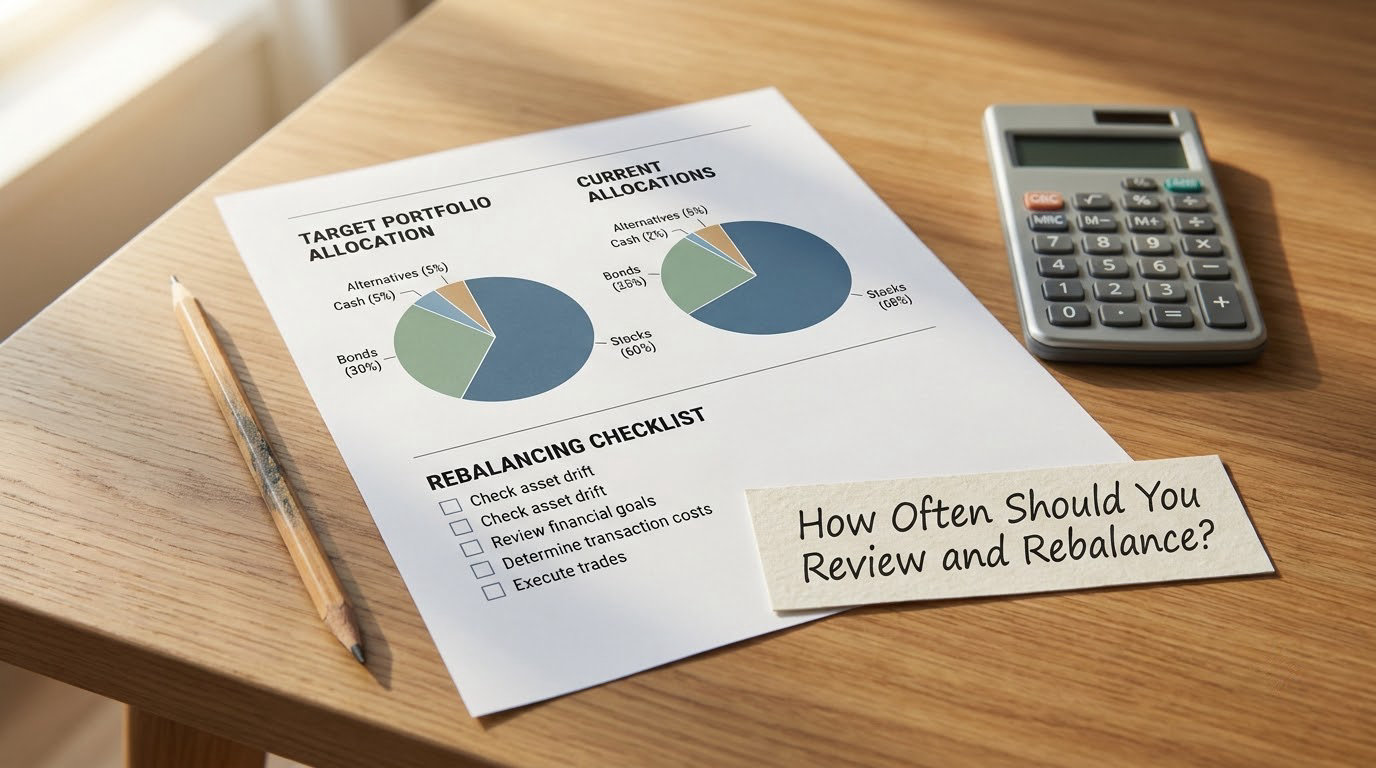
Once a year for most people, plus a trigger whenever life changes. That is the honest answer. Weekly monitoring does not improve a diversified portfolio, and frequent trading reliably converts a saver into a poorer saver through taxes and timing.
Run the review in the same order every time. First, confirm your goal and time horizon, because a retirement date that moved forward changes the correct allocation more than any market event. Second, compare current weights against your target and note any position that has drifted outside a band you set in advance, such as five percentage points. Third, check the costs you are paying now, since fees change and so do your account balances. Fourth, rebalance back to target.
Rebalance in the least costly order available. Direct new contributions and dividends toward the underweight asset first, since that sells nothing and triggers nothing taxable. Then sell the overweight holding that carries the biggest tax cost or the largest gain. Then sell the overweight holding that is most tax-efficient, usually the one with the smallest embedded gain. If the portfolio is inside sheltered accounts, tax consequences mostly disappear and you can rebalance more freely.
Rebalance bands are what keep the discipline from turning into market timing. Fixed bands such as plus or minus five percentage points force you to sell high and buy low mechanically, at moments when that feels worst. It works precisely because it feels bad.
Change your target allocation only for real reasons: a new goal, a new time horizon, a change in your ability to absorb loss, or a change in the fees and tax treatment of an account. Market moves are not a reason. Rising inflation alone is not a reason, because prices are already reflected in the nominal prices you pay for equities and bonds.
What Mistakes Can Make Your Portfolio More Vulnerable?
Most damage to an inflation-conscious portfolio comes from behaviour, not from picking the wrong asset. These are the ones that come up again and again in investing forums and in my own conversations with people who wish they had acted differently.
Holding too much cash “to be safe.” The correction is to size the cash bucket to actual spending needs and give the rest a job. Safety is having money for the next two years, not having five years of expenses sitting at a rate below inflation.
Chasing the year’s best performer. The correction is a written target allocation plus scheduled rebalancing, so the buying and selling is decided in advance rather than during a rally. Commodity spikes and gold manias both end with a lot of people holding the expensive thing.
Buying gold because it went up. Small allocations to precious metals work as portfolio insurance. Concentrated positions bought at a peak are a different activity, and one that has hurt plenty of well-intentioned investors. There is no timing rule that makes this reliable.
Treating TIPS as a guaranteed profit engine. The correction is to hold them for the inflation adjustment, keep in mind that they lost money in total return during the 2021-2022 spike, and decide whether individual bonds held to maturity or a fund fits your plan.
Selling after a market decline. Inflation rising and markets falling at the same time is exactly when retirees get hurt, because they are forced to sell. The correction is to hold two to three years of planned withdrawals in cash and short duration assets, so a bad market never forces a sale.
Spending growth disguised as inflation protection. Rising expenses are the fastest way to lose purchasing power, and they leave no market data behind. A cost-of-living adjustment on withdrawals is a legitimate tool in retirement, but it should follow a written plan, not a mood.
Ignoring what your pay already provides. Some paychecks and pensions adjust with the cost of living, which means part of your protection is already built in and should not be bought twice.
Forgetting the tax and fee side. The most expensive hedge is the one you pay a 1% fund fee and a full tax bill to hold. Check the net number, not the headline.
Frequently Asked Questions
Can I protect my entire portfolio from inflation?
No, and anyone promising that is selling something. You can build a portfolio whose expected long-run return outpaces expected inflation, which is the realistic goal. Over any short window, equities, bonds, and real assets can all fall at once while prices rise. Protection comes from a mix sized to your time horizon, low costs, and a rebalancing schedule, not from a single instrument.
How does inflation affect stocks and bonds?
Bonds suffer first and most directly, because fixed coupon payments and fixed principal lose buying power, and rising inflation pushes real yields up, which lowers long-duration bond prices. Equities suffer differently: companies eventually raise prices and grow earnings, but growth-heavy sectors get repriced lower in the short run. Equities have outpaced inflation over long horizons, not over any given year.
Are inflation-protected bonds better than regular bonds?
Better depends entirely on the job. If the money is needed in a specific year, TIPS are the right instrument because principal rises with the Consumer Price Index and coupons are paid on the higher principal. For long-term growth, the low real yields TIPS often carry make them a weak engine, and broad TIPS indexes posted negative total returns during the 2021-2022 spike as real yields rose.
Should I keep more cash when inflation is high?
Usually the opposite. High inflation means cash is losing purchasing power every month, and the yield on savings accounts typically resets downward with a lag. Keep cash sized to near-term goals and your emergency buffer, maybe three to six months of essential expenses, and put the rest to work in assets with more inflation sensitivity. What you should hold is cash with a job, not cash without one.
How much of my portfolio should be in TIPS?
There is no single right number. A common approach is to match TIPS to the portion of your portfolio you will spend within roughly five to ten years, often 10% to 30% for a retiree drawing income and less for a younger saver. Hold individual bonds to maturity if you want the inflation adjustment without price noise, and rebalance back to target when real yields move.
How often should I rebalance an inflation-conscious portfolio?
Once a year, plus a check after any major life change such as a retirement date moving or a new account. Most of the work is done with new contributions and dividends directed toward underweight positions, which avoids taxable sales. Use pre-set bands rather than judgment calls, because the moments that most need rebalancing are the ones that feel worst to act on.
Conclusion: Start With Your Purchasing-Power Plan
The first three moves take an hour and settle most of the problem. Write down what the money is for and when you need it, list your current holdings in two columns, stocks and everything else. Then decide what a sensible mix looks like for that horizon, and work out how much of the gap is cash that is quietly costing you purchasing power.
From there, size the TIPS allocation to the money you will spend in the next five to ten years, cut any holding with a fee you would not defend out loud, and put a review date in the calendar. The portfolio that survives inflation is rarely the most clever one. It is the one that still matches its plan ten years from now.