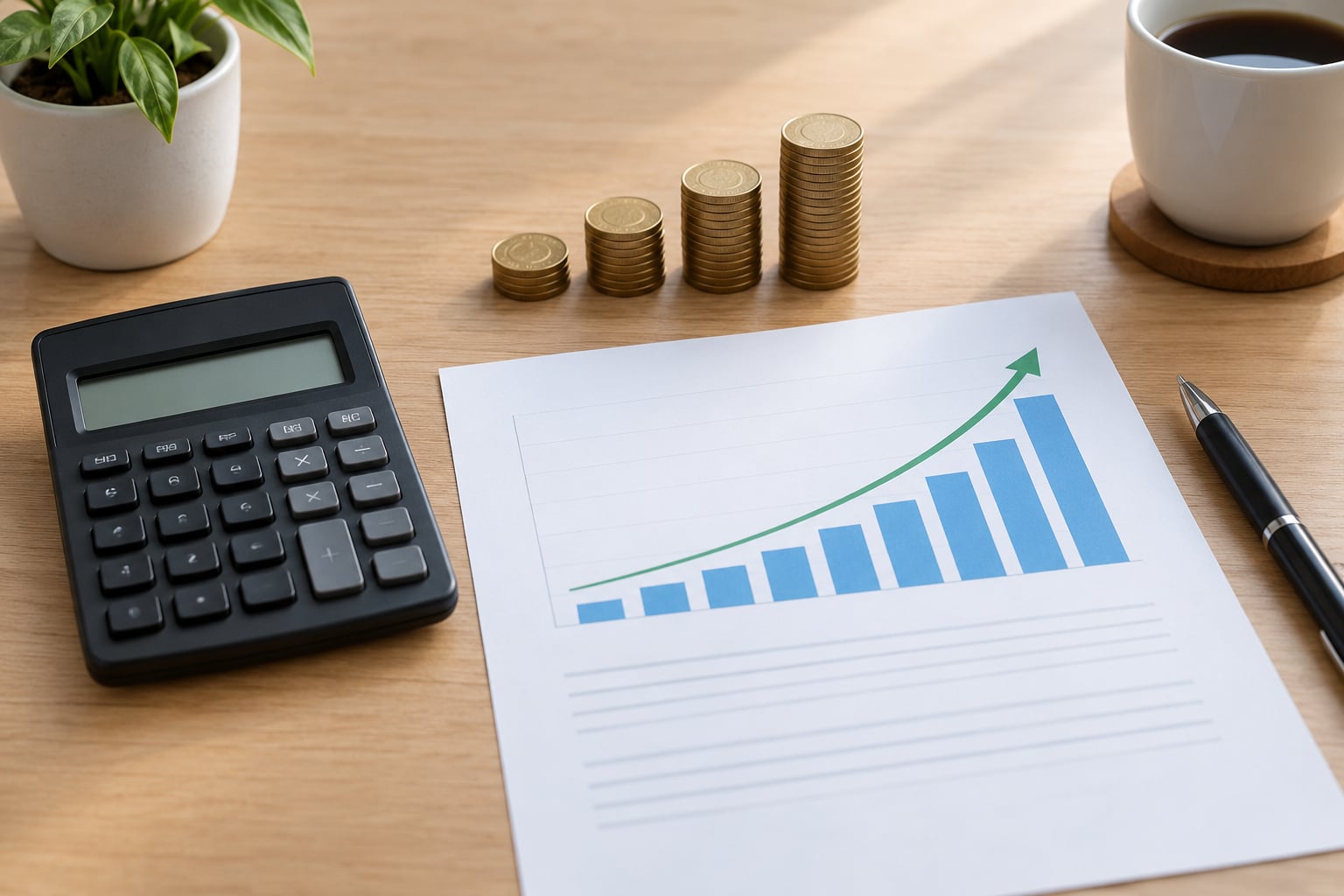
Compound interest is interest calculated on your original balance and on the interest that has already piled up, so each period earns a little more than the one before it. That is how compound interest actually works: your money starts earning interest, then that interest starts earning interest too, and the growth curve bends upward instead of staying flat. On a savings account the rate is small but predictable. On an investment the rate is uncertain, so the same mechanism can produce very different outcomes.
The best way to see it is with a number. Put 1,000 dollars into an account paying 5 percent, compounded annually, and leave it alone for ten years. You end up with about 1,629 dollars. Nothing was deposited after the first day. The extra 629 dollars is interest on interest, and it arrived mostly in the final years rather than the first ones.
Table of Contents
- What Is Compound Interest?
- The Compound Interest Formula Explained
- How Compound Interest Actually Works in an Account
- What Changes Your Compound Interest Results?
- Compound Interest vs. Simple Interest
- Why Starting Early Can Make a Big Difference
- How Investors Can Use Compound Interest Responsibly
- Frequently Asked Questions
- Does compound interest work the same way in every account?
- Is compound interest guaranteed?
- What is the best frequency for compounding?
- How much does compound interest grow $1,000?
- Should I choose an account based only on its interest rate?
- What is the difference between APY and interest rate?
- Start With the Basics
What Is Compound Interest?
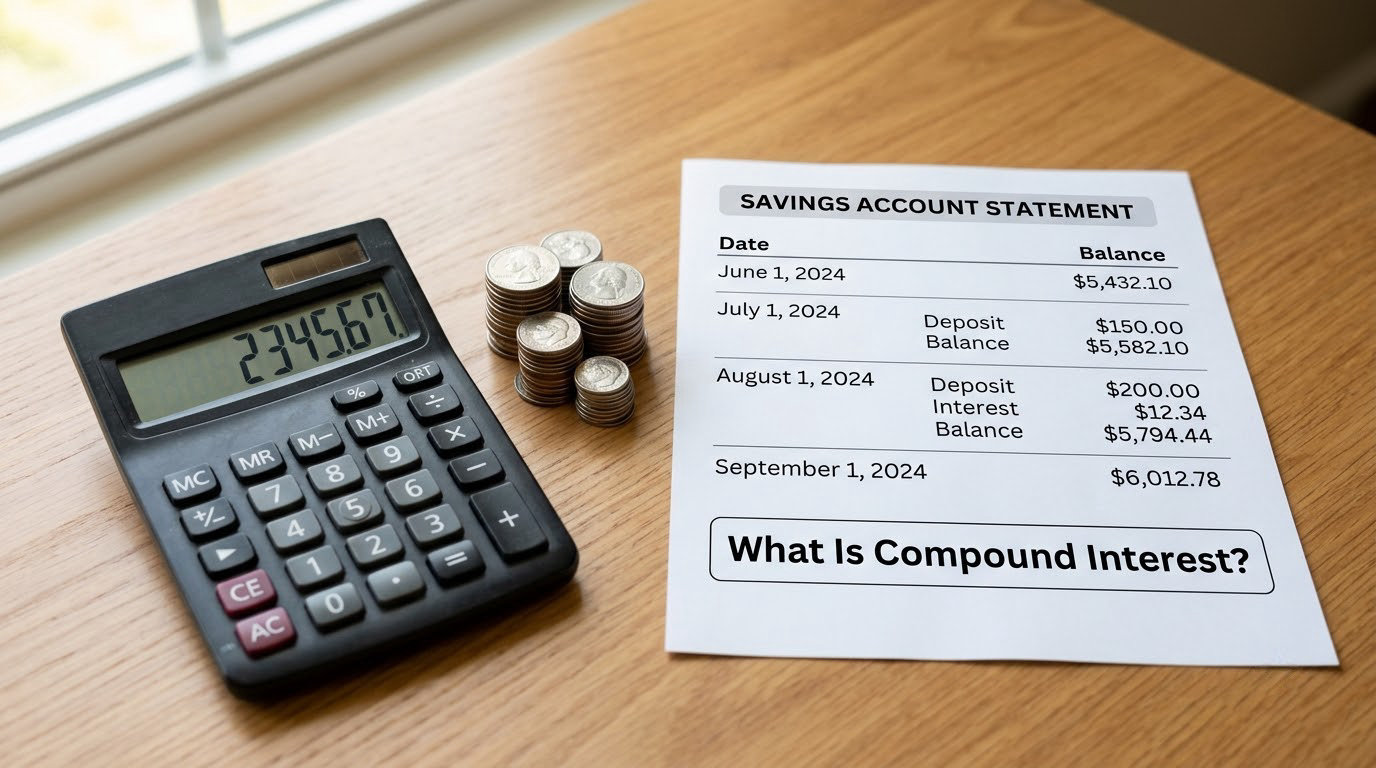
Compound interest is a mechanism, not a product. You do not buy it and you cannot invest in it directly. What you buy or choose is an account or an investment that happens to compound.
Simple interest only ever pays on the principal, the money you started with. Compound interest pays on the principal plus everything it has already earned. The difference starts small and widens with every period.
Here is the same 1,000 dollars at 5 percent over three years, both ways.
| Year | Simple interest balance | Compound interest balance |
|---|---|---|
| Start | 1,000 | 1,000 |
| Year 1 | 1,050 | 1,050 |
| Year 2 | 1,100 | 1,102 |
| Year 3 | 1,150 | 1,157 |
At the end of year three the gap is seven dollars. If you stopped here, simple versus compound interest would barely matter. Keep the same setup running to ten years and simple interest lands at 1,500 dollars while compound interest reaches about 1,629 dollars.
People sometimes describe compound growth as the snowball effect, and that is not marketing fluff, it is just the shape of the math. A small balance rolling downhill picks up mass as it goes.
The Compound Interest Formula Explained
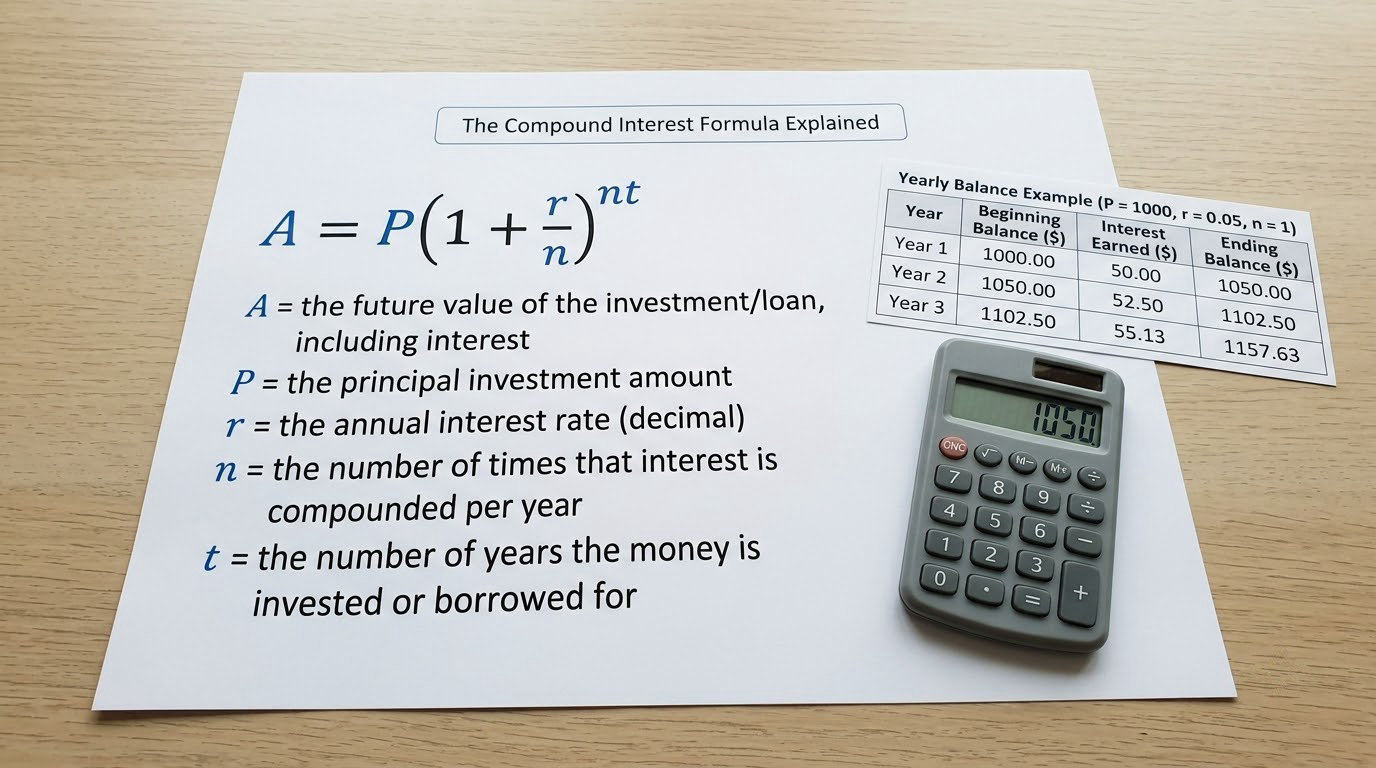
The standard formula for future value is A = P(1 + r/n)^(nt). It looks heavier than it is once you know what each letter means.
- A is the future value, the balance you end up with.
- P is the principal, your starting deposit.
- r is the annual interest rate written as a decimal, so 5 percent becomes 0.05.
- n is how many times per year interest is credited.
- t is the number of years.
Take 10,000 dollars at 5 percent compounded annually for ten years. The rate divided by the number of compounding periods is 0.05 divided by 1, which is still 0.05. Multiplying by the number of total periods, 1 times 10, gives an exponent of 10. So the calculation is 10,000 multiplied by 1.05 raised to the 10th power.
1.05 to the 10th power is about 1.6289. Multiplying by 10,000 gives roughly 16,289 dollars, which means about 6,289 dollars of interest over the full ten years.
If that same 10,000 dollars compounded monthly instead, the exponent becomes 120 and each step uses 0.05 divided by 12. The result edges up to about 16,470 dollars. Daily compounding pushes it to roughly 16,487 dollars. The frequency matters, but as you can see, not enormously.
Some accounts credit interest continuously, which uses the formula A = Pe^(rt) instead. For instance, 500 dollars at 8 percent compounded continuously for three years works out to about 636 dollars, because 500 multiplied by e raised to 0.24 lands near 635.62.
How Compound Interest Actually Works in an Account
Watch the balance grow year by year with 10,000 dollars at 5 percent compounded annually. Each row adds interest to everything above it, which is the whole trick.
| Year | Interest added that year | Balance |
|---|---|---|
| 0 | 0 | 10,000.00 |
| 1 | 500.00 | 10,500.00 |
| 2 | 525.00 | 11,025.00 |
| 3 | 551.25 | 11,576.25 |
| 4 | 578.81 | 12,155.06 |
| 5 | 607.75 | 12,762.82 |
| 6 | 638.14 | 13,400.96 |
| 7 | 670.05 | 14,071.01 |
| 8 | 703.55 | 14,774.56 |
| 9 | 738.73 | 15,513.29 |
| 10 | 775.66 | 16,288.95 |
Interest in year one is 500 dollars. In year ten it is roughly 776 dollars, and that year alone produced more interest than the first three years combined. The curve is not dramatic at first. It looks almost flat, which is exactly why so many people quit before the growth becomes visible.
A 401k or IRA works the same way, except nobody credits your account line by line. The money is invested, the account value moves with the investments, and each year’s gains sit inside the account ready to earn their share next year. Dividends follow the same path when you reinvest them instead of spending them.
What Changes Your Compound Interest Results?
Four variables drive the outcome and three more quietly reduce it. Ranking them by how much they matter in practice is more useful than treating them all as equal.
| Factor | What it does | Example |
|---|---|---|
| Time | The strongest lever; growth accelerates late in the timeline | 10,000 dollars at 5 percent is 12,763 after 5 years and 16,289 after 10 |
| Rate | Compounds the effect of everything else | 10,000 dollars at 4 percent reaches 14,802 after 10 years; at 6 percent it reaches 17,908 |
| Regular contributions | Add new principal that starts earning immediately | Adding 200 dollars a month for 20 years at 7 percent turns 10,000 dollars into roughly 142,800 |
| Starting principal | Sets the base the curve starts from | Twice the starting balance is not quite twice the ending balance |
| Compounding frequency | Small effect at normal rates | Annual versus daily at 5 percent over 10 years is a difference of about 198 dollars |
| Fees | Subtracted every year, and they compound too | A 1 percent annual fee on a large balance over decades removes a large slice of the ending figure |
| Taxes | Take a cut of each year’s gain | Taxable accounts pay tax on growth as they realize it, which slows the curve |
One shortcut for the time question is the Rule of 72. Divide 72 by your annual rate and you get roughly the number of years for money to double. At 6 percent, 72 divided by 6 is 12 years. At 9 percent it is 8 years. It is an estimate that works well for rates people actually see on accounts.
Two more things belong in this list because beginners often leave them out. Inflation matters: a balance growing at 5 percent while prices rise at 3 percent has gained about 2 percent of purchasing power, not 5. And interest is only ever truly real after fees and taxes, which is why the advertised number on an account is not the same thing as what you keep.
Compound Interest vs. Simple Interest
Both use the same inputs, and that is where the confusion starts. The only real difference is whether interest is calculated on the principal alone or on the principal plus accumulated interest.
Simple interest uses the formula A = P(1 + rt). With 10,000 dollars at 5 percent for ten years, that is 10,000 multiplied by 1 plus 0.05 times 10, which gives exactly 15,000 dollars.
Here is how the two approaches compare on identical money over time at 5 percent.
| Term | Simple interest | Compound interest, annual | Compound interest, monthly | Compound interest, daily |
|---|---|---|---|---|
| 5 years | 12,500 | 12,763 | 12,834 | 12,840 |
| 10 years | 15,000 | 16,289 | 16,470 | 16,487 |
| 20 years | 20,000 | 26,533 | 27,128 | 27,176 |
The compounding frequency column matters far less than the term column. Annual versus daily is worth a couple hundred dollars on this example, while simple versus compound at twenty years is worth more than six thousand.
Simple interest is not a scam or a trap. Car loans and many mortgages are built on it, and that is normal. The rule is straightforward: when you are earning, you want compounding. When you are borrowing, you want the simplest interest the lender will accept.
Why Starting Early Can Make a Big Difference
Here is the part most guides skip. Because growth is exponential, extra years are worth more than extra money added late. A person who starts ten years earlier with the same monthly amount usually ends up with far more than someone who starts later with a much bigger deposit.
The table below assumes a steady 10 percent average annual return, which is a planning assumption and not something any account or portfolio promises. Contributions are made monthly and compounded monthly, with a withdrawal-style ending at age 65.
| Starting age | Years to 65 | 100 dollars a month | 500 dollars a month | Total paid in |
|---|---|---|---|---|
| 20 | 45 | about 1,047,600 | about 5,238,000 | 54,000 or 270,000 |
| 30 | 35 | about 379,800 | about 1,899,000 | 42,000 or 210,000 |
| 40 | 25 | about 132,700 | about 663,500 | 30,000 or 150,000 |
| 50 | 15 | about 41,400 | about 207,200 | 18,000 or 90,000 |
Compare the 20-year-old saving 100 dollars a month with the 40-year-old saving 400 dollars a month. The late starter puts in more than three times the money and still finishes with roughly one eighth of the balance. Nothing clever is happening. The earlier saver’s money has simply had more periods to earn on itself.
The same idea explains why the first decade of a savings habit feels pointless. At 10,000 dollars and 5 percent, ten years adds about 6,289 dollars. Ten years after that adds roughly 10,402. Growth in absolute dollars speeds up even as the percentage stays constant.
One honest caveat on all of these figures: they use a fixed average return, and markets do not deliver one. Some years are negative, and a sequence of bad years near retirement can hurt more than the arithmetic suggests. That is a reason to diversify and to keep expectations modest, not a reason to skip the plan.
How Investors Can Use Compound Interest Responsibly
General guidance only here, since your situation is your own. Rates, tax rules and account terms vary by country and state and change over time, so check the current details with your own provider.
Keep an emergency cushion in a savings or money market account first. It earns less than an investment might, and that is the point. The job of that money is to be there, not to compound.
Once the cushion exists, put long-term money into tax-advantaged accounts such as a 401k or IRA where it can grow without annual tax drag, then diversify across a broad mix of low-cost index funds. Reinvest dividends and distributions automatically so the snowball never stops.
Watch the fee column, not just the return column. A small annual fee looks harmless on a starting balance and becomes a large number on a large one. Compare an account’s annual percentage yield against its stated interest rate, since the yield already includes compounding while the rate usually does not.
Finally, run the numbers on your own situation before committing. Put in your starting balance, your real monthly contribution, your realistic time horizon and a return assumption you can live with, then look at the fees you will actually pay. That single exercise tells you more than any general rule.
Frequently Asked Questions
Does compound interest work the same way in every account?
The mechanism is identical everywhere, but the inputs are not. The formula stays the same; what changes is the rate, how often interest is credited, whether contributions are added, and what fees and taxes take out. A savings account shows a fixed rate and a predictable curve. An investment account shows a rate that moves daily and a curve that can fall. A retirement account adds tax treatment on top. Judge each one by those four inputs rather than by the word compounding.
Is compound interest guaranteed?
On a savings account, certificate of deposit or money market account, the stated rate is generally fixed for the term, so the growth on your deposits is predictable within normal limits. On investments, nothing is guaranteed. The mechanism keeps working, but the rate can be negative in any given year. That is why people hold savings for short horizons and use diversified investments only for money they can leave alone for many years.
What is the best frequency for compounding?
More frequent compounding is always slightly better than less frequent at the same quoted rate, but the effect is small. On 10,000 dollars at 5 percent over ten years, annual compounding ends near 16,289 dollars, monthly near 16,470 and daily near 16,487. A better rate or a longer timeline matters far more than the compounding frequency, so choose based on access, fees and stability rather than chasing daily crediting.
How much does compound interest grow $1,000?
It depends entirely on the rate and the time. At 5 percent compounded annually, 1,000 dollars becomes about 1,050 after one year, 1,629 after ten years, 2,653 after twenty and 4,322 after thirty. At 8 percent it reaches roughly 2,159 after ten years. Notice how the second decade adds more than the first: the balance earned during year one is generating part of the year eleven gain.
Should I choose an account based only on its interest rate?
No. The headline rate is only one input, and it is often the least useful one on its own. Compare the annual percentage yield, which folds in compounding, and check how often interest is actually credited, whether there are monthly limits, what happens after a promotional rate ends, and what fees apply. A slightly lower rate with no limits and reliable crediting often beats a headline number that comes with conditions.
What is the difference between APY and interest rate?
The interest rate is the stated percentage before compounding, such as 5 percent. The annual percentage yield, or APY, is the effective return once compounding is included, so 5 percent compounded monthly shows as roughly 5.10 percent. Savings accounts advertise APY because it is the honest yearly figure. Credit cards and most loans advertise APR, the annual borrowing rate including fees, which is the number that matters when you owe money.
Start With the Basics
Compound interest actually works in one sentence: interest gets added to the balance, and the next period charges interest on that bigger number. Everything else, time, rate, contributions, fees and tax, either helps that curve or bends it against you.
Your first step is a rough estimate on paper or in a spreadsheet: starting balance, realistic monthly contribution, time horizon, a return you can live with, and the fees you will actually pay. Run the same numbers at two different starting ages and see what the extra years are worth. Then talk to a qualified financial professional about your own situation, because general math is all this article can offer.