
Diversifying an investment portfolio means spreading your money across different asset classes, industries, and regions so no single investment can sink the whole thing. The process is straightforward: document what you own, set a target mix of stocks, bonds, and cash, and rebalance on a schedule. Most of the work is one afternoon of honest bookkeeping.
It is worth being precise about what diversification does and does not do. It lowers the damage from any one bad outcome, a company collapse, a sector crash, a country-specific downturn. It does not remove risk, and it cannot protect you from a broad market decline that hits every asset class at once. It is the only lever in investing that costs you nothing but some upside.
What follows is a process I would hand a friend with a brokerage login and no finance background. It takes about two hours the first time, and twenty minutes a year once it is set up.
Table of Contents
- What You Need
- Step-by-Step
- Set Your Investment Goals and Time Horizon
- Measure Your Current Concentration
- Choose a Target Asset Allocation
- Diversify Within Each Asset Class
- Rebalance and Review on a Schedule
- Common Mistakes
- Frequently Asked Questions
- How many investments do I need to diversify my portfolio?
- Do I need bonds in my portfolio if I am investing for 20 years or more?
- How often should I rebalance my portfolio?
- What is the 70/20/10 rule for investing?
- What is the 7-5-3-1 rule in investing?
- How do retirement accounts and taxes change diversification?
- Conclusion
What You Need
Before touching a single position, gather five things. Without them you are guessing, and guessing is how portfolios end up with 60% of one sector.
Your goals and their dates. Write down what each account is for and when you need the money. A down payment in 2029 and a retirement in 2049 are different problems with different acceptable answers, and mixing them is the most common planning mistake I see.
Your full holdings list, every account. Pull the complete list from each taxable brokerage account, 401(k), IRA, and HSA. Most people check the one account they log into most. Your real exposure is the sum, and concentration usually hides in the account you ignore.
Your tax picture. Note which accounts are tax-advantaged and which are taxable, and whether you have unrealized losses you could use. Rebalancing inside a 401(k) costs you nothing in capital gains taxes. Rebalancing in a taxable account might, and that changes the cheapest way to do it.
Each fund’s expense ratio. Fees compound quietly against you. Ten funds at 0.80% is a meaningful drag over decades, and it is pure waste if five of them hold the same companies.
An emergency fund. Diversification is not a substitute for cash you need within two years. Money earmarked for near-term use belongs in cash or short-term Treasuries, not in the growth sleeve of your portfolio.
Investor.gov, the SEC’s investor education site, publishes plain-language material on asset allocation and diversification that is worth reading before you decide anything.
Step-by-Step

Set Your Investment Goals and Time Horizon
Sort every dollar you invest into one of two buckets: money you need on a known date, and money you will not need for a decade or more. Time horizon, not age alone, decides how much movement you can tolerate.
Money needed within roughly five years has no business in stocks. A 30% drawdown in the year you were planning to buy a house turns a goal into a delay. That money belongs in cash, a money market fund, or short-term Treasuries, and its job is stability rather than growth.
Long-horizon money is different. Over twenty years, equities have historically recovered from large declines that would have permanently damaged a five-year plan. The longer the horizon, the more of your portfolio can sit in stocks, and the shorter it is, the more it must lean on fixed income and cash.
Write each goal next to a target account, a target amount, and a target date. If you cannot fill in all three for a holding, you are holding it for no stated reason, and that is usually how dead money accumulates.
How to verify it worked: every position in every account maps to exactly one named goal and one date. Anything unmapped is either a mistake or a decision waiting to be made on purpose.
Measure Your Current Concentration
Now group everything you own by exposure rather than by ticker. Most people have never done this, and the result is usually surprising.
Group by asset class first: US stocks, international stocks, bonds, cash, real assets like REITs or gold. Then go one level deeper within the stock sleeve. Sort by sector, and by company size, since a portfolio of small caps behaves very differently from one of mega-cap names even if both are called “US stocks.” Do the same for bonds: government versus corporate, short versus long duration, investment grade versus high yield are genuinely different risks.
Note the geographic split too. A large share of most US retirement plans is US-based, and many Americans also hold employer stock or a home, which means their personal net worth is more US-concentrated than the account balances suggest. r/personalfinance threads are full of people surprised to learn their salary, their equity grant, and their house all depend on the same industry.
Flag anything that is a large share of the whole. As a rough screen, a single company above 20% of your portfolio deserves a deliberate decision, and a single sector above 30% usually means the portfolio is a bet, not a diversified one.
How to verify it worked: you have one page with the percentage weight of each asset class, each sector, and each region, and the top holding. If you cannot produce that page, you do not know what you own.
Choose a Target Asset Allocation
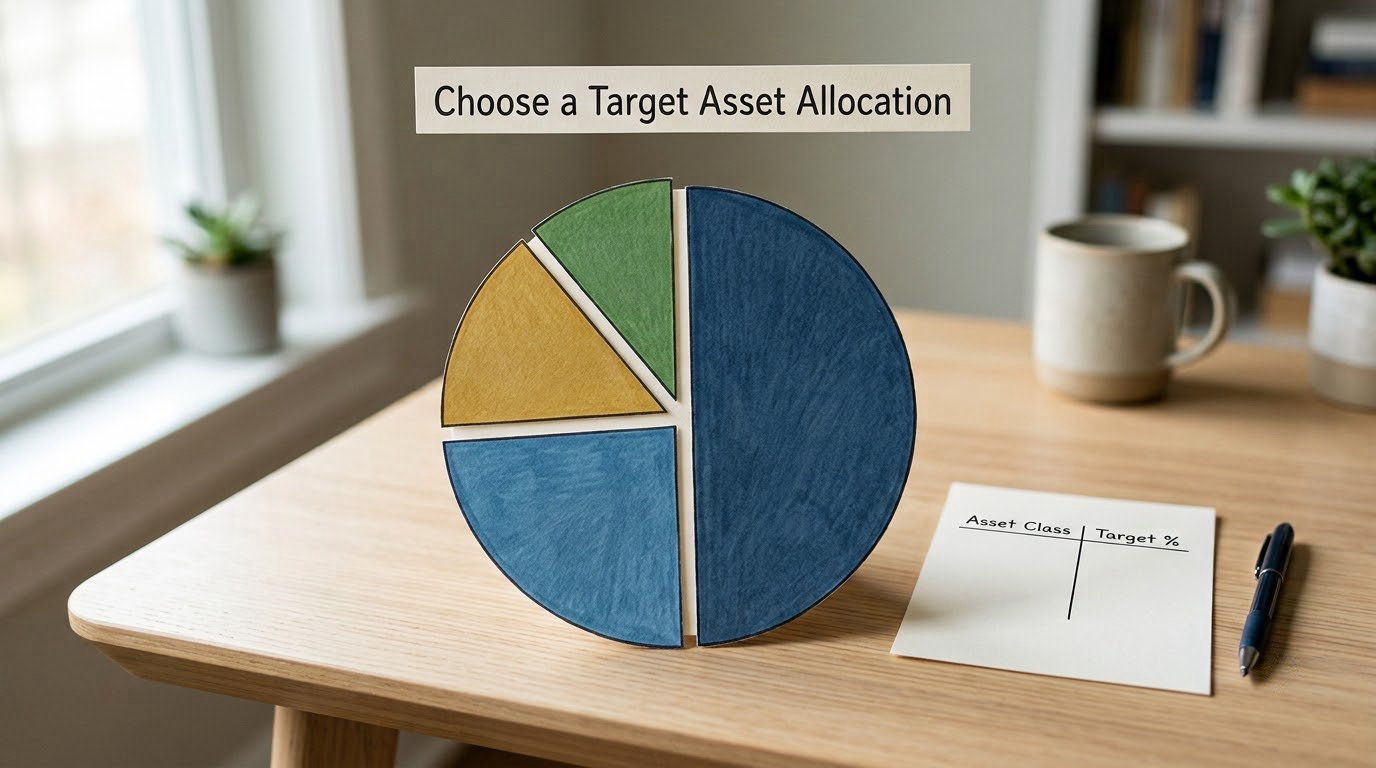
Now pick the mix you want to hold, and write it down. The right mix depends on two things only: your time horizon and how a 30% drop in value would actually affect your life. If that drop would mean selling in a panic, hold less stock, not more.
Here is what each asset class is generally for.
| Asset class | Role in the portfolio | Risk level | Typical share |
|---|---|---|---|
| US stocks | Long-term growth, dividends | High | 25-50% |
| International stocks | Growth from markets US holdings already exclude | High, sometimes higher | 10-30% |
| Bonds | Steady income, cushion in downturns | Low to medium | 10-40% |
| Cash and equivalents | Capital stability, near-term goals | Very low | 0-10% |
| Real assets | Inflation hedge, return source uncorrelated with stocks | Medium to high | 0-10% |
These are ranges, not rules. The most common mistake is picking an allocation to match the last two years of returns rather than the goal in front of you.
The second half of the decision is where the numbers get concrete. Vanguard, Fidelity, and Morningstar all publish model portfolios by risk profile, and a rough version of that idea is below. Treat these as starting points to adjust, not as prescriptions.
| Profile | Stocks | Bonds | Cash | Real assets |
|---|---|---|---|---|
| Conservative | 30% | 50% | 15% | 5% |
| Balanced | 60% | 30% | 5% | 5% |
| Growth | 80% | 15% | 5% | 0% |
| Aggressive | 90% | 8% | 2% | 0% |
Two rules of thumb show up constantly. The first subtracts your age from 100 to get your stock percentage, or 110 if you want a more aggressive reading. The second is the 70/30 split attributed to Warren Buffett, where 30% sits in short-term government bonds for stability. Neither is authoritative, and both drift out of date as life changes. Use them as a sanity check on your own number.
Turn the mix into a written allocation policy: one line per asset class, the reason it is that size, and the date you expect to revisit it. Vanguard’s education material is a good model for this kind of document, mainly because it is short.
How to verify it worked: every account has a stated role. Tax-advantaged accounts hold the assets that owe no tax on growth, which usually means broad funds, while the taxable account holds the tax-inefficient things you want anyway, like REITs or individual positions you plan to hold a long time. Doing this is called asset location, and it is a real second layer of diversification that most people never consider.
Diversify Within Each Asset Class
Having a stock bucket is not the same as being diversified inside it. This is where most portfolios quietly fail, and it is the single most common question raised on r/Bogleheads and r/portfolios threads.
Run a five-minute overlap check. Open each fund’s holdings list and compare the top ten names. If two of your US stock funds share most of the same top holdings, they are one holding wearing two tickers, and owning both does not spread anything. The same trap runs in reverse: an S&P 500 fund and a total US market fund overlap almost entirely, because the S&P 500 is most of the US market.
The fix is usually subtraction, not addition. One broad fund per asset class does more for a portfolio than six overlapping ones.
Individual stocks and sector funds can earn a place, but they are satellites, not the core. Bogleheads forum consensus is blunt about this: single stocks and sector funds are described as unnecessary and uncompensated risk. A reasonable pattern is a low-cost index core of 85-95% of the portfolio with a small satellite sleeve of 5-15% in whatever individual ideas you actually want to follow. A Canadian Money Forum thread on the other side of the argument is worth reading too, since it argues trimming concentrated positions can hurt, and there is no rule that fits every person.
Within bonds, remember that not all bonds move alike. A portfolio of long-duration corporate bonds added to a growth stock portfolio can be diworsification, since both can be hurt by the same rising-rate environment. Short and intermediate government bonds are the usual diversifier for a stock-heavy sleeve.
On employer stock specifically, most employers publish a 10b5-1 trading plan so you can sell on a fixed schedule without tripping insider trading rules or your company’s own trading window. If your grants have pushed a single employer past 20% of your portfolio, a staged sale under one of those plans is the standard route, and a tax professional can tell you whether to sell-and-rebuy, gift, or donate. Do not improvise around a blackout window.
How to verify it worked: no two funds in the same asset class share more than a handful of top holdings, and any single company or sector sits below the ceiling you set in the previous step.
Rebalance and Review on a Schedule
Once the portfolio drifts out of line, the mix you chose is no longer the mix you hold. Rebalancing puts it back, and it is the step people skip.
There are two triggers. Calendar rebalancing, once or twice a year on a fixed date, is simple and works well. Threshold rebalancing, acting when an asset class drifts about five percentage points from its target, is more responsive and cuts the number of trades. Pick one and put the date or the band in the same document as your target allocation.
The cheapest way to rebalance is with new money. Direct contributions to underweight funds before selling anything, and you get back to target without a single taxable sale. Only when contributions cannot close the gap do you sell.
When you do sell, be aware of the 30-day wash-sale rule, which blocks claiming a loss on a security you bought within 30 days of selling it, and of capital gains owed on gains. Tax loss harvesting, selling a loser to offset a gain, is the mirror image of the same mechanic, and it is a legitimate tool that many people never use. Every portfolio has a beneficiary no matter which share class or account type you hold, so a planned sale has a tax consequence attached.
Set the review rhythm so you are not tempted to check daily. A quarterly glance at whether you have drifted, and a real rebalance on your chosen date, is more than most people need. An Australian investing blog that documented losing 99% during the tech bubble made roughly this point: the portfolio that survives a bad cycle is the one whose owner stayed invested, not the one whose owner was watching.
How to verify it worked: a dated log of each rebalance, what you sold, the tax you paid, and what it brought your weights back to.
Common Mistakes
Overconcentration in one company or sector. Twenty percent in one employer feels like loyalty and is really a concentrated bet on one company’s earnings. Fix: use a staged sale plan and redirect proceeds into the broad core.
Buying more funds instead of different funds. Twelve ETFs that all hold the same mega-cap names is a false sense of safety, and a dozen expense ratios for one portfolio’s worth of exposure. Fix: run the overlap check and consolidate to one fund per asset class.
Diworsification. Adding more correlated assets raises risk while feeling like diversification. A tech fund added to a tech-heavy stock portfolio, or long-duration bonds added to a growth portfolio, both do this. Fix: check what an asset did in the last rate shock, not just what category it sits in.
Over-diversifying into 30 to 40 line items. The Canadian Money Forum has threads on this, and the objection has merit: every extra holding adds fees and admin, and spreading across dozens of positions makes it harder to track anything. Fix: a small, deliberate set of funds you can actually name from memory.
Chasing performance. Rotating into whatever led last year, which is how people end up concentrated by accident. Fix: write the allocation down before the news cycle changes and change it only when a life event happens, not when a sector does.
Ignoring fees and taxes. A 1.00% expense ratio versus 0.05% is a real gap over a thirty-year holding period, and a taxable account holding the wrong asset compounds the problem. Fix: check the expense ratio, and hold the tax-efficient assets in the tax-advantaged accounts.
Never rebalancing. A portfolio left alone for fifteen years can drift a long way from what you chose, because the assets that ran up take over the weight. Fix: calendar or threshold rebalancing on a set schedule.
Frequently Asked Questions
How many investments do I need to diversify my portfolio?
Most people need fewer than they think. One broad, low-cost fund per asset class, plus cash, covers the great majority of cases and is what most plain-vanilla portfolios do. Holdings only add diversification when they respond to the same events differently, so a dozen funds holding the same companies are one holding. A small number of individual stocks can sit alongside that core if you accept the extra risk.
Do I need bonds in my portfolio if I am investing for 20 years or more?
Not always. A long horizon lets you hold more equity, and an all-stock portfolio is defensible for someone with a stable salary and no near-term goals. Bonds do a specific job: they dampen the drop when stocks fall, and they fund short-horizon goals you would otherwise leave exposed to the market. If a 30% decline would not change your plans, a modest bond allocation is optional rather than required.
How often should I rebalance my portfolio?
Once or twice a year on fixed dates, or whenever an asset class drifts roughly five percentage points from its target, is a reasonable rule. Rebalance with new contributions first and taxable sales second, since selling inside a 401(k) or IRA does not trigger capital gains. Whatever schedule you pick, write it down in the same document as your target allocation so the decision is not remade every quarter.
What is the 70/20/10 rule for investing?
It is a popular shortcut, not a standard: 70% in a diversified core of stocks, 20% in bonds and stable assets, and 10% in speculative or alternative holdings. It roughly matches the balanced model in the table above, with an extra 10% carved out for whatever you consider higher-risk or higher-fee. Treat it as a starting point to adjust, since it ignores your time horizon, tax situation, and emergency savings.
What is the 7-5-3-1 rule in investing?
The 7-5-3-1 rule suggests holding 7% of your portfolio in aggressive growth assets, 5% in growth, 3% in income assets, and 1% in cash or short-term holdings, and it is also commonly described as a percentage of income to invest each category. The origin is uncertain, and the SEC’s Investor.gov has never endorsed it. It is widely repeated, not officially validated, and the age-based allocation tables above are a clearer place to start.
How do retirement accounts and taxes change diversification?
Account type is a second layer of diversification, often called asset location. Tax-advantaged accounts such as a 401(k), traditional IRA, or Roth IRA grow without an annual tax bill on dividends or gains, so they suit broad, tax-efficient index funds. REITs, individual shares you plan to hold a long time, and high-turnover funds fit better in a taxable account. Rebalancing inside the advantaged accounts first also avoids capital gains taxes.
Conclusion
If you do nothing else this week, do these three things. First, list every holding in every account and turn it into percentages, so you can see what you actually own rather than what you think you own. Second, write down a target mix and the reason behind each number. Third, make the smallest change that reduces your largest concentration, using contributions and tax-advantaged accounts first so the correction costs as little as possible.
After that, the job is small and boring. Check twice a year, rebalance on a threshold or a date, and let the plan sit. Most of the value in diversification comes from doing it once, clearly, rather than repeatedly and anxiously.
Updated October 2026. This article is educational and is not individual financial advice. Rules, tax rates, and account limits change, and they vary by state and country. Consider a fee-only financial advisor or a CPA for decisions specific to your situation.