An I bond is a U.S. Treasury savings bond that pays interest in two parts: a permanent fixed rate and an inflation rate that resets every six months, added together into a composite rate that can never fall below 0%. Unlike a savings account or a certificate of deposit, the rate on a bond you buy today is locked for its first year and then changes on that bond’s own six-month birthday.
How I bonds work and when to buy them is simpler than most explanations make it sound. Your principal never drops, you cannot touch the money for twelve months, and the month you purchase in quietly determines your rate for the first year. This guide covers the mechanics, the redemption rules, and a framework for timing a purchase, with no pretending that any of it is personalized advice.
For a reference point, bonds issued from May 1 through October 31, 2026 carry a composite rate of 4.26%, built on a fixed rate of 0.90%, based on the rates the Treasury announced on May 1, 2026. New composite rates are set every April and October for the windows beginning May 1 and November 1. Check the live figures at TreasuryDirect.gov before you act on any rate printed anywhere, including this one.
Table of Contents
- How I Bonds Work: Rates, Value, and Inflation
- How i bonds work and when to buy them: the basic mechanics
- How I Bond Interest Is Calculated
- When You Can Redeem I Bonds
- When to Buy I Bonds
- I Bonds vs. Treasury Bills, CDs, and High-Yield Savings
- Tax Treatment for I Bonds
- Common I Bond Mistakes to Avoid
- Frequently Asked Questions
- Are I bonds worth buying right now?
- What happens if I redeem an I bond before five years?
- Do I bonds really protect against inflation?
- Can I buy I bonds at a bank or do I need TreasuryDirect?
- How long do I bonds keep earning interest after they mature?
- Bottom Line
How I Bonds Work: Rates, Value, and Inflation
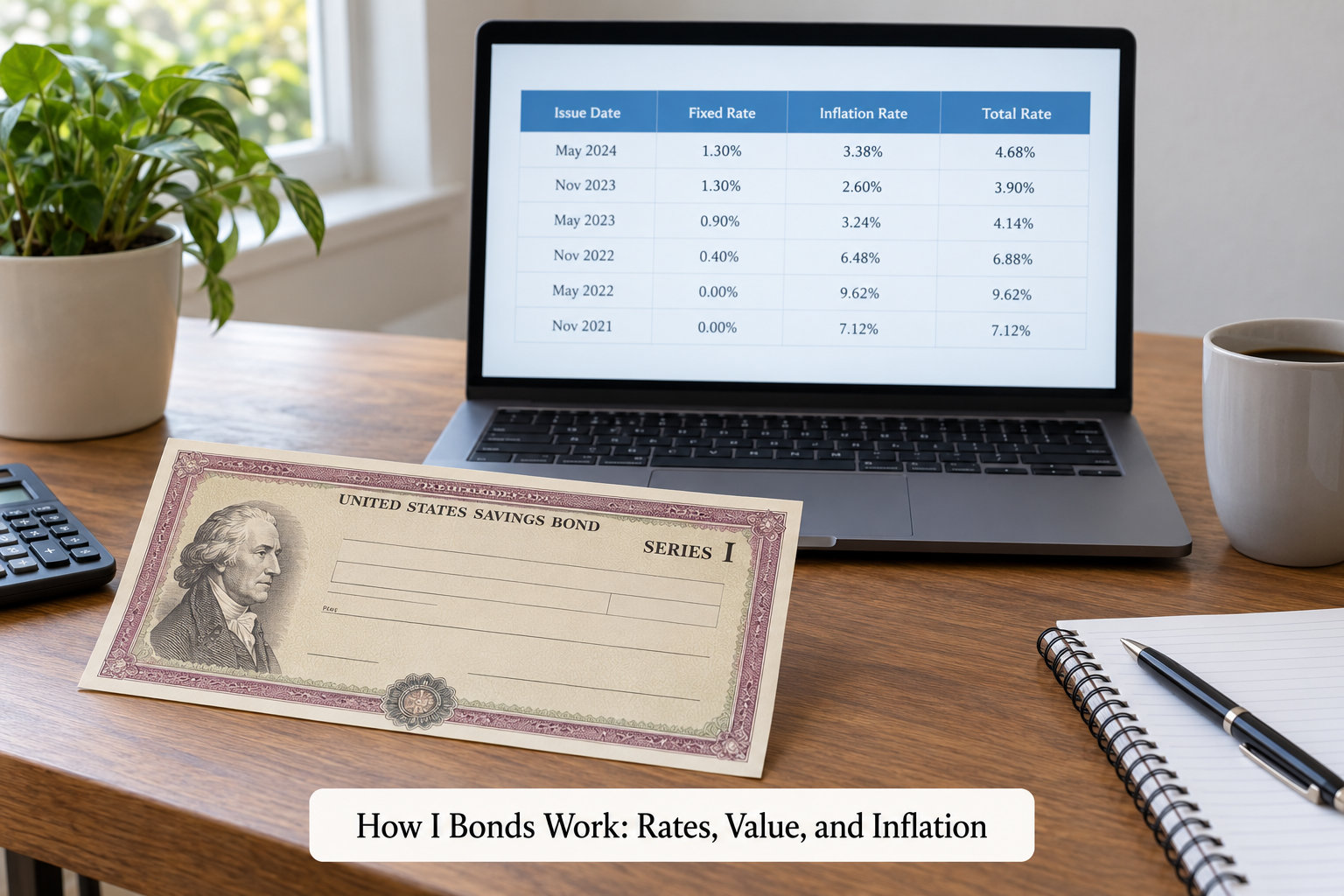
More precisely, a Series I savings bond is a government-backed note you buy for a fixed amount, hold for at least a year, and that pays interest until you redeem it or it reaches its 30-year final maturity. The interest has two components, and once you know which one does what, most of the confusion dissolves.
The fixed rate is set when the bond is issued and never changes for the life of that bond. If you bought at 0.90%, that number belongs to you for the next three decades. The Treasury publishes no formula for setting it, which is why people who track these things watch the real yield on 5-year TIPS as a rough signal of where the next fixed rate might land.
The inflation rate is the part that moves. The Treasury calculates it from six months of the Consumer Price Index for All Urban Consumers, the CPI-U, published monthly by the Bureau of Labor Statistics. It uses the non-seasonally adjusted index, announces the result at the end of April and the end of October, and applies it May 1 and November 1. When prices fall, the inflation rate drops to zero rather than going negative, so the composite rate never dips below your fixed rate. You keep every dollar of principal in either case, which is the whole reason people call the bond risk-free.
| Feature | Detail |
|---|---|
| Fixed rate (May-Oct 2026 window) | 0.90%, set at issue and permanent for that bond |
| Composite rate (May-Oct 2026 window) | 4.26% annual rate applied to the balance |
| Next rate announcement | End of October 2026, effective November 1, 2026 |
| Final maturity | 30 years from the issue date |
Interest accrues to your balance every month and compounds twice a year. The Treasury credits a month of interest on the first day of the following month, then reapplies the composite rate at your bond’s six-month anniversary. That anniversary is fixed by the month you bought in, not by the month the new rate was announced, and the gap between those two dates can run as long as two months. That single fact drives most of the timing advice further down this page.
How i bonds work and when to buy them: the basic mechanics
You buy electronic I bonds at TreasuryDirect.gov, the Treasury’s own site. There is no brokerage, no fee, and a minimum purchase of 25 dollars. You can set up a savings goal that sweeps a fixed amount each month into new bonds, or buy as a one-off from a linked bank account.
The annual limit is 10,000 dollars in electronic I bonds per person, per calendar year, counted from January 1 to December 31. You can take the whole amount on the first day of the year or spread it across twelve months. Money moving by bank account transfer typically takes a couple of business days to arrive, and the bond sits as pending until it settles.
Paper I bonds are no longer issued, so there is nothing to buy at a bank counter. If you still hold one from an earlier year, it keeps earning under exactly the same rules as an electronic bond, though redeeming it involves the paperwork your bank requires: a certified copy of the bond, and sometimes a form with the IRS to resolve a name mismatch on the certificate.
One more mechanic catches people out. Handing a bond to your child does not free up your buying room. A bond you purchase with your own money and then give away still counts against your own 10,000 dollar limit for the calendar year. The workaround couples describe on savings forums does work: one of you fills your limit, the other fills theirs, and the second partner’s bonds are delivered as gifts. That effectively doubles household purchases, and the person named on the bond is the one who reports the interest.
How I Bond Interest Is Calculated
The composite rate is the only number ever applied to your balance, and it comes from one formula:
composite = fixed rate + (2 x semiannual inflation rate) + (fixed rate x semiannual inflation rate)
The doubling converts a six-month inflation figure into an annualized one, and the last term is the compounding bonus. Take a fixed rate of 1.10% and a semiannual inflation rate of 1.20%: 1.10 + 2.40 + 0.013, or roughly 3.51%.
Now the part that trips up nearly every first-time owner. Your purchase value and your current value are two different numbers sitting in two different places on the same page. The purchase value is what you paid. The current value is the purchase value plus everything the bond has earned so far, and it changes every single month.
Which rate applies to which purchase depends on the month you bought in, and the schedule is simple enough to memorize:
| Month you buy the bond | Rate that applies to its first six months |
|---|---|
| May through October | The composite rate in effect from May 1 |
| November through April | The composite rate in effect from November 1 |
Here is a plain example. A 10,000 dollar purchase made during the May to October 2026 window at a 4.26% composite would be worth roughly 10,350 dollars after a year, before any tax. Now check the balance in the middle of a month and TreasuryDirect may show you a smaller number. The displayed current value is calculated as of the first day of the month, and for a bond younger than five years it is shown net of the three months of interest that would be forfeited if you cashed it out today. The money has not vanished. The screen is answering a different question than the one you are asking, and the gap closes on the next credit date.
When You Can Redeem I Bonds
You cannot redeem an I bond during the first twelve months from its issue date. After a year, redeeming is legal, but the cost of doing it drops in stages rather than disappearing all at once.
Between year one and year five, cashing out costs you the last three months of interest. The Treasury simply stops accruing, and the penalty is forfeiture rather than a fee taken from the balance. This is the detail that stings most often, because the three months you lose are frequently the good ones. That pattern comes up constantly on r/personalfinance and r/Bogleheads: the months forfeited are the highest-earning months of the cycle, and it feels like a bad deal even though it is just the rule.
On and after the five-year anniversary there is no penalty at all. Electronic bonds can be redeemed partially in 25 dollar increments after five years, which is handy if you want to leave the rest compounding.
So when should you actually pull the money? Experienced savers on those forums settle on a rule with two parts. Wait until after the first of the month so you collect that month’s accrual, and wait until roughly three months past your own rate reset, so the forfeited interest comes out of the lower-rate stretch. If a bond earned 4.26% in its first six months and something closer to 1.40% in the next, redeeming in month nine costs you the cheap months instead of the expensive ones.
Two final timing points. Interest stops at 30 years from issue regardless of the rate environment, TreasuryDirect notifies owners ahead of that date, and nothing is paid out automatically, so the balance simply sits there until you redeem it. And redeeming is a taxable event: the interest you have earned becomes federal taxable income in the year you cash, with the Treasury reporting it on Form 1099-INT.
When to Buy I Bonds
The honest answer is that the timing decision is narrower than the internet suggests, and most of it is about your cash flow rather than the calendar. Here is the framework, in the order I would work through it.
- Do the emergency fund first. An I bond you cannot touch for a year is a poor emergency reserve. If your high-yield savings balance covers three to six months of expenses, an I bond becomes a reasonable home for the layer above it.
- Use money you will not need for five years. One year is the legal floor, but the three-month penalty makes anything under five years feel punitive. Treat the five-year mark as the real horizon.
- Buy in the last few days of the month. A widely repeated tip on r/Bogleheads: buy at the end of the month and you are still credited for that entire month’s interest, while shaving the 12-month lock down to about eleven months and a day.
- Watch April and October, and understand what they can and cannot tell you. The composite in effect when you buy runs through the following six-month window. If you believe the next window’s composite will be lower, buying before the reset locks in the higher one. The catch is that the fixed rate can move up, and in late 2023 savers who waited for the reset were rewarded with a noticeably higher fixed rate than the one they had.
- Stagger purchases rather than timing one big buy. Buying smaller amounts in successive months spreads your exposure across rate windows and smooths out the damage from a bad reset, at the cost of a lower average fixed rate if rates are climbing.
- Compare before you commit. The composite is a headline number that moves twice a year. A certificate of deposit locks a known rate for a known term, and a Treasury bill has its own yield curve. If a comparable low-risk option pays more and you do not need inflation protection, the I bond is not the better tool.
It is worth saying plainly that timing the composite is a wager on two things you cannot know today: the inflation component, which is calculated from a window that has not closed yet, and the fixed rate, which reflects conditions the Treasury does not publish a formula for. Because the inflation rate is backward-looking, today’s headline CPI tells you very little about what the November composite will be.
I Bonds vs. Treasury Bills, CDs, and High-Yield Savings
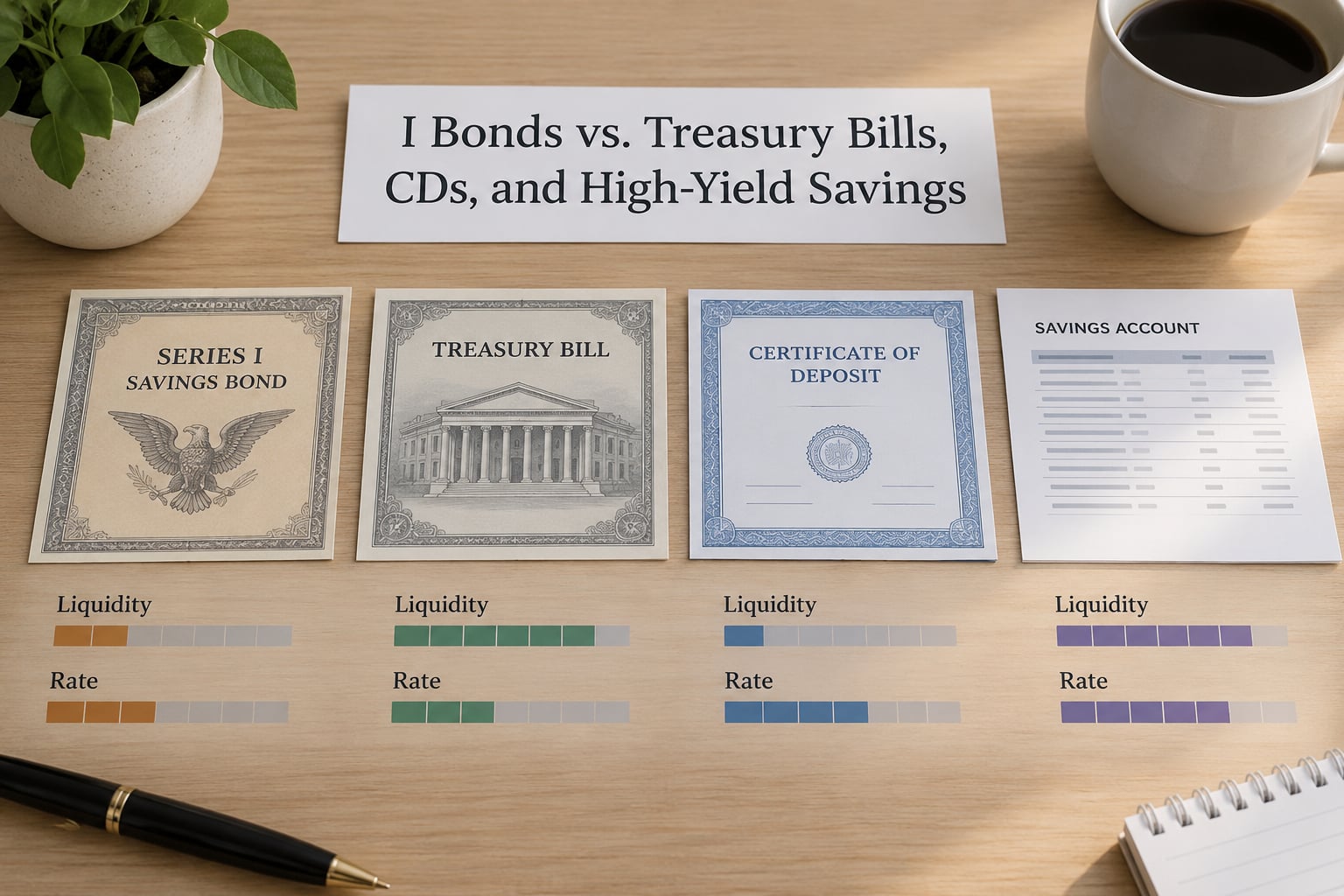
I bonds are not the best low-risk option for every job. The comparison below is the one people actually argue about on personal finance forums, and the differences come down to what is known, what is protected, and how fast you can get the money.
| Criterion | I Bonds | Treasury Bills | CDs | High-Yield Savings |
|---|---|---|---|---|
| Return known at purchase | No, resets every six months | Yes, fixed to maturity | Yes, fixed to maturity | No, can change any day |
| Inflation protection | Yes, via the CPI-U component | No, plain bills are fixed nominal | No | No |
| Liquidity | Locked for 12 months, penalty to year five | Sell or hold to maturity | Penalty for early withdrawal | Anytime |
| Backing | U.S. Treasury | U.S. Treasury | FDIC-insured, within limits | FDIC-insured, within limits |
| Tax treatment | Federal tax deferred to redemption, exempt from state and local income tax | Taxable annually as it accrues | Taxable annually as it accrues | Taxable annually as it accrues |
| Access requirement | TreasuryDirect account, no brokerage | Brokerage account | Bank or credit union | Bank or credit union |
| Best use | Money set aside for five years or more | Short horizons where the yield is known | Known term, known rate | Emergency fund and near-term cash |
One shortcut helps when comparing rates. Subtract the fixed rate from the composite rate and you get a rough measure of how much of the yield is inflation protection. A bond with a 4.26% composite and a 0.90% fixed rate is giving you about 3.36 points of expected purchasing-power growth, adjusted every six months. If a 5-year CD is paying meaningfully more than 4.26% and you do not care about inflation protection, the CD is the better deal for that money, full stop. The I bond wins on the combination of guaranteed principal, an inflation component, and no state or local tax, not on headline yield alone.
Two structural limits are worth keeping in mind. I bonds cannot be held in an IRA, which is a real problem for anyone who has already maxed out tax-advantaged space. And there is no secondary market, so you cannot sell a bond to a stranger for a different price the way you can with a Treasury bill on the secondary market.
Tax Treatment for I Bonds
I bond interest is not tax-free, and it is not currently taxed either. It is deferred. No tax is due while the interest accrues; the full amount becomes federal taxable income in the year you redeem, and the Treasury reports it on Form 1099-INT at that point.
Interest earned on an unredeemed bond is generally not included in your income while it sits there. If you redeem a portion of a bond after the five-year anniversary, only the interest attributable to what you cash out gets reported that year, and your basis in the rest of the bond carries forward.
State and local income tax is where most owners get pleasant news. I bond interest is exempt from state and local income taxes in essentially all cases, which for anyone in a high state tax bracket is a meaningful edge over Treasury bills, CDs, and savings accounts.
The owner of the bond is the taxpayer of record, which matters when bonds change hands. A parent who buys a bond for a child is the owner until the child reaches the age of majority, and a grandparent’s gift bond reports under the child’s name once ownership transfers. Reporting lines can get complicated enough that the IRS publications on savings bonds, such as Publication 970, are worth reading rather than guessing.
There is also an education angle. Interest from a redemption that pays qualified higher education expenses can be excluded from income, up to an annual exclusion amount that is adjusted for inflation, and Form 8815 is how you claim it. Whether that exclusion applies to you depends on your tax bracket and your expenses, so treat this as a lead to check with a tax professional rather than a conclusion.
Common I Bond Mistakes to Avoid
Reacting to a single rate announcement. A May or November headline does not change the rate on a bond you already own. Your rate changes on your own six-month anniversary. The fix is to look up your bond’s issue month and count six months, rather than reacting to news.
Confusing purchase value with current value. One is what you paid, the other is what it is worth today including accumulated interest, and the gap on a new bond looks suspiciously small at first. The fix is to check the issue date and the accrual schedule rather than assuming interest failed to post.
Taking money out in the first year. The Treasury will simply refuse. There is no early-exception provision, and it does not matter if the reason is a job loss or a medical bill. The fix is to keep I bond money in an account that already has its own buffer, so an emergency never forces a redemption.
Cashing out in year two because the rate looks bad. The three-month penalty falls on the most valuable months of your cycle. The fix is the one the forums settled on: redeem just after the first of the month, and wait until roughly three months past your own reset.
Buying more than the annual limit allows. The cap is 10,000 dollars in electronic bonds per person per calendar year, and it applies to every dollar you buy with your own money, including the ones you plan to give away. The fix is to check the calendar-year total, and to plan purchases in advance rather than in December.
Assuming the inflation adjustment is permanent. Only the fixed rate is permanent. The inflation component is recalculated twice a year from a six-month CPI-U window, and it can fall to zero. The fix is to treat the composite as a two-year snapshot rather than a permanent yield.
Thinking tax-deferred means tax-free. Deferred means the bill arrives when you redeem, on the full accumulated interest. The fix is to set the money aside for that tax, especially if you are in a higher bracket now than you expect to be later.
Frequently Asked Questions
Are I bonds worth buying right now?
It depends on your horizon, not the calendar. An I bond is a reasonable fit for money you will not need for five years, once your emergency savings are already covered, when you want Treasury-level safety with inflation protection and no state or local tax. It is a poor fit for a one-year goal, for a large share of your savings, or for someone who has already maxed tax-advantaged accounts, since bonds cannot be held in an IRA.
What happens if I redeem an I bond before five years?
Redeem during the first 12 months and the Treasury refuses the request outright, regardless of the reason. Redeem between year one and year five and you lose the last three months of interest, which the Treasury simply stops accruing rather than charging as a fee. From the five-year anniversary onward there is no penalty, and electronic bonds can be redeemed partially in 25 dollar increments.
Do I bonds really protect against inflation?
Partly, and the limitation is worth understanding. The inflation component of the composite rate tracks six months of the non-seasonally adjusted CPI-U, so it reacts with a lag and only measures that window. When prices fall, that component drops to zero instead of below it, and the fixed rate is too small to cover a deflationary stretch. The protection is real, partial, and periodically useless.
Can I buy I bonds at a bank or do I need TreasuryDirect?
TreasuryDirect.gov is the only place to buy new I bonds. Paper I bonds are no longer issued at banks or credit unions, and the annual electronic limit of 10,000 dollars applies to each person separately. If you already hold an old paper bond, you can still cash it at a financial institution that handles them, usually with a certified copy and sometimes an IRS form to fix a name mismatch.
How long do I bonds keep earning interest after they mature?
They stop. An I bond reaches final maturity 30 years after its issue date, and once that date passes no further interest is added to the balance. TreasuryDirect notifies owners as the deadline approaches, and nothing is paid out automatically, so the value simply sits in your account until you redeem it. Redeem before the 30-year mark if you want the interest to keep accruing.
Bottom Line
Start by opening TreasuryDirect.gov and reading two things: the composite rate currently in effect, and the redemption rules on their savings bond page. Then confirm the money you have in mind can sit untouched for at least a year, ideally five, without touching your emergency fund. How I bonds work and when to buy them both come down to that fit: a bond bought with patience, at a composite rate that still beats comparable low-risk options, adds inflation protection and a fixed principal to a small slice of savings. It is a sleeve, not a strategy, and the worst outcome is treating it as your entire cash plan.