
How to invest in international stocks comes down to four routes: a broad international mutual fund, an international ETF, US-traded American Depositary Receipts, or buying shares directly on a foreign exchange. Most US beginners should start with a low-cost fund or ETF, add it gradually to a portfolio that is otherwise tilted to their home market, and revisit the allocation once a year. The whole setup takes an afternoon; the discipline takes years.
That last part matters more than the mechanics. Buying a foreign-listed company is easy. Knowing how much of your portfolio should sit outside your own country, and holding that position for a decade, is the part beginners skip.
This guide walks through the prerequisites, a five-step process, the costs and tax rules that catch people off guard, and the mistakes that show up again and again. It is general educational information, not individual investment, tax, or legal advice, and past performance never predicts future results.
Table of Contents
- What You Need
- Step-by-Step: How to Invest in International Stocks
- 1. Set Your Goal, Timeline, and Risk Limit
- 2. Choose a Diversified International Fund or ETF
- 3. Check Costs, Liquidity, and Tax Treatment
- 4. Decide How Much to Allocate
- 5. Invest, Rebalance, and Review: How to Invest in International Stocks Over Time
- Common Mistakes
- Tips for Beginner International Investors
- Frequently Asked Questions
- Are international stocks safer than US stocks?
- How much should I put into international stocks?
- Is foreign currency automatically hedged in a US brokerage account?
- How are US taxes handled on foreign dividends and international funds?
- Are individual international stocks a good idea for beginners?
- Can I start investing internationally with a small amount?
- Conclusion
What You Need
Before you buy anything, you need a brokerage account that matches what the money is for. That is the single decision that shapes everything else, so it comes first.
A tax-advantaged account such as a traditional IRA or a 401(k) is usually the wrong home for international funds, because the foreign withholding tax on dividends inside those accounts is not currently recoverable. A taxable brokerage account is where most US investors hold international equity exposure for exactly that reason. If you are in a workplace plan, keep your domestic or total-market options there and place the international sleeve in a separate taxable account.
Beyond the account, you need five things lined up:
- An emergency fund. Three to six months of expenses in cash, somewhere you can reach it the same day.
- No unmanaged high-interest debt. Credit card balances and similar debt cost more than most investments are expected to return.
- A time horizon. International equities are volatile over months and rewarding over decades. Money you need within five years has no business in this sleeve.
- A written risk limit. Decide in advance how much a bad year is allowed to feel like, because the decision is much harder to make during one.
- A currency stance. You are buying overseas earnings with dollars. Decide whether you want that currency exposure or whether you want it reduced, and write down which one.
None of this is about picking the right fund. It is about making sure that when a market drops and the news is bad, you are not selling because you needed the money or because the last quarter scared you.
It also helps to separate investing from speculation. Building a diversified international position is investing. Concentrating a small account in a handful of unfamiliar companies on a foreign exchange is closer to speculation, and the same action can be either one depending on your reasoning.
Step-by-Step: How to Invest in International Stocks
Here is the process in order. Each step depends on the one before it, so resist the urge to jump to fund selection first and work backwards from there.
1. Set Your Goal, Timeline, and Risk Limit
Write down what the money is for before you write down what you want to buy. A retirement pot in thirty years and a house deposit in four years call for completely different allocations, and the second one does not belong in stocks at all.
Then pick a target percentage. For a US investor with a portfolio built around domestic large-cap index funds, a common range is roughly 10% to 40% outside the US, with most people landing somewhere in the middle once they account for what their employer plan already holds. The right number is the one you will still be holding in a drawdown, not the one that looked best in a chart.
The role of international stocks in a portfolio is diversification, not return-hunting. A domestic-only portfolio concentrates risk in one economy, one currency, and often one sector, because the largest companies at home tend to cluster in technology, communication, and consumer businesses. Adding a broad international sleeve introduces banks, industrials, automakers, energy, materials, and healthcare companies with completely different earnings drivers.
One honest caveat. The first decade of the 2010s taught many investors that international stocks were a dead weight, and plenty of people sold out of them at exactly the wrong time. That experience is real and worth naming. The counter is that a position you cannot hold through bad years is not diversification at all, it is a bet with extra steps.
2. Choose a Diversified International Fund or ETF
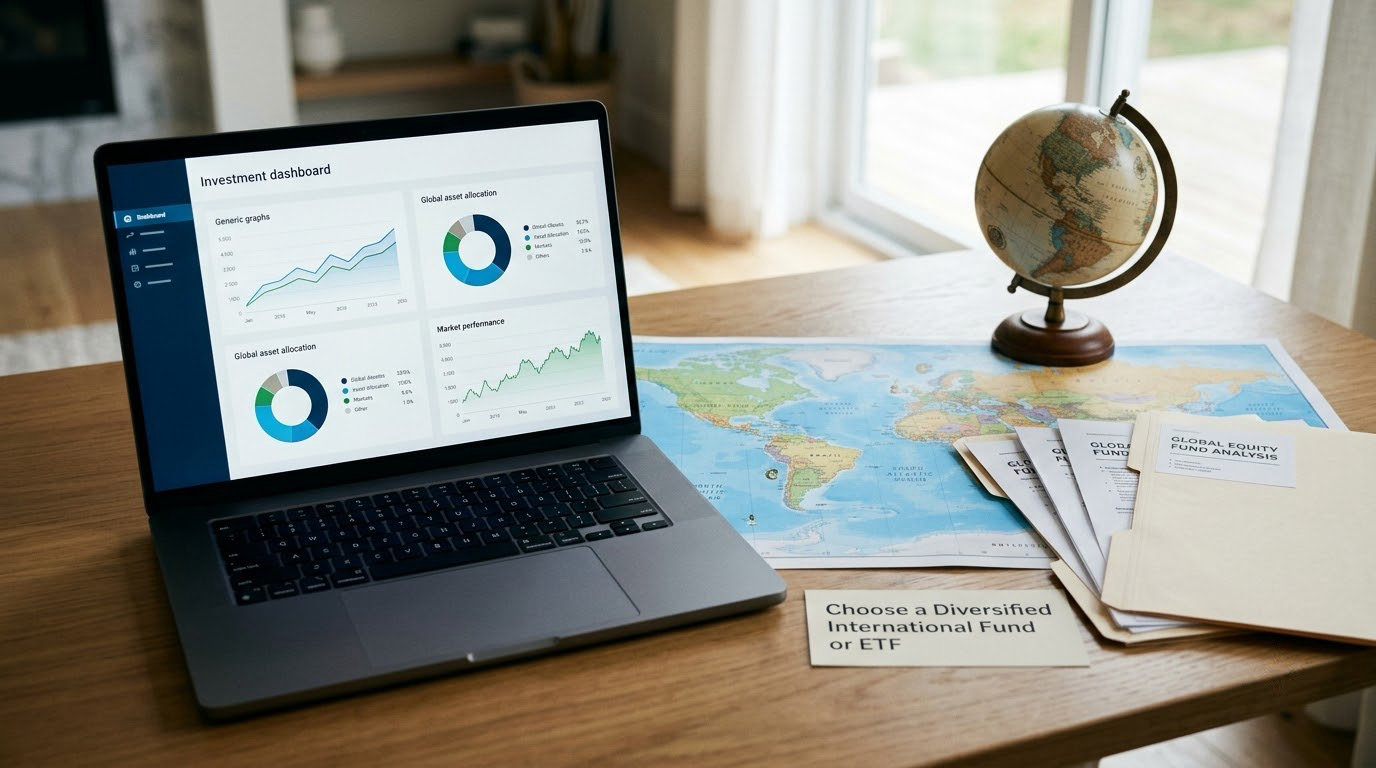
There are four fund categories to understand, and they differ mainly in which countries they cover.
A developed markets fund holds companies in places like Japan, the United Kingdom, Canada, and the major European markets. A emerging markets fund holds companies in countries such as China, India, Brazil, and South Korea. A total international fund holds both. A global fund includes the US too, so it overlaps heavily with a domestic fund and is a different tool entirely.
For a beginner, the total international category is usually the simplest starting point: one fund, one decision, no second-guessing about whether emerging markets deserve a separate slice. If you want a deliberate developed-versus-emerging split, treat it as a second decision you make after the first purchase has settled in.
One wrinkle worth knowing early, because it causes accidental double-counting. Index providers classify countries differently. FTSE treats South Korea as a developed market while MSCI treats it as emerging. If you buy a developed fund and an emerging fund, you may end up with two positions in the same company without realising it.
ETFs and mutual funds tracking the same index are usually the same portfolio in different packaging. The differences that matter to a beginner are structure rather than contents: ETFs trade intraday like a stock, mutual funds price once at the close, ETFs can be bought in fractional shares through most major US brokers while mutual funds often have minimums, and mutual funds may have higher minimum investment amounts for the initial purchase. Read the fund’s own fact sheet for the current numbers rather than trusting a comparison you found last year.
Currency exposure is the other question. An unhedged fund lets the dollar’s moves flow straight into your return, which adds volatility but also potential upside when the dollar weakens. A hedged share class tries to neutralise currency movement at the cost of a higher fee and, sometimes, a tax treatment that is harder to explain. Unhedged is the more common beginner choice, and understanding the fee before you buy matters more than the decision itself.
3. Check Costs, Liquidity, and Tax Treatment
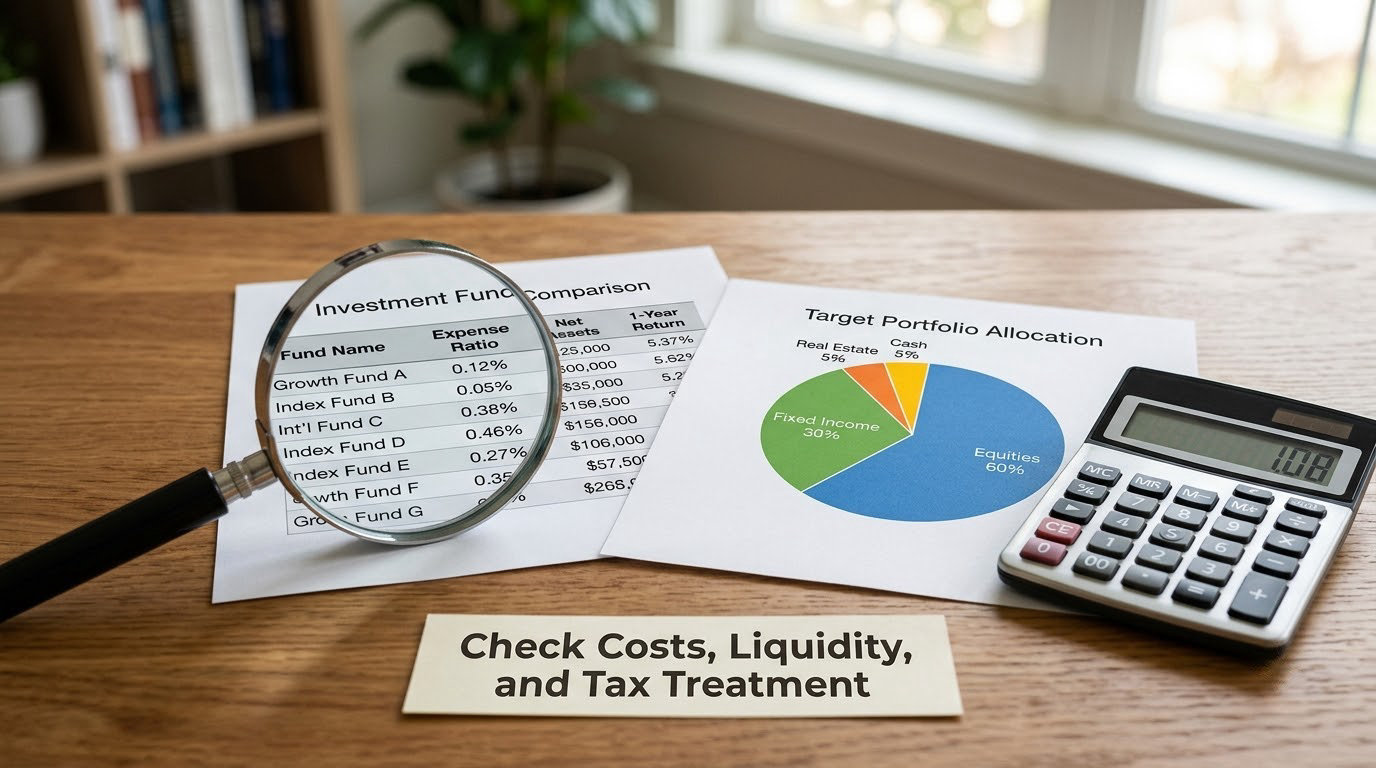
Four numbers decide whether an international position is cheap or expensive, and all four are published on the fund’s fact sheet.
The first is the expense ratio, the annual percentage taken out of the fund before you see anything. On a small balance the difference between a low-cost index fund and a higher-cost one is small in dollars, but the gap is real, permanent, and compounds. Pick the cheapest reasonable option and stop comparing fund A to fund B over a fraction of a percentage point. That obsession is common in forums and it costs more attention than it saves.
The second is the trading cost: the bid-ask spread you cross when you buy and sell, plus any commission. A US-listed ETF trades during US market hours like any other stock, which makes spreads tight and pricing transparent. A fund on a foreign exchange carries a wider spread and per-trade fees, and on a small account those costs can eat a meaningful share of the position. This is the core reason most beginners should avoid direct foreign-exchange trading.
The third is turnover. A fund that constantly trades its holdings has more embedded trading costs and more tax drag than one that simply holds the index. Two funds tracking the same index should have similar holdings, so this is a quick sanity check rather than a deep analysis.
The fourth is domicile and distribution rules, which determine the tax handling described below. A US-domiciled fund with US holdings and a developed markets fund behave very differently from a foreign-domiciled fund holding only foreign assets. Domicile is one of the least obvious numbers on the fact sheet and one of the most consequential.
Liquidity matters too. A US-listed international ETF with a healthy trading volume lets you sell on a normal business day at a known price. Some niche or thinly traded funds do not, and you should check average volume before you assume you can get out when you want to.
4. Decide How Much to Allocate
Sizing is where diversification turns into a portfolio decision. The question is not “how much international is good” but “how much of this portfolio should not be exposed to my home country.”
Start from your total investable assets, including retirement accounts, not just the account you are about to open. Count what you already own before adding anything. If your employer plan holds a total-world fund, part of your diversification already exists and a new position could tip you past your target.
Then watch for two failure modes. The first is a position so small it cannot matter, held in an account with a large cash balance sitting next to it. The second is a position so large that you have quietly become a country bet. A 70% allocation to a single overseas market is not diversification, it is a new version of home-country bias pointed somewhere else.
Currency exposure deserves its own line in the sizing decision, because it is a risk that does not show up in the number of tickers you own. Two funds holding companies in ten different countries can still be one bet on the dollar. A total international fund keeps that risk spread across many currencies, which is a decent argument for it as a default.
A worked example makes the mechanics concrete. Someone with a steady monthly contribution of a few hundred dollars might start by directing new money rather than new cash: keep buying the domestic fund they already own, and route part of each monthly deposit to the international fund until the international sleeve reaches the target percentage. No selling, no taxes triggered, no timing decision.
5. Invest, Rebalance, and Review: How to Invest in International Stocks Over Time
Once the allocation is decided, the actual purchase is the easy part. Log into the brokerage, search the fund’s ticker, and check three things on the order screen before submitting.
First, confirm you are buying the fund you meant to buy, not a similarly named one. Fund tickers are close together. Second, look at the bid-ask spread if the fund is an ETF; anything unusually wide means low volume right now, and you can wait a moment or place a limit order instead of a market order. Third, use a market order during normal US trading hours for a liquid fund, and a limit order if you care about the exact price you receive.
Then automate. Most major US brokers let you set a recurring purchase that executes on a fixed date, which removes the monthly decision entirely. Consistency of contribution matters more than the day you pick, and automation is the only reliable way most people keep that consistency through a bad quarter.
Set a review rhythm rather than a reaction loop. Once a year, check three things: whether the international percentage still matches your target, whether the fund’s expense ratio or structure has changed, and whether your time horizon has moved. That is the whole review.
Rebalancing has a simple rule: when the international sleeve drifts more than a few percentage points from your target, buy the underweight side with new contributions or sell the overweight side. Once a year is a perfectly good schedule. Many investors never need to sell at all, which avoids a tax bill as well as the discomfort of trimming a winner.
Keep records. The broker produces a consolidated 1099 for US-domiciled funds, and a tax return built from it is straightforward. The same is true of an international ETF held in a taxable account. It stops being straightforward the moment you hold foreign-registered shares directly or a fund domiciled outside the US, which is a strong practical argument for staying with the simple structure.
Common Mistakes
Almost every problem in international investing comes from doing something small and reasonable several times in a row.
Buying a handful of familiar global brands. Buying the handful of US-listed companies you already recognise, and calling it international exposure, is the most common mislabel of all. Several large multinationals are US listings of foreign companies, but that is not a diversified international portfolio. The correction is simple: if you cannot name the index your money tracks, you are picking stocks, not investing internationally.
Treating diversification as a set of exotic bets. Emerging markets carry higher volatility and, in some countries, real political and currency risk. That is a reason to size them deliberately, not to avoid them entirely and pretend the rest of the world does not exist. A total international fund handles both categories in one position.
Ignoring currency and fees until they show up. Currency moves can add or subtract several percentage points of annual return, and a higher expense ratio subtracts from every single year, forever. The correction is to read the fund’s currency hedging note and its fee line once, before buying, and to accept that result.
Investing money you might need soon. International equities have had long stretches where a decade of returns was disappointing. If the money has a date attached, it does not belong in this sleeve regardless of how cheap the fund looks. Fix: keep the short-horizon money in cash or short-term bonds and let the international position be the part of the portfolio with no deadline.
Trading it like a news cycle. Reacting to a currency move, a trade dispute, or a bad quarter in a foreign index usually converts a long-term plan into a realized loss. Experienced forum participants are consistent on this point: the funds they keep are the ones they stop watching daily.
Skipping the paperwork. Foreign accounts, registered foreign shares, and foreign-domiciled funds can trigger US reporting obligations and, in some cases, punitive tax treatment that is difficult to unwind. The correction is to stay with US-domiciled funds and US-listed instruments until you have confirmed with a tax professional what a specific structure would do.
Tips for Beginner International Investors
Start with one low-cost, broadly diversified vehicle and let it run. Add to it automatically, keep your cash reserves intact, and hold the position long enough that currency noise averages out.
Compare funds on total cost and actual exposure, not on recent performance. Last year’s leader is usually a good candidate for next year’s laggard, and the fund fact sheet tells you everything you need in one place.
Read the tax documents your broker sends. It takes ten minutes a year, and it is the difference between understanding your return and guessing at it.
Rebalance on a schedule rather than on a headline. The point of a rebalancing rule is that it is dull and mechanical, which is the whole advantage over trying to time it.
Frequently Asked Questions
Are international stocks safer than US stocks?
No, and safer is the wrong frame. International and US equities carry the same fundamental risk: company earnings can fall and markets can drop sharply. What international holdings change is the mix. They add exposure to other economies, currencies, and sectors, which reduces the effect of any single country’s downturn on your portfolio. Lower volatility comes from diversification, not from owning foreign stocks per se.
How much should I put into international stocks?
For a US investor, a common target sits somewhere between 10% and 40% of the portfolio outside the US, counting every account you own, including your employer plan. The right figure is the one your risk limit can support through a bad year. If your retirement plan already holds a total-world fund, count that before adding anything so you do not end up above your target.
Is foreign currency automatically hedged in a US brokerage account?
Usually not. A standard international or global ETF is unhedged by default, which means the dollar’s movement against the basket of foreign currencies flows directly into your return. That cuts both ways and adds volatility. Some funds and share classes hedge the currency, and those usually charge more and can be tax-complicated. Check the fund’s hedging note before you buy, and decide whether you want the exposure deliberately.
How are US taxes handled on foreign dividends and international funds?
US taxpayers owe tax on foreign dividends the same way as domestic ones, and foreign countries usually withhold tax first. For US-domiciled funds the foreign tax credit generally lets you offset that withholding, which is why these funds are usually held in taxable accounts. A W-8BEN is for non-US persons and changes treaty withholding. Foreign accounts, registered foreign shares, and foreign-domiciled funds can add reporting obligations, so confirm specifics with the IRS or a tax professional.
Are individual international stocks a good idea for beginners?
Usually not, and the reasons are mechanical rather than philosophical. Buying shares on a foreign exchange through a US broker means wider spreads, per-trade fees, foreign withholding that is often harder to recover, possible foreign-account reporting, and occasionally punitive treatment under PFIC rules. Experienced forum participants consistently advise beginners to use a diversified fund instead and only consider individual names once the account is large and the paperwork is understood.
Can I start investing internationally with a small amount?
Yes, and a fund is the reason. Most major US brokers let you buy a US-listed international ETF in fractional shares for a small recurring amount, and the expense ratio does not change with your balance. Buying individual foreign shares does not work that way: local lot sizes, settlement mechanics, and the currency conversion make small positions impractical, which is another argument for the fund route at the start.
Conclusion
Start with one thing this week: write down your goal, your timeline, and the percentage of your portfolio you are willing to hold outside your home country. Then open a taxable brokerage account at a broker you already use, buy one low-cost broadly diversified international fund in fractional shares, and set the purchase to repeat monthly.
From there the work is maintenance. Check the allocation once a year, rebalance with new contributions when it drifts, and read the fact sheet and tax documents as they arrive. That is the whole process, and it is enough to stop home-country bias from quietly running your portfolio for the next thirty years.
This is general educational information, not individual investment, tax, or legal advice. Tax rules, fund costs, and market conditions change, so verify current details with the IRS and your broker before you act.