Quantitative easing explained simply: a central bank creates money electronically, uses it to buy government bonds from financial institutions, and the extra demand pushes bond prices up and yields down. That is the whole idea. Everything else is detail about how, when and how well it works.
I have watched this topic scare people for years, mostly because the explanations assume you already understand yield curves and bank balance sheets. You do not need either. If you own a mortgage, a savings account, a bond fund or a retirement account, the short version above is enough to read the news intelligently. The rest of this guide builds that version up one piece at a time.
One note before we start: this is a general explanation, not financial advice. Rates, programmes and rules change over time, and individual circumstances differ.
Table of Contents
- Quantitative Easing Explained Simply: What It Is
- What Problem Is Quantitative Easing Meant to Solve?
- Rates hit the zero lower bound
- A liquidity trap
- Deflation risk
- Financial stress
- How Does the Federal Reserve Buy Bonds?
- What Happens to Interest Rates and Inflation?
- How Does Quantitative Easing Affect Stocks, Bonds, and Banks?
- What Are the Benefits and Risks?
- What Should US Savers and Investors Do?
- Quantitative Easing Explained Simply: Key Takeaways
- Frequently Asked Questions
- Is quantitative easing the same as the Federal Reserve cutting interest rates?
- Does quantitative easing mean the Federal Reserve simply prints money?
- Can the Federal Reserve use quantitative easing to buy stocks?
- How long does quantitative easing usually last?
- How does quantitative easing affect my mortgage, savings, and investments?
- Conclusion
Quantitative Easing Explained Simply: What It Is
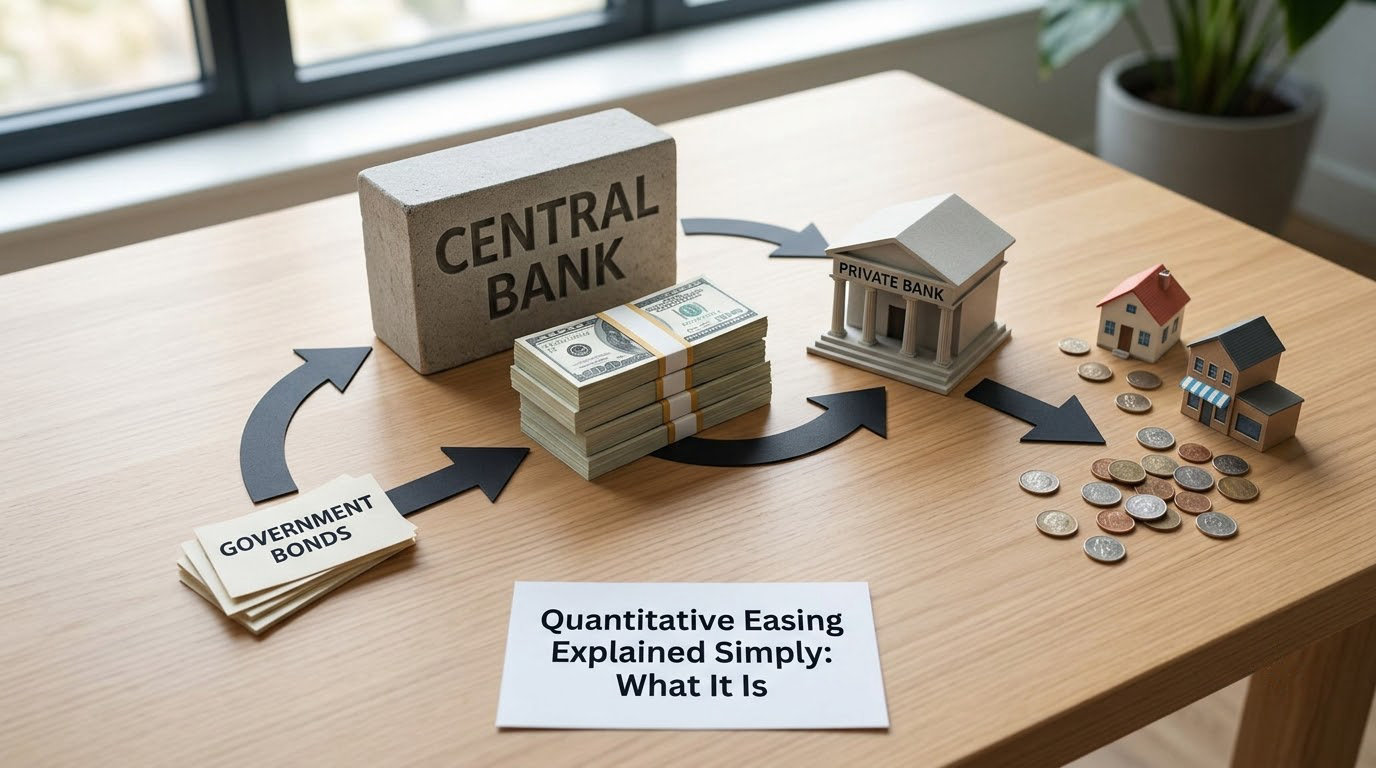
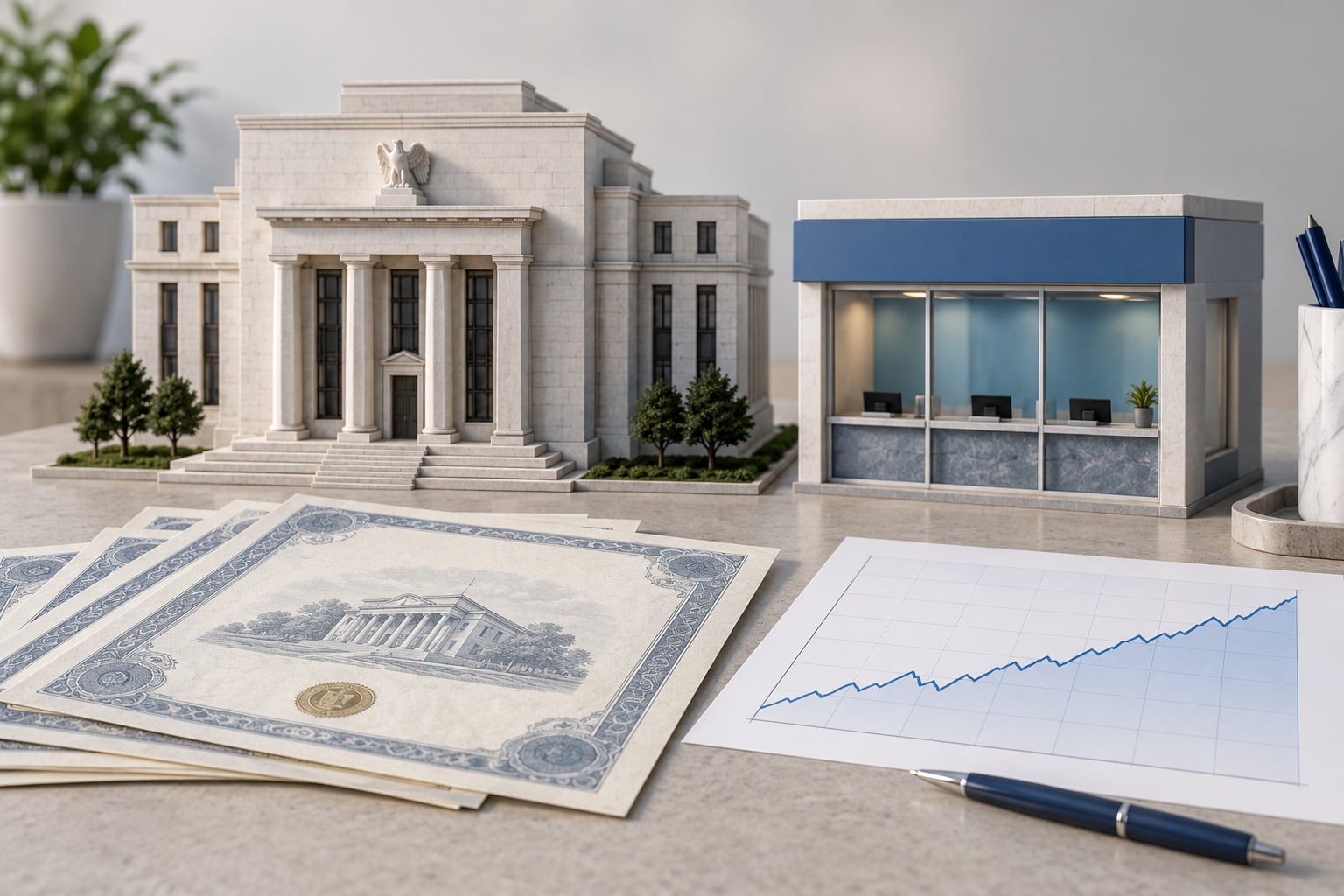
Think of a central bank as a very large bank that sits above ordinary banks and holds their accounts at the central bank itself. When the Federal Reserve buys a Treasury security from a commercial bank, it credits that bank’s reserve account and takes the bond in return. Money now sits with the central bank that used to sit with the bank.
The trick is in the word quantitative. Central banks normally steer the economy by moving the price of short-term money, the federal funds rate. Cutting the rate is cheap and reversible. When that rate is already near zero, there is no room left for further cuts, so the Fed eases the quantity of money instead. The name is unusually honest: it is about how much money there is, not how much a loan costs.
QE only ever runs alongside normal rate policy. It is not a replacement for cutting rates, it is what a central bank reaches for when cutting rates stops working.
What Problem Is Quantitative Easing Meant to Solve?
Quantitative easing is a response to conditions that make ordinary rate cuts useless. There are four situations that bring it out.
Rates hit the zero lower bound
When the federal funds rate approaches zero, the economy is described as being at the zero lower bound. Cutting further would mean paying banks to borrow, which is nonsense in normal times. The Bank of Japan spent years in exactly this position.
A liquidity trap
A liquidity trap is a market where everyone expects rates to stay low, so nobody wants to hold cash. Cash pays nothing, bonds pay something, and money is sitting idle anyway. Rates fall, people still hold cash, and rate cuts stop transmitting into spending. This is the situation QE was designed to break up.
Deflation risk
If prices are falling or expected to fall, people wait. That drags demand down further. Central banks buy assets partly to keep inflation expectations anchored above zero, which is why nearly every major central bank has a formal target around 2 percent.
Financial stress
During a crisis, markets can freeze even with plenty of money in the system. QE restores liquidity fast. The Bank of England created 895 billion pounds between March 2009 and September 2020, and by 2020 the central bank held roughly a third of all UK government bonds, known as gilts, in issue.
The immediate purpose is market plumbing. The intended longer-run effect is stronger lending, higher spending and steadier prices. Those two goals are not the same, and the gap between them is where most of the criticism lives.
How Does the Federal Reserve Buy Bonds?
The mechanics sound mysterious until you notice that nothing physical moves. Here is the sequence, step by step.
- Creating money. The Fed adds a reserve credit to the seller’s account at the Fed. That is the “printing,” and no printing press is involved. It is an entry in a ledger.
- Buying the asset. The Fed takes the security and credits the seller’s bank reserve account.
- Reserves grow. The banking system now holds far more reserves at the Fed than before.
- Bonds leave private hands. The stock of bonds held by the public falls, while the Fed’s balance sheet grows by the same amount.
- The Fed manages the size. Purchases can be capped by amount, extended by time, or slowed, which is why programmes always come with a schedule attached.
Two misconceptions trip up almost everyone.
The Fed does not buy bonds from the government. It buys in the secondary market, from banks and dealers, exactly like any other large institutional buyer. Treasury sells the bond to the public, and the Fed later buys it from whoever is holding it. That is why QE is not direct monetisation of the debt.
The seller does not walk away with piles of cash. The payment lands as a reserve balance at the Fed. Whether it ever becomes spendable money for that bank depends on what the bank does next.
Here is the arithmetic in miniature. A bank sells 1 million dollars of bonds to the Fed. The Fed creates 1 million dollars of reserves and the bank’s balance sheet now holds 1 million dollars more in reserves and 1 million dollars less in securities. No household has a new 1 million dollars to spend yet. Nothing has inflated. Money only expands if the bank lends it out or spends it, which is the whole argument about whether QE reaches the real economy.
What Happens to Interest Rates and Inflation?
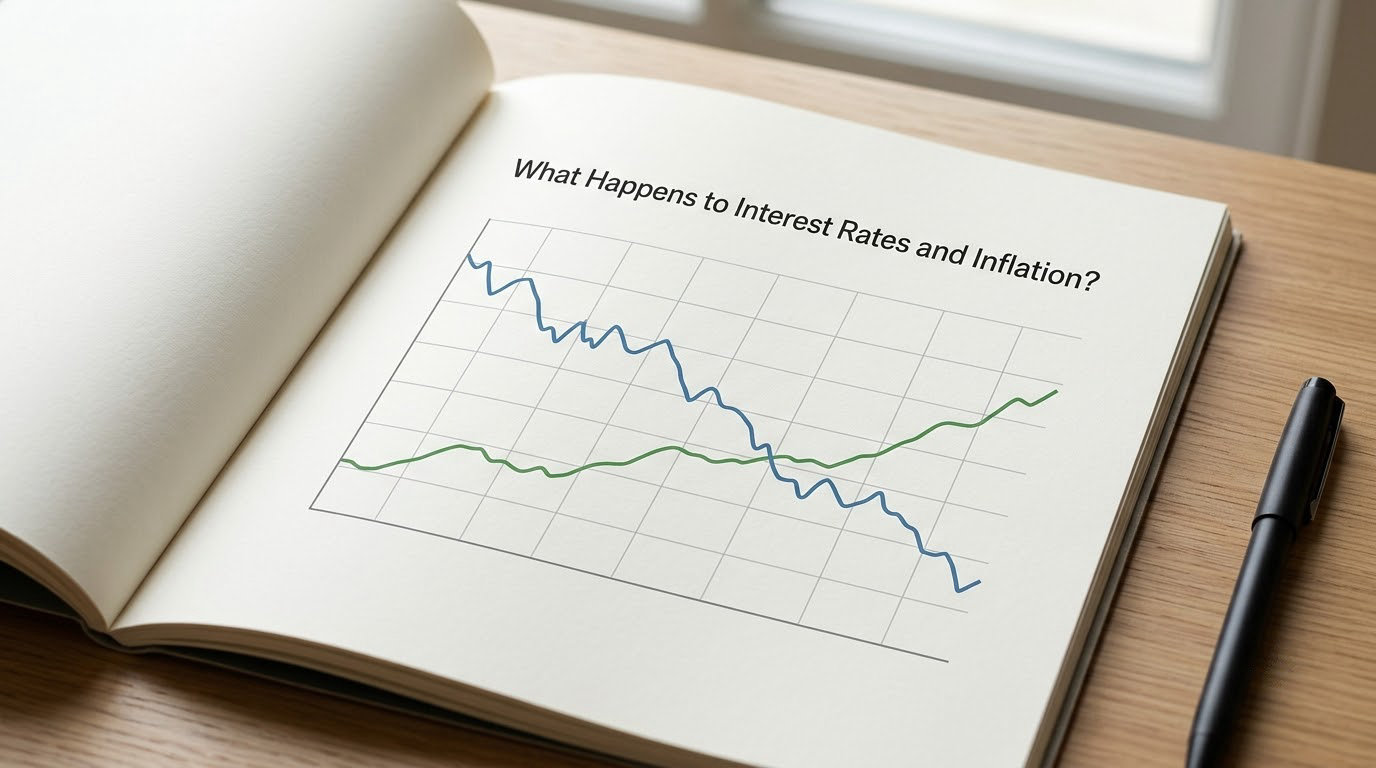
Bond prices and bond yields move in opposite directions. That single fact is why buying bonds lowers rates. A bond paying a fixed coupon becomes more attractive when it costs more, so the only way to bring its price back down to fair value is for the market to demand a higher yield on new issues.
Here is the version I wish someone had shown me first. Say a 10-year bond pays 3 percent and trades at 100. The Fed pushes its price to 110. That bond now pays 3 percent on 110 invested, which is closer to 2.7 percent. New buyers demand a higher coupon, so newly issued bonds pay more. Those rates feed into mortgages, corporate loans and auto loans.
| Starting condition | Policy action | First-order effect | Uncertain outcome |
|---|---|---|---|
| Rates near zero | Large-scale asset purchases | Bond prices rise, yields fall | Whether lending responds at all |
| Demand is weak | Balance sheet expansion | Banks hold more reserves | Whether reserves get lent out |
| Deflation expectations | Large-scale asset purchases | Rate expectations shift higher | Whether expectations actually move |
| Financial stress | Emergency liquidity purchases | Spreads narrow, markets reopen | How much damage was already done |
On inflation, be careful with confident claims in either direction. The transmission is not automatic. If reserves sit idle and lending does not expand, the money never reaches consumers and prices barely move. That is the strongest argument that QE is not simple money printing.
The other argument is that QE removes the constraint that would otherwise force rates higher, keeping borrowing costs low for longer than an economy with healthy demand can support. Over time, some economists argue that means more of the adjustment lands on prices instead of on asset values. Both readings are defensible, and the data is genuinely mixed.
How Does Quantitative Easing Affect Stocks, Bonds, and Banks?
Stocks and high-grade bonds tend to benefit first, because cash is now a relatively worse holding. Money moves into assets that pay something, which lifts prices. That rebalancing effect is one of the more reliable transmission channels, and it helps ordinary investors holding broad index funds, not just the banks.
Longer-dated bonds generally get more support than short-dated ones, since QE targets the longer end of the curve. It is a moderate tilt, not a guarantee.
For banks, the story is more complicated. Reserves are an asset, so a bank’s balance sheet expands. Whether that produces more lending depends on whether borrowers want loans. Evidence from the post-2008 and post-2020 rounds suggests the link between reserves and business lending is weaker than the textbook version implies.
Equity markets read QE as a vote of confidence in the financial system, though not necessarily in the underlying economy. Some sectors, especially rate-sensitive ones like housing and homebuilders, react more strongly than the index as a whole.
Treat all of this as a channel, not a forecast. These are tendencies under conditions that no longer hold, not rules that reliably repeat.
What Are the Benefits and Risks?
The benefits are real and they show up quickly in crises. QE restored functioning to markets that had seized, kept a deflationary spiral from forming in 2008, and held borrowing costs down while economies recovered from the pandemic shock. For savers, one underrated benefit is that a central bank holding huge bond portfolios tends to be slower and gentler about tightening later.
The risks are equally real.
- Inflation. If demand recovers while money and reserves are abundant, prices can rise faster than intended.
- Asset bubbles. Cheap money encourages investors to reach for yield and for riskier assets.
- Unequal outcomes. Asset holders benefit sooner than wage earners, which widens the gap between the two.
- A hard exit. Selling a large portfolio later can disturb markets, which is why tightening is slow and cautious.
- Possible ineffectiveness. If households and firms are deleveraging, more reserves do not create more spending.
Both camps make fair points. Bulls argue that the counterfactual without QE was worse. Bears, including plenty of academic economists, point to models showing that once short-term rates are already pinned down, large purchases move long rates less than markets expect. The honest summary is that we have decent evidence about what QE does to markets and weaker evidence about what it does to the real economy.
What Should US Savers and Investors Do?
You cannot control monetary policy and you should not trade on an announcement. You can, however, stop being surprised by it. A few general steps are worth a review.
Check whether your cash is doing a real job. With lower policy rates generally floating around for longer, an emergency fund sitting in a low-yield account is a decision you can revisit on your own terms.
Look at your borrowing exposure. Fixed-rate debt stays put no matter what the Fed does. Variable-rate debt tracks policy expectations more closely, and QE itself tends to pull the whole curve down while it runs.
Know your bond fund’s duration. The longer a fund’s average maturity, the more its price swings when rates move. If a long-duration fund fell in a tightening cycle, understanding why is more useful than reacting to the next headline.
Keep diversification and cash reserves. A mix that includes some short-duration holdings is one practical way to reduce how much any single policy shift matters to you.
Do not assume lower rates mean everything rises. QE has historically lifted some asset classes far more than others, and the effect fades once the programme stops.
Re-read this whenever the Fed announces a change. The mechanics stay the same; what changes is the starting condition.
Quantitative Easing Explained Simply: Key Takeaways
- The Fed creates money electronically, buys government bonds in the secondary market, and the Fed’s balance sheet grows by the amount it spends.
- The bank or dealer that sells the bond receives a reserve credit at the Fed, not cash in a drawer.
- Bond prices and yields move in opposite directions, so buying bonds pushes yields down and borrowing costs down with them.
- QE runs when rate cuts stop working: at the zero lower bound, in a liquidity trap, when deflation is threatened, or during financial stress.
- Asset prices usually react faster and more reliably than spending does, which is why stocks and long bonds benefit most.
- Whether QE creates real growth or mainly raises asset prices is still argued among economists. Treat it as uncertain.
- For savers, the practical takeaways are your own: cash yield, rate exposure, portfolio duration and diversification.
Frequently Asked Questions
Is quantitative easing the same as the Federal Reserve cutting interest rates?
No, they are different tools that can be used together. Cutting the federal funds rate lowers the price of short-term money, which is cheap to do and easy to reverse. Quantitative easing increases the amount of money and the size of the central bank’s holdings by buying bonds, which happens when rates are already near zero and cuts are no longer possible. Most people describe QE as the second line of defence, not a substitute for the first.
Does quantitative easing mean the Federal Reserve simply prints money?
Not in the way most people picture it. No paper is printed and no banknotes enter circulation. The Fed credits reserve accounts electronically, so the new money is a ledger entry held at the central bank. It only becomes money people spend if banks lend it out. That is why many economists describe QE as creating bank deposits rather than physical cash, and why its effect on the wider economy is harder to predict.
Can the Federal Reserve use quantitative easing to buy stocks?
Legally, the Federal Reserve’s authority to buy assets is limited, and buying individual company shares would raise separation-of-powers and political concerns that policymakers have generally avoided. Its large-scale programmes have focused on Treasury securities and agency debt such as mortgage-backed securities. Some other central banks have set broader mandates, but the Fed’s asset purchases have stayed in the bond market.
How long does quantitative easing usually last?
There is no fixed term, and that is one of the uncomfortable parts. The Fed announces a programme with an amount or a monthly pace, and then extends it as conditions warrant. The post-pandemic expansion ran from 2020 until October 2022. Programmes can be paused, slowed or stopped at short notice, which is exactly why investors try to anticipate the announcement rather than react to it.
How does quantitative easing affect my mortgage, savings, and investments?
Your mortgage: fixed rates stay fixed, variable rates tend to follow the path policy rates are expected to take, and QE generally pushes that path down while it runs. Your savings: cash yields usually drift lower with policy, so keeping a real emergency fund matters more. Your investments: bond funds can swing in price as yields move, and equities often benefit first. None of these is guaranteed, and rules and rates change over time.
Conclusion
Quantitative easing is an indirect attempt to make financial conditions easier when the Fed’s normal levers stop working: it creates reserve money, buys bonds, and hopes that lower yields translate into more lending and spending.
The part you control is smaller and more concrete. Start by reviewing your cash needs, your rate exposure on any variable debt, and what your bond holdings are actually doing when yields move. That puts QE news in context instead of turning every announcement into a reason to act.