
Lump sum investing beats dollar-cost averaging roughly two-thirds of the time, because money invested sooner has more years to compound. Dollar-cost averaging (DCA) is the choice when the risk of buying on the wrong day would actually make you sell. This is general education, not investment advice, and US tax rules change — check details with a tax professional or fiduciary.
Both strategies put the same money into the same assets. The only real difference is the date each dollar enters the market, so the decision comes down to one question: can you sit through a drawdown without changing course?
If you want the short version before the detail, these are the key differences:
- Returns: lump sum wins in about two-thirds of rolling periods, according to Vanguard’s research on the historical record.
- Risk: lump sum exposes the full amount on day one. DCA spreads that exposure, and that is its entire risk-management case.
- Psychology: DCA buys you fewer regrets, not more money. Investors who abandon a plan do worse than investors who picked the lower-return plan.
- Time: lump sum finishes in one transaction. DCA takes as long as you schedule, and the longer that window stretches, the worse it gets.
- Flexibility: DCA releases capital gradually, so money earmarked for a near-term bill never has to be sold in a crash.
Table of Contents
- Lump Sum Investing vs Dollar-Cost Averaging at a Glance
- How Lump Sum Investing Works: One Purchase, Maximum Compounding Time
- How Dollar-Cost Averaging Works: Fixed Amounts on a Fixed Schedule
- Two different jobs, two different names
- Lump Sum Investing vs Dollar-Cost Averaging: Core Differences
- Time in the market is the biggest single factor
- Average purchase price sounds like an advantage but is usually not
- Missing the best days quietly compounds
- Flexibility is DCA’s most underrated advantage
- Convenience runs the other direction
- Neither strategy reduces the underlying market risk
- What the schedule does to your cost basis
- Expected Return and Risk
- The two-thirds figure comes from rolling historical periods
- Why lump sum has the edge
- Where DCA makes a rational case
- Where sitting in cash ranks
- Taxes and Account Types
- Taxable brokerage accounts
- Roth IRAs
- Traditional IRAs and 401(k)s
- Keeping tax in mind without overthinking it
- Which Should You Choose?
- Choose lump sum when the money is already earmarked and the horizon is long
- Choose DCA when the money arrives gradually or the timing is uncertain
- Choose DCA when the downside would change your behavior
- Choose DCA when you are close to retirement
- Choose a hybrid when the answer is genuinely mixed
- How to Choose a Strategy You Can Follow
- Frequently Asked Questions
- Is lump sum investing better than dollar cost averaging?
- Does dollar-cost averaging reduce investment risk?
- Should I invest a lump sum or wait for a market dip?
- Can I use dollar-cost averaging in a retirement account?
- Can I switch from dollar-cost averaging to lump-sum investing?
- Conclusion
Lump Sum Investing vs Dollar-Cost Averaging at a Glance
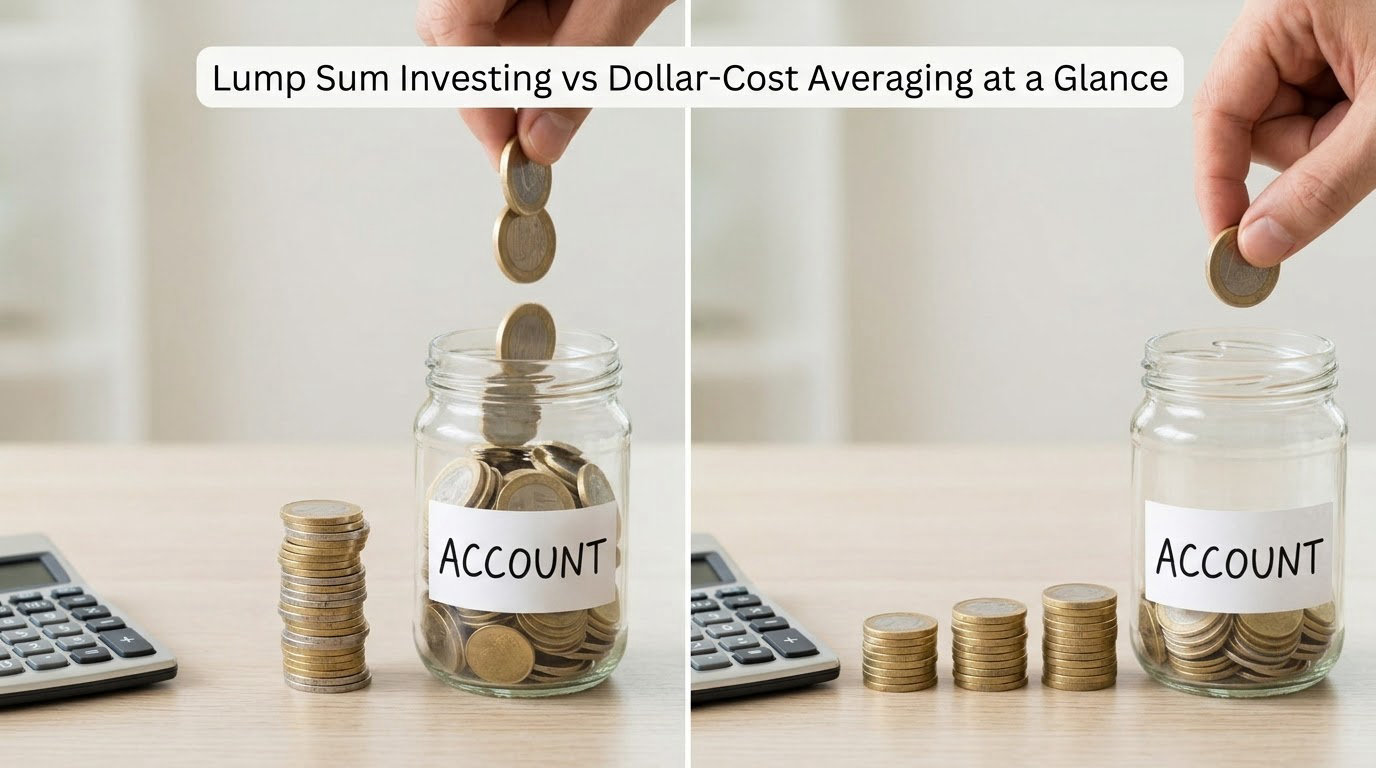
| Criterion | Lump Sum | Dollar-Cost Averaging |
|---|---|---|
| Capital deployment | Entire available amount in one purchase | Fixed amount on a schedule, weekly through yearly |
| Market exposure | 100 percent from day one | Ramps up gradually as each tranche lands |
| Cash drag | Minimal | Real, and it grows with the length of the window |
| Downside if markets fall 30 percent | Full amount takes the full hit | Only the tranches already in are hit |
| Historical return record | Higher in roughly two-thirds of rolling periods | Higher in roughly one-third, driven by the short windows where markets fell |
| Time to fully deploy | One transaction | Whatever schedule you set |
| Best-case gain from a rally | Full participation | Partial participation while cash waits |
| Average purchase price | One price, on one day | A blended average across many prices |
| Convenience | Low — one decision, then nothing to manage | Higher — recurring transfers or automatic contributions |
| Flexibility when expenses change | Committed money is hard to claw back without selling | Undeployed tranches can be redirected or stopped |
| Tax treatment | One sale event, easier to time a year | Multiple smaller events across years |
| Tends to suit | Long horizon, money already earmarked for investing | Ongoing income, uncertain near-term needs, nervous temperament |
That table is the whole argument in compressed form. Everything below is a longer version of one or two rows in it.
How Lump Sum Investing Works: One Purchase, Maximum Compounding Time
Lump sum investing means you take money that is already available and already decided upon, and you buy your investment in a single transaction. A 50,000 inheritance goes into a broad index fund on one day rather than being sliced into twelve pieces.
The mechanism is simple. Your starting cost basis equals whatever the market price happens to be on that day, and from then on the money is fully exposed to whatever the market does.
Here is what the timeline does to a 50,000 sum growing at 7 percent a year:
| Horizon | Lump sum value | DCA value, spread over 12 months | Difference |
|---|---|---|---|
| 1 year | 53,500 | 53,080 | 420 |
| 5 years | 70,130 | 69,180 | 950 |
| 10 years | 98,360 | 96,890 | 1,470 |
| 20 years | 193,490 | 190,790 | 2,700 |
Those figures use a steady 7 percent annual return and a 12-month DCA window, which is a deliberately gentle assumption. It shows the shape of the gap rather than a promise, and it assumes you keep the money invested and pay no fees or taxes.
The risk you are taking is real and it is front-loaded. If the market falls 30 percent three weeks after you buy, you are down 30 percent on the whole amount on day one. That single fact drives almost every recommendation against lump sums.
How Dollar-Cost Averaging Works: Fixed Amounts on a Fixed Schedule
Dollar-cost averaging means investing a set dollar amount at regular intervals, usually monthly, regardless of what the market is doing. You buy more shares when prices are low and fewer when prices are high, which is why it is called averaging.
The idea is old. Benjamin Graham wrote about spreading purchases over time in The Intelligent Investor, published in 1949, back when equity markets were far less institutionalised and the argument was about surviving volatility rather than compounding efficiently.
Say you put 12,000 into a fund over twelve months at 1,000 a month. If the price falls 20 percent in month three, that month’s 1,000 buys noticeably more shares than the month where it rose 20 percent. At the end, your average purchase price sits somewhere between the twelve prices you paid.
That averaging effect is often oversold. It lowers your average cost relative to buying at the worst day, but it also means you hold less money on the best days, and over long periods the best days matter more.
Worth saying plainly: payroll investing is not really the same decision. If you direct a fixed slice of each paycheck into a fund, you are constrained by when income arrives, not choosing a deployment window. The lump sum comparison barely applies.
Two different jobs, two different names
Investors use the DCA label for two separate habits. One is a genuine deployment choice: a specific sum already in hand, released on a schedule you set. The other is automatic accumulation from income, where no lump sum was ever available to hold.
Only the first one is a real choice between the strategies described here. Treating a paycheck contribution as a failed lump sum is a category error, and readers on investing forums make that mistake often enough to be worth naming.
DCA also has a quieter purpose that has nothing to do with timing. Automating the transfer removes the monthly decision, which means there is no month where you can talk yourself into skipping. On a 15,000 annual contribution, one skipped year is a bigger loss than most investors ever lose to a mistimed entry.
Lump Sum Investing vs Dollar-Cost Averaging: Core Differences
Time in the market is the biggest single factor
Markets rise more often than they fall over long stretches, so capital that arrives early compounds for longer. That is the entire mathematical case for lump sum, and it needs no further tricks. Everything else is a consequence of that one fact.
Average purchase price sounds like an advantage but is usually not
DCA gives you a lower average cost per unit than lump sum in most periods. It also gives you fewer total shares, because a large share of your money simply was not invested yet. More shares of a smaller pile loses to fewer shares of a larger pile when the market rises.
Missing the best days quietly compounds
JP Morgan Asset Management research found that if you were out of the market on the ten best days of a given year, the S&P 500’s annual return fell from about 9.2 percent to about 5.6 percent. Skipping days sounds harmless. It is not.
Flexibility is DCA’s most underrated advantage
If you are deploying 50,000 over twelve months and a medical bill lands in month four, the undeployed balance can simply stop. With a lump sum, that money is already inside the market and the only exit is selling into whatever conditions prompted the expense.
Convenience runs the other direction
Lump sum is one decision. DCA is a standing instruction, an automatic transfer, a watchlist, and twelve opportunities to talk yourself out of it. The administrative load is small, but the opportunities for self-sabotage are not.
Neither strategy reduces the underlying market risk
Both are fully exposed to a broad market decline over a full investment horizon. DCA softens the entry, not the destination. If you are drawing down the money, entry timing matters a great deal. If you are accumulating for decades, it matters much less.
What the schedule does to your cost basis
A lump sum gives you one cost basis: the price on one day. Spreading purchases produces a blended average across every date you bought, which is the number people describe as their average purchase price.
That blend only looks like a win when the market is falling on average across the window. In a rising market, the blended price is simply higher than the day you could have bought everything, and you are carrying more shares than a lump sum would have bought at that higher average. The arithmetic is not ambiguous even though the emotions around it are.
Expected Return and Risk
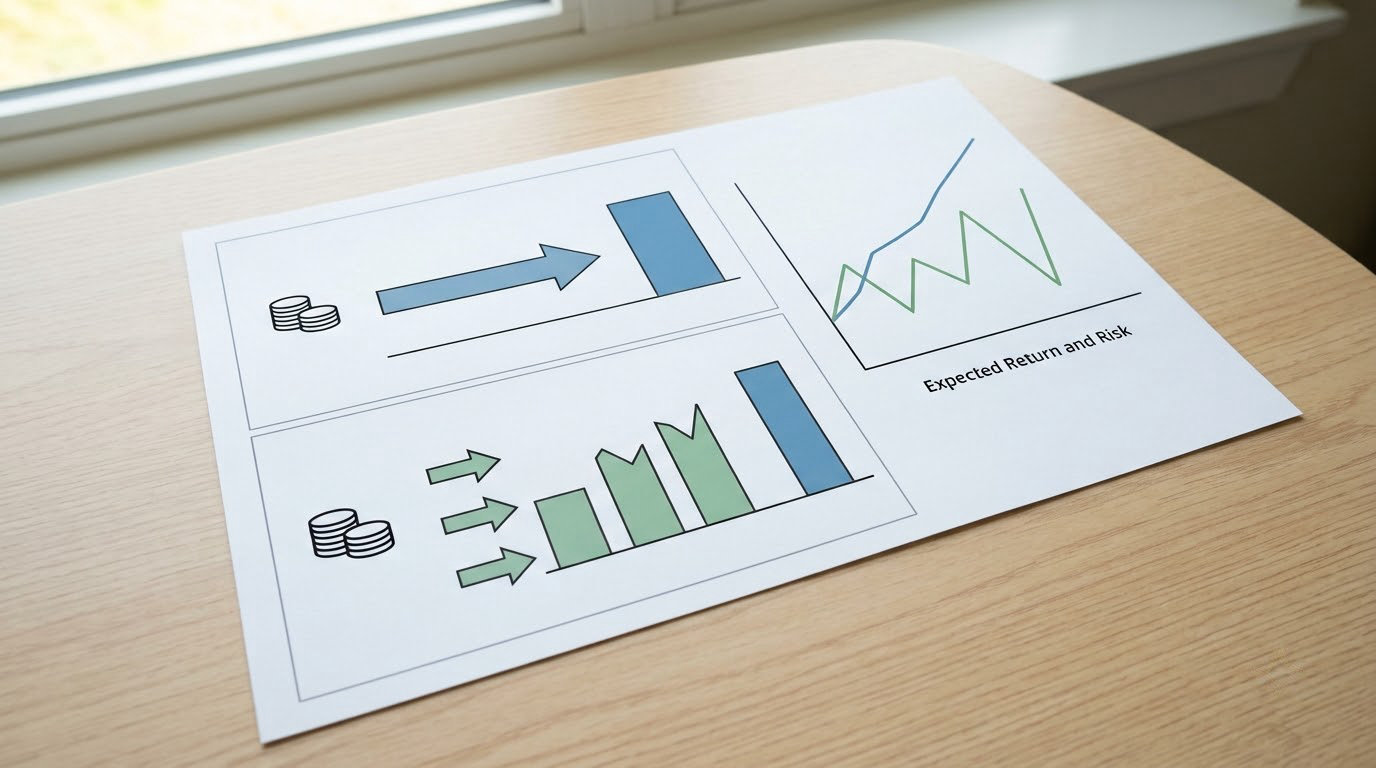
The two-thirds figure comes from rolling historical periods
Vanguard’s research comparing lump sum with roughly three-month DCA periods found lump sum delivered the higher return about two-thirds of the time across global markets. Charles Schwab reported a similar result for US investors, and Dimensional Fund Advisors has published figures in the 70 percent range depending on the market and period studied.
Understanding the methodology matters. These studies do not measure a single lucky stretch. They test every overlapping window — for example, every rolling three-year, five-year and ten-year period across decades of data — and count how often the faster route won. That is why the number lands between two-thirds and three-quarters rather than at a clean 100 percent.
A Maggiulli study on rolling one-year S&P 500 periods put lump sum ahead in about 78 percent of them, and one widely cited US analysis found lump sum ahead in 68 percent of rolling ten-year periods. Short windows favour lump sum less, because a bad start has more room to recover.
Read those numbers carefully and two limits stand out. They describe the past, and no historical average tells you what the next decade does. They also describe the pair of strategies, not a specific investor, because the outcome assumes you stayed invested through the bad periods rather than selling in one.
Why lump sum has the edge
Over the long run, equities have paid an equity risk premium over cash and bonds. Any strategy that holds a large share of your money in cash for a year is, by definition, giving up part of that premium. Cash drag compounds quietly against you, and inflation erodes what is left.
Where DCA makes a rational case
Three situations give DCA a defensible edge beyond comfort. The first is a near-retiree facing sequence-of-returns risk: when withdrawals start, an early decline is far more damaging than an equal later decline, because there are fewer contributions left to recover it.
The second is a valuation argument. If you believe the market is unusually expensive, spreading purchases over three to six months reduces the damage of buying a peak. Judge this yourself with a price-to-earnings measure such as the CAPE ratio rather than taking anyone’s word for it.
The third is currency and tax-bracket timing. An investor earning in a foreign currency or sitting in a high tax bracket with lower rates expected may have a real reason to phase purchases across years.
None of that guarantees a profit. DCA does not prevent losses, and lump sum does not protect against them.
Where sitting in cash ranks
It is worth naming a third option, because it is often the default and it is usually the worst of the three. Money that stays in a savings account through a full market cycle is exposed to inflation and gives up the equity risk premium entirely, and it is not safer in any meaningful sense once the horizon is long. Deferring the decision is itself a decision, with a measurable cost.
Taxes and Account Types
The account you hold the money in changes the mechanics more than the deployment schedule does, and US rules change, so verify current limits and rates.
Taxable brokerage accounts
Trades are not taxed by themselves. Selling appreciated positions at a gain triggers capital gains tax at your ordinary income rate, and losses can offset gains. A single purchase creates one cost basis and one taxable event, which makes a lump sum easier to time around a tax year or an expected bracket change.
Roth IRAs
Contributions carry a yearly limit, so a large windfall cannot go into a Roth in one go — that alone can force a phased schedule. The scheduling reason and the risk reason happen to point the same way here, which makes a Roth the least contentious place to DCA.
Traditional IRAs and 401(k)s
The same contribution ceiling applies, and deductions interact with your bracket. A rollover from a former employer plan has its own deadline and its own penalties if handled late, so verify those before moving money.
Keeping tax in mind without overthinking it
DCA across a tax year can spread realised gains over several years, which sometimes keeps you in lower brackets. If you are in a high bracket now and expect a lower one soon, delaying some sales has genuine value. If you expect the opposite, deploying sooner is the better tax move.
The strategic tax location of the account matters more than the timing of the purchase inside it. Get that right first, then decide the schedule.
Which Should You Choose?
Choose lump sum when the money is already earmarked and the horizon is long
An inheritance with no near-term claims, a 401(k) rollover with no debt attached, proceeds from a home sale you are done with, a CD maturity earmarked for retirement. Fifteen years or more to a goal, a diversified allocation you would hold anyway, and money you can genuinely leave alone until the drawdown. That is the textbook lump sum case, and it is the majority case.
Choose DCA when the money arrives gradually or the timing is uncertain
Paycheck contributions, freelance income with uneven months, a windfall you must spend partially within five years, or any large sum while high-interest debt is still outstanding. If you owe 20 percent on a card balance, paying it down beats either strategy.
Choose DCA when the downside would change your behavior
If a 25 percent drop would make you sell, the higher expected return of lump sum is hypothetical, because you will not collect it. The plan you actually hold beats the plan with the better backtest.
Choose DCA when you are close to retirement
Within roughly ten years of drawing down the money, sequence-of-returns risk deserves weight. For retirees, a three-to-six month window captures most of the behavioural comfort with far less cash drag than a multi-year plan.
Choose a hybrid when the answer is genuinely mixed
Half now, half over six months is the most commonly recommended compromise in investor forums, and readers report it costs little in expected return while removing most of the regret. It is also entirely reasonable to vary the pace with how stretched valuations look at the time.
How to Choose a Strategy You Can Follow
Work through this before choosing a schedule, in this order.
1. Confirm the emergency fund. If you have no cash buffer, that is where the money goes first. Three to six months of essential expenses, sitting somewhere accessible and separate from your investing.
2. Clear high-interest debt. Paying off 20 percent debt is a guaranteed return of 20 percent, and no market reliably beats it.
3. Split out near-term spending. Money needed for a car, a move, tuition or a down payment within five years does not belong in equities. Short-duration bonds, Treasury bills or a high-yield savings account suit that portion.
4. Check the time horizon on the rest. Twenty years away, timing barely matters and lump sum wins more often. Five years, the sequence risk is real. This single question resolves most cases.
5. Pick the account before the schedule. Tax-advantaged space fills up first, and contribution limits may force a phased schedule regardless of your preference.
6. Set the DCA window deliberately. Three to six months for a windfall, twelve months if that is the psychological maximum, and never longer than a year. Every extra month of waiting is a straight reduction in expected return with no added protection.
7. Decide where the undeployed cash sits. A high-yield savings account, Treasury bills or a government money market fund, kept somewhere separate so it is not spent by accident.
8. Write down the plan and the review date. A quarterly check on whether the money is still needed and the allocation still fits is plenty. Daily monitoring is not a strategy, it is a source of new decisions to regret.
If you want a middle path, three deployment schedules work well in practice:
- Tiered: half immediately, the remainder in equal monthly amounts over six months.
- Valuation-triggered: deploy a first tranche now, then release later tranches at set price-to-earnings levels rather than on a calendar.
- Rebalancing-driven: hold the un-deployed cash in short-term instruments and move it into equities as bonds and stocks drift out of your target weights.
Frequently Asked Questions
Is lump sum investing better than dollar cost averaging?
On the historical record, lump sum investing has produced the higher return in roughly two-thirds of rolling three-month, five-year and ten-year periods, a finding published by Vanguard, Charles Schwab and Dimensional Fund Advisors. That is an average, not a promise, and the losing periods are usually ones that began right before a decline. Dollar-cost averaging earns its place by reducing the chance of entering on a peak and the chance you will sell in a panic.
Does dollar-cost averaging reduce investment risk?
It reduces one specific risk: buying the entire amount on an unlucky day. It does not reduce the risk of owning equities over a full investing horizon, and it does not prevent losses. Averaging also means holding less money during rallies, which is why a market that rises steadily leaves DCA investors behind. The real question is whether the reduced entry risk matters more to you than the reduced expected return.
Should I invest a lump sum or wait for a market dip?
Waiting for a dip is market timing, and it is the more dangerous half of this decision, because cash drag runs while you wait. If you hold out for a decline that does not come, you deploy into a higher market with money lost to inflation in the meantime. A more disciplined version of the instinct is to buy part now and pace the rest, rather than making a single all-or-nothing prediction about a date.
Can I use dollar-cost averaging in a retirement account?
Yes, and in a Roth IRA or 401(k) it is often the natural fit. Annual contribution limits cap how much can go in at once, so a large windfall usually has to be phased over several years regardless of your preference. Inside the account, a long horizon favours investing the maximum as early as you can, and shorter windows suit anyone nervous about near-term volatility.
Can I switch from dollar-cost averaging to lump-sum investing?
You can, and it is not a mistake. Stop the scheduled transfers and buy the remaining balance in a single transaction. Nothing about your cost basis disappears or becomes invalid; you simply stop the cash drag. The one reason to hesitate is if the switch is driven by anxiety about a market dip rather than by a deliberate reassessment of your time horizon.
Conclusion
Start by confirming the money is genuinely available for long-term investing, with an emergency fund behind it, no high-interest debt left, and no near-term spending needs hiding in the balance. Then choose on the evidence rather than on a forecast: a long horizon and money you can leave alone points to lump sum, because it has produced the higher return in roughly two-thirds of historical periods.
If a drawdown would shake you out, spread the money over three to six months and be done with it. Half now and half staged is a reasonable answer for most people with a windfall, and it costs very little in expected return to remove almost all the regret. Whichever you pick, write down the schedule and the review date, then let it run.