You buy Treasury bonds directly from the U.S. Treasury through its own website, TreasuryDirect.gov, with no broker, no commission and no bid-ask spread in between. That direct route is genuinely simpler on cost than any brokerage, but it is fussier on timing: you buy at auction, you wait for settlement, and a newly purchased security is locked up for 45 days. Here is how the whole thing works, from opening the account to holding the bond at maturity.
I have walked through the TreasuryDirect flow more times than I care to admit, mostly for the small bills I park between jobs and tax refunds. The site itself is not pretty, and the terminology is government-speak, but the purchase mechanics take about ten minutes once the account exists.
Table of Contents
- What You Need Before You Start
- Step-by-Step: How to Buy Treasury Bonds Directly on TreasuryDirect
- Choose the Treasury Bond Type and Auction
- Enter and Submit Your Purchase Order
- Receive the Bonds and Track the Investment
- Buying on the Secondary Market Instead
- Common Mistakes to Avoid on TreasuryDirect
- Frequently Asked Questions
- Do TreasuryDirect purchases have any fees or commissions?
- What is the minimum purchase on TreasuryDirect?
- How often do Treasury bonds auction, and when do funds settle?
- Can I sell a Treasury bond before it matures?
- Are Treasury bonds taxed at the state level?
- What to Do First
What You Need Before You Start
The requirements are short, which surprises people who expect a brokerage application to take an evening.
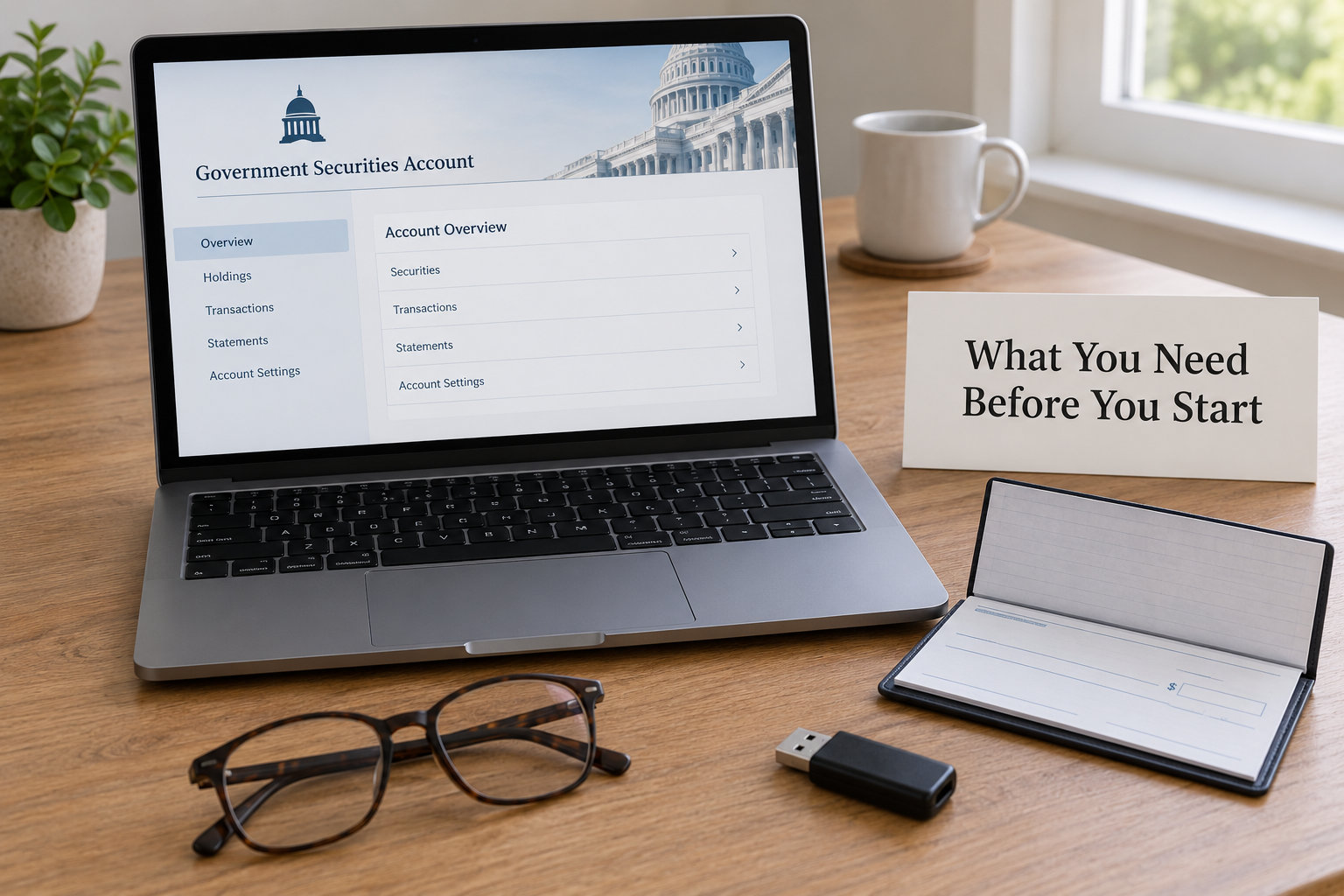
- A TreasuryDirect account. You open one at TreasuryDirect.gov with a Social Security number or an Employer Identification Number, an email address, a mailing address in the United States, and a phone number.
- A verified U.S. address. The Treasury mails a confirming code to the address on file, so a mailbox you control is part of the deal.
- A personal checking or savings account. You link it with a routing number and account number, and the Treasury debits it after the auction settles.
- Your TreasuryDirect number. This is the account identifier you choose during signup, and it is the single most important thing to record.
- At least one hundred dollars. The minimum purchase is one hundred dollars, and everything you buy is in hundred-dollar increments.
There is a citizenship question on the form. You are asked to confirm U.S. citizenship or residency status, and the account is limited to U.S. persons. Non-U.S. residents generally cannot hold a TreasuryDirect account and use a custodian or broker instead.
One more decision to make up front: do you want to buy at auction from the Treasury, or buy an already-issued security from someone else? The first gives you the full auction yield with no markup. The second, called the secondary market, lets you pick any maturity on any weekday, but you pay the going price, which can include a small spread or a per-bond fee at some brokers.
Savings bonds work differently from auction securities. Series EE and Series I savings bonds are not auctioned. You buy them at face value, which means a fifty-dollar bond costs fifty dollars, and you earn interest as the bond accrues toward its final value. They are a separate product on the same site.
Step-by-Step: How to Buy Treasury Bonds Directly on TreasuryDirect
Here is the direct purchase workflow in the order the site walks you through it.
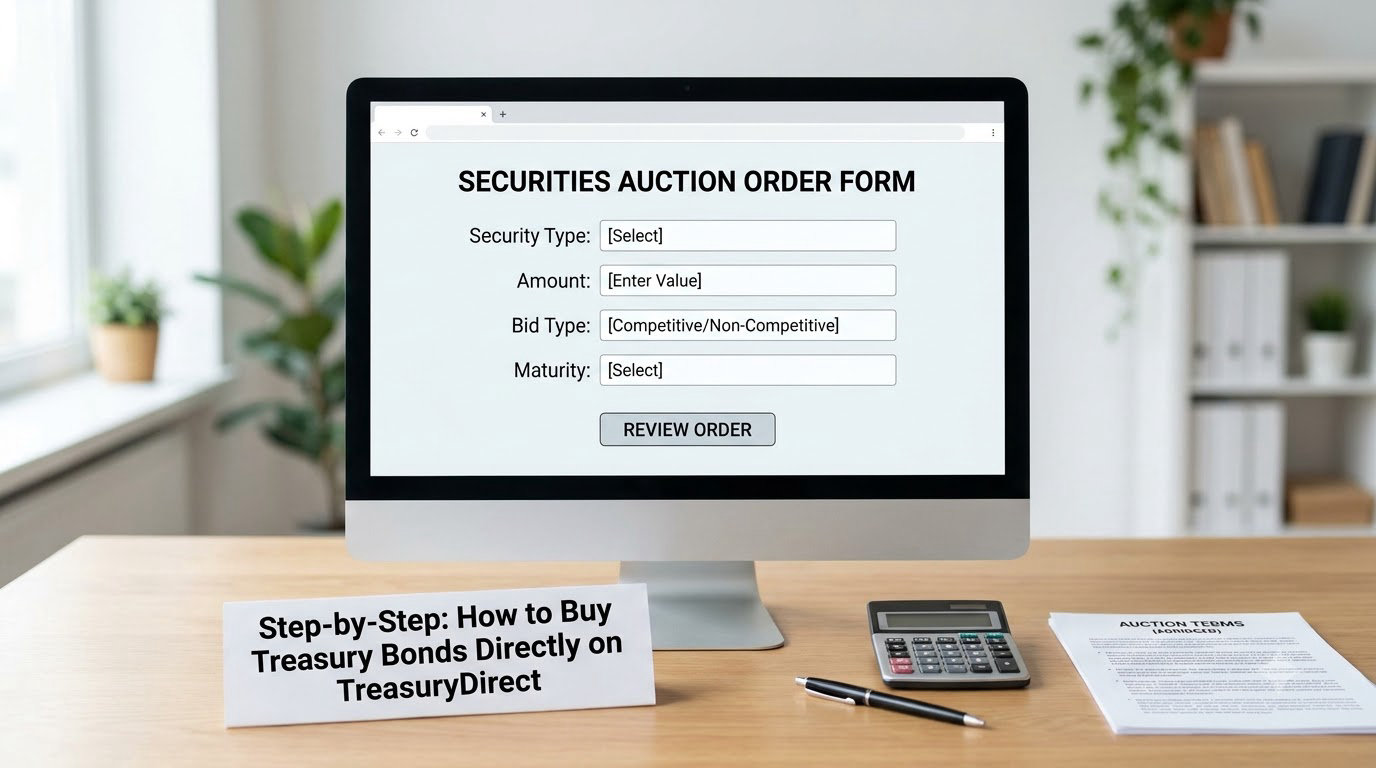
- Create an account or log in. On TreasuryDirect.gov, choose the account creation option for an individual, fill in your identity details, pick your TreasuryDirect number and password, and wait for the mailed verification code. Existing investors just log in.
- Open the BuyDirect tab. Once you are in, the navigation gives you the market actions: BuyDirect for new issues, SellDirect for holdings you want to sell to the Treasury, and ManageDirect to see your portfolio.
- Choose the security. Pick from Treasury bills, notes, bonds, inflation-protected notes, and floating rate notes. Savings bonds sit under a separate Buy Savings Bonds option.
- Select the auction date. Only upcoming auctions appear. Bills auction frequently, while notes and bonds come to market on a monthly cycle, so you get roughly one window a month for a given maturity.
- Enter the amount. Type the number of securities or the total dollar value you want. The total has to be a multiple of one hundred dollars, and the minimum is one hundred dollars.
- Select a payment method and confirm. Choose your linked bank account as the source of funds, review the order summary, and submit. The Treasury confirms the accepted order, and you can track it in ManageDirect.
Nothing is charged at the moment you submit. The auction settles a few days later, and only then does the money move from your bank account. That detail catches out first-time buyers who assume the funds leave immediately.
Choose the Treasury Bond Type and Auction
Bills mature in one year or less, notes run from one to ten years, and bonds mature in twenty or thirty years. Bills are sold at a discount to face value and pay no coupon, notes and bonds pay interest twice a year, and you get par, one hundred dollars per one hundred dollars of face value, back at maturity.
TIPS pay a fixed rate plus an adjustment for inflation, so the principal you get back keeps its purchasing power. FRNs pay interest every four weeks at a rate that resets, and they are the only auction security whose income changes during the holding period. A bill, note or bond locks its rate for the whole term once the auction settles.
Then there is the bidding method, which matters more than it sounds. A non-competitive bid simply says I want the security at whatever rate the auction sets, which is what nearly everyone should use. You can bid non-competitively up to five million dollars. A competitive bid lets you name your own yield, and accepted competitive bidders can take up to thirty-five percent of an offering. The Treasury fills non-competitive bids first, then awards competitive bids starting from the lowest yield.
Enter and Submit Your Purchase Order
The order screen is short. Pick the auction, type your amount in dollars or in securities, and confirm whether the bid is competitive or non-competitive. The summary shows the number of securities, the total cost including any accrued interest on notes and bonds, and the auction date.
There is no commission line, because there is no commission. Direct buyers often think a fee is hiding somewhere; it is not.
After you submit, the status moves from accepted to purchased and then settles on the auction settlement date. ManageDirect is where you verify it. If the order does not appear there within a few business days, contact the Treasury before the next auction rolls around.
Receive the Bonds and Track the Investment
Settlement usually lands about three business days after the auction, and the securities appear as electronic entries in your portfolio. Nobody mails you paper. Each holding shows its CUSIP, maturity date, and the rate you were allotted.
For a bill, the purchase price is below face value and the difference becomes your return at maturity. For a note or a bond, the auction price and the stated coupon work together to produce the yield you actually earn. You receive interest payments twice a year and the principal at maturity.
When the security matures, you choose what happens next: leave it to pay out, reinvest the proceeds into a new auction of the same tenor, or reinvest into a different maturity. Reinvesting on a schedule across different maturity dates is how you build a bond ladder, and TreasuryDirect lets you set the reinvestment choice once per holding rather than each time.
Buying on the Secondary Market Instead
The secondary market is where brokers and dealers trade securities that have already been issued. You can buy a 7-month bill today, or a specific CUSIP, or a bond with six months left to run. Your choices open up considerably. Learning how to buy Treasury bonds directly is half the decision; knowing when not to is the other half.
The tradeoff is cost and flexibility. Most discount brokers charge no commission on Treasuries and waive that fee below a certain size, though a per-bond charge has historically shown up on individual purchases at some firms. Even without a commission, a dealer sale can carry a small bid-ask spread. On the other hand, you can sell the same day and you are not waiting for the next auction.
Forum readers split on this honestly. On r/Bogleheads the recurring objection to TreasuryDirect is the interface rather than the economics, and the common advice for anyone who wants convenience is to buy individual Treasuries at a brokerage. Early-Retirement.org puts the cost difference plainly: government Treasuries from TreasuryDirect carry no commission and no spread, while some brokers have charged a dollar per bond.
So the rule is simple. If you can wait for an auction, can hold the money for 45 days plus the term, and want the cleanest price, buy direct. If you need a specific maturity tomorrow or expect to sell soon, use a broker.
Common Mistakes to Avoid on TreasuryDirect
Confusing the stated rate with what you earn. The coupon on a note is not your return. A bond bought above or below par changes the yield you actually realize. Judge the purchase by the auction yield, not the face coupon.
Missing the auction window. Notes and bonds auction once a month. Miss the date and you wait roughly four weeks, which matters if you were trying to capture a particular rate.
Choosing a maturity you cannot live with. A thirty-year bond is not a savings account. If you might need the money, a shorter bill or note fits the job better.
Ignoring reinvestment risk. When a bond matures you face the market again, and the rate waiting for you may be lower than the one you just earned. A ladder spreads that exposure across dates.
Funding from the wrong bank account. The linked account has to be your own personal checking or savings account in your own name. Linking a brokerage account or a joint account that does not match your registration causes a rejection.
Leaving the Social Security field blank or wrong. A mismatch between the name on your bank account and the name on the TreasuryDirect account is the most common reason a funding request fails.
Forgetting your TreasuryDirect number. It is the recovery key if you lose your password, and the Treasury does not hand it out. Store it in a password manager the day you register.
Two habits cover most of the rest. Place one small non-competitive bill bid first, so you learn the flow with money you do not need for months. And read the confirmation screen before you submit, because the auction date and the dollar amount are the only two things you cannot change afterward.
Frequently Asked Questions
Do TreasuryDirect purchases have any fees or commissions?
No. Buying Treasury bonds directly from TreasuryDirect.gov carries no commission, no bid-ask spread and no account fee. The Treasury sells the security to you at the auction price. Some brokers also charge nothing on Treasuries, but a small spread or a per-bond charge can appear in a secondary-market trade. That cost difference is the main reason people use the direct route.
What is the minimum purchase on TreasuryDirect?
The minimum for a Treasury auction purchase is one hundred dollars, and every order must be in hundred-dollar increments. Savings bonds are sold at face value, so the minimum for those is also one hundred dollars. Non-competitive bids can go up to five million dollars per auction, while competitive bidders may win up to thirty-five percent of an offering.
How often do Treasury bonds auction, and when do funds settle?
Bills come to auction frequently, often weekly, while notes, bonds, TIPS and FRNs follow a monthly cycle with new maturities opening as they are announced. Funds settle roughly three business days after the auction, and only then is your linked bank account debited. A missed auction date means waiting for the next one, which for a note or bond can be most of a month.
Can I sell a Treasury bond before it matures?
Yes, with conditions. A security bought at auction on TreasuryDirect must be held for at least 45 days before it can be sold. After that, you can sell it to the Treasury on the secondary market it maintains. Selling early means accepting the going market price, which can be below what you paid, so hold to maturity if you can.
Are Treasury bonds taxed at the state level?
Interest from Treasury securities is taxed by the federal government but exempt from state and local income tax in every state. You receive a form showing the interest you earned, usually in January or February, and that interest is ordinary income in the year it is paid or accrued. Price changes on a bill that matures at a discount can also create small gains or losses for tax purposes.
What to Do First
Open the TreasuryDirect account and write your TreasuryDirect number somewhere safe before you do anything else. Link a personal bank account, wait for the mailed verification code, then place one small non-competitive bid on a bill that matches a date you will not need the money. Once that settles and you can see it in ManageDirect, widen the maturities from there. That is the practical version of how to buy Treasury bonds directly: one account, one small bid, then patience.
Rates, auction dates and tax rules change, so confirm the current details on TreasuryDirect.gov before you commit funds. Nothing here is individual investment or tax advice.