
Dividend investing is how you buy shares of companies that pay part of their profits back to you as cash, usually every quarter, and hold them for years. Learning how to invest in dividend stocks for beginners comes down to five things: an emergency cushion, a brokerage account, a diversified basket, a quick check that the dividend is affordable, and patience. Set aside 60 to 90 minutes for your first setup, and expect the first dividend cheque to be small.
This guide explains how the whole process works, including account types, dividend dates, the ratios worth checking, and the taxes that hit the payments. Nothing here is personal financial advice, and tax rules change, so check the current numbers with the IRS or a tax professional.
Table of Contents
- What You Need Before You Buy Anything
- An emergency fund that covers three to six months of expenses
- High-interest debt under control
- A brokerage account you can actually open online
- An hour of reading and about twenty dollars for nothing
- Step-by-Step: How to Invest in Dividend Stocks for Beginners
- Step 1: Set Your Goals Before You Invest in Dividend Stocks for Beginners
- Step 2: Choose and Open a Brokerage Account
- Step 3: Build a Diversified Starting Portfolio
- Step 4: Learn How to Evaluate Dividend Safety
- Step 5: Research Stocks and Funds Before Buying
- Step 6: Place the Purchase and Control Position Size
- Step 7: Reinvest Dividends and Rebalance Periodically
- Step 8: Review the Investment and Adjust as Needed
- Common Mistakes Beginners Make With Dividend Stocks
- Chasing the highest yield
- Buying a dividend trap
- Concentrating in too few names
- Investing money you will need soon
- Ignoring taxes and fees
- Trading around the dividend dates
- Getting started without the basics
- Frequently Asked Questions
- How much money do I need to start investing in dividend stocks?
- Should a beginner buy dividend stocks or a dividend ETF?
- What is a safe dividend yield?
- Is a dividend cut a reason to sell a stock?
- Do dividend stocks pay every month?
- Conclusion
What You Need Before You Buy Anything
A dividend account is not a savings account, so the money you put in can lose value. Get these four things sorted first and the investing part becomes simple.
An emergency fund that covers three to six months of expenses
Dividend income is not reliable enough to live on in year one. Cash in the bank buys you time to stay invested during a bad quarter instead of selling at the worst moment.
High-interest debt under control
Credit card balances and most personal loans charge far more than most dividend stocks pay. Clearing that balance first is the closest thing in personal finance to a guaranteed return.
A brokerage account you can actually open online
Any registered broker with a website and mobile app works. Look for no trading commission on standard orders, fractional share purchases, and plain English account statements. There is no minimum balance requirement at most of them.
An hour of reading and about twenty dollars for nothing
You do not need premium tools, subscriptions, or an advisor to begin. Free filings, free screeners, and a written plan are enough for the first several years. The real requirement is time: an hour at the start, then twenty minutes a quarter.
Step-by-Step: How to Invest in Dividend Stocks for Beginners
The process below runs in order. Investors who try to shortcut it usually end up chasing the highest dividend yield they can find, which is the single most expensive mistake in this space.
Step 1: Set Your Goals Before You Invest in Dividend Stocks for Beginners
Write down two sentences before you open anything: what is this money for, and when will you need it. Money for a car in three years and money for retirement in thirty years belong in completely different places.
Next, be honest about how a 20 percent drop in value would feel. If that would make you sell, then a dividend portfolio is too aggressive right now, no matter how solid the companies are.
Decide whether income today or growth over decades matters more. A company that raises its dividend slowly and a company that triples its earnings reinvest the cash differently, and mixing them without a plan is how people end up owning thirty stocks and no strategy.
A few concrete anchors help. A retirement account fifteen or more years out can tolerate real volatility. A five-year goal cannot. If your income needs are more than ten years away, most beginners are better served by a broad index fund first and dividend stocks as a satellite holding rather than the whole portfolio. Getting that goal honest is the step people skip when they ask how to invest in dividend stocks for beginners, and it is the step that decides whether the money stays invested for thirty years or gets pulled out in a bad quarter.
Step 2: Choose and Open a Brokerage Account

There are three account types you will actually consider, and the right one depends on your tax bracket and how long you hold.
| Account | How dividends are taxed | Fits best when |
|---|---|---|
| Taxable brokerage | Qualified dividends are taxed at the lower long-term capital gains rate, up to 20% federally, plus any state tax | You already max out retirement accounts or you want access at any age |
| Traditional IRA or 401(k) | Dividends are tax-deferred until withdrawal; withdrawals are generally taxed as ordinary income | You want tax deferral now and expect a lower tax bracket later |
| Roth IRA | Qualified dividends are not taxed at all, and qualified withdrawals in retirement are not taxed | You expect your tax bracket to be higher later than it is now |
The IRS treats a dividend as qualified when it comes from a US corporation or a qualifying foreign corporation and the stock has been held more than 60 days. Everything else, including most payments from REITs and some foreign dividends, is taxed as ordinary income at your marginal rate.
Verify the broker before you send money. Check that the firm appears in the SEC’s Investment Adviser Public Disclosure database or is a member of FINRA, and confirm the account name on your first statement matches what you applied for. A confirmation email plus a matched name on the first statement means the account opened correctly.
Turn on two protections the same week you open it: two-factor login and dividend reinvestment switched off until you decide otherwise. Turning reinvestment on later takes one click, and starting with it on by accident can leave a beginner buying fractional positions they never researched.
Step 3: Build a Diversified Starting Portfolio
Individual stocks carry real company risk. One bad earnings report can cut twenty percent off a position in a day, and the dividend goes with it. Diversification is what keeps a bad quarter from becoming a bad decade.
Three vehicles cover most beginners. A low-cost total-market index fund gives you hundreds of companies and the lowest effort. A dividend index fund, such as a broad dividend ETF or a dividend mutual fund, tilts that exposure toward payers. Individual dividend stocks give you control and require real research.
Widely referenced dividend funds fall into two categories. Broad US dividend funds, including tickers like VYM and DVY, hold a few hundred large and mid-sized payers. Quality-screened dividend funds, including SCHD, apply profitability and balance-sheet filters before selecting holdings. Mentioning them here is a category explanation, not a recommendation.
| Vehicle | Diversification | Time per year | Beginner verdict |
|---|---|---|---|
| Total-market index fund | Highest | Under an hour | Best default for a first account |
| Dividend index fund or ETF | High | About an hour | Good when you want income built in |
| Individual dividend stocks | Low unless you hold 20 or more | Several hours a year | Add later, in small size |
Here is an illustrative allocation, not a recommendation for your situation: seventy percent in a total-market index fund, twenty percent in a dividend fund, and ten percent spread across five individual dividend stocks you can explain in one sentence each. The point of the illustration is the proportions, not the products.
Check the expense ratio before anything else. A 0.07 percent fund and a 0.65 percent fund both track the same index, and that difference compounds quietly for thirty years. If the stock portion of your portfolio goes up, ask why. Sometimes the answer is a great company, and sometimes it is that nothing else went up.
Step 4: Learn How to Evaluate Dividend Safety
Dividend safety is the only question that matters when you buy individual dividend stocks. Yield tells you what you get. Safety tells you whether you will keep getting it.
Four numbers cover most of the work. The dividend yield is the annual dividend per share divided by the share price. The payout ratio is the dividend divided by earnings per share. Free cash flow coverage compares the dividend with cash the business actually generates after capital spending. Dividend growth rate tells you whether the payment is rising.
Worked example, invented for illustration: a company pays a dividend of 1.20 per share and the shares trade at 30. Yield works out to 4 percent, because 1.20 divided by 30 equals 0.04. If earnings per share are 3.00, the payout ratio is 40 percent, and the dividend is comfortably covered. If earnings per share were 1.00, that same dividend would be a 120 percent payout, meaning the company pays out more than it earns.
Thresholds are rough guides, not laws. A payout ratio under 60 percent leaves room for a downturn. A free cash flow coverage ratio above 2 times means the business covers the dividend twice over from cash. A yield between 2 and 5 percent is normal for a healthy US payer, and the S&P 500’s own average yield has sat near the low 2 percent range for much of the past two decades, so a company yielding far above that deserves a question rather than a purchase.
Then look at the balance sheet and the business itself. High debt, a cyclical industry, or earnings that swing wildly from year to year all make the dividend more fragile. Utilities and consumer staples can support higher payout ratios precisely because their demand does not collapse in a recession, and comparing a regulated utility to a biotech on payout ratio alone is comparing two different businesses.
A five-question checklist you can reuse on any candidate:
- Does the payout ratio stay under roughly 60 percent through a bad year?
- Does free cash flow cover the dividend at least twice?
- Has the company raised or held the dividend through at least one full recession?
- Is net debt to earnings manageable for the sector?
- Does the business generate positive cash, not just positive accounting profit?
If you cannot answer most of those five from the company’s own filings, you are not ready to buy the stock.
Step 5: Research Stocks and Funds Before Buying
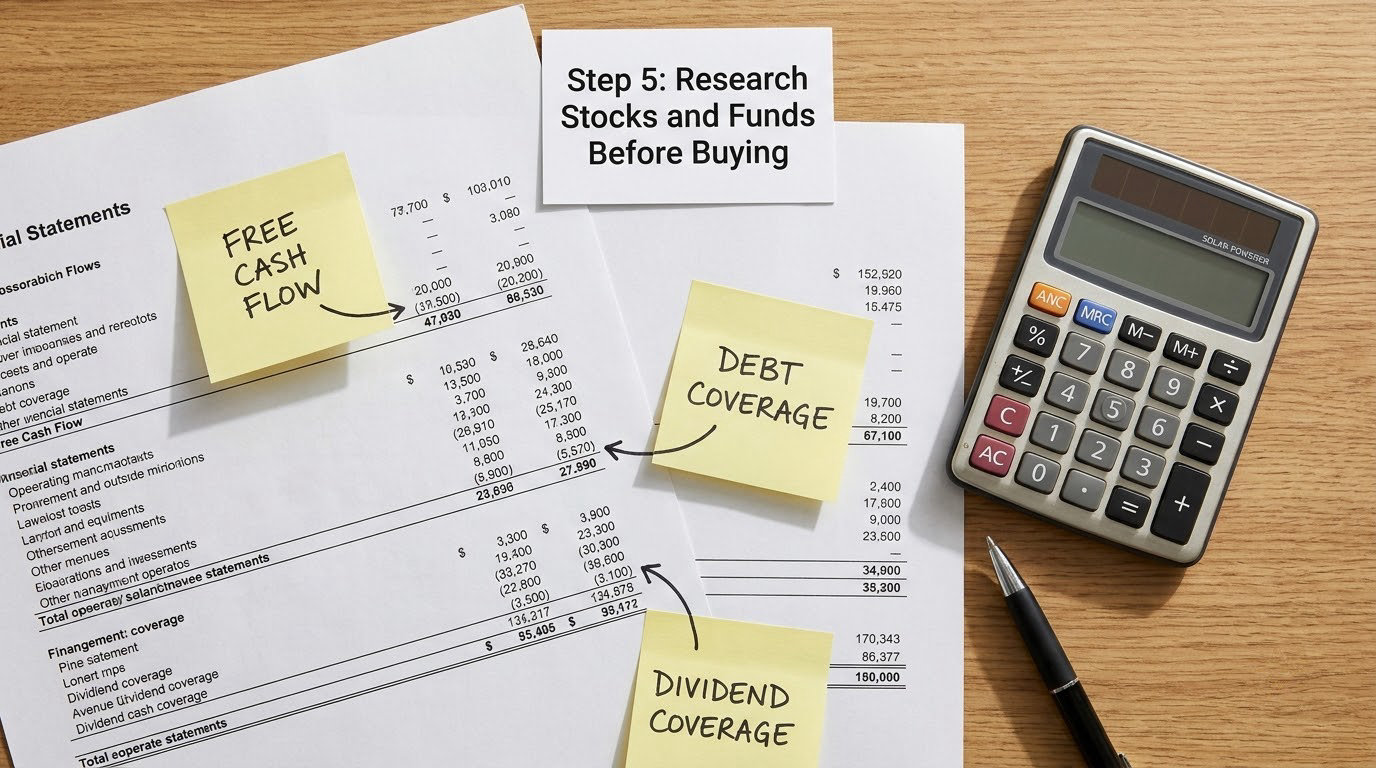
Read the document that makes the most confident claim: the annual report, then the latest earnings release, then the fund fact sheet if you are buying a fund. A dividend-stock profile page from any screener is a good way to narrow a list from three hundred names down to ten, and a bad way to make the final decision.
In the annual report, look for the dividend policy, the cash flow statement, and the debt note. In the earnings release, check whether management changed guidance and whether the payout still fits the plan.
Now imagine a screening example with invented numbers, so nobody mistakes it for a recommendation. Company A shows a 3 percent yield, a 45 percent payout ratio, and free cash flow coverage of 2.4 times. Company B shows a 9 percent yield, a payout ratio above 100 percent, and free cash flow coverage of 0.8 times. On the numbers alone, A is the more defensible holding and B looks like a yield trap, where a high payout signals a business in trouble rather than a bargain.
Ask six questions about anything you are considering: What does the company sell and who buys it? How cyclical is demand? How much debt does it carry and at what interest cost? Does management talk about the dividend as a priority? What would have to go wrong for the payout to be cut? And is the sector facing a structural shift, not just a bad quarter?
A stock screener is the fastest mechanical filter, and most brokers have one built in. Set the yield floor at 2 percent, cap the payout ratio at 60 percent, exclude anything with negative free cash flow, and require ten years of dividend history. That will not make you money, but it removes most of the obvious landmines in about five minutes.
Step 6: Place the Purchase and Control Position Size
Placing the order is the easy part. You type a symbol, choose a dollar amount or a share count, pick a time, confirm, and the broker fills it. The decisions that matter are the order type and the size.
A market order buys immediately at the best available price. A limit order sets the highest price you will pay and waits. Beginners should use market orders during normal trading hours for liquid, widely traded companies and funds, and limit orders when buying individual small-cap stocks where a gap can cost you more than you planned.
Many brokers now sell fractional shares, which lets you buy 2.40 USD of a stock priced at 60 USD. That removes the old awkward rule about needing 100 shares, and it is the single feature that makes small monthly contributions workable for beginners.
Size each position so no single company can hurt you. A practical rule is to keep any one holding under five percent of the portfolio and to add to it in stages rather than all at once. Ten equal positions spread across sectors is far more realistic for a first individual-stock basket than three names you are convinced about.
After the fill, confirm four things: the number of shares, the average cost per share, the order status showing filled, and the holding’s weight in your total portfolio. If your best-performing dividend stock has quietly grown to a fifth of the account, it is time to rebalance regardless of how much you like the company.
Step 7: Reinvest Dividends and Rebalance Periodically
You have three choices when a dividend posts: reinvest it, withdraw it, or split the two.
A dividend reinvestment plan, usually called a DRIP, buys more shares with the payment at the price on the reinvestment date. Most brokers offer the same thing without needing a plan form, which is simpler. Reinvesting is how compounding works in a dividend portfolio: more shares, more dividends, more shares.
The trade-off is taxes. Cash dividends in a taxable account arrive as income and you owe tax on them even if you reinvest. Inside a Roth IRA, that whole drag disappears, which is one reason beginners in a higher tax bracket often prefer retirement accounts for dividend-heavy portfolios.
| Starting balance | Monthly contribution | Value after 10 years at 6% | Value after 20 years at 6% | Value after 30 years at 6% |
|---|---|---|---|---|
| 5,000 USD | 250 USD | About 47,000 USD | About 156,000 USD | About 347,000 USD |
| 10,000 USD | 0 USD | About 17,900 USD | About 32,100 USD | About 57,500 USD |
| 100,000 USD | 0 USD | About 179,100 USD | About 321,000 USD | About 574,000 USD |
These figures assume a steady return and no tax drag, dividends reinvested, and no withdrawals. They are illustrations of the compounding mechanism, not predictions. The line that surprises people is the top one: regular contributions do far more work than a starting balance.
Rebalancing means returning to your target weights, usually once a year or when a position drifts more than five percentage points. Selling appreciated winners and buying laggards feels wrong every time and works over decades. Check the portfolio quarterly and act only when something is genuinely off, not when a headline makes you nervous.
Step 8: Review the Investment and Adjust as Needed
Put a recurring calendar reminder for one hour a year, plus a lighter check whenever earnings land. A yearly review should cover five things: whether each dividend was actually paid and at what rate, whether earnings and cash flow still cover the payout, whether debt went up or down, what the account cost in fees and taxes, and whether your goals have changed.
Here is a simple decision path for each holding. Keep it if the business is healthy, the payout is covered, and it fits your weight limit. Trim it if it has grown far past your target weight or if your goals shifted. Add to it if the thesis is unchanged and the position is underweight. Replace it if the payout is no longer covered by cash flow, management has abandoned the dividend, or you simply cannot explain why you own it.
Two things are worth saying plainly. A dividend cut is information, not an automatic sell signal: some companies cut in a recession and recover, and others cut because the business is deteriorating. And past income is never guaranteed. A company can raise its dividend for fifty years and stop the following year, which is why dividend aristocrats and dividend kings, the companies with 25-year and 50-year records of annual increases, are a starting point for research rather than an automatic buy list.
Common Mistakes Beginners Make With Dividend Stocks
Almost every avoidable loss in dividend investing traces back to one of six habits.
Chasing the highest yield
The highest yield in a sector is usually the market pricing in a problem, not offering a gift. Sort by yield descending and you will find companies whose dividends are about to disappear. The fix is to screen on payout ratio and cash coverage first, then look at yield.
Buying a dividend trap
A dividend trap is a stock that looks generous on yield and is unsustainable in reality: payout above earnings, negative free cash flow, or a cyclical business at the top of its cycle. The fix is to check the last five years of earnings, not just the last quarter.
Concentrating in too few names
Three stocks feels diversified and is not. One accounting scandal, one product failure, or one regulatory ruling can wipe out a third of the portfolio in a day. The fix is twenty or more holdings through funds, and no single company above five percent.
Investing money you will need soon
Dividend stocks are equities. They can fall thirty percent in a quarter with no dividend cut at all. The fix is to match the money to a date, keep near-term goals in cash or short-term bonds, and only buy stocks with money that can stay invested for a decade.
Ignoring taxes and fees
A 3 percent yield taxed at 15 percent is about 2.5 percent after tax, before fees. Account location matters more than most beginners expect. The fix is to put retirement contributions in a Roth IRA or 401(k) first, compare expense ratios, and reinvest in the account that gives you the lowest tax drag.
Trading around the dividend dates
Members of dividend forums ask this constantly, so the answer is worth stating. When a company declares a dividend, it sets a declaration date, an ex-dividend date, a record date, and a payment date. The stock typically trades down by roughly the dividend amount on the ex-date, so buying just before it does not hand you free money, it hands you a share at a slightly higher price.
Getting started without the basics
Open the account, fund it, and put a first purchase in a diversified low-cost fund this month, even if it is small. Learn the mechanics on something boring. Read one annual report before you buy a second individual stock. Set a reminder for the quarterly review and write down your position weights on paper. Write your rules down in advance, because the version of you that writes them during a downturn will be more generous than the version writing today.
Frequently Asked Questions
How much money do I need to start investing in dividend stocks?
You can start with any amount at a broker that offers fractional shares, including a few hundred dollars or even tens of dollars. The practical minimum for meaningful monthly income is much higher: at a 3 percent yield you need roughly 200,000 USD invested to collect 500 USD a month. Start small to learn the mechanics, then let regular contributions and reinvested dividends do the heavy lifting over decades.
Should a beginner buy dividend stocks or a dividend ETF?
For most beginners, a low-cost dividend index fund does more good than a hand-picked stock. One fund holds hundreds of companies, so no single bad earnings report can hurt you much, and there is nothing to monitor quarterly. Individual dividend stocks make sense once you hold a diversified core and want a small satellite of companies you can actually explain. Learn how to invest in dividend stocks for beginners with the fund first.
What is a safe dividend yield?
For a well-established US company, a yield between roughly 2 and 5 percent is normal. The S and P 500’s own average yield has sat near the low 2 percent range for much of the past two decades, so anything far above that range deserves a question rather than a purchase. Yield alone never proves safety. Check that the payout ratio is under about 60 percent and that free cash flow covers the dividend twice over.
Is a dividend cut a reason to sell a stock?
Not automatically. Some companies cut during a recession and raise it again afterwards, while others cut because the business is deteriorating and will not recover. Look at why the payout was cut, whether free cash flow and earnings still support a lower dividend, and whether management is committed to restoring it. A cut does tell you your original thesis needs re-checking, and dividends and returns are never guaranteed.
Do dividend stocks pay every month?
Almost never. Most US dividend stocks pay quarterly, on a schedule that usually runs in March, June, September and December, though the exact dates depend on the company’s board and include an ex-dividend date, a record date and a payment date. A few REITs and preferred securities pay monthly. If you want monthly cash flow, plan for a quarterly payment spread across your holdings rather than expecting one every month.
Conclusion
Start with the two decisions that cost nothing and matter most: what the money is for, and which account holds it. Then make one small purchase in a low-cost diversified fund this month so the mechanics stop being abstract. Add individual dividend stocks later, in small positions, only after you have checked the payout ratio and cash coverage. Review once a quarter, rebalance once a year, and ignore the highest yield on the screen. That is how to invest in dividend stocks for beginners without turning the biggest number on the page into your biggest mistake.
Dividends are a way of thinking about cash generation and discipline, not a promise. Returns vary, payouts can change, and taxes reduce what you collect.