If you want to know how to spot a financial scam, look at three things before you act on any request for money or financial details: unexpected urgency, a demand to pay through an untraceable method, and someone claiming to represent a bank, government agency, or investment firm. Financial scam warning signs almost always travel together. Check for that combination, verify the person independently, and you stop most attempts before any money moves.
Scammers no longer rely on clumsy emails. They call from spoofed numbers, message through WhatsApp and dating apps, and now post AI-generated videos of real financial personalities promising access to funds. This guide gives you the checks that still work, in the order to run them, updated for 2026.
This is general information about consumer protection, not personal financial advice. Rules and reporting routes vary by state and country, and they change.
Table of Contents
- What You Need
- Step-by-Step: How to Spot a Financial Scam Safely
- 1. Stop the Interaction and Protect Your Accounts
- 2. Preserve the Messages and Transaction Details
- 3. Verify the Person or Organization Independently
- 4. Check the Story Against 12 Known Warning Signs
- 5. Confirm the Request With a Trusted Second Source
- 6. Report the Incident and Limit Further Damage
- 7. Monitor Your Finances and Follow Up
- Common Mistakes
- Practical Tips for Avoiding Financial Scams
- Frequently Asked Questions
- What should I do if I think I was scammed?
- How quickly should I contact my bank after sending money?
- Can a small test payment to a supposed investor be safe?
- How can I tell the difference between a real financial offer and an impersonation scam?
- What information should I never send to someone I do not know?
- Will I get my money back if I report a financial scam?
- What to Do First
What You Need
You do not need forensic tools to investigate a suspicious message. You need four things, and three of them are free.
- A device the contact has never touched. A phone you did not use to reply, if you can manage it. Scammers install remote-access software and log keystrokes on compromised devices.
- The original evidence. The email header, the full text thread, the caller number, the link as written rather than the one you were sent to, the receipt, and the transaction confirmation.
- The organization’s real contact details from a source you chose yourself. The number on the back of your card, the number printed on a paper statement, or the official website you typed in by hand.
- Ten quiet minutes. Urgency is the scammer’s business model. Slowing down is the single most effective defense you have.
Read the rest of this before you need it. Recognising the pattern while you are calm is far easier than reconstructing it while your account is being drained.
Step-by-Step: How to Spot a Financial Scam Safely
Seven steps, in the order that keeps you safest. Do not reorder them, because the first two are about stopping damage and the last is about catching what got through.
1. Stop the Interaction and Protect Your Accounts
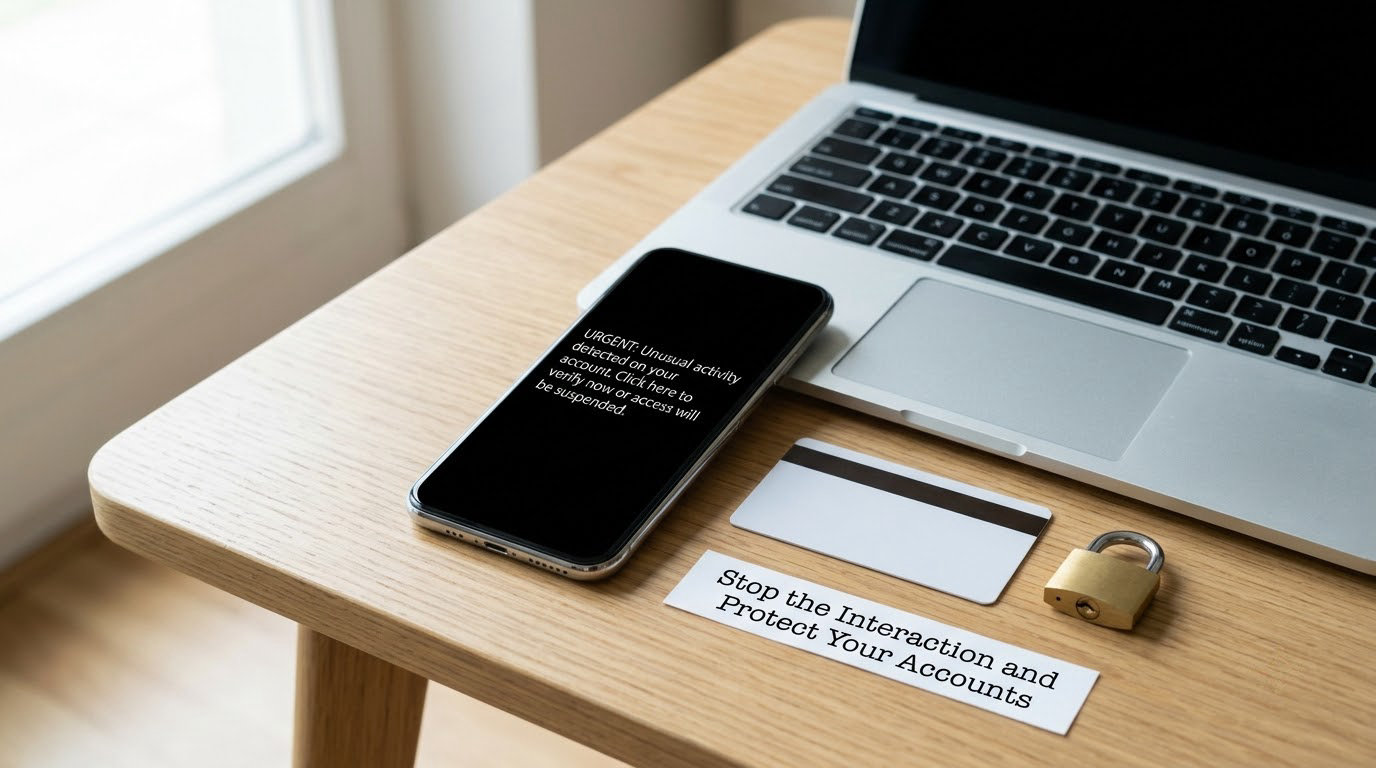
Do not click the link, open the attachment, return the call, or move any money while you are still unsure. Those four actions are what turn a convincing conversation into an actual loss.
If you clicked or already entered information, work the accounts that matter first. Lock or freeze your debit and credit cards through your bank’s official app, change any password you typed into a page you were sent to, and enable multifactor authentication everywhere it is offered.
Switch a code-based second factor to an app or hardware key where you can. SMS codes are the weakest option, and they are exactly what a scammer needs to finish an account takeover.
2. Preserve the Messages and Transaction Details
Screenshot everything before you delete anything: the full conversation, the sender address, the phone number, the URL, dates and times, account or wallet identifiers, and any transaction reference numbers. Evidence that survives the first hour is worth a great deal later.
Write down what was said in your own words too. Authorities rarely act on a screenshot alone, and a short written timeline of what happened, when, and how much, is easier to act on than a folder of images.
Do not forward the suspicious message to friends or family as a joke, and do not download attachments to “check” them. Forwarding spreads the scam, and attachments can carry malware to other people’s devices.
3. Verify the Person or Organization Independently
Ignore every contact detail the message supplied. That is the entire trick: their number, their website, their email, and their “official” chat are all under their control.
Then find the organisation yourself. Type the name into a search engine, or better, use the website you have used before, or the number printed on a statement or the back of your card. Call that number and describe the situation. If the organisation exists and is legitimate, they will tell you they never contacted you.
For a link, read it before you click it. Look for a misspelled domain, an unexpected subdomain, a shortened address, or a padlock sitting on a page that is not really the bank’s. A padlock only means the connection is encrypted, not that the site is honest.
If someone is selling you an investment or financial service, check the person and the firm against the official regulator registers before any money moves. Unregistered sellers and unregistered advisers are a warning sign, not a technicality.
4. Check the Story Against 12 Known Warning Signs
Scam scripts recycle. Run the story you have been told against these twelve flags and see how many it matches. One match is a question; three or more means stop.
- False urgency. You are told to act now, today, before an account is closed or a price rises. Example: “Your account will be frozen within 24 hours unless you verify.”
- Threats and authority. Arrest, deportation, a warrant, a suspension, a tax penalty, or a lawsuit from an agency or court that will not take questions. Example: “The IRS is filing against you today.”
- Guaranteed returns. Any investment pitched as risk-free, fixed, or guaranteed. Legitimate investing carries risk; a guaranteed return is the claim, not the pitch. Example: “Our fund pays 30 percent a month, every month.”
- An upfront fee to release money. Taxes, insurance, clearance charges, or a deposit required before you receive funds. Example: “Send a processing fee and the full amount is released to you.”
- Untraceable payment methods. Wire transfers, gift cards, cryptocurrency, payment apps used to send money to strangers, or a request to deposit into someone else’s account. These are chosen because they do not reverse.
- An offer you never sought. An unexpected prize, grant, inheritance, job, refund, or investment contact out of nowhere. Legitimate businesses you have never contacted usually do not call with money involved.
- Secrecy. Instructions not to tell your bank, your adviser, your family, or anyone else. Example: “Please don’t discuss this with your spouse.”
- Unverifiable identity. No company registration number, no physical address, no written agreement, no receipt, and an address that disappears once money is sent.
- A request to move your own money. Instructions to transfer money between your accounts, withdraw cash, or buy gift cards and read out the codes. This is the move that makes you the instrument.
- Pressure against your usual provider. Instructions not to use your bank, not to tell your adviser, or to use a specific unregulated platform. Legitimate firms work alongside your existing institutions.
- Insistence on a channel you chose. All contact forced through encrypted messaging apps where calls are discouraged, since those apps block the payment and dispute trails you would need later.
- Recovery promises after a loss. A second contact from someone offering to recover your money for a fee. This is a known second bite, and no real recovery firm works this way.
The phrases are just as useful as the concepts. Lines like “I need you to act quickly,” “your account has been compromised,” “this is your final notice,” “there will be no fees to pay, guaranteed,” “transfer to a safe account,” and “do not tell anyone” appear in almost every script. If you hear two of them in one conversation, hang up.
AI video and cloned voices deserve their own note, because knowing the person is no longer proof. Tells include stiff or drifting lip movement, blinking that looks off, a flat or robotic cadence, an odd turn of phrasing, poor lighting on the face relative to the background, and a video cut off at exactly the moment you are supposed to act. Ask a question a scripted clip cannot answer, such as a detail only the real person would know, or simply hang up and call the person on a number you already hold.
One more thing that trips people up: a caller who knows your name, your bank, and your most recent transaction is not evidence of good faith. Data brokers, previous breaches, and leaked records mean your details are cheap. Knowing your information is a reason for suspicion, not comfort.
5. Confirm the Request With a Trusted Second Source
Before you act, tell one other person who has no stake in the outcome. A friend, a family member, or an adviser who will ask you the obvious question: “Have you verified this independently?”
For anything touching your accounts, contact your financial institution through its official channel and ask whether they contacted you. For government matters, contact the agency directly using the number on its official website. Nobody legitimate will object to you taking an hour to check.
If you have already sent money, this step becomes a call to your bank’s fraud line straight away. Speed is what makes a recall or a dispute possible.
6. Report the Incident and Limit Further Damage
In the United States, report to your bank or payment provider first, because only they can stop a transaction or open a dispute. Then file with the Federal Trade Commission at ReportFraud.ftc.gov, and with the FBI’s Internet Crime Complaint Center at ic3.gov for anything that crossed state lines or the internet.
Consumer Financial Protection Bureau complaints go to consumerfinance.gov, investment and brokerage complaints can go to FINRA, and state-level fraud is handled by your state attorney general. If a Medicare or health-benefits impersonation is involved, the relevant federal health program has its own hotline.
Report the message on the platform where it appeared as well, so it stops reaching other people. Reporting rarely recovers money on its own, but it documents the case, feeds enforcement patterns, and sometimes triggers a bank to act that had not yet.
7. Monitor Your Finances and Follow Up
Check your statements line by line for the next few months rather than just the total. Small recurring charges are how an account takeover test run works before the larger theft, and a single unfamiliar merchant line is often the first visible sign.
Dispute anything unauthorized as soon as you see it, in writing, and keep the case number. Review your credit reports for accounts you never opened, and consider placing a freeze if identity details were shared.
Keep checking your inbox and phone for months afterwards. Victims are targeted repeatedly, and the follow-up contact usually arrives as someone claiming to be a recovery agent, investigator, or regulator who can get your money back.
Common Mistakes
These six mistakes show up in almost every thread where someone lost money. Each one is easy to avoid in advance and hard to undo afterwards.
- Playing detective to collect more proof. Staying on the line to “gather evidence” keeps you in the scammer’s script. The fix is to end contact first and investigate afterwards from a clean device.
- Treating a small test payment as safe. A modest first payment, a small deposit, or a token fee is often the cheapest way to build trust. The fix is to decide before any money moves, based on the verification, not the amount.
- Trusting caller ID or a paid search ad. Both are trivially faked and routinely are. The fix is to end the incoming contact and dial a number you already hold.
- Deleting the evidence early. Clearing the thread, deleting the voicemail, or emptying the recycle bin destroys your only leverage. The fix is to screenshot and back up before you do anything else.
- Paying an upfront recovery fee. Anyone charging money to recover lost funds is almost always the same fraudsters, returning. The fix is to never pay anyone who contacts you unsolicited about your loss.
- Treating shame as a reason to stay quiet. People describe themselves in the harshest terms after being caught, and that silence delays the bank call that could still stop a payment. The fix is to report the same day, and to tell someone you trust.
Practical Tips for Avoiding Financial Scams
Prevention is unglamorous, and it works. Set these up once, while nothing is wrong.
- Turn on transaction alerts for every account, card, and wallet, so a charge is visible to you before it becomes a dispute.
- Bank and broker through official apps and websites only, typed by hand or reached from a bookmark. Never from a link in a message.
- Save the real numbers in your phone for your bank, broker, credit cards, and the agencies you might need, so you never search for them during a call.
- Use a password manager and unique passwords, with multifactor authentication on an app or hardware key rather than SMS.
- Let unknown numbers go to voicemail and block the ones that persist. Screening your calls is one of the cheapest protections available.
- Treat every unexpected offer as a warning sign, not as a lucky break, and give unsolicited financial offers the same suspicion you would give a stranger at your door.
- Keep your credit frozen when you are not actively applying for something, and check whether that freeze covers fraud alerts too.
- Talk to the people who could be targeted, including an older relative, without humiliation. A simple agreement that nobody in the family will be angry, and that suspicious calls get checked together, defeats most of these scams.
None of this makes you scam-proof, and any article promising that is selling something. It makes you slower, which is exactly what the scripts are built to defeat.
Frequently Asked Questions
What should I do if I think I was scammed?
Stop contact with the person or organization, then call your bank or payment provider using the number on your card or statement and say clearly that you made an unauthorized payment. Next, change the password on any account where you entered details and freeze the affected cards. Preserve screenshots of the conversation, the sender details, and every transaction reference number. Then file a report at ReportFraud.ftc.gov and ic3.gov. Speed matters most in the first 24 hours, because recall and dispute windows are short.
How quickly should I contact my bank after sending money?
Call your bank immediately, the same day if you can, because recall and dispute windows are measured in hours rather than weeks. Wire transfers are close to irrevocable once sent, though a recall request is still worth making because it sometimes lands before the money clears. ACH transfers can be pulled back more often, card payments carry the strongest chargeback rights, and cryptocurrency and gift cards are effectively unrecoverable. Reporting fast also gets the request in front of a human who can act on it.
Can a small test payment to a supposed investor be safe?
A small payment tells you very little. Scammers frequently request a modest first deposit or token fee precisely because it feels low-risk and because it builds the trust they need for the larger request that follows. The amount is irrelevant to the decision. Judge the opportunity on verification alone: did you confirm the person and firm independently through a regulator’s register and the official website you found yourself? If not, no size of payment is safe.
How can I tell the difference between a real financial offer and an impersonation scam?
Judge by process, not by tone. A legitimate offer survives independent verification: you find the firm through a regulator’s register, reach it on a contact number printed on official paperwork, and are given documents before money moves. An impersonation scam depends on you never leaving the contact details it supplied. Remember that accurate personal information is not credibility; scammers buy and leak details. Any request for urgency, secrecy, or an untraceable payment method ends the conversation regardless of how official it sounded.
What information should I never send to someone I do not know?
Never send passwords, PINs, one-time security codes, your full account and routing numbers, your Social Security number, a gift card or wire code, or a cryptocurrency wallet seed phrase. Genuine banks, brokers, and government agencies never ask for these, and no legitimate recovery service asks for payment details to release funds. If someone says they already have partial details, that is a reason to stop and contact your institution, not a reason to continue the conversation.
Will I get my money back if I report a financial scam?
Reporting helps, but it is not a promise of recovery, and anyone who guarantees a refund is running the second scam. What you get back depends almost entirely on how you paid. Card payments usually carry the strongest chargeback rights, ACH transfers can sometimes be pulled back, wire transfers are hard to reverse once settled, and cryptocurrency and gift card payments are generally unrecoverable. Early reporting to your bank meaningfully improves your odds on the recoverable rails, and filing with the FTC or IC3 also builds the case that helps everyone after you.
What to Do First
If you read nothing else, do these five things in this order. End contact with the person or number that started it, and do not use any contact detail they gave you again. Save screenshots of the conversation and every transaction record before you delete anything.
Then call your bank on a number you already have, on the back of your card or printed on a statement, and tell them plainly that you made an unauthorized payment or shared details you should not have. Lock the affected cards and change any password entered on a page you were sent to.
After that, report it: your bank’s fraud line first, then ReportFraud.ftc.gov and ic3.gov, plus your state attorney general if the loss is meaningful. And tell one person you trust, because shame is the reason most of these losses grow past the point where a bank can still act.