Splitting your direct deposit means telling your employer to send one paycheck to two or more accounts: a fixed dollar amount or a percentage of net pay goes straight to savings, and the rest lands in checking. That is how direct deposit splitting can boost savings, because the money is spoken for before the month starts instead of being decided over again every payday. The whole setup takes about fifteen minutes in a payroll portal, plus a conversation with HR if you have never changed your deposit details.
The catch is arithmetic, not effort. A split that leaves too little in checking gets you an overdraft fee, and a split with no goal behind it tends to get drained by month end. So the work is picking a number you can live with and putting the savings somewhere specific.
Table of Contents
- What You Need Before You Change Anything
- How Direct Deposit Splitting Can Boost Savings: Step-by-Step
- How direct deposit splitting works
- Choose an automatic savings split that you can live with
- Update payroll and confirm the first deposit
- Review and increase the split gradually
- Where the Savings Portion Should Go
- Common Mistakes That Defeat a Split
- Frequently Asked Questions
- Can I split one direct deposit into multiple accounts?
- Does splitting direct deposit change my take-home pay?
- How much should I send to savings from every paycheck?
- Will a direct deposit split cause an overdraft?
- Can I use direct deposit splitting to pay down debt?
- What if my employer does not allow multiple deposit accounts?
- Conclusion
What You Need Before You Change Anything
You need three things ready: a primary checking account that stays open, one or more destination savings accounts, and access to your employer’s payroll portal. Payroll is the only place that can split a single deposit, so this prep is what makes the next ten minutes quick.
- A checking account that stays open. Do not close it when you add savings. Some payroll systems treat a missing account as a stop-payment, and switching the checking account mid-stream can trigger proration on your next paycheck.
- One or more savings accounts to receive the split. Most banks will let you open a goal-specific savings account in a few minutes inside their app. Give each one a job: emergency fund, a sinking fund for a car repair or a vacation, and a general savings bucket.
- Your routing number and account number for each account. Write them down and check the digits against the bank’s website or app, not against a letter in the mail.
- The account type. Payroll forms ask whether an account is checking or savings. Marking a savings account as checking is a common reason a split gets rejected.
- A written allocation plan. One line, in your own handwriting: how much goes to emergency savings, how much to a goal account, and how much stays in checking. You will refer back to it every time your pay changes.
- Your pay schedule and payroll cutoff date. Changes submitted after the cutoff usually start the following cycle, not the current one.
How Direct Deposit Splitting Can Boost Savings: Step-by-Step
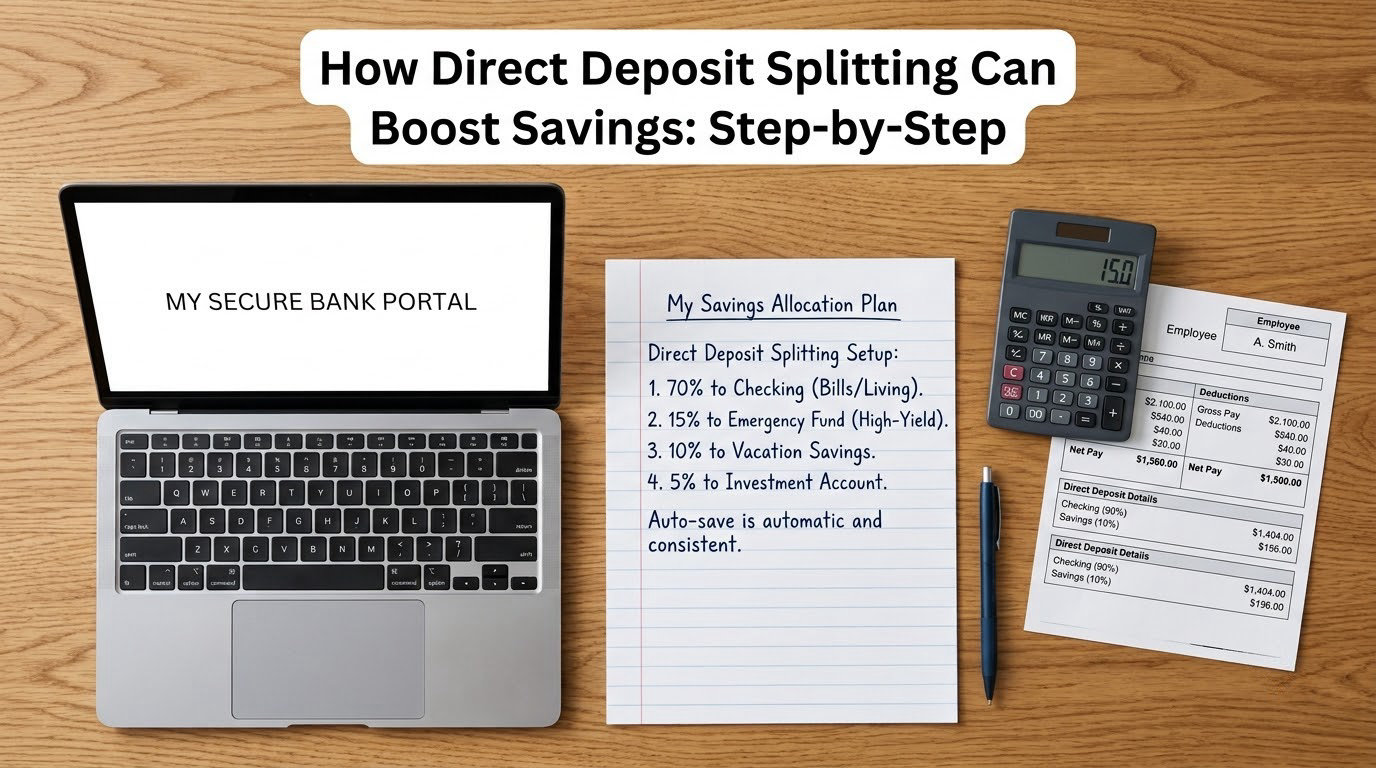
How direct deposit splitting works
Your payroll system stores a list of deposit accounts. For each one it holds the account type, routing number, account number, and an allocation that is either a flat dollar amount or a percentage of that paycheck. On each pay date the system takes your net pay and posts the allocation to every account on the list in the same run.
That is the entire mechanism. Nobody moves the money later, so the savings portion is not sitting in checking where you can see it and decide it is fine to spend this weekend. This is the same logic behind the pay-yourself-first approach: the transfer happens at the top of the cycle rather than at the bottom of it.
Two things follow from the mechanics. First, the money is split after taxes and deductions, so you are splitting net pay, not gross pay. Second, the split happens the same day your paycheck lands, not a day or two later, which matters for bills due in between.
Choose an automatic savings split that you can live with
Percentage splits scale up with every raise, which is attractive, but they also scale the risk of an overdraft when your checking balance is already thin in a month with an early bill. Fixed dollar splits are less exciting and much easier to survive an expensive month. Most people do better starting with a fixed amount they know is already covered by their budget, then raising it a few months at a time.
Here is what different percentages do to a paycheck. All amounts below are in US dollars, the salaries are illustrative, and the take-home figures are after a typical withholding estimate.
- 40,000 a year: about 1,240 take-home per paycheck. A 10% split sends 124 to savings, 15% sends 186, and 20% sends 248.
- 60,000 a year: about 1,860 take-home per paycheck. That leaves 186 at 10%, 279 at 15%, and 372 at 20%.
- 80,000 a year: about 2,480 take-home per paycheck, or 248 at 10%, 372 at 15%, and 496 at 20%.
- 100,000 a year: about 3,100 take-home per paycheck, which splits into 310 at 10%, 465 at 15%, and 620 at 20%.
A 15% savings rate is the most commonly recommended starting point, and it lands near the median of what people in budgeting communities report being able to sustain. It is a target, not a rule, and a 10% split that never gets raided is better than a 25% split you end up reversing by the third payday.
Before you commit to a number, work backward from the amount that has to survive in checking: rent or mortgage, utilities, insurance, groceries, transport, debt minimums, and the subscriptions you will not actually cancel. Whatever remains after those bills is the buffer your split can borrow from. Subtract the bills that land before your next payday, and the rest is your realistic starting split.
If your income changes week to week because of hourly hours, tips, commission, or freelance work, skip the percentage. A fixed dollar amount set below your leanest realistic pay period is the safer route, and it is what people earning variable income tend to prefer for that reason. A percentage on a small check can shrink your savings contribution in exactly the months you need it most.
Bonuses and commission checks are separate from regular payroll in many systems, so the split you set may not apply to them at all. If you want a rule for irregular pay, decide the percentage once and apply it manually when the deposit lands, or set up an automatic transfer that sweeps a fixed share into savings on a set day.
Update payroll and confirm the first deposit
Log in to the payroll portal your employer uses and look for direct deposit, payment elections, or deposit distribution. The wording differs by vendor and the fields sit in a different place in each one, so expect a few minutes of hunting. What you are looking for is the option to add more than one account and set an allocation per account.
- Open the deposit distribution section and add your savings account.
- Enter the account type first, then the routing number and account number.
- Choose the allocation type: fixed dollar amount or percentage.
- Enter the amount or percentage for each account so the total equals 100%.
- Set the effective date, staying ahead of the payroll cutoff.
- Save and download or screenshot the confirmation for your own records.
- After the next payday, check every account in the list and confirm the amounts landed as configured.
If your portal only allows one account, that is a vendor limit, not a rule about your money. Some payroll systems cap the number of deposit accounts at two. Before you assume you are stuck, ask HR these five questions: how many deposit accounts can I have, can the allocation be a percentage, can the accounts be at different institutions, how far in advance of payday must a change be submitted, and can you confirm the split to me in writing before the first deposit runs.
Splitting between two different banks works fine. You use each bank’s own routing and account number, and the accounts do not need any relationship to each other. Expect the new account to go through a pre-note hold, which is a standard verification period where the bank confirms the account is open and belongs to you; it can run one to two pay cycles, and some banks release funds immediately if you have had an account there for a while. Larger employers may ask for a voided check or a bank letter of attestation to authorize the new account, which is routine paperwork rather than a red flag.
Check the first deposit in every account, not just the checking side. People who split across banks and never look at the second account are the ones who discover months later that the allocation was set to zero or that the account was marked as the wrong type. Your confirmation email or portal receipt is the record to compare against.
If payroll truly cannot split, use a standing transfer instead. Set an automatic transfer from checking to your savings account for one or two days after each payday, when the money is already in checking and the transfer cannot borrow from money you do not have. The savings arrive later, but the automation and the discipline are the same. This is also the setup some people prefer because they can cancel it in thirty seconds without filling out a payroll form.
Review and increase the split gradually
A split is not a setting-and-forget decision, because your expenses change faster than you expect. Track three pay cycles before you judge it, and write down three numbers each time: what landed in savings, what your checking balance was on the worst day of the cycle, and whether any bill had to wait.
Look at the shape of your spending rather than the total. If your checking balance dips hardest in the second week before payday, the problem is timing, not the size of the split, and a small shift in when bills are due fixes it more cheaply than lowering the split. If the low point is spread evenly across the cycle, the split is simply too aggressive for what you are earning.
Raise the amount when something genuinely changes: a raise, a paid-off debt, a partner’s income ending, or a move to a cheaper place. People who automate a percentage rarely lower it after a raise, which is exactly the behaviour that makes the strategy worth doing. If cash flow gets tight, lower the split first and say so out loud to yourself, because a paused split that gets restarted in two months is a success and a split you quietly abandon is a failure you did not know you were having.
The last review is the easiest one. Every quarter, look at where the emergency fund and the goal accounts actually stand against the number you wrote down at the start. If the emergency fund is funded, move that portion toward the goal account or a retirement contribution instead of letting it sit.
One destination account is enough to start. Where you point it matters more than how many you open.
Where the Savings Portion Should Go
Put the core savings portion in a high-yield savings account. Checking pays roughly nothing on most balances, and a high-yield account pays a meaningful annual percentage yield on the same money with the same access. Rates move, so check what your bank is actually paying this month rather than assuming from an old article.
Give your emergency fund its own account rather than a slice of a general savings balance. A separate account keeps it identifiable: you can check the balance in seconds to see whether a real emergency justifies using it, instead of trying to work out how much of a shared balance is technically still yours. A typical target is three to six months of essential expenses, and the number matters more than the account title.
Then use sinking funds for money with a known deadline. A car repair fund, a vacation fund, and a deposit fund each get their own account so a withdrawal from one does not quietly shrink another goal. This is the piece people who use zero-based budgeting tools tend to struggle with, because a single savings balance does not show which bucket is short.
Only park money in something less liquid once the emergency fund is done and a near-term goal is funded. Certificates of deposit and short-term treasury bills pay more than a savings account but tie the money up for a set term, which is fine for a down payment eighteen months out and a bad idea for money you might need in March.
Common Mistakes That Defeat a Split
Saving through your paycheck fails for predictable reasons, and every one of them has a simple fix. These are the ones that show up repeatedly in personal finance and budgeting discussions.
Leaving too little in checking. The most common mistake is splitting based on what is left over after expenses instead of what is left after the buffer. Fix: before each payday, subtract every bill due before the next one from your checking balance, then split what survives that subtraction.
Saving without a name attached. A savings balance with no purpose behaves like extra checking, because there is nothing stopping a person from spending it. Fix: one account per goal, each labelled for a specific purchase or a specific buffer size, so any withdrawal reads as a deliberate choice.
Confusing a payroll split with a standing transfer. They are different tools. A payroll split moves the money before you see it and cannot fail; a standing transfer runs after payday from money already in checking and can bounce if the balance is short. Fix: use the payroll split for the core emergency fund, and a standing transfer for flexible or irregular amounts.
Treating the emergency fund as a cash buffer. The point of the emergency account is that it is not your spending cushion. If you dip into it before the emergency, the fund stops being an emergency fund. Fix: keep a separate everyday cushion in checking, and define in advance the specific jobs that justify a withdrawal from the emergency account.
Splitting a thin paycheck with a percentage. A percentage feels safe because it looks proportional, but on a short check it takes the same bite from a smaller buffer. Fix: if your hours or income vary, use a fixed dollar amount set below your leanest realistic week.
Missing the payroll cutoff. Submit the change after the cutoff and it silently starts a cycle or two later, which reads as the split not working. Fix: find the cutoff date in the portal, note it in your calendar, and confirm the effective date shown on the confirmation screen before the first run.
Never checking the first deposit. Wrong account type, a transposed digit, an allocation that saved as zero. Fix: within a few days of the first payday, open every account on the deposit list and compare what landed against your confirmation record.
One more worth mentioning, because it costs real money: splitting does not change your taxes. Your withholding is calculated on your gross pay through the payroll system, so the savings portion is already-taxed money. Direct deposit splitting is an allocation tool, not a tax strategy.
Frequently Asked Questions
Can I split one direct deposit into multiple accounts?
Usually yes, two is standard and many payroll systems allow three or four. You enter each account with its type, routing number, account number, and either a fixed dollar amount or a percentage, and the total has to equal 100 percent. Some payroll vendors cap the number of accounts, so check your portal or ask HR before you plan a four-way split, and confirm the totals on the summary screen before you save.
Does splitting direct deposit change my take-home pay?
No. Splitting happens after taxes and deductions are calculated, so the same net pay lands on your accounts, just divided differently. Your withholding is based on gross pay through the payroll system, which means splitting direct deposit is an allocation tool rather than a way to reduce what you owe. A first paycheck after you add an account can look different if proration applies, so confirm the effective date.
How much should I send to savings from every paycheck?
Fifteen percent of net pay is the most common starting target, and ten percent is a perfectly respectable floor. What matters more is whether your checking balance survives the worst stretch between paydays. Subtract every bill due before your next payday from your take-home, and split whatever remains above your essential costs. A split you keep is worth more than a larger one you reverse.
Will a direct deposit split cause an overdraft?
It can, if you size the split against money that is already spoken for. Overdrafts usually come from two habits: splitting the same paycheck twice, and setting a percentage higher than your leanest realistic pay period can support. Keep a cushion in checking, size the split below your worst month, and turn on balance alerts. If cash flow gets tight, lower the split rather than hoping.
Can I use direct deposit splitting to pay down debt?
Yes, and it is one of the more flexible uses. Route a fixed dollar amount to a savings account labelled for debt payoff, then sweep it to the lender on a schedule you can actually meet. Some employers support extra payments through the same portal. Just watch the math: a credit card balance accruing interest while you hold its payoff money in a lower-yielding account can cost you more than you gain.
What if my employer does not allow multiple deposit accounts?
That is a payroll vendor limit, not a rule about your money. Ask HR how many accounts you can have and whether the allocation can be a percentage. If the answer is one, set up an automatic transfer from checking to savings for one or two days after payday, so the money is already in the account before it moves. The transfer arrives later, but it needs no payroll form and cancels in seconds.
Conclusion
Start with one destination account and one fixed dollar amount you know your budget covers, and submit it far enough ahead of the payroll cutoff to land next payday. Watch every account after the deposit runs, then raise the amount once you have three pay cycles of data showing your checking balance holds. That first split is the only piece that takes real effort, and it is the whole answer to how direct deposit splitting can boost savings: the savings after it are the system doing the work for you.