A cash-out refinance replaces your existing mortgage with a bigger loan and hands you the difference in cash. A home equity loan leaves your current mortgage exactly as it is and adds a second lien for a single lump sum. Which one wins comes down to your current note rate, how much cash you actually need, and whether you want one payment or two.
Before the detail, the short version: a cash-out refinance usually costs more upfront but prices cheaper and gives you one predictable payment. A home equity loan usually costs less upfront and protects the rate you already have. Rates, fees and eligibility all depend on the lender, the property and where you live, so treat the numbers below as working ranges rather than quotes.
Table of Contents
- Cash Out Refinance vs Home Equity Loan at a Glance
- How a Cash Out Refinance and Home Equity Loan Work
- Cash Out Refinance vs Home Equity Loan: Rates and Closing Costs
- Borrowing Amount and Monthly Payment Differences
- Repayment Flexibility and Draw Periods
- Credit Requirements and Impact
- Which Uses Make Each Option Safer?
- Risks, Eligibility, and Costs to Watch
- Which Should You Choose?
- Frequently Asked Questions
- Can I get a cash-out refinance with bad credit?
- Does a home equity loan have a variable interest rate?
- Can I use either option to consolidate debt?
- Can home equity be used for an investment property?
- Are cash-out refinances and home equity loans tax-deductible?
- Does closing the mortgage after a cash-out refinance remove the new lien?
- Conclusion
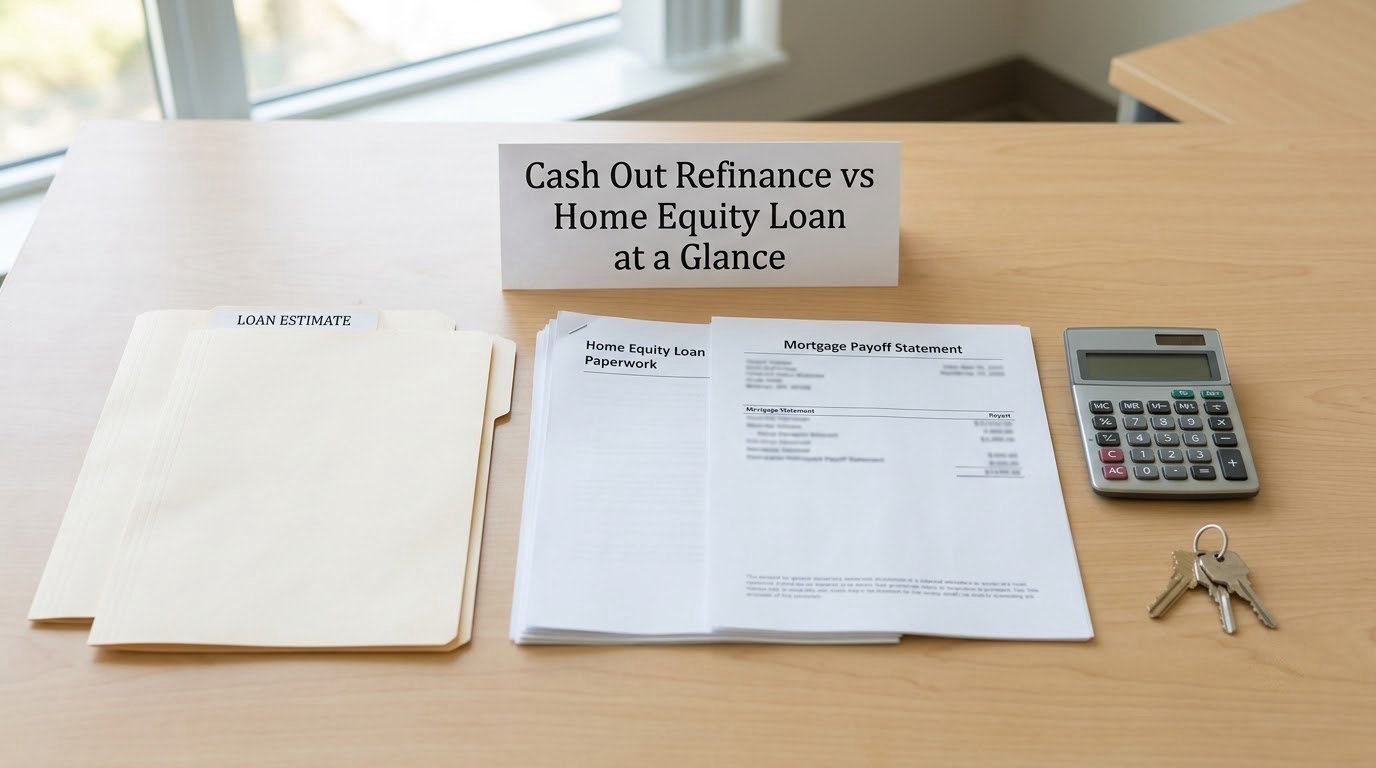
Cash Out Refinance vs Home Equity Loan at a Glance
| Criterion | Cash-out refinance | Home equity loan |
|---|---|---|
| How you borrow | New, larger first-lien mortgage; old loan paid off at closing | New second lien stacked on top of your existing mortgage |
| Typical use | Large lump sum plus a chance to improve the rate or term | A defined lump sum while keeping the current rate and payment |
| Monthly payments | One payment on a brand new amortization schedule | Two payments: yours plus the new second-lien payment |
| Rate behaviour | Usually fixed; adjustable and step-down products also exist | Usually fixed; the HELOC variant is variable |
| Closing costs | Roughly 2% to 6% of the new loan amount | Roughly 1% to 5%, and some lenders charge nothing |
| Access to cash | One advance at closing | One advance at closing (revolving access only with a HELOC) |
| Repayment flexibility | Fixed maturity, early payoff usually fine | Fixed term; prepayment penalties sometimes apply |
| Credit impact | New mortgage inquiry, new account, payment history resets | Smaller effect, but a new lien still counts in your debt-to-income ratio |
| Term effect | Restarts the clock on your remaining balance | Leaves your existing payoff date untouched |
| Best fit | Big cash need plus a rate worth improving | Good existing rate, moderate lump sum, budget for two payments |
One structural fact drives everything else: a cash-out refinance pays off your first mortgage, so the old loan disappears. A home equity loan does not touch it, so you carry both debts at once.
How a Cash Out Refinance and Home Equity Loan Work
A cash-out refinance is priced as a primary mortgage. You apply for a loan larger than your current balance, the existing lender is paid off at closing, and the remainder arrives to you after closing costs are taken out. For a refinance transaction you generally have a three-day right of rescission before funds disburse, which is why the money often shows up about three business days after signing rather than on the spot.
A home equity loan is priced as a second lien. The lender advances one lump sum, adds it to the total balance owed on your home, and records a lien behind your existing mortgage. Your current note rate, remaining term and monthly payment stay exactly where they were.
A simple illustration: a home valued at $400,000 with a $240,000 balance carries about $160,000 of equity. A borrower who wants $60,000 would ask for roughly a $300,000 cash-out refinance or a $60,000 home equity loan. The difference is not the cash. It is that the refinance re-amortises $300,000 over a new term, while the equity loan leaves $240,000 on the original schedule and adds $60,000 on a second one.
Cash Out Refinance vs Home Equity Loan: Rates and Closing Costs
A second lien gets priced above a first lien, because the lender’s collateral sits behind whatever mortgage is already there. That gap is the main reason a cash-out refinance often carries the better rate even after you pay more in fees to get it.
Closing costs are where the two diverge most sharply. Expect roughly 2% to 6% of the loan amount on a cash-out refinance, and roughly 1% to 5% on a home equity loan, with some lenders waiving them entirely on the second lien. Those fees typically include an origination charge, title work, recording, and often an appraisal or automated valuation.
This is where break-even math earns its keep. If a refinance costs $7,000 in closing costs and shaves $180 off your monthly payment, you need to stay in the home roughly 39 months just to get your money back, before a single dollar of the lower rate has helped you. Sell or move sooner and the refinance can cost more than it saved.
Compare the APR on the Loan Estimate, not the advertised rate. Look at how much of the new loan is being used as cash-out, whether the rate is fixed or adjustable, whether there is a prepayment penalty, and what the total of payments is projected to be. If you cannot get a refinance below roughly 2% better than your current rate, the closing costs usually eat the gain.
Borrowing Amount and Monthly Payment Differences
Both products are capped by equity, and lenders measure it three ways. Your loan-to-value ratio uses only your first mortgage. Your combined loan-to-value adds the new second lien to the total. Your home equity combined loan-to-value does the same with the proposed cash-out refinance, and many lenders set the strictest limit there.
The standard ceiling is 80% total LTV on conventional and FHA loans, which preserves the 20% equity cushion. VA borrowers can often go further, in some cases to 100% of the property value, because the guaranty carries part of the loss risk. Every lender adds its own margin below the ceiling, and private lenders cap cash-out amounts in absolute dollars too.
Now the payment math, using the same $400,000 home and $240,000 balance. Say the existing loan is at 3% and the refinance comes in at 6.5% on $300,000 over 30 years. The existing payment is roughly $1,012. The new refinance payment is roughly $1,892, so you hand over about $880 more each month to receive $60,000. A $60,000 home equity loan at 8% over 15 years runs about $581, added on top of the $1,012 you already pay.
That is the trade in one line. You either pay less per month in interest and give up your low-rate first mortgage, or you keep the low rate and carry a second payment. Interest starts accruing on the entire refinance balance from day one, which is a detail bank marketing pages rarely mention.
Repayment Flexibility and Draw Periods
A cash-out refinance has a fixed maturity. You make one payment for a set number of years, and when the term ends the loan is simply done. There is no draw period and no repricing, because the whole balance was advanced at closing.
A home equity loan is also closed-end and fixed: one advance, one payment, one end date. A HELOC is different in kind. It works like a revolving credit card against your house, with a draw period of typically ten years where you can borrow as needed, then a repayment period where the balance amortizes and the draws close.
During the draw period a HELOC often charges interest only on what you actually borrow, which makes it cheaper for an uncertain renovation bill than committing to $60,000 on day one. Interest-only payments during the draw period can also create payment shock at the reset, when the principal suddenly starts amortizing and the payment jumps.
Early repayment deserves a look before you sign. Cash-out refinances are quick to prepay in most cases, while home equity loans and HELOCs can carry prepayment penalties during an initial period. If you might sell within a few years, ask for the penalty clause in writing and date your decision to it.
Credit Requirements and Impact
Qualifying for a cash-out refinance is the harder of the two. Lenders run a full underwriting: income documentation with W-2s or tax returns, a credit review, a property valuation, and a debt-to-income calculation on the entire new payment. With lower credit tiers, most lenders will still do it, but at a higher rate or with a lower maximum LTV.
A home equity loan is usually an easier approval. The collateral is already there, and many lenders price it around credit profile plus home value and lien position rather than credit alone. Documentation is lighter, though a self-employed borrower still needs to show income the same way.
On impact, a new mortgage creates a hard inquiry, a new account and a large new balance on your report, which usually nudges your score down in the short term before payment history helps it recover. A home equity loan adds a smaller account and a smaller inquiry. Either way, both payments count in your debt-to-income ratio, and lenders will count them against a future auto loan, student loan or next mortgage.
That last point catches people off guard. Two payments of $1,000 each take the same bite on DTI as one payment of $2,000, whether you actually make both every month or not.
Which Uses Make Each Option Safer?
Both products are reasonably matched to a defined, planned need. A renovation that adds measurable value, tuition for a child with a real deadline, consolidating credit card and personal loan balances at a lower rate, or building a reserve that survives a job loss all hold up.
The pattern that works: you know the amount, you have a timeline, and the money goes toward something that survives the loan. Under those conditions the second lien is usually the calmer choice, because you keep the low-rate first mortgage and the extra payment is bounded.
Higher-risk uses include speculative investing, day trading, funding a business that has not launched, and short-term borrowing against a home with no plan to repay it. Putting your emergency savings into the down payment of a second property is the classic trap. Tapping equity to cover a month of overspending is a worse one.
Investors should know that cash-out refinance pricing on an investment or second home runs higher than on a primary residence, and the loan comes with a seasoning requirement that delays access to the cash. Several readers on mortgage forums make the same point about deploying capital into a renovation: the return has to beat the cost of the money, and home improvement is not guaranteed to do that.
Risks, Eligibility, and Costs to Watch
Start with what disqualifies you. Being underwater, meaning you owe more than the home is worth, blocks both products and stops a cash-out refinance outright. Too little equity for a second lien closes the home equity door too. Past-due accounts, a recent foreclosure or bankruptcy, high revolving balances, and a debt-to-income ratio above the lender’s threshold can all knock you out of one or both.
On the cost side, itemise every fee before signing: origination, appraisal or waiver, title search and insurance, recording, survey if flood-zone applicable, and any discount points you buy down front. Discount points are prepaid interest, so a rate buydown only pays off if you keep the loan a long time. Cash-out refinances can carry prepayment penalties during the first few years, which matters a lot if you might sell.
Watch variable-rate exposure on any HELOC, and make sure the draw period end date is written down somewhere you will see it. Your home secures both products, and either lender can foreclose on a default. A popular tactic is to close the old credit accounts when a refinance pays them off, but think twice before touching cards you have used for years, since closing them shortens your credit history.
One practical trap: refinancing into a full 30 years when you have only eight left on the old loan. The payment looks smaller, but the total interest paid over a fresh 30-year term is far higher than finishing the original balance. If you are within roughly a decade of paying off your mortgage, some lenders will quote a home equity loan with your existing balance wrapped into it, which can be worth asking about.
On taxes, the cash you receive is generally not taxable income because you are borrowing against equity you already own, not selling the house. Interest deductibility depends on what you did with the funds and on your overall tax position. Treat that as general information and confirm the details with a tax professional before you claim anything.
Which Should You Choose?
Choose a cash-out refinance when you need a large sum, your current rate is meaningfully higher than what you can get today, and you are staying in the home for many years. The single payment and the lower rate win when the term is long enough to clear those closing costs.
Choose a home equity loan when your existing rate is already good, the need is a known lump sum, and your budget can carry two payments without strain. You keep the amortization you already have and pay far less in fees.
Consider a HELOC when the amount is uncertain or the project runs in stages, since you pay interest only on what you draw during the draw period. Watch the payment reset at the end of it, and confirm whether your planned use even qualifies, since some lenders restrict HELOC draws to the primary residence.
Whatever you pick, get written estimates from at least two lenders, or from a lender and a mortgage broker, using identical assumptions: the same cash amount, the same term and the same rate lock. Compare the APRs, the cash-out portions and the projected total of payments side by side. Then give each lender the same three facts: your current rate, the amount you need and your credit score. Quotes built on different assumptions cannot be compared.
Frequently Asked Questions
Can I get a cash-out refinance with bad credit?
Possibly, but expect a higher rate and a lower maximum loan-to-value ratio. Most lenders set credit score floors in the 620 to 680 range, with better pricing below 740. FHA and VA cash-out refinances can be more forgiving than conventional ones. Recent collections, a bankruptcy within the past few years, or a high debt-to-income ratio will usually cost you the loan entirely.
Does a home equity loan have a variable interest rate?
Usually not. A home equity loan is a closed-end second lien with a fixed rate and a set monthly payment for the life of the term, so your payment never changes. The variable-rate product is the HELOC, which is a revolving line that reprices periodically, usually tied to the prime rate. Confirm which one you are being quoted, because the names get mixed up constantly.
Can I use either option to consolidate debt?
Both can pay off credit cards or a personal loan, and both convert unsecured debt into debt backed by your home. A home equity loan usually costs less to set up, while a cash-out refinance often carries a lower rate on the whole balance. Run the numbers on total interest over the life of each loan, because a lower rate on a much larger balance can still cost more overall.
Can home equity be used for an investment property?
Yes, most lenders offer both products on second homes and investment properties. Two differences matter. Second-home financing usually carries a higher rate and a lower maximum LTV, and cash-out refinance loans often require the property to be seasoned for several months before proceeds can be released. Your primary residence will normally price better for a large cash-out need.
Are cash-out refinances and home equity loans tax-deductible?
The cash itself is generally not taxable income in either case, because you are borrowing against equity rather than selling the home. Interest may be deductible depending on how the funds were used, how much you itemise, and your overall tax position. HELOC interest is treated as home equity interest, which has its own limits. Confirm your situation with a tax professional.
Does closing the mortgage after a cash-out refinance remove the new lien?
No. Closing your old credit accounts after a cash-out refinance only affects your credit report, not the property record. The new first lien stays on the deed until you sell, refinance again, or pay the balance off, and the old lien is already released because the old loan was paid off at closing. Title work and a payoff statement handle the release, not closing bank accounts.
Conclusion
The rule is simple: refinance when your rate is worth improving and the cash need is large enough to justify the fees, and stay put on a second lien when your current rate is already good and the need is bounded. Whichever direction you lean, run both options all the way to the total of payments over the period you expect to keep the loan, confirm exactly how much cash you need after fees, and get written estimates from at least two lenders before you sign anything.
This is general information, not financial advice. Rates, fees and eligibility vary by lender, property and location, so your own numbers will decide it.