
A mutual fund capital gains distribution is taxable in the year you receive it, whether you take the money or reinvest it. Your brokerage reports it on Form 1099-DIV, Box 2a, and the fund’s own holding period on the securities it sold decides whether the gain is taxed at long-term rates (0, 15 or 20 percent) or at ordinary income rates.
That last part is the one that trips people up. You did not sell anything, yet you owe tax. This guide walks through where the gain comes from, how the paperwork reports it, which rate applies, and what changes when the same fund sits inside an IRA or 401(k). Rules and thresholds are adjusted for inflation every year, so verify the figures that apply to your tax year against current IRS guidance.
Key takeaways: the fund must distribute realized gains at least once a year, and you report the amount on your return. Your own purchase date does not set the rate. Retirement accounts delay or exempt the tax but do not always erase it. Capital losses elsewhere in your portfolio can offset part of the bill, and a surprise distribution can push you past your safe-harbor for estimated payments.
Table of Contents
- What Is a Mutual Fund Capital Gains Distribution?
- How Mutual Fund Capital Gains Distributions Are Calculated
- Which Forms and Tax Documents Report the Distribution?
- What Determines Whether the Gain Is Short- or Long-Term?
- How Is the Distribution Included in Federal Taxable Income?
- How Mutual Fund Capital Gains Distributions Are Taxed at Long-Term vs. Short-Term Rates
- How Are Exceptions Such as Wash Sales and Death or Gift Property Handled?
- Do Taxable and Retirement Accounts Treat the Distribution Differently?
- What Can Change the Final Tax Result?
- Should You Sell Before the Distribution to Avoid the Tax?
- How to Check and Report the Distribution Correctly
- Frequently Asked Questions
- Do I owe tax on a mutual fund capital gains distribution if I did not sell my shares?
- Why does my capital gain distribution show a different cost basis on Form 1099-DIV?
- Are mutual fund capital gains distributions taxed the same as long-term capital gains?
- Can I reinvest a mutual fund capital gains distribution without triggering taxable income?
- What should I do if the 1099-DIV amount is wrong or missing?
- Conclusion: What to Do First
What Is a Mutual Fund Capital Gains Distribution?
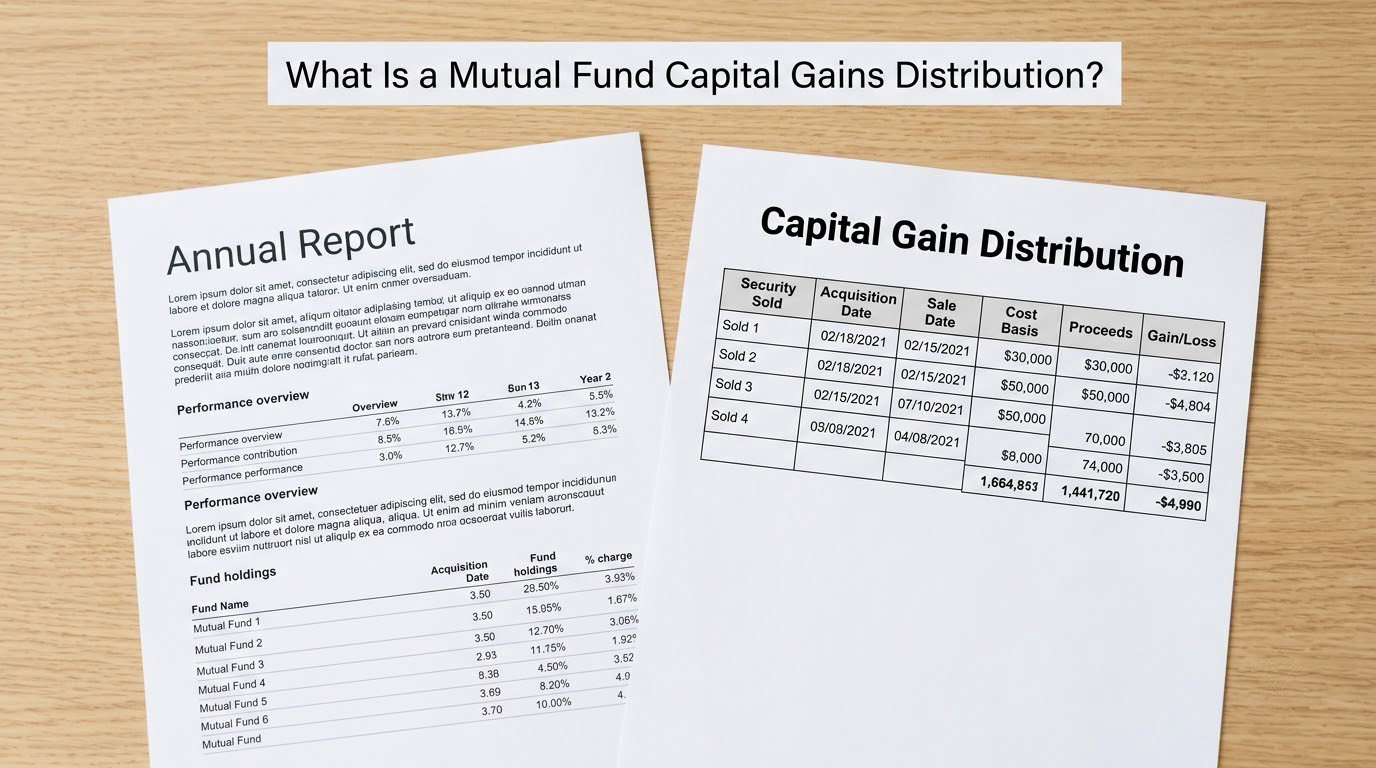
A capital gains distribution is the share of net gains a fund realizes by selling securities for more than it paid, then passes through to shareholders. It is not a bonus and it is not extra money from somewhere else. It comes out of the fund’s own value.
That distinction explains why the tax feels unfair. When the distribution is paid, the fund’s net asset value drops by roughly the same amount per share, so your account balance barely moves. You are taxed on a payment that never increased your wealth. Investors describe this on investing forums as the fund handing you your own money with a tax bill attached.
Three different items get packed into one Form 1099-DIV, and keeping them apart makes everything else easier:
- Interest from bonds and money market holdings, which is ordinary interest income.
- Dividend income from stocks the fund owns, some of which may be qualified dividends.
- Capital gains from selling securities the fund no longer wanted to hold.
Registered mutual funds are required to distribute realized gains and income to shareholders at least annually, so this is a legal pass-through rather than a fund’s choice to pay you. Exchange-traded funds do not operate under the same requirement, which is the core reason the two wrappers behave differently at tax time.
Another thing worth naming early: a fund can pay a large capital gains distribution in a year it lost money or barely gained anything. The trigger is often redemptions. When other shareholders sell enough, the fund has to raise cash, and if it sells appreciated holdings to do it, those gains get passed through to everyone still holding, including you. Portfolio turnover inside the fund does the same thing. Investors see this as unfair for a reason that has nothing to do with performance.
Some funds are habitual distributors, paying out gains every single year regardless of how the portfolio performed, which keeps a steady annual tax obligation in taxable accounts. A fund that distributes rarely is easier to plan around. The prospectus’s after-tax return disclosure is where this shows up, and it is worth reading before you buy.
How Mutual Fund Capital Gains Distributions Are Calculated
The arithmetic happens inside the fund. Take proceeds minus adjusted basis for every security sold, net out any losses, and subtract distributions already made during the year. The remainder is the net capital gain the fund must pass through.
A simple bond fund example: it buys a bond for 100, it rises to 108, and the fund sells. Gain of 8 per unit, on 10,000 units, is 80,000. Minus expenses and earlier distributions, if 72,000 remains to distribute and the fund has 12 million shares, that is 6 dollars of gain per share. Every holder receives 6 dollars per share and is taxed on that 6 dollars.
Your broker then prepares your records. Basis generally comes from the average cost method, unless you asked for specific share identification. The holding period dates the broker reports reflect the fund’s positions, not when you bought your shares.
Which Forms and Tax Documents Report the Distribution?
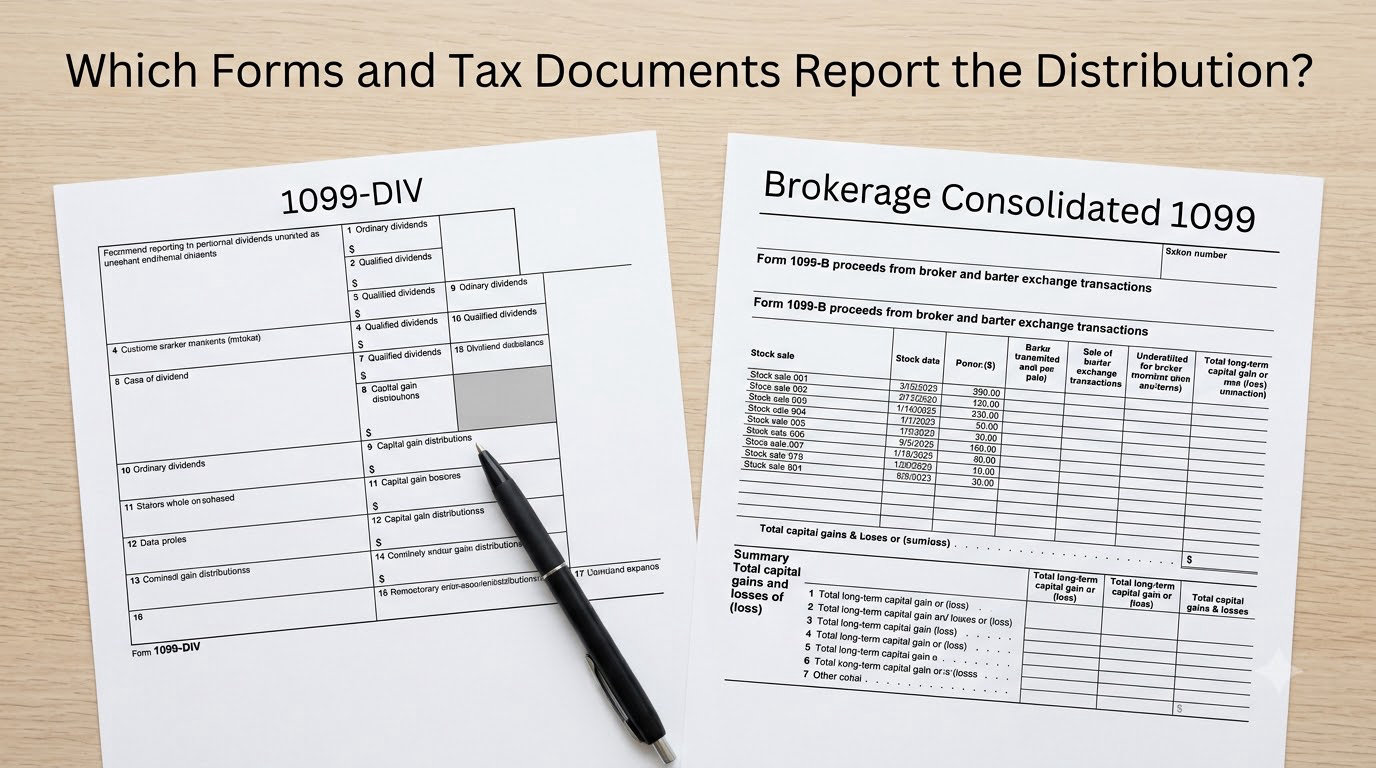
Form 1099-DIV is the document that reports the distribution. The boxes you actually need are few:
- Box 1a lists ordinary dividend income, including amounts that may qualify as qualified dividends.
- Box 2a lists capital gain distributions from a mutual fund or real estate investment trust.
- Box 2b shows the amount in 2a that came from unrealized appreciation on securities the fund still holds.
- Box 4 lists the amount of tax-exempt interest, common in municipal bond funds.
If you hold the fund at more than one brokerage, you should receive a separate 1099-DIV from each one. A consolidated form from a larger brokerage arrives if the firm custodies assets for other institutions, so read the label before assuming which documents you owe.
Form 1099-B is a different form for a different event: your own sales. If you sold shares of the fund yourself, that gain appears on 1099-B and flows through Form 8949. A fund-level distribution and your own realized gain are reported separately even when both arrive in the same tax year.
The comparison that catches errors: add the totals on every 1099-DIV against the year-end consolidated statement your brokerage issues. Mismatches usually mean a duplicate form, a missing account or a corrected document still in transit.
What Determines Whether the Gain Is Short- or Long-Term?
The fund’s holding period decides, not yours. If the fund held a security more than one year before selling it, that gain is long-term. One year or less makes it short-term, and short-term gains are taxed at your ordinary income rates.
This is the concept that causes the most confusion. You might have owned the fund for a decade, but a fund that rebalances constantly is generating short-term gains every year, so your distribution is taxed at ordinary rates. A fund that holds securities until they mature can generate long-term gains even if you bought the fund six months ago.
The practical consequence is real. A fund’s turnover ratio tells you how much trading happens inside it, and a high-turnover or actively managed fund tends to produce short-term gains that you pay full ordinary rates on, distributed to every holder regardless of their own preference.
Buying right before the distribution date is the same lesson from the other direction. You will not receive the distribution, but you will pay tax on a share of the gain that accrued before you arrived.
How Is the Distribution Included in Federal Taxable Income?
The general rule is simple: a taxable distribution is included in your income in the year it is paid. Reinvesting changes where the money goes, not whether it is income. The reinvested shares simply carry a higher cost basis afterward.
Here is a filing example. Suppose Box 1a shows 900 dollars of dividends, Box 2a shows 1,400 dollars of capital gain distributions, and all of it is long-term qualified. You report 900 dollars on the dividend line of Form 1040 as qualified dividend income and 1,400 dollars on Schedule D as a long-term capital gain. Both amounts then meet on the capital gain tax worksheet, which stacks them with your own realized gains and losses before applying rates.
Not every component is taxable in the same way. Tax-exempt interest in Box 4 is reported separately and can still push up the alternative minimum tax. Return of capital is not income at all; it reduces your basis, and once basis reaches zero, later distributions become capital gain.
Qualified dividend income is the overlay worth understanding. Dividends from a mutual fund can qualify for the same preferential rates that apply to long-term gains, provided the fund meets the holding-period and eligible-security tests. Distributions from a bond-heavy fund usually do not.
How Mutual Fund Capital Gains Distributions Are Taxed at Long-Term vs. Short-Term Rates
Long-term capital gain distributions are taxed at preferential rates that top out at 0, 15 or 20 percent. Which one applies depends on your total taxable income and filing status for the year, and where you land can be pushed up by other income. Short-term distributions are taxed at your ordinary income rates, which run higher at the top.
The structure in short: long-term gains get the preferential rate schedule, short-term gains get ordinary rates, and if either pushes you into a higher bracket, the excess flows into that bracket rather than being taxed at one flat rate.
Worked examples on a 10,000-dollar distribution show how wide the spread is. Each row assumes the entire amount is long-term gain and taxed at a single rate.
| How the 10,000 dollar distribution is treated | Federal tax |
|---|---|
| Entirely long-term, taxed at the 0 percent rate | 0 dollars |
| Entirely long-term, taxed at the 15 percent rate | 1,500 dollars |
| Entirely long-term, taxed at the 20 percent rate | 2,000 dollars |
| Treated as short-term, taxed at a 12 percent ordinary bracket | 1,200 dollars |
| Treated as short-term, taxed at a 38 percent ordinary bracket | 3,800 dollars |
Short-term treatment costs roughly twice as much as the 20 percent long-term rate at the same income level. That gap is the entire reason fund turnover matters to you as a shareholder, and it is why the tax cost of a fund shows up in its after-tax return disclosure.
The same spread applies to a smaller distribution. A 1,000-dollar long-term distribution costs 0 dollars, 150 dollars or 200 dollars depending on the bracket. A 50,000-dollar distribution at a single 20 percent rate means 10,000 dollars, so larger balances make the difference between brackets far more expensive.
Check the numbers before you rely on them. The income breakpoints for the 0 percent bracket, the boundaries of the 15 percent band and the ordinary income brackets are all indexed and revised annually. The IRS publishes the current figures each year in its revenue procedure on inflation adjustments, and the thresholds in this paragraph are deliberately not stated as fixed dollar amounts because they move. Pull the current year values from IRS.gov before you estimate anything.
Two additional federal charges are worth keeping in mind. Capital gain distributions are investment income, so they can be subject to the 3.8 percent net investment income tax for taxpayers with modified adjusted gross income above the statutory threshold. Tax-exempt interest can feed the alternative minimum tax even though it is not taxable income.
How Are Exceptions Such as Wash Sales and Death or Gift Property Handled?
Wash sales do not apply to a fund distribution by itself, but they absolutely apply to the harvesting you might do around it. If you sell shares at a loss within 30 days before or after buying substantially identical shares, including shares of the same fund or a twin ETF tracking the same index, the loss is disallowed and added to the basis of the new shares.
That last point catches people who switch a fund to its ETF version to escape distributions. The two are often treated as substantially identical for wash-sale purposes, so the strategy can quietly move a harvested loss into a higher basis instead.
Property conversions work differently. Mutual funds that convert into a different legal entity, or undergo a reorganization, usually carry a basis that flows to the new shares. The IRS treats a fair market value conversion at or above the conversion date as a taxable exchange in most cases, with limited exceptions.
Gifts and death both change basis. Shares you received as a gift generally carry the donor’s basis. Shares you inherited get a step-up to fair market value at the date of death, which often eliminates the gain entirely on a later sale.
Form 8949 is not required for the distribution itself. You report fund-level distributions through Schedule D rather than listing them line by line. Form 8949 comes into play for your own sales of the fund and for harvesting transactions.
Do Taxable and Retirement Accounts Treat the Distribution Differently?
Yes, and the difference explains why two people holding the same fund see very different tax years. Inside a taxable brokerage account, the distribution is income this year. Inside a traditional IRA or 401(k), it is not taxed now but the account carries the tax to the future. Inside a Roth IRA or Roth 401(k), no tax is due on the distribution at all, because contributions were already made after tax.
A health savings account behaves much like a traditional account: no tax on the growth now, with the tax deferred until you withdraw it, after you reach age 65. The contribution limits and the rule against Medicare-covered expenses apply on their own.
Deferral is not erasure. Withdrawals from traditional accounts and required minimum distributions from large IRAs generally flow at ordinary income rates regardless of which account paid the distribution years earlier. Qualified charitable distributions from an IRA are a common exception, and appreciated mutual fund shares donated directly to a qualified charity can bypass capital gain tax entirely.
The practical lesson is account placement. Tax-inefficient funds with high turnover belong inside tax-advantaged accounts, and low-turnover index funds or tax-managed funds are the ones to hold where the tax is owed.
What Can Change the Final Tax Result?
Beyond the rate itself, several things move the number on your bill:
- Capital losses. Realized losses offset gains dollar for dollar, up to the amount of gains, with any remainder deductible against ordinary income in that year and limited thereafter. A loss in one family member’s account does not offset a gain in another member’s account.
- Qualified dividend status. If the fund’s distributions qualify, they stack with your long-term gains for preferential-rate purposes.
- Other capital activity. Trades throughout the year, including short-term gains on other positions, feed the same worksheet.
- Net investment income tax. The 3.8 percent surtax applies to higher earners with investment income above the statutory threshold.
- State and local tax. Most states conform to the federal classification of long-term gains, and a few treat them differently. Municipal bond fund distributions are often exempt from state income tax.
- Deductions and credits. Itemized deductions can reduce the income base the capital gain worksheet runs against, and credits may offset part of the tax.
- Donation. Giving appreciated shares directly to charity avoids realizing the gain and provides a deduction, subject to the usual substantiation rules.
Estimated tax payments deserve their own note. A distribution that lands in December cannot be paid for until the following April, and if it pushes your tax due beyond your safe-harbor amount, an underpayment penalty can apply. Investors who plan for it with an extra quarterly payment avoid that entirely.
Should You Sell Before the Distribution to Avoid the Tax?
No, almost never. This is the most repeated mistake in investing forums, and the arithmetic explains why. Say your position holds 20,000 dollars of unrealized gain and the fund is about to distribute 10,000 dollars in total to every holder. Selling beforehand means you realize the full 20,000 dollars yourself and pay tax on it. Staying means the fund distributes 10,000 dollars and the tax falls on that amount instead. You replaced a 10,000-dollar bill with a 20,000-dollar one, plus transaction costs.
There is one narrow exception. A fund that pays out gains year after year gives you repeated bills, and harvesting losses in the same year can offset them. That is a portfolio-level decision, not a year-end trade, and it needs the wash-sale window handled correctly.
Prevention beats reaction. Low-turnover index funds, tax-managed funds and placing tax-inefficient funds inside tax-advantaged accounts all remove the distribution from your tax year entirely, and unlike a pre-emptive sale, none of them cost you a second gain.
How to Check and Report the Distribution Correctly
Work through this list before filing:
- Gather every 1099-DIV, including forms from custodians you have forgotten, and confirm the totals match your December consolidated statement.
- Read Box 2a and Box 2b separately. Box 2b shows how much came from securities the fund still holds, which is the piece most likely to make a distribution feel unfair.
- Confirm whether the gain is long-term or short-term using the fund’s reported classification, not your own purchase date.
- Check the reported basis against your own records if you used specific share identification, since the broker’s average cost default can differ.
- Total the capital gain worksheet with your own Form 8949 entries, then let Schedule D carry the result to Form 1040.
- Look for offsets before the deadline: realized losses elsewhere, a harvest against the 30-day wash-sale window, or a donation of appreciated shares.
- Keep the records. Basis and holding period support should be retained for as long as you own the position, and longer if you file an amended return later.
Ask a CPA or enrolled agent when the transaction is unusual: a conversion or reorganization, shares held across a merger, a gift, an inherited position, or a fund that distributes every single year. The rules interact in ways a worksheet cannot resolve on its own.
Frequently Asked Questions
Do I owe tax on a mutual fund capital gains distribution if I did not sell my shares?
Yes, in a taxable account. Registered mutual funds must distribute realized capital gains to shareholders at least once a year, and the amount is taxable income in the year you receive it. The fund’s net asset value drops by roughly the same amount, so your balance does not really grow, but the tax still applies. Reinvesting the distribution changes nothing about the tax owed.
Why does my capital gain distribution show a different cost basis on Form 1099-DIV?
The basis reported on your 1099-DIV reflects the cost of the securities inside the fund, not what you paid for your fund shares. The fund computes a per-share basis from its own purchases and sales, and that figure is used to categorize part of the distribution as unrealized gain in Box 2b. Comparing it against your own purchase price is one of the most common sources of confusion.
Are mutual fund capital gains distributions taxed the same as long-term capital gains?
Often, but not always. A mutual fund can pass through both long-term and short-term gains, and each part is taxed on its own terms. Long-term portions use the preferential capital gain rates while short-term portions are taxed at your ordinary income rates, even for a long-term gain from your own sale of the fund. Check the classification your broker reports rather than assuming the whole amount received one rate.
Can I reinvest a mutual fund capital gains distribution without triggering taxable income?
No. Reinvestment changes where the cash goes, not whether the distribution is taxable. The amount is reported on Form 1099-DIV and is included in your income for the year, whether you take it as cash or buy more shares. The reinvested shares do carry a higher cost basis, which can reduce the gain on a later sale. Directing the distribution to a tax-advantaged account can still be worthwhile.
What should I do if the 1099-DIV amount is wrong or missing?
Contact your brokerage first, since corrected forms are usually reissued in January and February. If the numbers still do not match your December statement, ask the firm to explain the difference in writing. If a form is never issued, report the distribution from your own records and keep the documentation. A tax professional can handle corrections that involve a merger, conversion or prior-year restatement.
Conclusion: What to Do First
Reconcile the Box 2a amount on your 1099-DIV against your brokerage’s year-end statement, confirm the reported basis and holding period match your records, and then check the current IRS figures for your tax year before you estimate anything. When the position involves a conversion, a gift, an inheritance or a fund that distributes every year, get a CPA involved early. It is a much smaller conversation in March than it is in April.
This article is general educational information about US federal tax treatment of mutual fund distributions. It is not individual tax advice. Rules, rates and thresholds change, so verify current guidance with the IRS and consult a qualified tax professional about your situation.