
PMI private mortgage insurance explained in one line: it is a policy that protects your mortgage lender, not you, and most lenders require it on a conventional home loan when you put down less than 20%. You pay the premium, it adds to your monthly payment, and it can usually be removed once your balance reaches a set share of the home’s original appraised value. Here is how the pieces fit together in 2026.
Most people meet PMI for the first time in the Loan Estimate, usually as a line item they did not expect next to property taxes and insurance. It feels like an extra tax on an already stretched first purchase. It is not, and it is not permanent.
Table of Contents
- What Is PMI Private Mortgage Insurance?
- Why lenders require PMI private mortgage insurance
- PMI in brief
- When Is PMI Required?
- How Much Does PMI Cost?
- How Does a PMI Premium Work?
- Can You Pay PMI Upfront?
- How Can You Reduce or Remove PMI?
- The 80% request threshold and the 78% automatic threshold
- The cancellation checklist
- Is it worth paying extra to kill PMI?
- PMI for a Conventional Loan vs. FHA, VA, and USDA Loans
- How to Talk with Your Lender About PMI
- Frequently Asked Questions
- How much is PMI on a 400,000 dollar loan?
- Is PMI tax-deductible?
- Can you remove PMI at 20% equity?
- Does the lender have to remove PMI automatically?
- Do you ever get your PMI back?
- What is the fastest way to get rid of PMI?
- Conclusion
What Is PMI Private Mortgage Insurance?
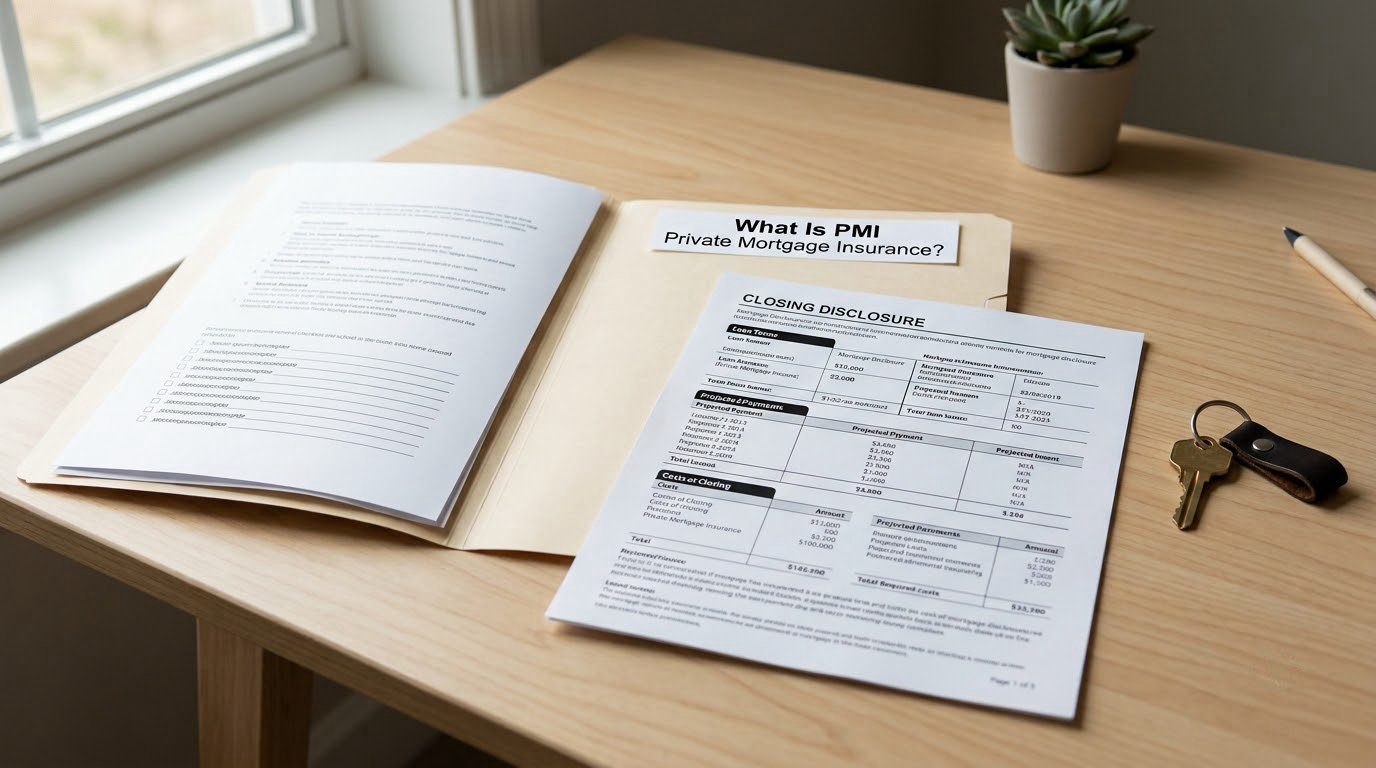
Private mortgage insurance, usually shortened to PMI, is an insurance policy a lender requires before it will fund a conventional mortgage with less than 20% down. If the borrower defaults, the insurer covers part of the lender’s loss on the property. The homeowner pays the premium and, in return, keeps no direct claim on the policy.
That last point causes most of the confusion. Borrowers assume a policy named after their mortgage is protecting their home and their credit. It is not. Homeowners insurance covers the building. PMI covers the note.
Why lenders require PMI private mortgage insurance
A 20% down payment means the buyer has 20% of their own money in the deal, so a drop in home value or a missed payment rarely leaves the lender underwater. Under 20%, the lender absorbs more of that risk, and PMI prices it back down to an acceptable level.
In short: PMI is the lender’s safety net, priced by the borrower. It sits on conventional loans. FHA, VA and USDA loans carry their own government-backed mortgage insurance instead, which is a different product with different fees and different cancellation rules.
PMI in brief
- Who it protects: the lender, not the borrower.
- When it appears: conventional loans, usually when the down payment is under 20%.
- Typical cost: roughly 0.5% to 1% of the loan amount per year, often expressed as about 30 to 70 dollars per 100,000 borrowed.
- How it is paid: monthly with the mortgage payment, or as an upfront premium at closing.
- Borrower-request threshold: a balance at 80% of the original appraised value.
- Automatic threshold: a balance at 78% of the original appraised value.
When Is PMI Required?
PMI is required when the loan-to-value ratio is above 80%, which means the mortgage is more than four-fifths of the property’s value. Put less than 20% down on a conventional purchase and you cross that line automatically.
The rule attaches to the loan, not to your intentions. Gifts of equity from a parent, down payment assistance or a seller-paid contribution do not change the arithmetic the lender uses, and PMI still applies even though the cash came from somewhere else.
Several situations put PMI in play:
- Conventional purchase with under 20% down. The most common trigger by far.
- A refinance above 80% LTV. Tapping equity with a cash-out refinance can bring PMI back on a loan that previously had none.
- A low credit score or thin cash reserves. These affect the premium rate rather than the requirement itself, and lenders often float a conventional rate up when the file is marginal.
- Financing around seller concessions. If the loan covers closing costs the seller agreed to pay, the effective loan amount rises.
Not every purchase involves conventional financing. A home bought with cash, or financed through a state housing authority’s first-time buyer program, may never carry PMI at all. Lender and program rules vary, so treat the details on your own Loan Estimate as the version that applies to you.
How Much Does PMI Cost?
The typical US range is 0.5% to 1% of the loan amount per year, which works out to roughly 30 to 70 dollars per 100,000 borrowed. A borrower with a lower credit score, a larger loan, or a thin reserve often lands near the top of that range, sometimes above it.
The table below shows illustrative monthly amounts at two common annual rates. These are examples for planning only; the figure on your Loan Estimate is the one that counts.
| Home price | Down payment | Amount borrowed | Monthly PMI (0.55% to 0.90% annual) |
|---|---|---|---|
| 300,000 | 5% (15,000) | 285,000 | about 131 to 214 |
| 300,000 | 10% (30,000) | 270,000 | about 124 to 203 |
| 350,000 | 10% (35,000) | 315,000 | about 144 to 236 |
| 350,000 | 15% (52,500) | 297,500 | about 136 to 223 |
| 400,000 | 10% (40,000) | 360,000 | about 165 to 270 |
| 400,000 | 15% (60,000) | 340,000 | about 156 to 255 |
| 400,000 | 20% (80,000) | 320,000 | no PMI required |
Four factors move the rate more than anything else: your credit score, your loan-to-value ratio, the size of the loan relative to the property, and the loan term. Borrowers with scores in the mid-700s and above generally price near the low end, while files with scores in the low 600s can be quoted several times higher than that. Adjustable-rate loans have historically carried their own risk premium on top.
These are typical US ranges that vary by lender, region and market conditions, and they change over time. Your quote will not match this table exactly.
How Does a PMI Premium Work?
The arithmetic is short, and it helps to see it once. Take a home priced at 400,000 with 5% down: the borrower puts 20,000 in and finances 380,000. At an illustrative annual rate of 0.65%, the annual premium is 380,000 multiplied by 0.0065, which comes to 2,470. Spread across twelve months, that is roughly 206 per month, which then appears on your statement next to principal, interest, taxes and insurance.
Three details in that calculation trip people up.
First, the stated rate is annual while the payment is monthly. Whenever you see a percentage in a disclosure, divide by twelve before you compare it to your bill.
Second, the percentage is applied to the loan amount, not the purchase price. On the same 400,000 home with 20% down, the borrower finances 320,000, so the same rate costs less in dollars each year.
Third, many servicers recalculate monthly borrower-paid PMI against the declining balance as the loan amortizes, so the line item can shrink on its own over time. Others bill a fixed amount set at origination until you request a change. Ask which one you have.
Over a full year on the 380,000 example, the premium runs into the low thousands. Across an entire loan it can run into five figures, which is why the removal rules matter more than the monthly figure.
Can You Pay PMI Upfront?
Yes, and the choice changes what removing PMI later looks like. Four structures come up, and they are easy to mix up.
- Borrower-paid monthly. The premium is part of your monthly payment and stays cancellable. Most conventional buyers end up here without choosing.
- Single-premium. One large payment at closing, often financed into the loan. In exchange for the discount rate, the policy usually carries a fixed term, commonly several years, and you pay nothing after that window closes.
- Split-premium. A portion upfront and the remainder monthly. A common middle ground for borrowers who want part of the savings without the full commitment.
- Lender-paid. The lender pays the insurer from its own margin and folds the cost into a higher rate on the loan.
Lender-paid options get marketed as the no-cost route, and they are not free. You trade a visible premium for a higher interest rate that compounds across decades. It also cannot be removed later: there is nothing to cancel, because the lender never held a cancellable policy in your name.
If your goal is to get PMI off the loan eventually, a cancellable borrower-paid structure is the one that gets you there.
How Can You Reduce or Remove PMI?
Two different thresholds drive removal, and mixing them up causes most of the frustration.
The 80% request threshold and the 78% automatic threshold
At 80% of the original appraised value, the borrower can request cancellation in writing while the loan is still current and in good standing. At 78%, the servicer must terminate it without being asked. The automatic rule kicks in earlier, and it is the one that most borrowers never discover.
So can you remove PMI at 20% equity? Yes, by asking. Can the lender remove it automatically? Also yes, once the balance reaches 78% of the original appraised value. Neither path requires the home to be worth anything in particular today, because the test is against the value recorded at origination, not today’s market.
The cancellation checklist
- Find the original appraised value. It is on page one of the Loan Estimate and repeated on the Closing Disclosure. Multiply it by 0.78 and by 0.80 to get your two target balances.
- Check your current balance. Your monthly statement shows the principal balance. Compare it with both targets.
- Confirm good standing. Servicers look for a current payment history, no second lien recorded against the property, and no unpaid PMI-related fees.
- Send a written request. Email or certified letter to the servicer, not the loan officer who originated the loan, and ask for written confirmation once PMI ends.
- Give it the stated window. Under federal rules the servicer must respond to a properly submitted request within a set period; check your note for the exact number, and follow up in writing if the date passes.
- Escalate if needed. If the servicer refuses, ask for the reason in writing. A complaint to the lender’s regulator or to the CFPB gets a faster answer than repeated phone calls.
Is it worth paying extra to kill PMI?
This is the recurring debate in homeowner forums, and the honest answer depends on your situation. Over 15 years, a 60 per month premium is a meaningful sum to redirect. But if a modest extra principal payment would leave your emergency fund thin, PMI is a modest price for liquidity that you may need before then.
Two other levers get overlooked. Rising home values alone do nothing, because removal is tested against the original appraised value, not current value. And if the balance has not fallen far enough yet, refinancing into a conventional loan with 20% equity can clear PMI in one step, at the cost of closing fees and a new rate.
What PMI will not do is pay you back. Monthly premiums are consumed as you pay them, and single-premium policies are generally non-refundable. It does not cover foreclosure costs, property damage or the balance owed after a death. Those are separate policies entirely.
PMI for a Conventional Loan vs. FHA, VA, and USDA Loans
Conventional PMI and government-backed mortgage insurance solve the same lender problem for very different populations, and the fees are not comparable. These ranges are typical US figures that change over time.
| Program | Who it is for | Upfront fee | Annual or ongoing | How long it lasts |
|---|---|---|---|---|
| Conventional PMI | Conventional buyers financing more than 80% of the purchase price | None if paid monthly | About 0.5% to 1% of the loan per year | Until 78% of original value, on request at 80% |
| FHA mortgage insurance premium | Credit scores as low as 580 with 3.5% down | Typically 1.75% of the base loan, partly financed | Often 0.15% to 0.75% depending on term and LTV | 11 years, or the life of the loan when the term is longer than 11 years |
| VA funding fee | Eligible service members, veterans and some surviving spouses | Roughly 1.25% to 3.3%, waived for some disability ratings | None monthly | No monthly payment; financed amount is permanent |
| USDA guarantee fee | Buyers in eligible rural areas meeting income and credit limits | About 0.60% to 0.65% of the loan | Often 0.25% to 0.35% depending on LTV | Until 80% LTV, on request |
The terminology difference trips readers up. FHA calls its mortgage insurance an MIP, not PMI, and its rules are not interchangeable with conventional ones. Borrowers on an FHA loan often assume the 11-year rule makes the insurance disappear on its own; in practice the fee is usually financed into the balance, and refinancing to conventional is the common exit.
VA is the outlier in a helpful way. There is no monthly premium at all, only the funded fee, and eligible borrowers with a qualifying disability rating are often exempt from paying it.
How to Talk with Your Lender About PMI
Most PMI disputes are won or lost at the loan estimate stage, not at closing. Put these questions to a lender before you sign:
- Is this loan conventional, and does it require PMI or another program’s mortgage insurance?
- What exact annual rate applies, and is it applied to the original loan amount or the current balance?
- Will the premium be monthly, upfront, or split, and is the structure cancellable?
- Does my file qualify for a lender-paid option, and what rate would that option carry?
- What balance do I need to reach for automatic termination, and against which valuation date?
- How do I submit a cancellation request, who handles it, and what is the response deadline?
Compare written Loan Estimates from more than one lender side by side. Two offers that differ only in the PMI line can differ a lot once you project three decades of interest. And when a servicer tells you something about removal over the phone, ask for it in writing, because that is the version you can hold them to.
Frequently Asked Questions
How much is PMI on a 400,000 dollar loan?
It depends on your down payment and credit tier. On a 400,000 home with 10% down you borrow 360,000, and PMI in the typical 0.5% to 1% range works out to roughly 150 to 300 per month. The stated rate is annual and the payment is monthly, so divide the percentage by twelve after applying it to the loan amount.
Is PMI tax-deductible?
The deduction was made permanent and applies starting with tax year 2026, claimed on your return filed in the following spring. Only borrower-paid monthly PMI qualifies. Single-premium and lender-paid arrangements do not, because neither is paid as an itemized monthly premium. Keep the annual statements from your servicer as proof.
Can you remove PMI at 20% equity?
Yes, by asking. Once the balance reaches 80% of the home’s original appraised value, you can request cancellation in writing while the loan is current and in good standing. Because the automatic termination threshold is 78%, many borrowers are already past it and did not realize they qualified.
Does the lender have to remove PMI automatically?
At 78% of the original appraised value, yes, termination is required without the borrower asking. Plenty of homeowners only find out after months of extra principal payments, because nobody told the servicer to check. Below that threshold you must request it yourself, which is why some people keep paying longer than necessary.
Do you ever get your PMI back?
Usually not. Monthly borrower-paid premiums are consumed as you pay them, and single-premium policies are typically non-refundable once the loan closes. PMI also does not cover death, foreclosure costs or damage to the home, so it is worth understanding what you actually bought before you assume it pays out in a crisis.
What is the fastest way to get rid of PMI?
For most borrowers the fastest path is automatic: keep paying principal until the balance reaches 78% of the original appraised value and confirm with your servicer in writing that it has been cancelled. If you cannot reach that balance soon, a refinance into a conventional loan with 20% equity clears the requirement in a single step.
Conclusion
Start by pulling your Loan Estimate or Closing Disclosure and finding the mortgage insurance line. Note whether it is conventional PMI, an FHA MIP, a VA funding fee or a USDA guarantee fee, because the removal rules differ. Then ask your lender, in writing, for the exact premium rate, the balance that triggers automatic termination, and the address for a cancellation request. Everything else on this page is general guidance; those documents are the version that governs your loan.