
A 1099 is an information return, not a bill. A payer sends one to the IRS and usually a copy to you, reporting money they paid you during the year that nobody withheld taxes from. What a 1099 means for your taxes is simple: the IRS now knows about the income, so your return has to agree with it.
That second part is the part that surprises people. They spend the money in October, the form shows up the following January, and the tax bill lands in April. In between sits a stretch where you were paid but the government had no record of it, so nothing was taken out along the way.
Tax rules, thresholds and rates shift from year to year, and every state handles this differently. Treat what follows as a general explanation of how the form works, not tax advice for your situation.
Last reviewed: October 2026
Table of Contents
- What Is a 1099, and Why Did You Receive One?
- What a 1099 Means for Your Taxes in Simple Terms
- 1099 vs. W-2: What Is the Difference?
- What Are the Most Common Types of 1099 Forms?
- Does a 1099 Mean I Owe Taxes?
- How Is the Amount on a 1099 Taxed?
- Which Boxes and Codes on a 1099 Matter Most?
- How Do You Verify That a 1099 Is Correct?
- What If Your 1099 Is Missing, Wrong, or Replaced?
- How to Report Common 1099 Income on Your Tax Return
- What Records Should You Keep With Your 1099s?
- Frequently Asked Questions
- Do I have to pay taxes on every 1099 I receive?
- Why did I get a 1099 instead of a W-2?
- Can I combine several 1099 forms from the same payer?
- What if the 1099 amount does not match my bank deposit?
- Why did the IRS send me a notice after I filed my return?
- How long should I keep 1099 forms and supporting records?
- Conclusion
What Is a 1099, and Why Did You Receive One?
The 1099 family covers a dozen different forms, and they all share one job: telling the IRS about money that moved to you, or out of an account you own, in ways nobody could see from a W-2.
You usually get one because someone paid you for services you provided as an independent contractor, sold something, earned interest or dividends, withdrew from a retirement account, collected rent, or received unemployment benefits. The common thread is that no tax was withheld at the source, so the burden of reporting and paying sits entirely with you.
When the form arrives, four things are worth checking before you read anything else into it:
- Who issued it, and whether you actually worked with that payer
- The tax year the payments belong to
- Your name and taxpayer identification number, spelled the way the IRS has them
- The amount, and whether it matches what actually landed in your account
A form you have never seen before is not automatically an error. Client names get changed, businesses get acquired, and a payment processor may sit between you and the company you billed.
What a 1099 Means for Your Taxes in Simple Terms
It means three things. First, income exists that the IRS has on paper. Second, no federal income tax was taken out of it, so the entire amount is now your problem to sort out. Third, the number is a starting figure, not a final tax, because your own deductions, credits, losses and payments change the outcome.
Four different numbers get confused constantly, so it is worth separating them. Gross income is everything you were paid before any expenses. Taxable income is what remains after adjusting gross income for deductions and any exempt amounts, which is the base the tax rates apply to. Adjusted gross income is the line many above-the-line deductions are measured against. Tax owed is the final result after credits and anything you already paid.
And to answer the question behind most of the searching: yes, you can get a refund on 1099 income. Nothing about being self-employed blocks a refund. You overpaid only if deductions, credits or estimated payments exceeded what you actually owed.
1099 vs. W-2: What Is the Difference?
A W-2 comes from an employer who runs payroll, withholds as they pay you, and contributes half of your FICA taxes on top. A 1099 comes from a payer who does none of that. The gap between the two shapes nearly every part of your financial life, so it is worth seeing side by side.
| Point of comparison | W-2 employee | 1099 recipient |
|---|---|---|
| Who issues it | An employer, through payroll | A client, payer, broker, plan administrator or benefits agency |
| Work relationship it signals | Common-law employee status | Independent contractor payment, though the form alone does not settle the legal classification |
| Income tax withheld | Yes, based on your Form W-4 elections | No, unless backup withholding applied |
| Social Security and Medicare | Split between you and the employer | You pay both yourself, through self-employment tax |
| Benefits | Employer-sponsored plans, paid time off, workers compensation | You arrange your own health insurance and retirement contributions |
| Records you keep | Your employer handles most of it | You keep invoices, receipts, bank records and mileage logs yourself |
| What it does not prove | Your final tax liability | Your final tax liability, or that you owed nothing that quarter |
One caution on that third row. Receiving a 1099-NEC is strong evidence of how a payer treated the relationship, but it does not by itself make you a legally established independent contractor. Agencies test classification on their own criteria, and a misclassification can carry back payroll obligations for both sides.
What Are the Most Common Types of 1099 Forms?
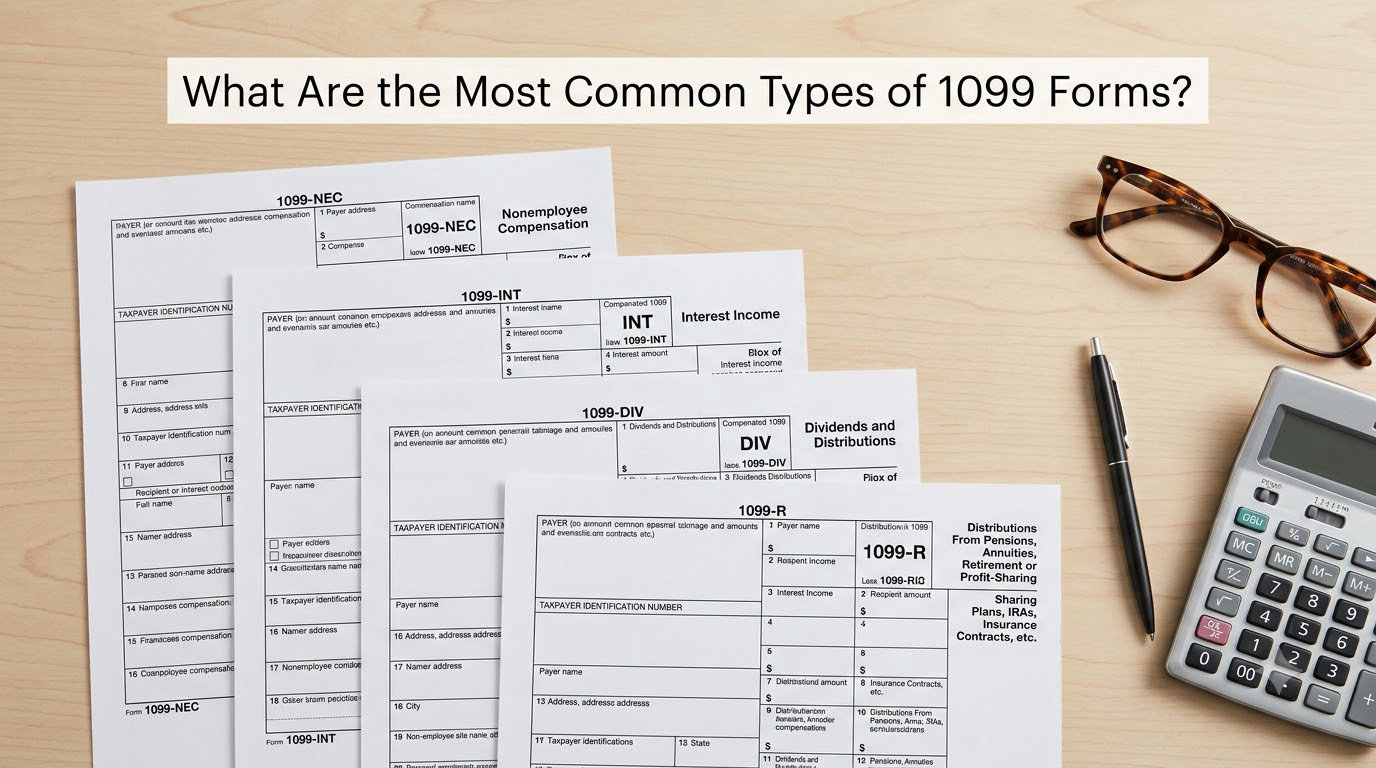
Most people only ever see one or two of these, but it helps to know which one arrived, because each one belongs in a different place on the return.
| Form | What it commonly reports | Box or section to check | Why compare it with your records |
|---|---|---|---|
| 1099-NEC | Nonemployee compensation paid for services | Box 1, nonemployee compensation | The full amount is your gross receipts; a partial year, a prepaid year or a bonus can change the total |
| 1099-MISC | Miscellaneous payments, including certain reimbursements and rental income reported by some payers | Box 3, other income | Reimbursed expenses and gross rent can be reported in ways that overstate what you actually earned |
| 1099-INT | Interest from banks, bonds and similar sources | Box 1, interest income | Some early penalties reduce the taxable amount, and certain interest passes through to an entity |
| 1099-DIV | Dividends and capital gain distributions | Box 1a ordinary dividends, Box 2a qualified dividends, Box 3 capital gain distributions | Qualified dividends and capital gain distributions are taxed differently from ordinary dividends |
| 1099-R | Distributions from retirement plans and accounts | Box 1, gross distribution, and the taxable amount in Box 2a | Early distributions carry an extra charge, and the taxable amount can be much smaller than the gross withdrawal |
| 1099-K | Gross payment card and third-party network sales | Box 1a, gross amount | This often overlaps with a 1099-NEC for the same work, so reporting both can double-count |
| 1099-B | Sales of securities and other investments | Box 1 proceeds, Box 1d cost basis, Box 2 gain or loss | A missing basis figure can cost you, and a wash sale may need adjusting |
| 1099-C | Cancellation of debt | Box 1, amount cancelled | Some cancellations are excluded from income under insolvency rules |
| 1099-G | Unemployment compensation and certain government benefits | Box 1, unemployment compensation | Benefits repaid to a plan during the year reduce the taxable amount |
| 1099-DA | Distributions from donor-advised funds | Box 1, fair market value of distribution | Contributions you never itemized can still be difficult to document at distribution time |
Reporting thresholds change. For contractor compensation, the trigger for a 1099-NEC rose to 2,000 dollars for payments made in 2026, up from 600 dollars previously, and the amount is indexed for inflation going forward. Interest and dividends report from 10 dollars. Check IRS.gov for the current figures before you rely on any specific number.
Does a 1099 Mean I Owe Taxes?
No, and this is the most useful thing to internalize. The form does not calculate anything. It reports a payment so that both you and the IRS can see the same transaction, and the tax is whatever your own return works out to.
That number depends on a long list of things. Your filing status sets the brackets. Standard or itemised deduction changes the taxable base. Business expenses, retirement contributions and certain self-employed health insurance reduce it further. Capital losses, credits for education, childcare or energy, and any withholding you already paid all move the final figure.
Gross versus net is worth pausing on. If a client paid you 5,000 dollars and you spent 1,200 dollars on materials, your receipts may show 5,000 while your profit is 3,800. Depending on the expense type, some of that 1,200 is deductible against business income, some is a capital cost that only matters if you sold the asset, and some is neither.
Self-employment earners face a second layer most people forget. On top of income tax, there is a separate contribution for Social Security and Medicare that is not withheld for you and is not part of your adjusted gross income line. Freelancers frequently underestimate it because they are comparing themselves to salaried employees, where half of it was invisible.
Withholding, estimated payments and income from a spouse or a second job all land on the same balance. A large 1099 next to a full-time W-2 is common, and the two are reported separately before combining on one return.
How Is the Amount on a 1099 Taxed?
Start by naming the activity, because the label decides everything downstream. The first step is to sort each form into one of a few buckets.
- Employee wages. A 1099 is not how wages are reported, so anything that is really wages belonged on a W-2 from an employer. Ask the payer directly if the relationship is ambiguous.
- Self-employment income. Typical for freelance, contract and gig work, reported on Schedule C, with self-employment tax calculated on Schedule SE.
- Investment income. Interest, dividends and capital gain distributions, reported on Schedule B and Schedule D, with different rate treatment for qualified amounts.
- Retirement distributions. Reported on Form 1040, with the taxable amount, not the gross withdrawal, as your income figure.
- Rent and other property income. Reported on Schedule E, where the amount you may report can be lower than the rent collected if you itemize expenses or make improvements.
- Special reporting situations. Debt cancellation, gambling, prize winnings and similar items have their own forms and their own quirks.
The number printed on the form is rarely the last word. Brokerage sales need a basis calculation, a retirement distribution may be partly non-taxable, rent may come in below gross receipts, and contractor payments may be spread across several forms from the same or different payers that need combining.
Which Boxes and Codes on a 1099 Matter Most?
Ignore the boxes that concern the payer filing the form. You care about a handful of figures, and box meanings vary slightly by form version, so read the form in front of you rather than a generic guide.
The payment amount is the headline number, but look for whether it is gross or net. Gross rental income is rent before any expenses, which is the number most forms report, and your taxable portion is usually lower. A services figure of 10,000 dollars is also different from a 10,000 dollar payment to a corporation, which is not reported as personal income at all.
Federal income tax withheld tells you whether anything was set aside for the IRS on your behalf. It is uncommon outside specific arrangements, and if you see it, it counts as a payment when you compute your balance.
State tax withheld and state income figures matter for your state return, and they are not always consistent with what your state requires. A payment processor in one state and a client in another can produce reporting that does not match your state’s own rules.
Taxable amount boxes are the most useful ones on several forms. A 1099-R can show a 20,000 dollar distribution with a taxable amount far below it after contributions and basis. A 1099-B shows proceeds, and a cost basis box tells you what the gain or loss actually is.
Finally, category and service codes tell you what kind of work the payer is reporting, which is useful context when you did not expect that income at all.
How Do You Verify That a 1099 Is Correct?
Verification takes twenty minutes per form and prevents the most common expensive mistake, which is agreeing with a number you could have corrected yourself.
Start with identity. Your legal name and taxpayer identification number should match what you have filed for years. A transposed digit means the form does not match your return, and the IRS will notice that before anything else.
Then match the payer. A legitimate client, platform or institution should be able to explain the payment, and a real business has a working address and a contact who answers questions.
Next, trace the money. Compare the amount against your bank deposits, invoices, brokerage statements, retirement plan statements or loan records for the same period. Timing does not have to match exactly, but the total should be findable somewhere in your records.
Watch for gross-versus-net differences. Reimbursed expenses, materials you passed through, and agency commissions all show up in reported amounts without being income you kept.
Look for duplicates. If a payment processor and the client both issued a 1099 for the same work, you have two forms for one payment, and the answer is to report it once.
Finally, keep the paperwork. Scanned copies in a folder named by tax year, plus the underlying records, means a question two years from now does not turn into an afternoon of archaeology.
What If Your 1099 Is Missing, Wrong, or Replaced?
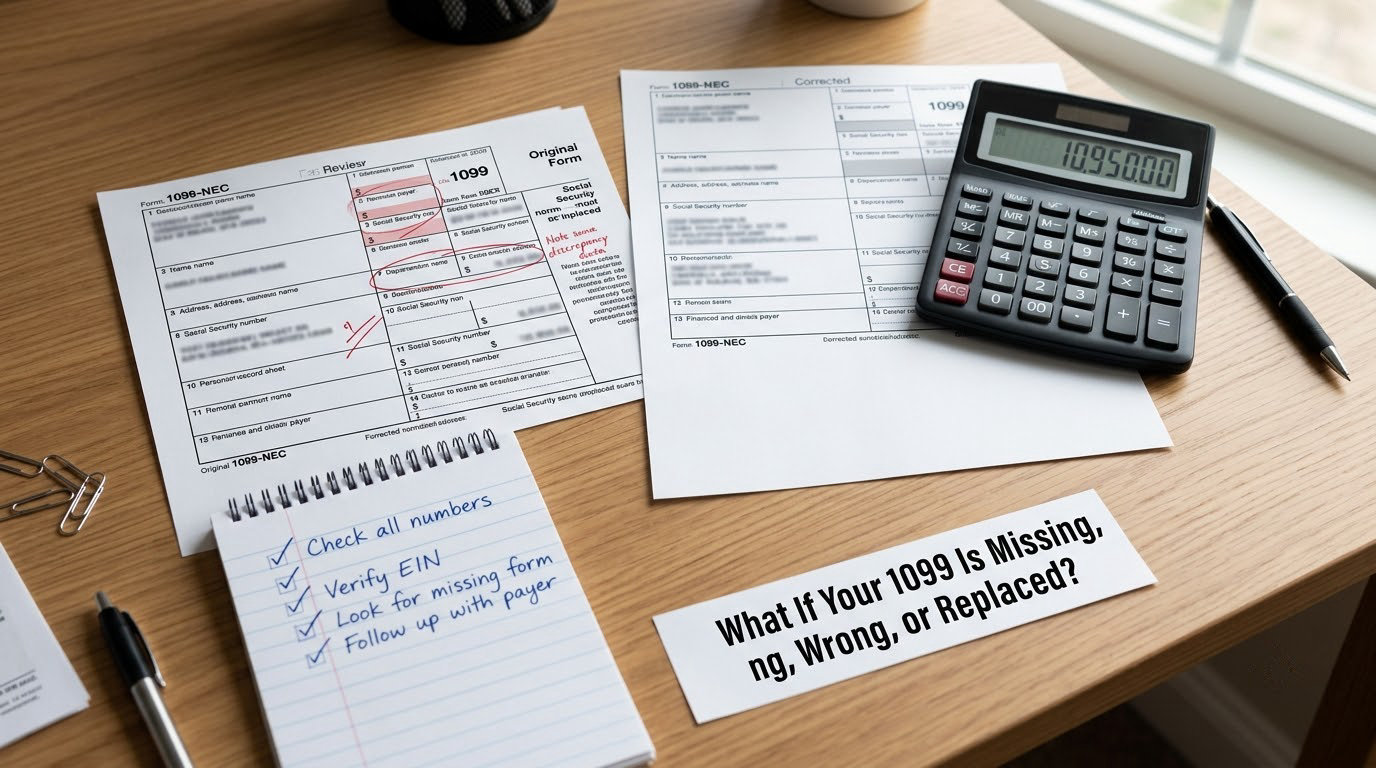
A missing form and an incorrect form are different problems. A missing form is a paperwork problem for the payer. An incorrect form is a problem for your return, and it is worth fixing rather than ignoring.
Not receiving a form does not erase the income. This is the point that causes the most anxiety and it is the one people most often get wrong. If you were paid, the income is yours to report whether or not a form arrives, and the payer still has reporting obligations of their own. Plenty of people file successfully with no forms at all, using bank statements and invoices as their documentation.
When a form is wrong, ask the payer for a corrected copy. Contact them in writing so you have a record, state exactly what is incorrect, and be specific. A name misspelling, a wrong taxpayer identification number, a missing payment and an amount that does not match your records all need different corrections.
Corrected copies are clearly marked as such, and they can arrive well after the original. If one shows up after you have filed, do not assume you have to amend anything immediately. Review whether the change is material, and if it is, the normal route is an amended return, which has its own processing timeline and fee.
If the payer will not correct it, your reporting duty is unchanged. You report what your own records show, keep your documentation, and respond through official IRS channels such as IRS.gov, the national telephone assistance line, or a practitioner who can represent you. Do not rely on a number from an unsolicited call or message.
And filing without a form does not automatically resolve a mismatch if the IRS has one for you. The IRS compares its copy against your return, which is exactly why the form exists in the first place.
How to Report Common 1099 Income on Your Tax Return
The workflow is more mechanical than most people expect. Match each form to the right place on the return, total them, carry the numbers across, and check that everything agrees before you submit.
Contractor income generally goes on Schedule C, with the gross amount, your deductible business expenses, and the resulting net profit carrying to Form 1040. Self-employment tax is calculated separately on Schedule SE and claimed on Form 1040. A sole proprietor can often do this in a single form, which makes a 1099-only filer’s return shorter than most people’s.
Investment income usually goes on Schedule B, with capital gain or loss detail on Schedule D when there is a sale to report. Retirement distributions carry to Form 1040 at their taxable amount. Rental income goes on Schedule E, where you can report less than the gross rent shown on the form if you itemize expenses, though the first few years of a property carry special limits.
Where you have several forms, add the amounts across, or the software does. Where two forms describe the same payment, report it once. Where a 1099-K and a 1099-NEC overlap, the NEC figure is normally the more reliable source for contractor income.
Complex cases benefit from software or a professional. Multiple states, a rental property, an outside investment, retirement income and side work in the same year is a reasonable moment to stop doing it by hand.
What Records Should You Keep With Your 1099s?
Documentation is what turns a disagreement into a five-minute conversation instead of a year of correspondence. What you keep depends on the type of income.
- Contractor and gig work: contracts, invoices, payment confirmations, bank statements, mileage logs, and receipts for equipment and supplies.
- Investment income: brokerage confirmations, cost basis reports, and any records explaining adjustments such as wash sales.
- Retirement distributions: plan statements, contribution records, and proof of any after-tax basis in the account.
- Rental income: the lease, receipts, expense records, improvement invoices and mileage for property visits.
- Unemployment benefits: benefit statements showing gross amounts and any amounts you repaid to the agency.
- Estimated payments: confirmation of each payment, whether made online or by electronic funds transfer.
Keeping the underlying records also protects deductions. Without receipts, a home office or a vehicle expense is far harder to support, and a percentage allocation of rent and internet is an area where people most often guess.
Retention periods vary by record type and circumstance, and longer is usually better than shorter. Keep records at least as long as the filing deadline plus the period in which the IRS can assess additional tax, which is generally three years from the filing date and longer in some situations.
Two final notes for the year ahead. If you have both a W-2 and a 1099, report them separately and let them combine, and consider whether a retirement account or a self-employed health insurance plan lowers your taxable amount. And if you are self-employed, paying tax as income arrives is a reasonable alternative to waiting for a bill, because the alternative to set-aside is no set-aside.
Frequently Asked Questions
Do I have to pay taxes on every 1099 I receive?
Not every dollar is necessarily taxable, and not every form is the same. Reimbursed expenses, non-taxable portions of a retirement distribution, and certain excluded items reduce or eliminate the reported amount. Most other income, including contractor pay, interest, dividends, rent and unemployment benefits, is reportable. The type of form tells you the rules that apply.
Why did I get a 1099 instead of a W-2?
A W-2 comes from an employer running payroll, which means taxes were withheld as you were paid. A 1099 comes from a payer who did not withhold anything, which usually means you provided services as an independent contractor. That said, the form reflects how the payer treated the relationship. It is not a final legal determination, and agencies apply their own tests for classification.
Can I combine several 1099 forms from the same payer?
You can total them for reporting, but each form still matters on its own, and duplicate reporting is the real risk. Two forms from the same payer may be one payment reported twice, such as a 1099-K and a 1099-NEC covering the same work. Report that income once. Different payments from the same payer are separate income and are summed in the appropriate place on your return.
What if the 1099 amount does not match my bank deposit?
Compare totals rather than dates, since a payment can post in a different month than the period it covers. A gap often means a commission, platform fee, reimbursement or expense you fronted was deducted. If the payer reported gross while you received net, that explains the difference. If it still does not add up, request a corrected copy from the payer in writing and keep your records as support.
Why did the IRS send me a notice after I filed my return?
The most common reason is a mismatch between the amount the IRS holds from information returns and the amount on your return. A missing 1099, a math error, or a form that arrived after you filed can all trigger it. Some notices are just informational. Others propose a balance. Read the specific notice, compare the figures it cites against your return and your records, and respond through official IRS channels or with a tax professional.
How long should I keep 1099 forms and supporting records?
Keep records at least as long as the period in which the IRS can assess additional tax, which is generally three years from the filing date and longer when certain conditions apply. Keep the forms themselves, plus invoices, bank statements, receipts, basis reports and proof of estimated payments. Retention periods differ by record type, and losing underlying documentation is what makes a deduction hard to defend later.
Conclusion
Collect every 1099 you received, whether it arrived by mail, in a portal or nowhere at all. Check the name and taxpayer identification number on each one, then compare the amounts against your bank deposits, invoices, brokerage records and retirement statements, because the ones that disagree are the ones worth a correction request.
Once the numbers hold up, put each amount in the right category before filing: self-employment, investment, retirement, rent or something with its own rules. If a single year involves more than one of those, or more than one state, a professional will usually save more than the fee costs.