
How to budget on an irregular income by planning around your lowest month, protecting the essential bills, and directing every surplus payment into reserves before spending it. It takes about an hour to set up and one evening a month to maintain.
A salary gives you a fixed number on a fixed date, so a budget can be a subtraction exercise. Freelancers, contractors, commission sellers, ride-share drivers and seasonal workers don’t get that. Their money arrives in lumps, on days they don’t choose, and some months bring nothing at all.
The fix isn’t a more complicated budget. It’s a smaller one, built from your worst realistic month, plus a system for handling the extra. Budgets built on a bad month feel restrictive for a few weeks. Budgets built on a good month fall apart in October.
Table of Contents
- What You Need Before You Budget
- How to Budget on an Irregular Income: Step by Step
- 1. Track Your Income for Three Months
- 2. Separate Fixed, Variable, and Flexible Expenses
- 3. Set a Safe Baseline From Your Lowest Months
- 4. Create Sinking Funds for Bills and Irregular Costs
- 5. Build an Emergency Buffer in Small Automatic Amounts
- 6. Prioritize Bills, Savings, and Spending
- 7. Automate What You Can and Review Monthly
- Common Mistakes That Break the System
- Frequently Asked Questions
- Will budgeting work if I have an irregular income?
- Should I budget based on my average income or my lowest month?
- What are examples of irregular income?
- How much of an emergency fund should I keep with an irregular income?
- How should I handle taxes with an irregular income?
- What should I do after a very low income month?
- Conclusion
What You Need Before You Budget
Five things, and you probably already have most of them somewhere. Gather them before you open a spreadsheet, because the exercise takes one focused session rather than a weekend.
- Twelve months of income records. Bank statements or invoices work. Bank statements are easier and less flattering.
- Your fixed expenses with amounts. Rent, insurance, minimum debt payments, phone, utilities, subscriptions.
- Your variable expenses. Groceries, fuel, childcare, eating out, clothing, travel for work.
- Bill due dates. Note which ones fall before your slowest-pay periods.
- A separate place for reserves. A high-yield savings account at a different bank, or a second checking account, so reserves aren’t accidentally spent.
If you’re self-employed, add your estimated tax rate to that list. In the US, federal income tax, self-employment tax and state tax all apply to net profit, and the payment schedule doesn’t match the money’s arrival schedule. A CPA can set the right number; until then, set aside at least a quarter of every payment and adjust quarterly.
How to Budget on an Irregular Income: Step by Step
1. Track Your Income for Three Months
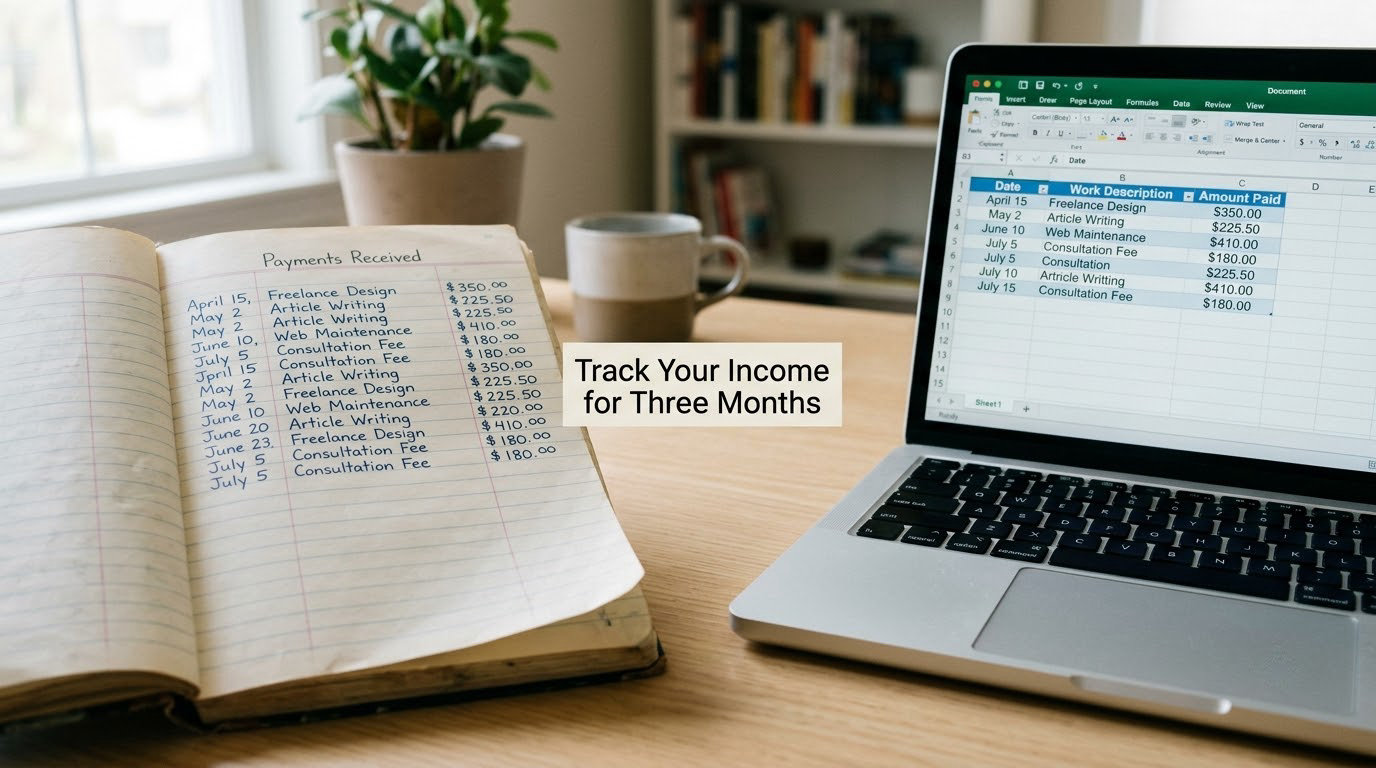
Write down every payment: the date, the amount, the client or source, and roughly how many hours it took. That last column matters more than people expect, because it shows whether a good month came from better rates or more hours.
Three months gives you a first read on range. Twelve months gives you a season, and seasons matter enormously if you do seasonal work. Most people find their lowest month is 40 to 60 percent below their best, which is the gap the budget has to absorb.
How to know it worked: you can name your three lowest months and the reasons behind them. If one was a car repair or a slow season, that’s a pattern you can plan for.
2. Separate Fixed, Variable, and Flexible Expenses
Fixed expenses are the ones that show up every month with roughly the same number: rent, utilities, insurance, minimum debt payments. These are your floor, and nothing gets cut here without a real decision.
Variable expenses move with usage: groceries, fuel, utilities that vary by season, insurance on a variable-usage vehicle. These flex a little but shouldn’t swing wildly.
Flexible expenses are the ones you actually decide: dining out, subscriptions, hobbies, new clothes, upgrades. This is where the honest reckoning happens, and most people underestimate it. One coffee-shop habit can quietly cost more per year than a car payment.
Grouping matters because each category behaves differently in a slow month. A helpful rule from Nebraska’s banking and finance regulators: cover your essentials first, then set a spending target, then save with whatever remains.
3. Set a Safe Baseline From Your Lowest Months
Take the lowest of your three lowest months, or better, the average of your three lowest months. That’s your income floor, and it’s the number you plan from. Not your average month, and definitely not your best one.
Now subtract your fixed expenses from that floor. What’s left is your true discretionary budget, and it’s often smaller than people expect. Many freelancers who earn well in good months discover their floor spending number is only a few hundred dollars above bare essentials.
How to know it worked: your essential bills fit inside your baseline month, and you can describe what a slow month actually looks like in dollars rather than in worry.
4. Create Sinking Funds for Bills and Irregular Costs
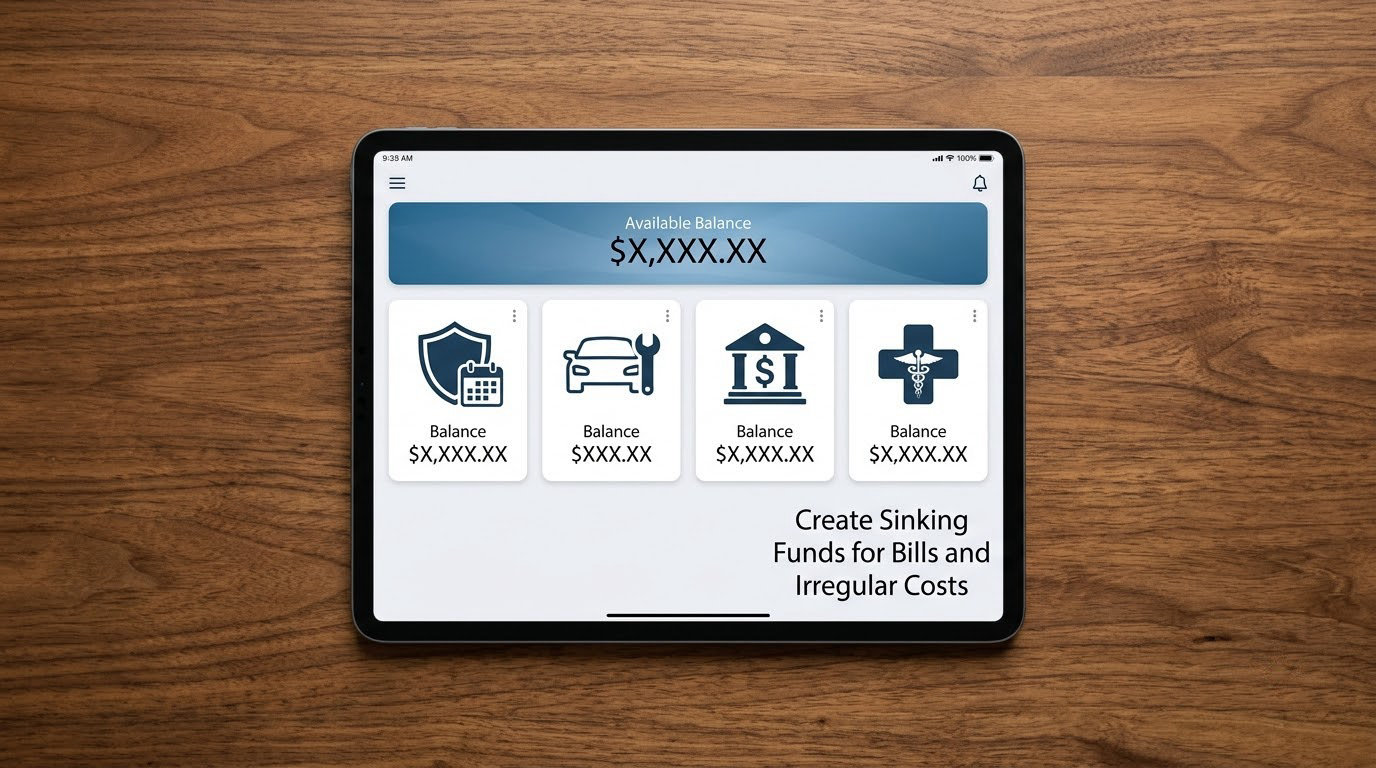
A sinking fund is a named pot for a cost that doesn’t arrive monthly. Take the annual figure, divide it by twelve, and add that slice to each payment you receive. A 1,200 annual insurance bill becomes 100 a month.
Build these first, because they cause the crashes: car repairs and maintenance, annual insurance premiums, home or auto registration, property tax, professional dues and equipment, quarterly and annual taxes, holiday and birthday spending, deductible amounts for health coverage.
Keep them as separate labelled accounts or envelope categories rather than one merged “savings” balance. The label is the point. A single fund named savings gets raided in a hard month; a fund named “car repair, 900 remaining” is understood.
5. Build an Emergency Buffer in Small Automatic Amounts
Start with a small target you can hit without pain: one month of bare-bones expenses, often 1,500 to 3,000 for a single person. Transfer a fixed percentage of every payment, 5 or 10 percent, the day it lands. Small and automatic beats large and aspirational.
Move it to high-yield savings once the first target is met, then work toward three to six months of expenses if your income swing is wide or your clients are concentrated. Long payment delays are normal in freelance work, so the buffer is really insurance against your own pipeline.
Users on budgeting forums describe this as the piece that removes the panic. The months become quiet because a bad one is already funded.
6. Prioritize Bills, Savings, and Spending
Every payment gets the same order, in the same evening it arrives:
- Set aside the tax slice first, before anything else.
- Pay minimum debt payments and every essential bill.
- Fill the sinking funds that are due this month.
- Contribute to the emergency buffer.
- Pay yourself a fixed personal salary from the remainder.
- Spend what’s left on flexible spending.
Paying yourself a fixed salary is the trick that makes irregular income feel regular. If your baseline is 2,600, you transfer 2,600 to your personal account on every payment day, whatever came in. Everything above that is surplus, and everything below it is your problem to solve from the buffer.
When a payment is short of your obligations, don’t move money between categories to make the numbers work. Cut flexible spending in the order you listed it and defer non-essential sinking fund contributions until the next payment.
7. Automate What You Can and Review Monthly
Automate the predictable parts: minimum debt payments, fixed bills, the tax transfer, and the buffer contribution. Irregular income defeats scheduled transfers that assume an exact payday, so automate from your business account the day funds clear instead.
Then run a 20-minute monthly review. Compare what you budgeted against what you actually spent, check which sinking funds moved and which didn’t, and note anything unusual. Update the baseline if your income range has shifted permanently.
How to know it worked: you can answer three questions in under a minute — what’s in the buffer, what’s due next, and what’s my baseline. If those take longer, your tracking is too scattered.
Common Mistakes That Break the System
Budgeting from a good month. This is the most common error, and it feels like optimism while it’s happening. A budget built on a strong month is a budget that fails. Fix: rebuild from your floor before spending a single surplus dollar.
Treating annual costs as monthly costs. When the car repair lands, people reach for savings that isn’t there and borrow instead. Fix: fund the sinking fund first, every time, even when the month feels generous.
Forgetting quarterly taxes. Self-employment and business taxes arrive in chunks and surprise people who treat them as an annual problem. Set the money aside per payment and confirm the dates and amounts with a tax professional for your situation.
Keeping no reserve at all. One slow month becomes a credit card balance, and recovering from it takes far longer than one good month would have saved. Fix: a small automatic transfer, raised whenever income allows.
Spending a large payment before it’s assigned. A 4,000 payment feels like freedom. Assign it first, then decide what the remainder is for.
Treating side income as budget money. Extra income from a side project gets folded into regular spending, and then disappears. Give it a job first.
Couples budgeting different income types. One partner on a salary, one on commission, and the salary gets treated as the household’s whole budget. Agree on a fixed transfer amount regardless of whose month is better.
Frequently Asked Questions
Will budgeting work if I have an irregular income?
Yes, and it works better than a fixed budget once you stop budgeting month to month. Plan around your lowest reliable income, protect essential bills, and treat every payment above that baseline as a surplus to assign. The monthly review keeps the baseline current as your work changes.
Should I budget based on my average income or my lowest month?
Use your lowest month, or the average of your three lowest months. An average-based budget fails in exactly the months when you can least afford a shortfall. Build the budget from the floor, then decide in advance where surpluses go so you are not deciding while spending.
What are examples of irregular income?
Freelance and contract work, commission-based sales in real estate, insurance and sales, ride-share and delivery driving, seasonal work in landscaping, hospitality and teaching, plus small business revenue where monthly totals depend on sales. Any of these can vary in amount, in timing, or both.
How much of an emergency fund should I keep with an irregular income?
Start with one month of bare-bones expenses, then work toward three to six months if your income swings widely or you depend on a few clients. The first target matters more than the final one, because it converts a slow month from a crisis into a mild inconvenience.
How should I handle taxes with an irregular income?
Set aside a fixed slice of every payment, often 25 to 30 percent for US self-employment, before you spend anything. Transfer it to a separate account on the day the payment lands, and confirm due dates and amounts with a tax professional, since self-employment tax and state rules vary.
What should I do after a very low income month?
Do not borrow against a future month you cannot see yet. Pause flexible spending, keep paying essentials and minimum debt, and skip non-essential sinking fund contributions until the next payment arrives. If the same shortfalls repeat, rebuild your baseline from the new lower average rather than hoping for a better month.
Conclusion
Start tonight with three numbers: what came in over the last year, what your three lowest months looked like, and what your essential bills total. That gives you your income floor, and it is the starting point for how to budget on an irregular income.
From there, take the next payment you receive and run it through the same order every time — taxes, essentials, sinking funds, buffer, then spending. Review the numbers once a month and adjust as your work changes. The system isn’t a prediction of the year ahead; it’s a way to make sure one quiet month doesn’t decide your finances for you.