
Fee only vs commission financial advisors is a question about who pays the person giving you advice, and that answer changes what you are actually buying. A fee-only advisor is paid a fee by you and nothing else. A commission-based advisor is paid by the insurer or fund company when you buy their product, so the advice costs you nothing on the invoice and can cost you a great deal inside the product. Here is the honest version, with real numbers.
One thing to know before you read further. Nearly every page ranking on this topic is published by a firm that sells financial advice, so the bias runs one way or the other. This one is written by an editor, not an advisor, and there is no product here to buy.
If you want the short decision: fee-only wins when your finances are straightforward and you want product-neutral recommendations. Commission-based can make sense when you genuinely need insurance or annuity expertise and you are willing to pay for it inside the product. Everything between those two poles is a question of how much the advice is really costing you.
Table of Contents
- Fee Only vs Commission Financial Advisors at a Glance
- How Fee Only and Commission-Based Advisors Get Paid
- The commission side
- The label trap nobody warns you about
- How Compensation Creates Conflicts of Interest
- Fiduciary, suitability, and Regulation Best Interest
- Costs, Fees, and Account Minimums
- The costs that are not the advisor’s fee
- Services and Investment Flexibility
- Which Type of Financial Advisor Is Right for You?
- Choose fee-only when you are managing a large portfolio
- Choose fee-only when you are near retirement income
- Stay commission-based when insurance is the real question
- Use commission-based or flat-fee planning when your account is small
- Consider doing nothing before you hire anyone
- Get help after a windfall
- Questions to Ask Before Choosing an Advisor
- Frequently Asked Questions
- Is a fee-only financial advisor better than a commission-based advisor?
- Can a fee-only advisor still receive commissions?
- Are fee-only financial advisors fiduciaries?
- What is the difference between an asset-based fee and a commission?
- How much should I pay a financial advisor in the US?
- Can I hire a financial advisor with a small portfolio?
- Conclusion
Fee Only vs Commission Financial Advisors at a Glance
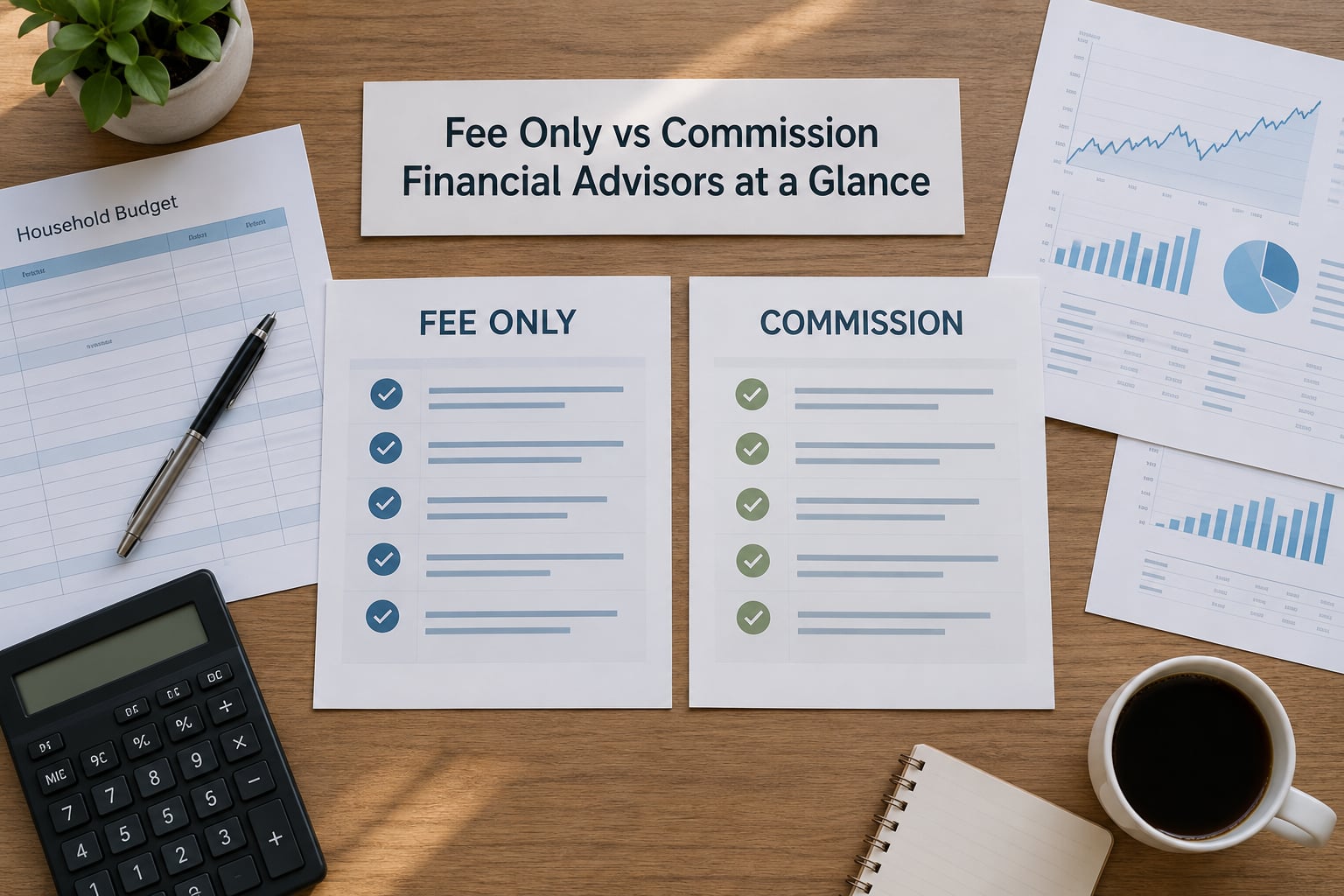
The single biggest mistake people make with this comparison is treating it as two options. There are three, and the middle one causes most of the confusion.
| Criterion | Fee-only | Fee-based (hybrid) | Commission-based |
|---|---|---|---|
| Who pays the advisor | You do, directly | You do, and sometimes the manufacturer does too | The insurer or fund company does |
| Can they earn commissions | No, by definition | Yes, on products they place | Yes, this is the business |
| Typical charge | Hourly, flat project fee, monthly retainer, or a percentage of assets under management | Retainer or asset-based fee plus product commissions | Built into the annuity, insurance policy, or fund share price |
| Legal standard of care | Fiduciary | Fiduciary for the advice, suitability for the product sale | Suitability |
| Investment choice | Open architecture, nearly any fund or account | Firm menu plus approved outside funds | Mostly the firm’s proprietary and approved products |
| Common firm type | Registered investment adviser (RIA) | RIA with a broker-dealer affiliate, or a bank or wirehouse | Broker-dealer or insurance general agency |
| Typical licensing | Series 65 or 66 registration, or state registration | Series 7 plus insurance licenses | Series 7 plus insurance licenses |
| Account minimums | Often 250,000 dollars or more for ongoing managed accounts | Commonly 500,000 dollars and up | Frequently none, which is the appeal |
| Best fit | DIY-capable investors who want a second brain and product-neutral recommendations | Clients who want planning plus one-stop product access | Insurance and annuity needs, one-time transactions, small accounts |
| Main risk | Paying a visible fee for advice you might have handled yourself | Paying twice without realising the second payment is inside the product | Buying a product that is suitable but not your cheapest option |
Notice the row most guides skip. Account minimums. A commission-based advisor will often take a 40,000 dollar retirement account and give advice for nothing, because the compensation comes later if a policy gets sold. That is a genuine service and it is why commission-based advice still exists.
It is also why the fee-only side of the table has minimums that make a small portfolio awkward. More on that below.
How Fee Only and Commission-Based Advisors Get Paid
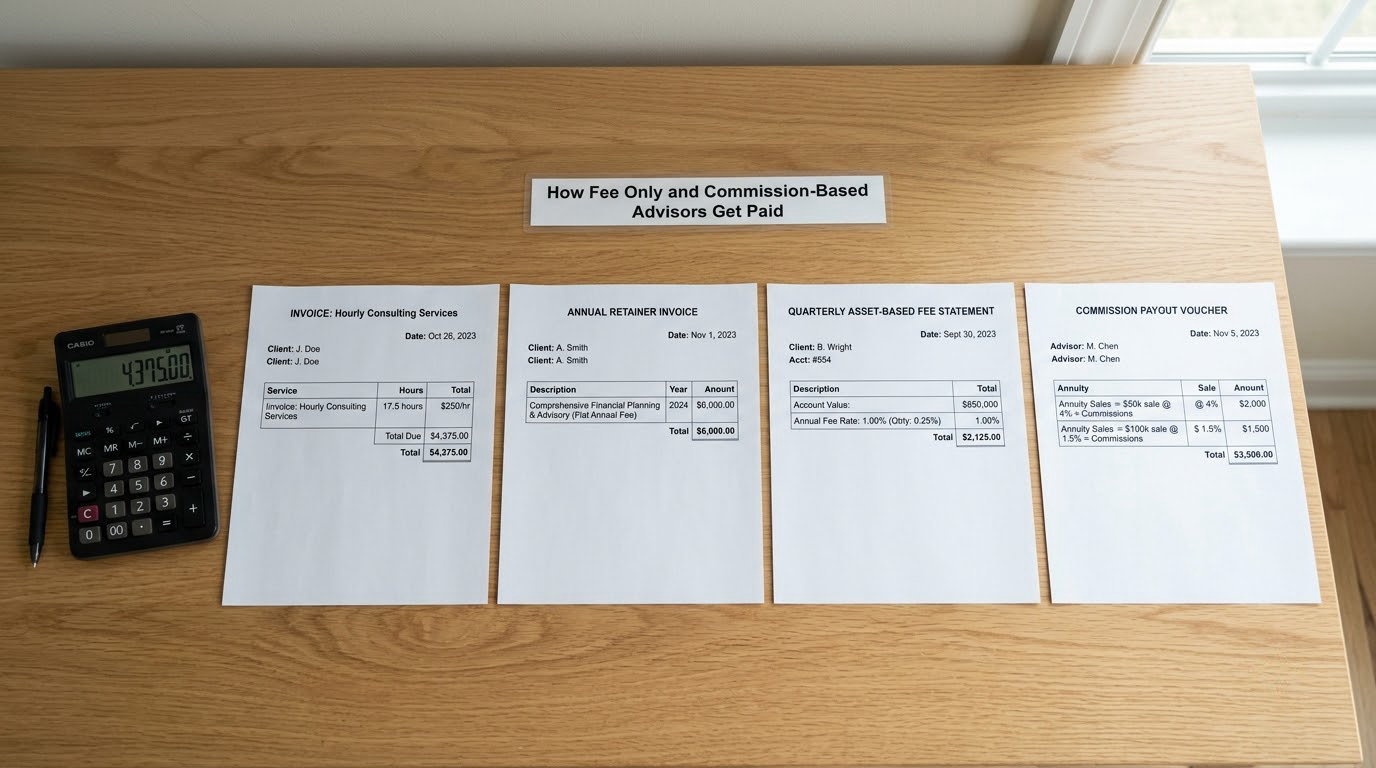
Fee-only describes the source of the money, not the size of it. A fee-only advisor can charge in several shapes.
- Hourly fees. Typical range runs 150 to 400 dollars an hour, billed for planning or one-time work like a divorce settlement or a business sale.
- Flat project fees. A fixed price for a defined deliverable, usually a written financial plan. One-time plans commonly fall between 2,000 and 10,000 dollars depending on complexity.
- Monthly retainers. A set monthly amount for ongoing access and advice, without any asset management. Often 200 to 1,000 dollars a month.
- Asset-based fees. A percentage of assets under management, typically 0.25 to 1.00 percent a year. Charged quarterly, on the market value at the end of the quarter, not the average value during it.
That quarterly point causes real confusion. On a 100,000 dollar portfolio at one percent a year, the bill is about 250 dollars a quarter, not 1,000 dollars a quarter. When you see a “one percent fee” quoted anywhere, ask whether it is annual. Forum discussions in r/personalfinance keep circling the same misunderstanding.
The commission side
Commission-based compensation arrives in a few recognisable forms.
- Front-end load. A percentage taken off the top when you buy. On a mutual fund this can run to 5 percent, though retirement-protection (class A share) rules push most of it into year one.
- Trailing commission. A small ongoing percentage of the value while you hold the fund, usually 0.25 to 1.00 percent, taken from the expense ratio. Also called a back-end load or 12b-1 fee.
- Annuity and insurance commission. A percentage of the first-year premium, often 5 to 10 percent on a commission-based annuity, or a similar figure on a permanent life policy.
- Spread. The gap between what the insurer keeps and what it credits toward your cash value, built into the contract itself and never shown on a statement.
An annuity at 6 percent commission has no annual bill, no invoice, no Form ADV fee schedule. The cost is invisible unless you go looking for it, which is exactly why it is worth looking.
The label trap nobody warns you about
Fee-only and fee-based are not synonyms, and the difference is not semantic. A fee-only advisor takes no product compensation at all. A fee-based advisor charges you a fee and may also earn a commission on what you buy, often under a written agreement that offsets the fee by the amount of commission received.
Fee-based is not automatically bad. It is simply a different product, and the label tells you nothing on its own. Some fee-based advisors hold a fiduciary duty across both sides of the relationship, which is stronger than what most commission-based advisors owe. The Fee-Only Network and NAPFA both publish plain-language comparisons on this distinction, which is worth reading before you assume anything from a firm name.
How Compensation Creates Conflicts of Interest
A conflict of interest is not proof that bad advice will happen. It is a standing incentive that has to be managed. Here is what each model sets up.
Fee-only advisor
- How they get paid: a fee from you, based on assets, hours, or a flat project.
- Standard of care: fiduciary, meaning they must act in your best interest and disclose conflicts.
- Pros: no product-based incentive, access to nearly any investment, clear written fee schedule, easy to compare costs.
- Cons: you pay a visible bill, you may hit account minimums, and they cannot place an annuity or life policy for you.
Commission-based advisor
- How they get paid: the insurer or fund company, out of your premium or your share price.
- Standard of care: suitability, meaning the recommendation has to be appropriate for you, not necessarily the least expensive thing available.
- Pros: no bill, often no minimum, and real expertise in insurance products that are genuinely hard to evaluate.
- Cons: the incentive runs toward the product they earn on, and the cost is buried where you will not see it.
That parallel structure is the whole argument in miniature. Note that “suitable but not your cheapest option” is not a bug in the standard. It is exactly what suitability means. A 6 percent commission annuity can be the right answer for someone who wants a guaranteed income floor for ten years and would otherwise panic-sell at the bottom.
Fiduciary, suitability, and Regulation Best Interest
The SEC’s Regulation Best Interest, effective in 2019, tightened what broker-dealers must do before making a recommendation: a reasonable basis that it is in the client’s best interest, disclosure of material costs, and a duty of care. It raised the floor for commission-based advice. It did not convert broker-dealers into fiduciaries.
Registered investment advisers are fiduciaries under the Investment Advisers Act. Broker-dealer representatives are held to the Reg BI standard. That is the cleanest dividing line in this whole topic, and it is not the one most marketing pages lead with.
One detail worth knowing: a CFP designatee is held to a fiduciary standard in the CFP Board’s code, so a fee-based CFP is a contradiction in terms. r/CFP threads point this out regularly, and plenty of clients find it surprising. A credential is not proof of a compensation model, but it does narrow the possibilities.
Costs, Fees, and Account Minimums
Here is the arithmetic nobody in this space publishes. Annual cost across the common fee shapes at three portfolio sizes. The commission-only column is zero by definition, which is the point and also the trap.
| Fee structure | At 100,000 dollars | At 500,000 dollars | At 2,000,000 dollars |
|---|---|---|---|
| 1.00 percent AUM, billed quarterly | 1,000 | 5,000 | 20,000 |
| 0.75 percent AUM | 750 | 3,750 | 15,000 |
| 0.50 percent AUM | 500 | 2,500 | 10,000 |
| Flat retainer, 4,000 dollars a year | 4,000 | 4,000 | 4,000 |
| Hourly, 6 billable hours at 250 dollars | 1,500 | 1,500 | 1,500 |
| One-time plan at 5,000 dollars, amortised over 5 years | 1,000 | 1,000 | 1,000 |
| Commission-based, no advisory fee | 0 | 0 | 0 |
Two things fall out of that table immediately.
First, the asset-based fee scales and the flat fee does not. A 4,000 dollar retainer looks absurd at 100,000 dollars and looks cheap at 2 million. That is why flat-fee and retainer planners exist, and why many of them have no minimum at all.
Second, the break-even point. If a commission-based advisor puts you in an annuity paying 6 percent commission on a 100,000 dollar premium, that is 6,000 dollars taken from your money in year one, against zero on the advisory invoice. The “free” advisor is five times more expensive than the one percent fee you were trying to avoid.
Run that same comparison the other way and the arithmetic flips. If you buy a plain low-cost index portfolio with no product sales, the commission-based advisor earns nothing and gives you the same advice for nothing. That is the scenario where commission-based wins outright, and it is more common than annuity-alert readers assume.
The costs that are not the advisor’s fee
Separately from any advisory fee, you are paying fund expense ratios, insurance charges, and rollover costs. A commission-based advisor who never replaced your high-fee legacy mutual funds is saving you nothing, because their income depends on those funds staying put. That is the quiet failure mode of commission-based accounts: nothing bad happens, and nothing gets better.
And check the rollover rule. Many annuity contracts waive surrender charges only if you hold for a set number of years, commonly five to seven. Move too early and you pay a penalty on top of everything else.
Services and Investment Flexibility
Compensation shapes services as much as it shapes cost.
Fee-only advisors are hired for planning as often as for picking funds: retirement income modelling, withdrawal sequencing in the first decade of retirement, tax-loss harvesting, charitable giving, estate and beneficiary strategy, and business-owner cash-flow planning. That planning work usually sits outside the asset-based fee, which is why a retainer or an hourly arrangement exists as a separate product. On a 100,000 dollar portfolio, a good planner will simply tell you the asset-based fee is not worth it yet.
Commission-based advisors are typically hired for a transaction. The annuity sale, the permanent life policy, the college funding plan, the one-time insurance need. They may be very good at that. Insurance contracts are genuinely complex, and a person who places annuities for a living reads the fine print faster than you will.
Investment flexibility follows the same split. Fee-only advisors work in open architecture, which means they can hold the cheapest share class of a fund instead of a proprietary one. A wirehouse advisor’s menu is approved products, and the approved fund is often the one that pays the firm.
The most common fee-only complaint is the annuity gap. A fee-only advisor legally cannot take a commission on your annuity, so they refer you to someone else who can, and that person is paid by the insurer. You have now added a handoff you did not ask for, and the cost is still there. Budget for it, and ask who will actually do the work.
Which Type of Financial Advisor Is Right for You?
Match the model to the situation rather than to the argument.
Choose fee-only when you are managing a large portfolio
Above roughly 500,000 dollars, product commissions are worth less to the advisor than keeping you, and the incentive to sell you something weak drops sharply. The visible fee also becomes a smaller share of the value at work. If you have real assets and want recommendations that are not filtered through a product menu, this is the clearer side of the trade.
Choose fee-only when you are near retirement income
The first decade of retirement is a sequence problem, not a return problem. Coordinating Social Security timing, Roth conversions, required distributions, and withdrawal order is planning work that a transaction-based advisor is not paid to do. If that is your actual question, hire a planner and ask whether they manage assets at all.
Stay commission-based when insurance is the real question
If you need a permanent life policy, a structured annuity, or disability coverage, a specialist who places those products will be faster and cheaper than a generalist who has to refer you out. Just ask for the commission amount in writing, in dollars, before you sign anything.
Use commission-based or flat-fee planning when your account is small
At 40,000 dollars, a one percent fee is 400 dollars a year for a lot of meeting time. Many RIA minimums sit at 250,000 dollars. Flat-fee planners and commission-based advisors cover this gap, and one-time planning engagements are the most honest version of the whole market.
Consider doing nothing before you hire anyone
If you already hold a broad, low-cost index portfolio across two or three accounts, you may want a second opinion rather than a manager. A one-time plan at 2,000 to 5,000 dollars is the version of this that makes sense. Bogleheads and fatFIRE regulars treat advisors skeptically for good reason, then typically change their minds when tax, estate, or withdrawal planning enters the picture.
Get help after a windfall
Inheritance, business sale, or divorce settlement. These are the moments where the fee-only case is strongest, because the risk is expensive mistakes rather than missing a margin.
Questions to Ask Before Choosing an Advisor
Interview three of them. No legitimate advisor objects to that, and anyone who does is telling you something.
- Are you a fiduciary, and in what capacity? Get it in writing. An RIA is a fiduciary. A registered representative at a broker-dealer is not.
- What is your total annual cost in dollars at my portfolio size? Not a percentage. Ask them to do the multiplication out loud.
- Is the asset-based fee charged quarterly or annually? And on ending market value or average value?
- What happens to my fee if you receive a commission? A written fee-offset clause is the clean answer.
- What is the account minimum, and what does it cost me below it?
- Which custodian holds my assets, and is it independent of your firm?
- Have you ever recommended a no-load, low-cost index fund? Can you show me?
- What is in your Form ADV Part 2A brochure, and will you send it before we meet?
- Who handles my annuity or life insurance if you cannot, and what will that cost me?
- How do I leave, and what happens to my accounts?
Then verify independently, in this order. Request the written fee schedule and the Form ADV Part 2 brochure. Look up the firm and the individual on the SEC’s Investment Adviser Public Disclosure site at adviserinfo.sec.gov, where disciplinary history and the fee description appear in the record. If the person is a registered representative rather than an adviser, check their FINRA BrokerCheck status and which licenses they hold, Series 7 for securities and Series 6 for insurance. Cross-check membership in NAPFA, the Fee-Only Network, or XYPN, which require compensation disclosure as a condition of joining.
A Raymond James or Ameriprise advisor is a registered representative at a broker-dealer who earns commissions on the firm’s approved products, including its proprietary funds and its insurance arm. That is a legitimate business. It is also the answer to how they make money, stated plainly, which is more than most competing pages manage.
Frequently Asked Questions
Is a fee-only financial advisor better than a commission-based advisor?
For most people with a straightforward plan and a portfolio big enough to justify advice, yes. A fee-only advisor owes you a fiduciary duty and has no product-based incentive, so recommendations tend to be cheaper and more open-ended. A commission-based advisor can still be excellent, particularly for insurance and annuity work, and the advice itself may cost you nothing. The deciding factor is whether you are paying a visible fee for product-neutral thinking, or paying inside a product for expert placement.
Can a fee-only advisor still receive commissions?
No, not on investment or insurance products they recommend. That exclusion is the definition of fee-only. Some fee-only advisors arrange a third party to handle an annuity or life policy, and that party is paid a commission by the insurer, so ask who does the work and what it costs. A fee-based advisor, by contrast, charges you a fee and may also earn commissions under a fee-offset agreement.
Are fee-only financial advisors fiduciaries?
Yes. Registered investment advisers owe a fiduciary duty under the Investment Advisers Act, and fee-only firms operate in that structure. The duty requires acting in your client’s best interest and disclosing conflicts. Registered representatives at broker-dealers are instead held to the SEC’s Regulation Best Interest standard, which is a disclosure and care obligation but not the same legal category. Ask any candidate which entity they are registered with.
What is the difference between an asset-based fee and a commission?
An asset-based fee is a percentage of your invested assets, billed to you by your advisor, typically 0.25 to 1.00 percent a year and charged quarterly. A commission is paid by the manufacturer to the advisor when you buy a product, taken out of your premium or fund share price. The first is visible on a statement you receive. The second usually is not, which is why it needs to be asked about explicitly.
How much should I pay a financial advisor in the US?
Common ranges: hourly planning at 150 to 400 dollars, a one-time written plan at 2,000 to 10,000 dollars, a monthly retainer from 200 to 1,000 dollars, and asset-based management from 0.25 to 1.00 percent a year. A 1 percent fee on 100,000 dollars is 1,000 dollars a year, billed at 250 dollars a quarter. Rates vary by region and change over time, so treat these as typical US ranges rather than quotes.
Can I hire a financial advisor with a small portfolio?
You can, but your options narrow. Many registered investment advisers set minimums between 250,000 and 500,000 dollars for ongoing managed accounts, because a 1 percent fee on 60,000 dollars does not cover the work. Commission-based advisors and flat-fee planners will take smaller accounts, and a one-time planning engagement often makes more sense than a management relationship at that size.
Conclusion
Fee only vs commission financial advisors comes down to what you want the relationship to be. If you want product-neutral thinking and you can afford a visible fee, fee-only is the cleaner arrangement, and it is the right default for a large portfolio or a retirement-income plan. If you have a genuine insurance or annuity need, or a portfolio too small for most registered investment advisers to accept, a commission-based advisor may serve you well.
Do this first, this week: multiply your balance by one percent, then ask two advisors to write their total annual cost in dollars at that number, including every commission you would pay on anything they might sell you. Compare the two pieces of paper side by side. The model matters far less than whether someone is willing to put the real number in writing.
Rules and fee ranges vary by state and change over time, so treat everything here as general information rather than personal financial advice. Fee practices vary widely between firms, and the right choice depends on your specific situation. When in doubt, a fee-only financial planner is a genuinely useful first call, even if you do not hire them afterwards.