Property taxes are an ad valorem tax, which means they are charged according to what a property is worth. The county assessor puts an assessed value on the parcel, your state and county turn that into a taxable value after exemptions, and the local millage rate multiplies the result into the bill you mail in every fall. Nearly everything about that chain can be checked by a homeowner, and the one number in it that can be challenged in a formal hearing is the assessed value.
This guide walks through how property taxes are assessed in the United States, why your bill rarely matches what you paid for the house, and what to do in the window between receiving the notice and the deadline. Rules and rates differ by state and county and change from year to year, so treat the numbers below as a worked example of the math rather than as your own bill.
Table of Contents
- How Property Taxes Are Assessed
- Step 1: The parcel is identified and a valuation date is set
- Step 2: A mass appraisal model estimates market value
- Step 3: The assessment ratio converts market value into assessed value
- Step 4: An equalization factor adjusts for statewide levels
- Step 5: Exemptions are subtracted to reach taxable value
- Step 6: The millage rate is applied to produce the tax bill
- What Determines a Property’s Assessed Value?
- How the Assessor Establishes Market Value
- How Property Taxes Are Assessed From the Notice to the Bill
- Why Your Property Tax Bill May Differ From Your Purchase Price
- What Can You Do If You Think the Assessment Is Wrong?
- Run the checklist
- Know what an appeal can and cannot change
- File formally, in levels
- Frequently Asked Questions
- How often are property taxes reassessed?
- Is a property tax assessment the same as the home’s market value?
- Why did my property taxes increase even though my home did not sell?
- Can I appeal my property tax assessment?
- Are property tax assessments based on the mortgage appraisal?
- How do homestead exemptions affect a property tax bill?
- Conclusion
How Property Taxes Are Assessed
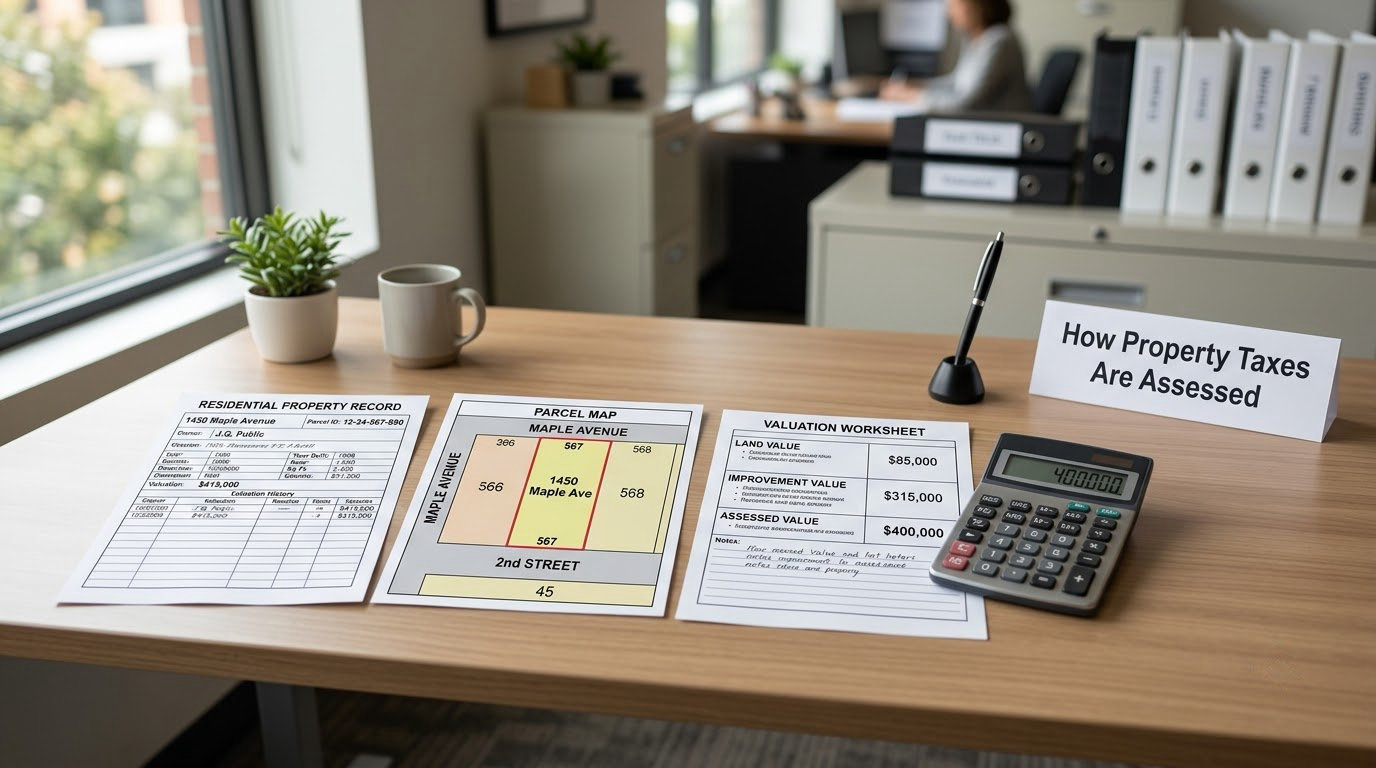
The chain runs the same way almost everywhere, even though the labels change. If you remember only one thing about how property taxes are assessed, remember these six steps.
Step 1: The parcel is identified and a valuation date is set
Every piece of land has a parcel number and a legal description on the tax record. A valuation date, also called a lien date in some states, sets the moment in time when the property is measured for tax purposes.
Many places use January 1. That date matters more than anything else on your notice, because it freezes the value used for a full year even if the market moves the next month.
Step 2: A mass appraisal model estimates market value
A mass appraisal model is a computer system that applies the same statistical model to thousands of parcels at once. It looks at square footage, lot size, age, bedrooms, garages, condition, and the recent sales nearby.
This is why most people never see someone walk through their living room. The number on your notice was generated by a model, not from an interior inspection.
Step 3: The assessment ratio converts market value into assessed value
Most states do not tax the full market value. They apply a fixed ratio, set in state law, to arrive at an assessed value. Illinois outside Cook County uses roughly 33.33 percent, so a home worth 400,000 is assessed near 133,333.
A few states tax closer to full market value. Texas, for example, uses a 100 percent ratio to market value, and Florida’s just value system also tracks the market more closely.
Step 4: An equalization factor adjusts for statewide levels
Because each county sets its own assessments, the state publishes an equalization factor that scales the county’s numbers to a common statewide level. The result is the equalized assessed value, which is what taxing entities actually bill.
Without this step, a county that assessed aggressively would quietly out-collect its neighbors.
Step 5: Exemptions are subtracted to reach taxable value
A homestead or primary residence exemption is subtracted from the equalized assessed value. Senior, veteran, disability, and agricultural exemptions work the same way, and a circuit breaker can cap the bill itself once income or the tax burden crosses a threshold.
Taxable value is what remains. It is the number the millage rate multiplies.
Step 6: The millage rate is applied to produce the tax bill
A millage rate is dollars per thousand of taxable value. One mill is 1 dollar per thousand, so a rate of 20 mills means 20 dollars for every thousand of taxable value, or about 2 percent.
Your bill is the sum of several rates at once: county, city or township, school district, and sometimes a fire district, water district, or other special district. Each one bills you separately but on the same parcel.
What Determines a Property’s Assessed Value?
The inputs are mostly physical and geographic. Location usually carries the heaviest weight, because the model leans on what comparable nearby parcels sold for.
- Comparable sales — the three to six nearby sales the model treats as evidence, weighted toward the most recent ones.
- Lot and improvements — square footage of the living area, the number of bedrooms and bathrooms, finished basement space, and the year built.
- Condition and quality — updates such as a new roof, remodeled kitchen, or a deferred maintenance backlog.
- Site features — garage spaces, a water view, extra acreage, or a corner lot.
- Neighborhood movement — a new subdivision, a highway interchange, or a commercial development nearby moves every parcel in the model.
Here is how a few inputs push a number up or down. A 2,400 square foot colonial with a two-car garage in a good school district sits well above the neighborhood average. The same floor plan with a failing furnace, no garage, and a lot that backs onto a rail line sits below it.
Record cards also carry errors. A missing bedroom, the wrong year built, or a basement counted as unfinished does more than add a small gap. Those fields feed the model, so a fix at the source changes the number the model produces.
How the Assessor Establishes Market Value
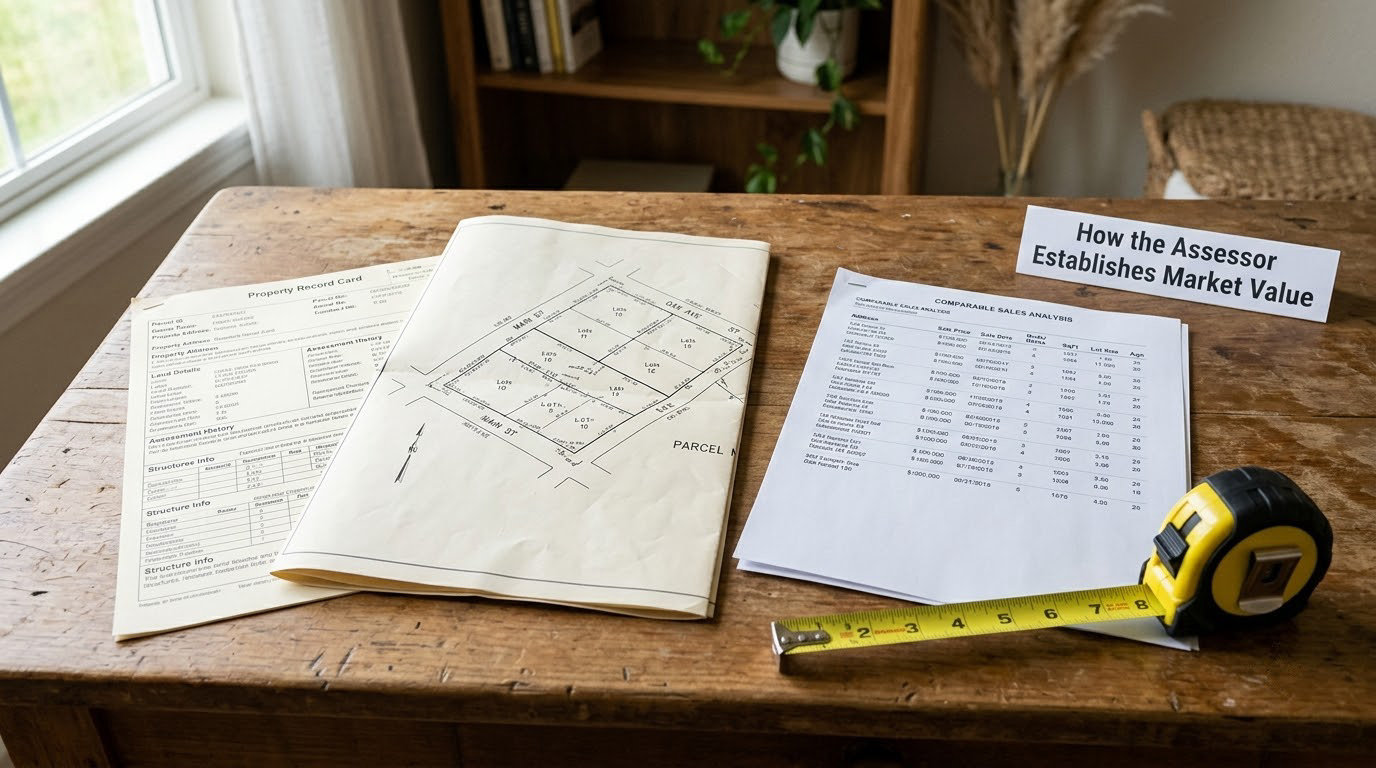
Counties that appraise property one at a time use one of three approaches, or a blend of them.
Comparable sales is the most common residential method. The assessor finds genuinely similar sales nearby and adjusts each one up or down for differences in lot size, garage, condition, and finish level.
Cost to replace starts from what it would cost to rebuild the structure and adds land value. It suits areas where few homes change hands and is the traditional method for agricultural and remote property.
The income approach capitalizes the rent the property could earn. Assessors use it for apartments, commercial buildings, and farmland.
Adjustments are where a value is won or lost. A water view, a remodeled kitchen, a new roof, or a lot that gained 200 square feet from a neighbor’s sale all move the estimate. So do changes outside your walls: a new bypass nearby lowers values, a rebuilt shopping center raises them.
Nothing in the process is adversarial, and nothing in it is personal either. The model is built to be applied uniformly, which is the entire point of mass appraisal.
How Property Taxes Are Assessed From the Notice to the Bill
One home, taken through every step, makes the arithmetic easy to follow. All amounts are US dollars.
| Stage | What happens | Amount |
|---|---|---|
| Market value | Mass appraisal model output for a single-family home | 400,000 |
| Assessment ratio applied | Illinois-style ratio outside Cook County, 33.33 percent | 133,333 |
| Equalization factor | County-to-state adjustment of 1.05 | 140,000 |
| Less homestead exemption | Primary residence exemption subtracted | minus 10,000 |
| Taxable value | Equalized assessed value minus exemptions | 130,000 |
| Millage rate | Combined county, school, and district rate | 6.5 percent |
| Annual property tax bill | Taxable value multiplied by the rate | 8,450 |
Note the gap between the two largest numbers. A home valued at 400,000 produced a bill in the low thousands, because the ratio cut the base down before any rate was applied. That is the single most common source of confusion between a purchase price and an assessment.
The bill itself arrives after the notice, usually once the taxing entities publish their certified rates. Payment deadlines, and whether penalties start on a certain date, come from your local collector.
Why Your Property Tax Bill May Differ From Your Purchase Price
If the purchase price and the assessment point in different directions, that is normal. Six things explain most of it.
Timing. The valuation date is usually months before the notice and sometimes more than a year before the bill is due. A house bought in a fast market can be assessed above the price you paid, and one bought at the peak of a slow market can be assessed below it.
Different rates in different places. Two similar homes on the same street can carry different bills when they sit in different school districts, or when one is annexed into a district that levies a dedicated tax for a specific purpose.
Exemptions you may not be claiming yet. A homestead exemption often has to be filed once. It does not apply automatically everywhere, and filing it late can mean you pay a full year at the higher rate before the exemption takes hold.
Caps and circuit breakers. Many states limit how fast an assessment can rise, or cap the bill as a share of income or of the assessment itself. Those caps can put your bill far below the formula, which is why the formula alone will never match your statement.
Supplemental assessments. A new addition, a garage, or a finished basement can generate its own bill for the remaining part of the year, separate from the regular notice.
Special districts. Fire, water, sewer, and drainage districts bill separately and are easy to mistake for an error.
Because the rules vary, the comparison below is a starting point rather than a reference table.
| State | Assessment approach | Cycle | Typical appeal window |
|---|---|---|---|
| Illinois (most counties) | 33.33 percent assessment ratio | Triennial | Around 30 days from notice |
| Illinois (Cook County) | 10 percent ratio, newer construction assessed by formula | Triennial | Around 30 days from notice |
| California | Base 1 percent of full value under Proposition 13 | Annual appraisal, no periodic increase | Generally 12 months for value appeals |
| Texas | 100 percent ratio to market value | Annual, January 1 | Typically 30 days from notice |
| New York | Full market value, STAR exemption reduces the base | Annual | Varies, often 60 days |
| Utah | 45 percent assessment ratio plus a primary residence exemption | Annual | Around 45 days from notice |
One more piece of the puzzle sits with your lender. If you have a mortgage, most servicers collect property taxes into an escrow account and spread them across your monthly payment. When the assessment rises, the lender usually re-estimates the annual bill at the next annual review, and your monthly payment moves with it.
What Can You Do If You Think the Assessment Is Wrong?
Start with a self-review before you file anything. Fifteen minutes with the public record usually tells you whether you have a real problem.
Run the checklist
Pull the assessment notice and write down three numbers: market value, assessed value, and taxable value. If the assessment is a fraction of market value, that is the state ratio working normally, not an error in itself.
Next, open the property record card for your parcel. Compare the lot size, living area, bedroom and bathroom count, year built, and garage spaces against what is actually on the property. Anything mismatched is a factual error, and factual errors are the easiest kind to correct.
Then look at the comparable sales the county used. Most record systems publish them, and they are the yardstick for an overvaluation argument.
Finally, write down the appeal deadline the moment you find your notice. Miss it and you generally wait a full cycle, which in a triennial state can mean three years.
Know what an appeal can and cannot change
Appeals hear evidence about the value of the property. They do not reduce the tax rate, and they cannot undo a school district budget vote. If your bill rose because the rate rose, an assessment appeal is the wrong tool.
What an appeal can change is the assessed value: that the home is overvalued against its comparables, that it is valued inconsistently with comparable neighbors, or that the record contains factual errors.
File informally with the assessor first when the problem is a data error. Those corrections are usually free, quick, and more likely to succeed than a hearing.
File formally, in levels
A value appeal typically starts with the county assessor and moves to a board of equalization or board of review if the first decision goes against you. A third level, a state tax appeal board, exists in most states for a further review on the record.
Gather your evidence before the hearing rather than during it: the property record card, a small set of clean comparables with dates and distances, dated photographs of condition problems, and permits or invoices for improvements the county missed.
One reassurance from the people who file these: in most jurisdictions, appealing cannot result in a higher assessment. It is a review of the evidence, not a second bite at the taxpayer.
If a buyer’s assessed value lands far above the purchase price and escrow was not built for it, that is worth planning for before closing. Ask your lender for an escrow estimate based on the assessed value rather than the contract price, since the escrow payment follows the bill.
Frequently Asked Questions
How often are property taxes reassessed?
It depends on the state. Some reassess every year, using a January 1 valuation date and current market data. Others run a triennial or four-year cycle, where a third or fourth of the county is reappraised each year while other parcels keep their prior value until their turn. Within a cycle, a purchase, new construction, or a permit almost always triggers an on-site reappraisal and a new notice.
Is a property tax assessment the same as the home’s market value?
Usually not, and the difference is by design. Most states apply a fixed assessment ratio, such as 33.33 percent, to market value to get the assessed value. Some states, including Texas, use a 100 percent ratio and stay close to market value. The assessment is a tax-basis number, so how far it sits from market value tells you about your state’s rules, not about an error.
Why did my property taxes increase even though my home did not sell?
Because the assessment is not tied to a sale. A mass appraisal model revalues parcels on a set cycle, so your assessed value can rise with local sales even though no transaction involved your house. The rate can also change, and separately, a new special district, a school budget vote, or a supplemental bill for a new addition will each show up as an increase. Check which of the three moved before assuming a mistake.
Can I appeal my property tax assessment?
Yes, in nearly every state, and the filing deadline is the part that matters. Appeals generally address the value of the property: overvaluation, inconsistent treatment compared with similar homes, or factual errors on the record card. They cannot reduce the tax rate or overturn a district budget. Start with the assessor for record corrections, then escalate to a board of review and a state appeal board if needed.
Are property tax assessments based on the mortgage appraisal?
No. The mortgage appraisal supports the loan, and the county assessment supports the tax bill, and the two rarely match. A lender pays for an appraisal to size the risk on a specific property. The county runs a mass appraisal model across every parcel for consistency and equalization. In fact, a mortgage appraisal well above the assessed value is common and is usually a good sign for your tax bill.
How do homestead exemptions affect a property tax bill?
A homestead or primary residence exemption subtracts an amount from the assessed value before the rate is applied, so it lowers the bill rather than the rate. Because exemptions apply to taxable value, a rate cut produces a larger dollar saving than it looks like on paper. Filing requirements differ widely, and some states require a one-time application, so check whether yours is on file.
Conclusion
Find your assessment notice and put two dates next to it: the valuation date the county used and the appeal deadline. Compare the three numbers on it, market value, assessed value, and taxable value, against the ratio your state sets, and then open the property record card to confirm the physical details are right.
If the record is accurate and the comparables support the number, the assessment probably stands. If something does not match, you have a factual error worth correcting, and you have a filing window to do it in. Rules differ by state and county and change regularly, so confirm the current figures with your county assessor before you rely on them for 2026 planning.