Mortgage points are optional fees you pay a lender at closing in exchange for a permanently lower interest rate, and one point costs exactly 1% of your loan amount. Each point typically cuts your note rate by about 0.25 percentage points (25 basis points), which lowers your monthly payment and the total interest you pay over the life of the loan.
On a $400,000 mortgage, one point costs $4,000 and usually drops the rate from 6.5% to 6.25%, saving roughly $65 a month. That money is spent before you make a single payment, and it is gone if you sell, refinance, or pay off the loan early.
Here is the short version before the details:
- One point = 1% of the loan amount, paid at closing, and it is optional.
- Points are not a fee for the loan. They buy a lower note rate that lasts the full term of a fixed-rate mortgage.
- Your break-even month is the point cost divided by your monthly savings.
- If you leave the loan before that month, you have lost the difference.
- Compare lenders with APR, not the advertised rate, because APR folds points and fees into one number.
Table of Contents
- How Mortgage Points Work
- What Do Mortgage Points Cost?
- How Many Points Can You Actually Buy?
- Do Mortgage Points Save Money?
- How Mortgage Points Affect the Interest You Pay
- Do Mortgage Points Work the Same on a Refinance?
- What Happens to Points on an Adjustable-Rate Mortgage?
- How to Calculate the Mortgage Points Breakeven
- Worked Example: Two Points on a $400,000 Loan
- What Is the Difference Between Mortgage Points and a Lower Interest Rate?
- How to Compare Two Lenders Using APR
- Can You Negotiate Mortgage Points?
- How to Decide Whether to Buy Mortgage Points
- Points Versus a Larger Down Payment
- Points Versus Extra Principal Payments
- Frequently Asked Questions
- Are mortgage points tax deductible?
- Are mortgage points required to get a mortgage?
- How many mortgage points are usually worth buying?
- Do mortgage points lower the principal I borrow?
- Can I pay mortgage points at closing?
- Is it better to buy mortgage points or pay a lower lump sum?
How Mortgage Points Work
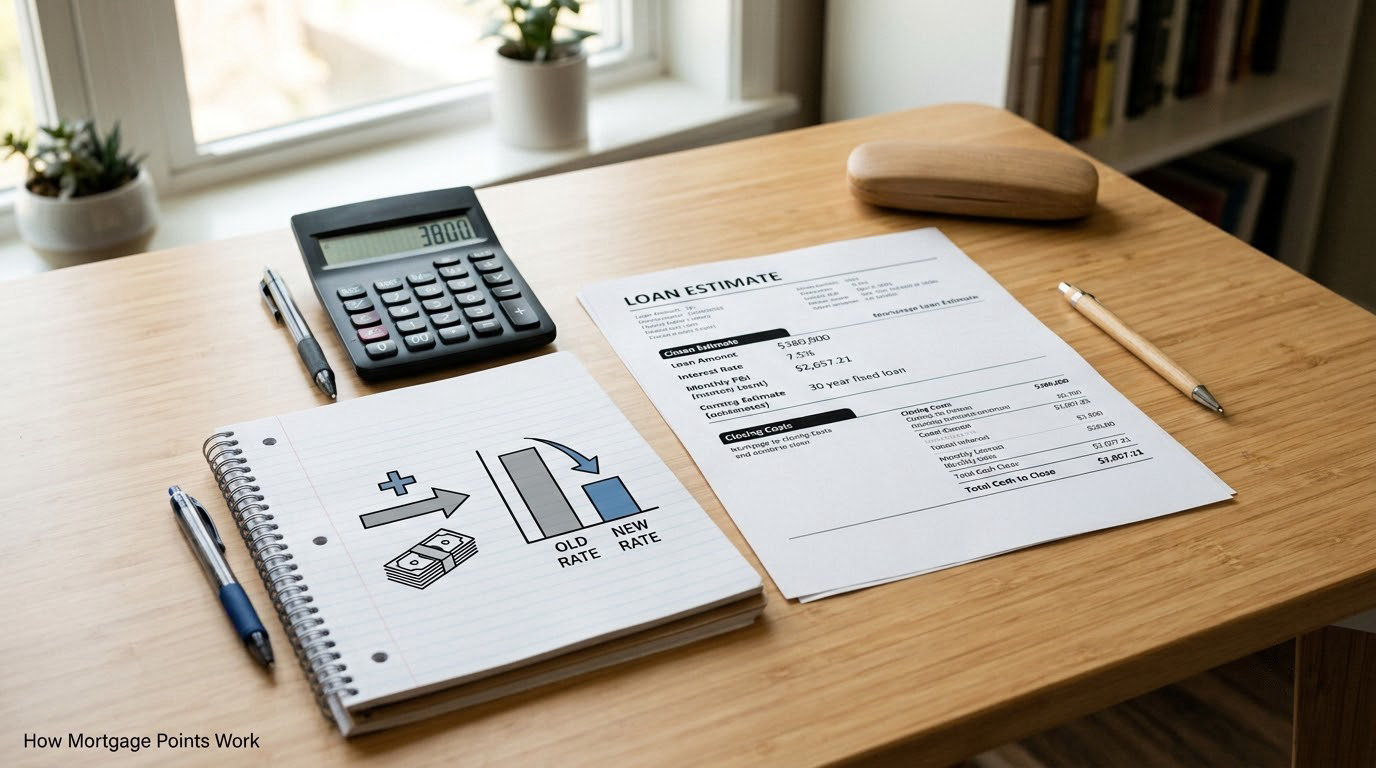
A point is a prepayment of interest. You hand the lender cash on the closing day, and in return the note rate printed on your note is lower than the lender’s standard rate. Nothing else about the loan changes: the principal you borrowed, the term, and the amortization schedule all stay the same. The payment is simply recalculated at the reduced rate.
Here is the arithmetic anchor most lenders use. On a $400,000 loan, one point is $4,000. On a $300,000 loan, one point is $3,000. On a $960,000 jumbo loan, one point is $9,600, which is why the same rate sheet reads very differently for a jumbo borrower than for a first-time buyer.
The exchange rate is roughly 0.25 percentage points of rate reduction per point, though there is no fixed conversion and it varies by lender, by the day you lock, and by where you are shopping. A lender’s rate sheet is the only reliable source for your loan.
Points are also not the same as prepaid interest, which is a separate line on page 2 of your Closing Disclosure. Prepaid interest covers the days between your closing date and your first payment. It buys you nothing and saves you nothing.
What Do Mortgage Points Cost?
There are two kinds of points on most Loan Estimates, and they do different things.
| Point type | What it buys | Typical size | Where it shows up |
|---|---|---|---|
| Discount point | A permanently lower note rate | 1% of the loan amount each | Fees charged by the lender |
| Origination point | Usually nothing beyond paying the lender’s own cost | 0.5% to 1%, or replaced by a flat fee | Fees charged by the lender |
| Negative point / lender credit | Cash from the lender toward your closing costs | 1% of the loan amount each | Credits charged by the lender |
Origination points are a fee for making the loan. Discount points are a purchase of a lower rate. Many borrowers see both lines and assume they are the same thing, which makes the real price of the loan harder to see than it needs to be.
Some lenders have moved away from origination points altogether and quote a flat dollar fee instead. If you see a line that does not change your rate, ask what it covers and whether it is negotiable.
How Many Points Can You Actually Buy?
There is no legal cap, but most rate sheets run from about 4 points to 6 points and then stop. The reason is arithmetic: each additional point buys a smaller rate cut than the one before it, so a 5-point deal gets you noticeably less than five times the benefit of a 1-point deal.
Fractional points are normal. A 0.25, 0.5 or 0.75 point shows up often when a buyer wants part of the rate reduction without the full cash outlay. On that $400,000 loan, a half point costs $2,000 and, at a quarter point per point, moves the rate to 6.375%.
VA loans add a wrinkle worth knowing. Borrowers with service-connected disability may qualify to pay the VA funding fee in advance and finance it into the loan, which is a separate mechanic from buying discount points.
Do Mortgage Points Save Money?
How Mortgage Points Affect the Interest You Pay
Two things improve when you buy points: the monthly principal and interest payment, and the total interest over the full term. Nothing about the balance you borrowed changes. The lower payment is the part borrowers notice on the statement, and the lower lifetime total is the part that actually pays back the points.
The honest answer to whether points save money is that it depends almost entirely on how long you keep the loan. Points pay off over time because the savings accumulate monthly. Leave early and there is no accumulation, only the cash you already spent.
Take the $400,000 example with 2 points, which brings the rate to 6.0% and the payment from $2,528 to $2,398 a month. You have paid $8,000 on day one. If you sell after 36 months, you have saved about $4,674 in total. That is a loss of roughly $3,326 with no recourse and no refund, which is exactly the sunk-cost problem borrowers describe in mortgage forums.
Mortgage professionals also make a distinction that most articles skip. The simple break-even counts every future dollar of savings at full face value. The real break-even adds about six months, because rates reprice, people pay extra principal, and some of those future savings get discounted. Plan on the longer number.
Timing matters too. When rates are high, a point buys more rate reduction and the break-even shortens. When rates are low, a point buys less and the same break-even stretches out. Points are worth checking in a high-rate environment and rarely worth buying in a low one, all else equal.
Do Mortgage Points Work the Same on a Refinance?
The mechanics are identical, but the break-even is much shorter because the loan already exists and the only new cost is the points. On a $300,000 loan at 6.750%, the payment is about $1,946 a month. Refinancing to 5.750% with 2 points, a $6,000 cost, brings it to about $1,751, saving $195 a month. That breaks even in roughly 31 months.
Add the rest of the refinance closing costs to that number before you decide. Lender fees, appraisal, title work and recording fees can easily double the cash you put in, and they are usually not recoverable either.
What Happens to Points on an Adjustable-Rate Mortgage?
On an ARM the buydown usually covers only the initial fixed period, such as five or seven years, and the rate then resets to an index plus a margin. Any break-even calculation that runs past that date is fictional.
You can also spend a point on a permanent buydown on a 30-year ARM, where the discount applies for the whole term. It costs more upfront and lenders price it differently. Ask for both numbers in writing.
How to Calculate the Mortgage Points Breakeven
The calculation is one division, but the errors come from the inputs, not the formula. Work through it in this order.
- Calculate the cost of the points. Multiply the number of points by the loan amount by 1%. Two points on a $400,000 loan is $8,000.
- Get the par rate payment. Ask the lender for the payment at zero points. That is the baseline you are comparing against.
- Get the buydown payment. Ask for the payment at the point count you are considering, on the same loan and term.
- Subtract to get monthly savings. Par payment minus buydown payment.
- Divide cost by savings. $8,000 divided by $130 is about 62 months.
- Add about six months. That is your real breakeven, not the simple one.
- Compare to your expected time in the home. If the breakeven is longer than your plan, the points do not work for you.
Here is the same math across several point counts on a $400,000 loan, 30-year fixed, with a par rate of 6.500% and a quarter point of rate reduction per point bought.
| Points | Upfront cost | Note rate | Monthly P&I | Interest saved over 30 years | Breakeven |
|---|---|---|---|---|---|
| 0 | $0 | 6.500% | $2,528 | Baseline $510,080 in interest | Not applicable |
| 0.5 | $2,000 | 6.375% | $2,495 | $11,758 | 61 months |
| 1 | $4,000 | 6.250% | $2,463 | $23,432 | 61 months |
| 2 | $8,000 | 6.000% | $2,398 | $46,739 | 62 months |
| 3 | $12,000 | 5.750% | $2,334 | $69,761 | 62 months |
| 5 | $20,000 | 5.250% | $2,209 | $114,926 | 63 months |
Read the last column carefully. It barely moves as you add points, which means the fifth point is doing the same job as the first one in terms of payback timing. What changes with each point is the total interest saved, which is why the decision is really about how many years you have.
Real rate sheets are not perfectly linear, and a lender may quote 2 points for 0.48 instead of 0.50. That small difference pushes breakeven out by a couple of months, so use the lender’s numbers rather than the rule of thumb.
Worked Example: Two Points on a $400,000 Loan
Cost: 2 points × $400,000 × 1% = $8,000. Par payment at 6.500% = $2,528. Buydown payment at 6.000% = $2,398. Monthly savings = $130. Breakeven = $8,000 ÷ $130 = 61.5 months, call it 62. Real breakeven with the six-month cushion = about 68 months, or five years and eight months.
If your plan is to move in four years, you would have saved about $6,240 against $8,000 spent. You are roughly $1,760 short. If your plan is eight years, you finish ahead by about $4,480. The same loan, the same points, opposite outcomes.
What Is the Difference Between Mortgage Points and a Lower Interest Rate?
There is no difference in the loan itself. A lower rate and points are two sides of the same trade, which is why they are compared against each other on the same rate sheet. What borrowers actually need to separate is discount points from the other charges that happen to be expressed in points.
A discount point lowers your note rate permanently. An origination point pays the lender’s cost of originating the loan and does not change your rate. A negative point, shown as a lender credit, runs the trade in reverse: the lender gives you cash toward your closing costs and raises your rate.
Negative points are not free money. They are a loan at a worse rate. If you take a lender credit of $4,000, expect your note rate to sit meaningfully above the par rate, and expect the total cost of credit to reflect it.
How to Compare Two Lenders Using APR
The note rate is what you pay. The APR is what the loan costs you including points and most closing fees, expressed as a single yearly percentage. When two lenders quote different rates because one has points and one does not, APR is the only fair way to compare them.
| Offer | Points | Note rate | Cash for points | APR |
|---|---|---|---|---|
| Lender A | 0 | 6.500% | $0 | 6.62% |
| Lender B | 2 | 6.000% | $8,000 | 6.55% |
| Lender C | 1.25 | 6.188% | $5,000 | 6.51% |
On these numbers, buying points from Lender C wins on APR but costs the most cash up front. That is the real choice: lowest cost of credit, or least cash on the closing day. Only you know which one your budget can handle.
APR is a comparison tool, not a decision tool. It assumes you keep the loan for its full term and, on an ARM, that future rates follow the index. Shop with APR, then decide with your own breakeven number and your own timeline.
Can You Negotiate Mortgage Points?
Usually, at least a little. The point-to-rate exchange is set by a rate sheet, but the sheet is not a legal document and lenders have room to move on both ends of the trade.
Here is what works in practice. Ask what the par rate is, which is the rate at zero points, and ask for the sheet. Then ask whether the lender will fund a lender credit instead of charging you points, or credit you for points above a certain count. Both are common and both are worth asking about.
On the Loan Estimate, discount points appear in Section 8, fees charged by the lender, listed as points or as a percentage of the loan amount. Origination charges sit in the same section. Compare that block across lenders, because two quotes can look very different until you see that one includes a flat fee the other expresses in points.
Two limits are worth knowing. A federal rule lets you shop three lenders and receive their Loan Estimates within three business days of applying, so get competing written quotes before you negotiate anything. And origination points are the easier line to move, because they buy you no rate reduction at all.
How to Decide Whether to Buy Mortgage Points
Answer three questions in order, and the answer usually falls out on its own.
How long will I keep this loan? Points only make sense if you expect to stay past the real breakeven. If your honest answer is three to five years, take the lower cash requirement and the par rate. This is the single biggest driver and it is the one people guess at.
Can I pay for points without touching my reserves? Points should come from cash you have already set aside, not from your emergency fund or your down payment savings. If paying points means starting the new job with no cushion, take the higher rate.
What does APR say across my quotes? Run the APR comparison, then run your own breakeven on each option. If two lenders are within a few hundred dollars of the same breakeven, the more flexible one on cash is the better deal.
Loan type changes the answer too. On a 5/6 or 7/6 ARM, a buydown that only covers the fixed period only pays off if you break even inside that window, which is rarely a good bet. On a jumbo loan the same percentage costs several times more cash, so the breakeven math matters more, not less.
Points Versus a Larger Down Payment
These two rarely compete dollar for dollar. Points buy a lower rate. A larger down payment lowers the amount you borrow, and on a conventional loan it can also remove private mortgage insurance once you reach 20% equity, which is where the two uses of cash finally meet.
On a $500,000 purchase with 12% down, PMI runs a few hundred dollars a month depending on your credit profile. Putting another $40,000 down gets you to 20%, removes PMI entirely, and permanently shrinks the loan. Spending that same $40,000 on points instead buys a rate cut, and PMI stays on your statement.
That is why the two are not really interchangeable. If you have enough spare cash to reach 20%, reach it. If you are short of the threshold, points are competing with a much smaller reserve decision, and the comparison changes.
Points Versus Extra Principal Payments
Extra principal paid early in the life of a loan is a close competitor. Early payments are weighted toward interest, but the balance is still large, so the savings compound fast and breakeven on a consistent extra principal payment is usually much shorter than breakeven on points.
Most borrowers cannot do both comfortably, and that is the real constraint. If you have the cash for points but not for a monthly add-on, points are the better choice. If you have the monthly room but not the closing-day cash, an extra principal payment gets you most of the benefit with none of the upfront risk.
Frequently Asked Questions
Are mortgage points tax deductible?
Discount points on the purchase of your primary residence are generally deductible in the year you pay them, but only if you itemize deductions rather than taking the standard deduction. Origination points on a purchase are usually not deductible and are generally treated as part of the cost of the home. On a refinance, origination points can often be deducted over the life of the loan. Rules depend on your tax year, your state and your overall tax picture, so confirm the treatment with a tax professional before you count on it.
Are mortgage points required to get a mortgage?
No. Almost every mortgage can be closed with zero points, and plenty of borrowers do exactly that. You still have to cover closing costs such as appraisal, title services, recording fees and prepaid interest, and on a conventional loan with less than 20% down you still have PMI. Points are the optional line on that list, which is precisely why they are negotiable and worth questioning.
How many mortgage points are usually worth buying?
Most borrowers who buy points at all buy between one and two. One point is the common sweet spot because it is easy to model and easy to fund at closing. Beyond three or four, each additional point buys less rate reduction than the last, and the breakeven stretches out. The right number depends far more on your expected time in the home than on the point count itself.
Do mortgage points lower the principal I borrow?
No. Points do not change the loan amount at all. The principal you borrow, the term and the amortization schedule stay exactly the same; only the interest rate changes. Your monthly payment falls because the interest portion of it falls. If your goal is to owe less principal, that comes from a larger down payment or from extra principal payments, not from points.
Can I pay mortgage points at closing?
Yes, and that is the only time you pay them. Points are a closing cost, paid in cash or financed into the loan on the closing day, which raises the loan amount and adds interest on the borrowed portion. Points must be paid at closing because the reduced rate applies from the first payment. Paying them earlier or in installments is not a thing lenders offer.
Is it better to buy mortgage points or pay a lower lump sum?
If you mean putting the same cash toward a larger down payment, compare them on what each actually buys. Points lower your rate for the whole term. A bigger down payment lowers what you owe and can remove private mortgage insurance once you reach 20% equity. If the extra cash gets you to 20%, the down payment usually wins. If it does not, the two are not really comparable and points may be the better use.
Start with one number: how many months do you expect to keep this loan. Multiply that by your real monthly savings and compare it to the point cost. If the breakeven month arrives well before your moving date and the cash comes from money you have already set aside, the points work. If not, take the par rate and keep the cash.