
You should refinance your mortgage when the new rate is meaningfully lower, the closing costs are small relative to your balance, and you will stay in the home long enough to get that money back. Most borrowers need at least a 0.75% to 1% drop before the math works, and a typical refinance takes 30 to 45 days to close.
This guide walks through that math step by step. All figures below are in US dollars, and every rate and loan program rule changes over time, so treat the numbers as a worked example rather than a quote.
This is educational information about how mortgage refinancing generally works in the United States, not personalized financial advice.
Table of Contents
- What Does Refinancing Your Mortgage Mean?
- Rate-and-term refinance vs cash-out refinance
- When Refinancing Can Save You Money
- Should you refinance your mortgage to pay off other debt?
- When Refinancing May Not Be Worth It
- How to Calculate Your Break-Even Point
- What Rate Drop Do You Actually Need?
- What to Compare Before You Refinance
- Refinance, recast, HELOC or home equity loan?
- How to Compare Refinance Loan Offers
- How Much Does Refinancing Cost?
- Is a No-Closing-Cost Refinance Actually Free?
- Refinancing a Home You Just Bought
- Should You Wait or Lock In a Rate?
- Should You Refinance Your Mortgage for a Shorter Term?
- What Risks Should You Consider?
- What Credit Score and Loan-to-Value Do You Need?
- How to Decide Whether to Refinance Your Mortgage
- Frequently Asked Questions
- Is refinancing worth it if the new rate is only 1% lower?
- How long does it take to break even on a mortgage refinance?
- Does refinancing restart my 30-year mortgage clock?
- Can I refinance with little or no equity in my home?
- Should I choose a cash-out refinance to pay off other debt?
- Are mortgage rates lower when I refinance with no closing costs?
- The Bottom Line
What Does Refinancing Your Mortgage Mean?
Refinancing means paying off your existing loan and replacing it with a brand-new mortgage. The new lender receives the money, retires your current note, and you start a fresh amortization schedule with a new monthly principal and interest payment.
Nothing about your home changes. You keep the same house, the same address, and usually the same amount of ownership equity you have built up. What changes is the loan sitting on top of it.
Rate-and-term refinance vs cash-out refinance
A rate-and-term refinance keeps the amount you borrow roughly the same and changes the rate, the term, or both. This is the version that usually produces real savings, because you still owe the same amount of principal and simply pay less to borrow it.
A cash-out refinance increases the loan balance and hands you the difference in cash. People use that money for renovations, tuition, or paying off credit cards and HELOC balances. It is a different decision with different risks, and I cover it further down.
The third type people ask about is a streamline or no-cash-out refinance, where government-backed loans let you skip the full appraisal and some of the paperwork. It costs less and closes faster, but the rate is usually not the lowest on the market.
When Refinancing Can Save You Money
Here are the situations where a refinance genuinely pays off, with the reason each one works.
- Your rate is well above today’s market. The gap between your note rate and available rates is the only thing that creates savings. Everything else is a side effect.
- You want the loan gone faster. Moving from a 30-year schedule to a 15-year schedule costs more per month and cuts total interest dramatically, because you pay principal earlier and borrow less for less time.
- You are on an adjustable-rate mortgage. If your ARM is about to reset higher, locking a fixed rate now converts an unknown into a known number.
- You can drop private mortgage insurance. Lenders cancel PMI once you reach 80% loan-to-value on request, with no new appraisal and no penalty. Many borrowers drop it sooner by bringing more equity to the closing through a cash-out refinance or a large lump-sum principal payment.
- You consolidate expensive short-term debt. Moving a credit card balance in the 20% to 26% range down to a mortgage rate in the mid-single digits can free real cash flow, provided you do not run the cards back up.
- Your payment is straining the budget. Extending the remaining term back to 30 years lowers the payment significantly. It feels like relief and it costs more interest over time, so treat it as a budget decision rather than a savings decision.
One pattern keeps showing up in borrower forums: refinancing an existing loan is cheap, while refinancing one year after purchase is often not. Borrowers with a high original rate who shopped three or more lenders frequently report final fees in the low hundreds of dollars rather than the thousands. That gap is worth chasing.
Should you refinance your mortgage to pay off other debt?
Sometimes, with conditions. Moving 20,000 of credit card debt at 22% onto a mortgage at 6% removes roughly 120 a month of interest payments, and that money comes back to you every month.
Those rates are illustrations, not quotes. Card APRs run from low teens to high twenties depending on the card and your credit, and mortgage rates move weekly, so plug in the numbers from your own statement.
The conditions matter more than the arithmetic. Do not refinance a mortgage to clear balances unless you have already changed what caused the balances. Borrowers who skip that step describe the same loop repeatedly: cards paid off in the spring, recharged by summer, with the same cards, lower equity, and a larger loan balance than when they started. If the spending pattern has not changed, the savings will not either.
When Refinancing May Not Be Worth It
Sometimes the answer is simply no. These are the situations where a refinance costs you money or wastes effort.
- The rate gap is small. A quarter-point or half-point improvement on a modest balance rarely covers thousands of dollars in closing costs.
- You plan to move soon. If you are likely to sell within three years, you may never reach the break-even point. Selling costs also eat into any equity you built.
- You bought recently. Many refinance loans carry a prepayment penalty, sometimes calculated as a percentage of six months’ interest. Loans inside the first year may also be treated differently by underwriting.
- You barely have equity. Above 80% loan-to-value, conventional refinances usually require private mortgage insurance, which can eat the savings. FHA streamline and VA IRRRL refinances are the exceptions.
- You would extend the term to cut the payment. This lowers your payment now and raises the total interest you pay. The break-even looks fantastic precisely because it is not counting the extra interest.
- Your credit got worse. You refinance at today’s rate using today’s credit profile, not the rate you qualified for years ago.
Borrower consensus on r/Mortgages is that waiting is a legitimate strategy. Several people deliberately sit on a refinance for a year, betting rates fall further, and then execute. That is a bet on the market, and only works if you have the cash to sit out the gap and the flexibility to be wrong.
How to Calculate Your Break-Even Point
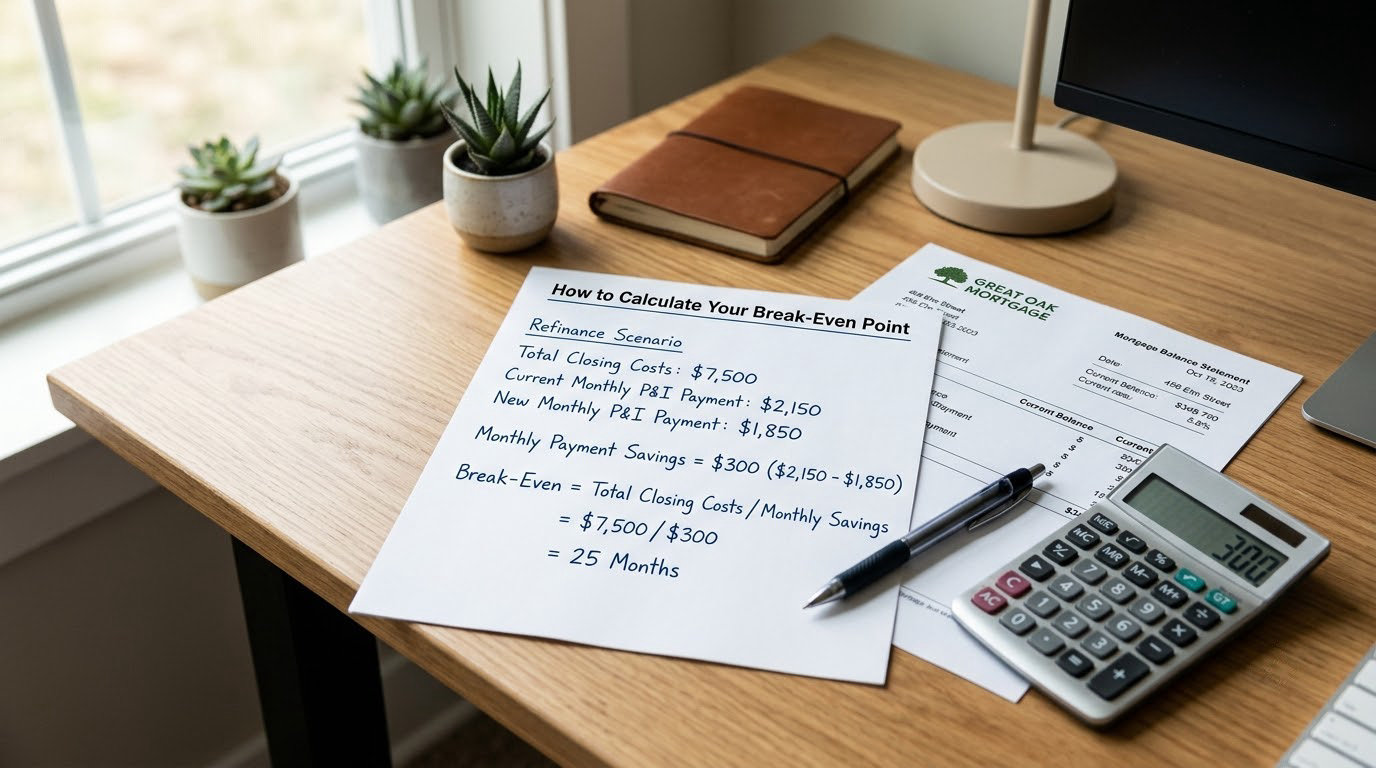
Break-even point is the number that decides this. The formula is simple: total closing costs divided by monthly principal and interest savings.
Break-even months = closing costs ÷ monthly savings
Worked example: a 400,000 balance with 20 years remaining at 6.5% carries a principal and interest payment of about 2,982. Refinanced at 5.5% with the same term, that payment falls to about 2,751, so you save roughly 231 per month. At 3% closing costs, which is 12,000 on a 400,000 loan, break-even lands at about 52 months.
| Scenario (400,000 balance, 20 years remaining) | Monthly savings | Closing costs | Break-even |
|---|---|---|---|
| 6.5% to 5.5%, same 20-year term | 231 | 12,000 | 52 months |
| 6.5% to 5.75%, same 20-year term | 174 | 12,000 | 69 months |
| 6.5% to 5.5%, extended to 30-year term | 711 | 12,000 | 17 months |
Read the last row carefully. Extending to 30 years drops break-even to 17 months, but total interest on that 30-year loan comes to roughly 417,700 over its life. Keeping the 20-year term at 5.5% costs about 260,300 in interest. Same house, different math, a gap of more than 150,000.
Balance size changes everything too. On a 200,000 loan at 6% going to 5% over a fresh 30 years, monthly savings are about 126 and closing costs around 6,000, which gives break-even near 48 months. The same 1% improvement on a 750,000 balance saves over 470 per month and breaks even in roughly 20 months. A percentage rule that works for one borrower is meaningless for another.
Most calculators you will find online for a refinance break-even use exactly this formula. Run your own numbers rather than trusting a single headline rate, and check the result against your real timeline.
What Rate Drop Do You Actually Need?
There are three rules of thumb floating around, and they disagree because they were written for different loan sizes.
The old rule says wait for a full 2% reduction. That advice dates from an era when rates moved in bigger steps and closing costs ate a larger share of a typical loan. On a small balance, a 2% gap genuinely is needed. On a large one, it is wildly conservative and you could sit waiting for years while leaving real savings on the table.
The middle rule says 1%, which is the most useful default. It works reasonably across loan sizes once you factor in term and time in the home.
The current guidance you will find most often, including in the AI summaries dominating search results for this question, is 0.75% to 1%. That range reflects how closing costs have fallen as a percentage of the loan and how much lenders compete on fees.
The honest answer is that the number scales with three things: your balance, how much time you have left on the loan, and how long you will stay.
- 0.5% can work when your closing costs are unusually low, your balance is large, and you will stay well past break-even. One r/Home borrower moved from 3.75% to 2.25% and from a 30-year to a 15-year term for roughly 650 in fees after shopping around, which is why that outcome shows up in the forum record.
- 0.75% to 1% is the practical floor for most conventional situations.
- 1% to 2% is right for small balances where fees cannot be negotiated down, and for anyone who is undecided about how long they will stay.
Freddie Mac’s Uniform Settlement form, the closing document behind the standard Loan Estimate, gives you the machinery for this. Section A of the Loan Estimate shows your payment at several different rates, and the settlement form lets you enter a target total interest figure and read back the rate that produces it. Working backwards from a total cost you can afford is more useful than any rule of thumb, and the rates update as the market moves through 2026.
What to Compare Before You Refinance
Two offers with the same rate are rarely the same deal. Compare these line items instead.
- Interest rate versus APR. The rate is the price of borrowing. The APR folds in fees and expresses the true annual cost, which is what you should judge offers on.
- Loan term. Same term means a straight comparison. A different term makes everything harder to read.
- Monthly principal and interest. Quote this on principal and interest only, so taxes and insurance do not distort the comparison.
- Total interest over the life of the loan. This is where term extension shows its real cost.
- Discount points. One point costs 1% of the loan amount and typically buys about 0.25% of rate reduction. You pay points up front to avoid interest later, so they only make sense when break-even is short.
- Lender fees. Origination, underwriting, application, and processing fees vary widely between lenders for identical loans.
- Third-party costs. Appraisal, title search and insurance, recording, and credit report fees are usually near market but still worth confirming.
- Mortgage insurance. Check whether the new loan carries PMI and what it costs monthly.
- Escrow amounts. Property taxes and homeowners insurance can shift even when your principal and interest payment is identical.
Rates move weekly, so get quotes close together. Comparing an offer from Monday with one from six weeks ago is not a comparison.
Refinance, recast, HELOC or home equity loan?
Before you refinance, make sure you need to. Three other tools solve similar problems with very different math.
| Option | Best for | Rate and cost | Main catch |
|---|---|---|---|
| Refinance | A meaningfully lower rate or shorter term | Closing costs of 2% to 6% of the balance, new rate today | New loan, full closing costs, clock resets |
| Recast | A lower payment with extra cash already in hand | One-time fee of a few hundred to a few thousand dollars, keeps your rate | Only works if you send principal payments first, and only one recast every year or two |
| HELOC | Short-term access to cash with the option to repay quickly | Usually variable rate, minimal closing costs | Variable rates can jump, and lenders can freeze or close the line |
| Home equity loan | A known lump sum at a fixed rate | Fixed rate, moderate closing costs | Fixed monthly payment regardless of what you do with the money |
If your only goal is to pay the loan off faster and you can do it with cash on hand, a recast often beats a refinance. It costs a fraction of the closing costs and leaves your rate untouched. If your goal is a lower rate, only a refinance gets you there.
How to Compare Refinance Loan Offers
Get at least three written Loan Estimates within a short window and compare them line by line. Borrowers on mortgage forums consistently name shopping lenders as the single biggest lever on final cost.
Ask every lender for the same assumptions: the same loan amount, the same term, the same rate, and the same credit profile. If one lender quotes a rate that looks unusually generous, check what they assumed about loan-to-value or the escrow pre-payments.
Watch for three things that quietly reshape the offer. A cash-out quote and a rate-and-term quote are different products and should never sit in the same column. Prepayment penalties matter if you might sell soon. And a no-closing-cost refinance is never free, which I explain below.
Higher rates tend to come with cheaper closing costs, and lower rates tend to come with more expensive ones. That is normal market structure, not a trick by any one lender.
How Much Does Refinancing Cost?
A refinance typically costs 2% to 6% of the loan amount. The low end applies to streamline and no-cash-out refinances with no appraisal. The high end reflects a full cash-out refinance on a first mortgage, where you pay an appraisal, title work, and origination fees on a larger balance.
On a 400,000 loan, that range runs from about 8,000 to 24,000. That is the number your break-even calculation is recovering, and it is why two borrowers with the same rate can reach opposite conclusions.
The full line-item list on a standard Loan Estimate runs from Section A through Section J, and it is worth reading every line rather than only the total:
- Origination fee, underwriting fee, application fee, and processing fee
- Discount points, if you buy the rate down
- Appraisal fee, which a streamline refinance usually waives
- Title search, title insurance, and settlement services
- Recording fees and transfer taxes
- Credit report fees
- Prepaid interest, usually covering the days between closing and your first payment
- Escrow pre-paids, often several months of taxes and insurance
Two of those surprise people. Prepaid interest and escrow pre-paids are not fees, they are money you are moving ahead, but they still come out of your account at closing and they still change your cash position on the day you sign.
A typical refinance takes 30 to 45 days from application to closing. If you are rate shopping seriously, expect to gather two years of W-2s or tax returns, two months of bank statements, and current pay stubs. Borrowers on mortgage forums mention one recurring frustration: existing customers get deprioritized when a loan officer’s book is full of new purchase clients, so ask directly when your file will be worked.
Is a No-Closing-Cost Refinance Actually Free?
No. A no-closing-cost refinance simply moves the cost into the rate. Somebody still pays the appraisal and the title work, and it comes out of the lender’s margin, which is collected from you as a higher rate.
The increase is usually a quarter-point to half a point. On a 400,000 loan, half a point over 20 years costs roughly 24,000 in extra interest, which is usually more than the fees it replaced. On a very large balance the comparison gets worse, not better, because the interest compounds against a bigger base.
There is one situation where no-closing-cost makes real sense: when the break-even on the improved rate is long and you would rather not tie up cash at closing. If your rate is excellent but your savings are thin, you are buying a lower monthly payment at the cost of total interest. Read the APR on the Loan Estimate, since the APR comparison exposes the bump that the advertising rate hides.
Refinancing a Home You Just Bought
Refinancing within the first year of purchase is usually the worst version of this decision, and it comes up constantly in borrower forums. The reasons stack up: you likely have little equity, you may carry a prepayment penalty, and the lender who just lent you the money gave you their best available rate already.
New builds add one more wrinkle. A builder buy-down that locked you into 4.75% for the first three years only applies to the original loan. Refinance it in year two and the buy-down is gone, which is why the better move is usually to let the rate step up and stay put.
One exception is worth naming. If you are holding an adjustable-rate mortgage that is about to reset sharply higher, refinancing shortly after purchase makes sense regardless of the numbers above, because you are buying certainty rather than savings.
Should You Wait or Lock In a Rate?
This is the question borrowers agonize over most, and there is no clever answer, just a choice about which risk you prefer to carry.
Locking protects you against rates rising before your closing. That matters most when you have already decided to refinance and your budget genuinely cannot absorb the higher rate. Waiting protects you against the possibility that rates fall again and you have to do this twice, paying closing costs twice.
Several borrowers describe waiting deliberately, then refinancing the following summer once rates moved their way. That worked for them. It fails when rates climb instead, and the second set of closing costs eats the first advantage.
A practical middle ground: get your numbers to break-even first, then lock once the rate you would accept is available. That way the decision is done and only the timing is open.
Should You Refinance Your Mortgage for a Shorter Term?
Shortening the term is where refinancing produces its biggest genuine savings. You pay more each month and owe the home free sooner, which is exactly the tradeoff people want when they have room in the budget.
Using the numbers above, going from 6.5% to 5.5% while keeping 20 years cuts total interest from roughly 315,700 to about 260,300. Going from a 30-year to a 15-year schedule usually saves far more, though the monthly payment can jump sharply.
The catch is flexibility. A higher payment is harder to carry through a job loss or a career gap. Ask yourself whether you would still make that payment on your worst month, not your average one.
Many people try to have both by refinancing at a lower rate and a shorter term, accepting a payment similar to what they pay now. That works only if the savings cover the payment increase, so run both numbers side by side.
What Risks Should You Consider?
Refinancing carries real downsides that are easy to skip over in the moment.
- You are refinancing into a higher rate. If your original loan was priced well and today’s market is worse, you lock in a worse deal on a brand-new schedule.
- The amortization clock resets. A loan with 10 years remaining becomes a new 30-year loan, and interest you already paid does not reduce what remains.
- Cash-out spending habits follow the cash. Borrowers who use a refinance to clear card balances frequently run them back up, leaving less equity and the same balances.
- You pay closing costs with no savings behind you. If closing depends on a bonus or a sale that falls through, you can be left scrambling.
- PMI can return. If you refinance above 80% loan-to-value without federal backing, mortgage insurance comes with the new loan.
- Your credit takes a temporary hit. A new hard inquiry and a new account lower your score for a few months. If you are planning other credit activity soon, sequence it around the refinance.
- Variable income complicates approval. Self-employed borrowers often need larger reserves and longer documented income history than when they first purchased.
None of these are dealbreakers on their own. They matter because they change what a lower headline rate is actually worth to you.
What Credit Score and Loan-to-Value Do You Need?
Loan-to-value ratio is your loan balance divided by the home’s value, and it is the number that decides whether you pay mortgage insurance. At 80% or below, most conventional refinances skip PMI entirely.
Approximate minimum credit scores vary by lender and program, but the broad pattern holds:
- Conventional rate-and-term refinance: about 620
- Conventional cash-out refinance: about 640, since the balance increases
- FHA streamline refinance: roughly 500, with no appraisal and no minimum equity requirement
- VA IRRRL interest rate reduction: no published minimum, because the VA guarantees a share of the loss
Those are floors, not targets. Pricing improves meaningfully at 680 and above, and most lenders want to see 700 before offering their best terms. If your score dipped after your purchase, the difference in rate between what you can get now and what you could get a year ago can erase the savings from refinancing.
Debt-to-income works alongside the score. Lenders generally want your total monthly debt payments, including the new mortgage, under roughly 43% of gross income. Paying down a card balance before you apply is often the cheapest rate cut available, and it costs nothing but a few months.
How to Decide Whether to Refinance Your Mortgage
Run through these six questions in order. If the answer to the first three is no, stop and keep your current loan.
- Is the new rate at least 0.75% to 1% lower? On a large balance, a half-point can work. On a small one, hold out for a full point. The AI answers crowding this topic cite that range, while older advice says one to two points and some say two.
- Does break-even fall comfortably inside your expected time in the home? Add a cushion. If break-even is 52 months and you plan to move in three years, the answer is no.
- Do you have enough equity and credit to qualify at a reasonable cost? Check your loan-to-value ratio and your credit score before you fall in love with a rate.
- Do you still have reserves after closing? Closing costs of 2% to 6% of the balance are typical, and you should not be emptying your emergency fund to cover them.
- Are you keeping the term, or are you aware of the cost of extending it? Compare total interest, not monthly payments, before you accept any quote.
- Have you compared three Loan Estimates on identical assumptions? If not, you do not yet know what the deal looks like.
If all six come back yes, refinance. If the savings are marginal and you are unsure, wait. The cost of waiting is that rates may not fall; the cost of moving early is thousands of dollars in fees you cannot get back.
One last option deserves a mention. If your goal is a lower payment and you have extra cash each month, a mortgage recast is sometimes the better route. You pay a fee, the lender re-amortizes the balance at your existing rate and term, and your loan finishes sooner with no rate change and no new closing costs.
Frequently Asked Questions
Is refinancing worth it if the new rate is only 1% lower?
On a large balance, usually yes. A 1% reduction on a 400,000 loan with 20 years remaining cuts roughly 231 per month in principal and interest, which recovers 12,000 of closing costs in about 52 months. On a 200,000 loan the same 1% saves around 126 per month and takes closer to four years to pay back. Judge the offer on your break-even months against how long you plan to stay.
How long does it take to break even on a mortgage refinance?
Divide your total closing costs by your monthly principal and interest savings. A 400,000 loan going from 6.5% to 5.5% with 12,000 of costs and 231 of monthly savings breaks even in roughly 52 months. Most borrowers consider anything inside five years reasonable if they expect to stay that long, and a comfortable target is three years or less.
Does refinancing restart my 30-year mortgage clock?
Yes, always. The new loan begins a new amortization schedule, so ten years of progress disappear and you are starting from the current balance with a full term ahead of you. The interest you have already paid does not come back. If you keep the same term, the clock still restarts but at a lower balance and rate, which is why same-term refinances are easier to justify.
Can I refinance with little or no equity in my home?
It depends on the loan type. Conventional rate-and-term refinances generally need at least 20% equity to avoid private mortgage insurance. FHA streamline and VA IRRRL refinances can work with far less, and assumable loans sold with the home are a separate path entirely. FHA streamline also waives the appraisal, which lowers the cost and shortens the timeline considerably.
Should I choose a cash-out refinance to pay off other debt?
Only if you will not run the balances back up. A cash-out refinance replaces 22% credit card debt with 6% mortgage debt and can free real monthly cash, but it raises your loan balance and reduces your equity. Borrowers on personal finance forums repeatedly describe paying off cards with the cash out and charging them up again within a year. Change the spending first, then refinance.
Are mortgage rates lower when I refinance with no closing costs?
Almost never. The costs are rolled into the rate instead. Lenders price a no-closing-cost refinance above the market because someone still pays the appraisal, title work, and fees. On a 400,000 loan, a quarter-point rate concession covers a meaningful share of those costs, and the same quarter-point is real money over twenty years. Read the APR, not the tagline.
The Bottom Line
The decision is arithmetic, not sentiment. Get three Loan Estimates, calculate your break-even months, and check that number against the length of time you expect to stay in the home.
If the rate gap is 0.75% to 1% or better, the term stays put, and break-even lands comfortably inside your timeline, refinance. If any of those fail, your current loan is probably the better deal, and the only thing left to decide is whether to wait for a better rate window.