
Public Service Loan Forgiveness forgives what remains on your federal Direct Loans after you make 120 qualifying monthly payments while working full-time for a government or qualifying nonprofit employer. That is the whole program in one sentence, and everything after it is detail: which loans count, which employers count, and how the months get stacked up one at a time.
I break the rules down below and flag the places where borrowers most often lose months without being told. Last reviewed October 2026.
Table of Contents
- What Is Public Service Loan Forgiveness? Explained Simply
- Who Qualifies for Public Service Loan Forgiveness?
- What counts as full-time qualifying employment
- Nonprofit and 501(c)(3) employment
- Job changes, gaps and multiple employers
- Which Student Loans and Payments Count?
- Loan types that qualify
- Repayment plans that count
- How a payment gets counted
- How Do You Apply for Public Service Loan Forgiveness?
- The application checklist, step by step
- What to do if your application is denied or your counts are wrong
- How Does PSLF Affect Your Taxes?
- Common PSLF Mistakes and How to Avoid Them
- Frequently Asked Questions
- Does public service loan forgiveness explained mean I qualify for every federal student loan?
- Does working for a nonprofit organization automatically qualify me for PSLF?
- What happens if I stop working in public service or have an employment gap?
- How long does it take to apply for and receive public service loan forgiveness?
- Is public service loan forgiveness taxable, and will forgiveness improve my credit score?
- The Bottom Line
What Is Public Service Loan Forgiveness? Explained Simply
Public Service Loan Forgiveness (PSLF) is a Department of Education program. It cancels the remaining balance on certain federal student loans after a decade of qualifying work and qualifying payments. The forgiven amount is excluded from federal taxable income.
Four things have to line up at the same time. Miss one and the other three do not save you.
- Eligible loans. Federal William D. Ford Direct Loans, including loans consolidated into a Direct Consolidation Loan. Federal Family Education Loan (FFEL) and Perkins loans must be consolidated into a Direct Loan first, and their old payment history does not transfer. Private loans never qualify.
- Qualifying employment. Full-time work, generally 30 hours or more a week, for a federal, state, local or tribal government agency, a 501(c)(3) nonprofit, AmeriCorps or Peace Corps, or certain other public-service organizations.
- Qualifying repayment plan. An income-driven repayment plan or the 10-year standard plan. Monthly payments must be the full scheduled amount, made on time.
- 120 qualifying monthly payments. Ten years of eligible work and payments. The count does not have to be consecutive.
PSLF is not the same thing as the forgiveness that arrives after 20 or 25 years under some income-driven plans, and it is not a discharge for anything other than the balance left after the count is complete.
Who Qualifies for Public Service Loan Forgiveness?
You qualify through your employer, not your job title. A nurse at a county clinic and a case worker at a 501(c)(3) agency can both qualify; an accountant at the same county clinic does not automatically qualify just by sharing a building with one who does. Qualifying employment is employer-based, full-time, and paid.
What counts as full-time qualifying employment
Government and nonprofit employers generally report full-time as 30 hours or more a week. Your hours come from the employer, and the employer confirms them on the federal Employment Certification Form, not from your own description.
- Full-time public or private nonprofit school employees, including teachers, counselors, administrators and staff
- Nurses, clinicians and other staff at nonprofit hospitals and community health centers
- Government employees at the federal, state, local and tribal levels, plus active military service
- Public defenders, legal aid attorneys and civil rights organization staff
- Child welfare and public health social workers, librarians, and 501(c)(3) staff at social service agencies
AmeriCorps and Peace Corps members count for their service periods. Some other organizations listed by the Department of Education also count, and the list changes, so check it rather than assume.
Nonprofit and 501(c)(3) employment
Nonprofit status alone does not do the work. The organization has to hold 501(c)(3) tax-exempt status from the IRS, and you have to be on its payroll. Churches are a separate case: they are not subject to the 501(c)(3) requirement for religious employers.
The traps here are mostly about how you are engaged rather than who you work for. Borrowers write in with the same question over and over:
- 1099 contractors. Working through a staffing agency or as an independent contractor usually disqualifies the period, because the qualifying employer is not your employer of record.
- Adjunct and per-diem instructors. Per-diem staff with no guaranteed hours often fail the full-time test. Full-time adjuncts at a qualifying nonprofit school can qualify.
- Multiple simultaneous employers. Hours split across two qualifying employers can add up to 30 a week, and each one certifies its own portion.
Five minutes on the Department of Education’s PSLF employer search tool answers most of this, using the legal name and address on your pay stub.
Job changes, gaps and multiple employers
Payments do not have to be consecutive. You can move from a county clinic to a legal aid nonprofit, take four years off to raise children, come back, and still land forgiveness as long as you were working for a qualifying employer when you applied. Years spent outside qualifying work are the ones that do not count toward the 120.
The gap itself is not the problem. The problem is a long break and then applying without a clean employment history showing the qualifying dates.
Which Student Loans and Payments Count?
Direct Loans count, and only Direct Loans in the William D. Ford program qualify without any restructuring. A qualifying repayment plan, on-time full payments and non-defaulted status all have to hold for the same month.
Loan types that qualify
- Direct Subsidized and Unsubsidized Loans. Eligible as is.
- Direct Consolidation Loans. Eligible, though only the payments made after consolidation are credited toward PSLF. Older FFEL and Perkins payments do not carry over.
- Parent PLUS Loans. Not eligible on their own. Consolidating a Parent PLUS with a qualifying Direct Loan can open the door, and the consolidated loan uses the income of the person who took it on.
- FFEL and Perkins loans. Must be consolidated into a Direct Loan first. Count the consolidation as the start of a new payment history.
- Private student loans. Never qualify, and refinancing a federal loan into a private one permanently ends PSLF eligibility for that balance.
Consolidation has a real cost. It resets the qualifying payment clock and can raise the rate on a subsidized loan. Do it only because a loan type is ineligible, not because a servicer suggests it.
Repayment plans that count
Only the plans listed on the PSLF chart count. In practice that means the income-driven plans and the 10-year standard plan. Interest that accrues because you are on an income-based payment counts against you at the end, so a plan that keeps the balance growing is a plan that ends with a big number to forgive. That is still often the better outcome than paying ten years of a large balance.
Months in deferment or forbearance do not count. There is no credit for a payment you did not make, and a stretch of months on the SAVE plan during its wind-down does nothing for you.
How a payment gets counted
Each qualifying month needs the full payment scheduled for that month, made no later than 15 days before the due date. Late or partial payments break the chain. If you were placed in a deferment you did not request and should not have been in, those months get stripped from your count, sometimes long after the fact.
That retroactive change is the single most reported complaint I found from borrowers, and it usually surfaces when someone runs the PSLF Help Tool with their servicer and sees a certified count that is lower than what they believed. Confirm your payment history with the servicer each year rather than assuming.
How Do You Apply for Public Service Loan Forgiveness?
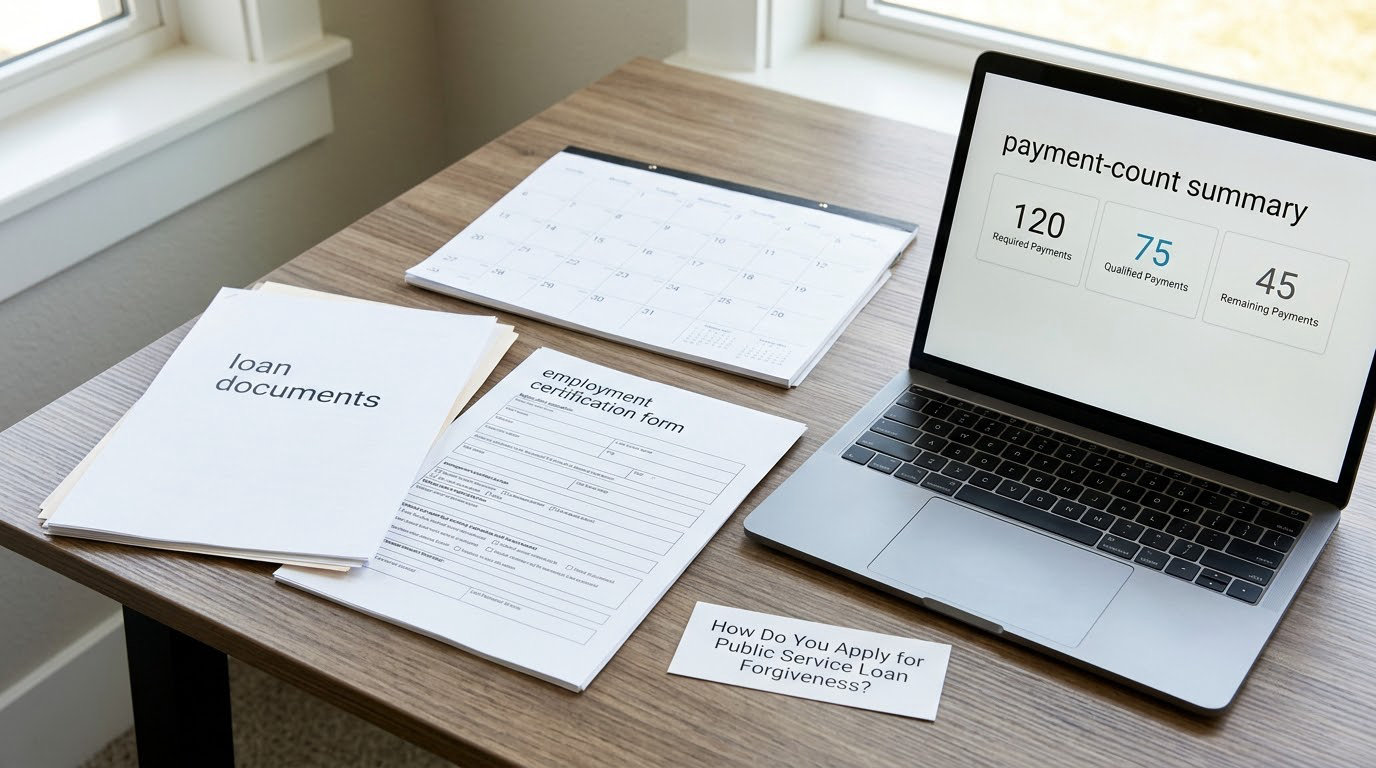
Apply through the PSLF Help Tool on StudentAid.gov, and certify your employment every single year rather than waiting until month 120. Most of the failures I read about were avoidable, and they came from years of silence followed by one large application.
The application checklist, step by step
- Confirm your loans are Direct Loans. Check every loan with the servicer, not from memory. Consolidate FFEL or Perkins loans first if you want them in scope.
- Enroll in a qualifying repayment plan. An income-driven plan is the usual choice. Ask the servicer to confirm in writing that the plan counts toward PSLF.
- File the Employment Certification Form annually. Use the PSLF Help Tool on StudentAid.gov, search your employer’s legal name and address, have an authorized official sign it, and note the date the employer signed.
- Keep the certified counts. Save the signed form each year. If a month later gets reclassified, the form is your proof of the dates you claimed.
- Watch your payment history. Once a year, pull a payment history from the servicer and compare the qualifying payments against your own records.
- Apply for forgiveness when the count is done. Use the same Help Tool, submit it, and follow up in writing. Processing regularly runs months, and longer when the servicer has to reconcile an old record.
If the balance shows as forgiven but your servicer account still carries a figure, do not panic and do not make new payments on the forgiven loans without asking. Save the forgiveness letter, contact the servicer in writing, and start the escalation below. Borrowers describe both cases often, and they resolve once there is a dated paper trail.
What to do if your application is denied or your counts are wrong
Work up this ladder in order, and keep every submission dated.
- Servicer reconsideration. Ask for a line-by-line explanation of the denial and request a correction for any month you can document. This is where most count fixes happen.
- Consumer complaint. File with the Consumer Financial Protection Bureau, which pushes servicers to respond on a required timeline.
- Ombudsman. Ask the Federal Student Aid ombudsman group to review the case. These specialists exist for exactly this pattern of servicing error.
- Legal help. Nonprofit legal aid organizations handling student loan matters take cases with a clean paper trail, and many states have bar-certified student loan help lines.
Temporary Expanded PSLF was the narrow 2021 to 2023 window for borrowers whose payments had been steered onto the wrong plan. That window is closed. The remaining routes are a PSLF buyback under the current regulations and the ordinary appeal path above.
Ignore anyone who offers to process PSLF for a fee, asks for your account login, or promises forgiveness in exchange for an upfront payment. Use the free tools on StudentAid.gov, and never refinance a federal loan into a private one while counting toward forgiveness.
How Does PSLF Affect Your Taxes?
PSLF forgiveness is generally excluded from federal taxable income, which is the reason it is worth so much more than a loan modification. The Internal Revenue Code treats discharge of a qualified educational loan as an exclusion when the discharge comes from a government program.
A few practical notes:
- The exclusion applies to the forgiven balance, so it can be a large item. Keep the forgiveness letter and a record of the payment history.
- State rules are separate. New York, for example, has treated some of this forgiven debt as income for most filers, so a resident in that state can owe state tax on the same forgiveness.
- If you filed taxes in an earlier year and later received forgiveness for that same year, the amount is generally still excluded, but check with a preparer.
Read IRS Publication 970 and current guidance on your account type, and run the numbers with a tax professional before you file. Rules on forgiven debt have moved before and can move again.
Common PSLF Mistakes and How to Avoid Them
Five mistakes account for most of the broken counts I found in borrower threads. Each one is preventable.
- Skipping annual certification. Applying once at month 120 means every disputed month is unresolved at the worst possible time. Certify every year while the memory and the paperwork are fresh.
- Refinancing a federal loan. A private refinance can remove the loan from PSLF forever. No interest rate makes that trade worth it if forgiveness is the plan.
- Assuming any income-driven plan counts. Plan eligibility lists change. Ask the servicer to confirm the specific plan in writing, and check the Department of Education’s chart before you enroll.
- Ignoring retroactive deferment reclassification. Months can be moved into in-school deferment after the fact, which quietly removes them from your count. Pull your payment history annually and compare it against your certified forms.
- Paying someone to handle the paperwork. Debt-relief firms target PSLF-eligible borrowers precisely because the promise feels real. The federal tools are free, and a company that asks for your StudentAid.gov credentials is not helping you.
One more worth naming: assuming PSLF is the only goal. If you owe 40,000 dollars and can clear it in ten years of aggressive payments, forgiveness on a small remainder may not be the best trade. If you owe 180,000 dollars, the same math runs the other way. Model both paths with the official repayment estimator before you commit.
Frequently Asked Questions
Does public service loan forgiveness explained mean I qualify for every federal student loan?
No. Only Direct Loans under the William D. Ford program qualify, including Direct Consolidation Loans made after October 1, 2007. FFEL and Perkins loans must first be consolidated into a Direct Loan, and only the payments made after that consolidation count. Private student loans never qualify, and defaulting at any point can bar forgiveness.
Does working for a nonprofit organization automatically qualify me for PSLF?
Not automatically. The organization generally needs 501(c)(3) tax-exempt status and you need to work at least 30 hours a week while on its payroll. Contractors paid through a staffing agency, independent contractors working on a 1099, and per-diem staff without guaranteed hours are the most common disqualifiers. Churches are treated separately from the 501(c)(3) requirement.
What happens if I stop working in public service or have an employment gap?
Payments do not have to be consecutive, so a gap does not reset your count. The months you spent outside qualifying employment simply do not add to your total, and you must be working for a qualifying employer at the time you apply for forgiveness. Months in a deferment or forbearance also add nothing, because no qualifying payment was made during them.
How long does it take to apply for and receive public service loan forgiveness?
The full path runs about ten years of qualifying work and payments, plus processing time. The application itself usually sits under review for several months, and longer when a servicer has to reconcile an old payment record or correct a deferment classification. Borrowers who certify employment every year tend to have the cleanest files when they finally submit.
Is public service loan forgiveness taxable, and will forgiveness improve my credit score?
PSLF forgiveness is generally excluded from federal taxable income under the qualified educational loan discharge rules. State treatment varies, and a few states tax it for most filers, so check your state rules or ask a preparer. Paying down federal student loans builds credit gradually, but forgiveness itself removes the balance without any payment on the account.
The Bottom Line
Check three things this month: that every loan is a Direct Loan, that you are on a repayment plan listed as qualifying, and that your current employer shows up when you search it in the PSLF Help Tool. Those three answers tell you whether the next ten years count.
Then file the Employment Certification Form every year. That single habit is what separates the borrowers whose counts survive to month 120 from the ones writing forum posts about months that disappeared without warning.