
You should refinance student loans only when you have good credit, steady income, and debt you are certain you will not need for forgiveness or flexible repayment. For everyone else, the rate savings rarely survive the fees and the protections you give up. Most of the advice you will find on this topic comes from lenders who want your application, so this guide does the opposite: it works from the math outward and tells you when the answer is no.
One note before we start. We are not affiliated with any refinance lender, and nothing here is individual financial advice. Rules and rates for federal loans change, so verify anything specific to your account at the U.S. Department of Education through Federal Student Aid at studentaid.gov.
Table of Contents
- Should You Refinance Student Loans?
- What Refinancing Student Loans Changes
- How to Calculate the Refinance Break-Even Point
- What is the 2% rule for refinancing?
- When a Lower Interest Rate Is Not Enough
- Should you refinance for a lower monthly payment instead of a lower rate?
- Federal Versus Private Student Loan Refinancing
- Refinancing Federal, Private, Parent PLUS, and Consolidated Loans
- Refinancing private student loans
- Refinancing federal Direct Loans
- Refinancing Parent PLUS loans
- Loans you have already consolidated
- Refinance Costs and Requirements to Check
- When You Should Probably Avoid Refinancing
- How to Compare Student Loan Refinance Offers
- Frequently Asked Questions
- Is it better to refinance student loans for a lower monthly payment or a lower interest rate?
- Can I refinance federal student loans and keep income-driven repayment or forgiveness?
- Does refinancing student loans hurt your credit score?
- How long does it take to refinance student loans?
- Is refinancing student loans worth it if the new loan has a lower monthly payment?
- Conclusion
Should You Refinance Student Loans?
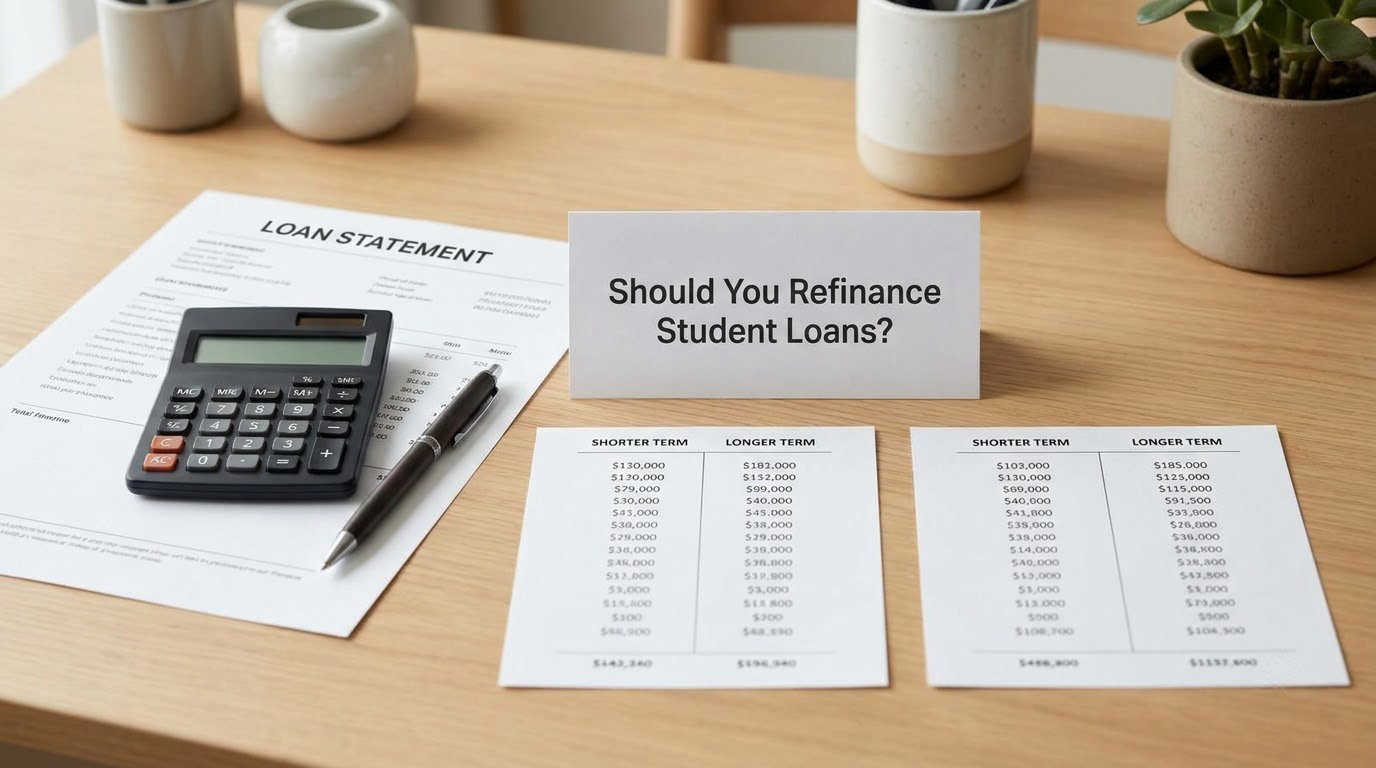
Refinancing pays off your existing loans with a brand-new loan from a private lender, ideally at a lower fixed rate with one monthly payment. It helps when the rate cut is large and you have no use for federal programs. It hurts when fees eat the savings, when the term stretches out, or when you need deferment, forbearance, or forgiveness later.
Here is the short version, with the conditions spelled out.
When you should refinance:
- Lower interest rate: You are cutting your rate by a meaningful margin, not a fraction of a percent.
- Private loans only: You hold private student loans and there is no forgiveness attached to them anyway.
- Simplified payments: Several small private balances become one payment with a clearer rate.
- Remove a co-signer: You have the credit and income now to release a parent from the obligation.
When you should not refinance:
- Federal protections: You need income-driven repayment, Public Service Loan Forgiveness, deferment, or forbearance.
- Unstable income: Contractors, gig workers, and early-career teachers have trouble qualifying at all.
- Small balance: You would take a hard credit hit and new fees to move a few thousand dollars.
What Refinancing Student Loans Changes
A refinance is not a rate adjustment on your existing loan. It is a brand-new loan, and five things change at once.
A new lender and servicer. Your payments move to a different bank, often with a different portal, phone number, and set of hardship options. Any progress you made with your current servicer does not travel with you.
A new rate structure. Most refinance lenders offer a fixed rate, some offer fixed for a period then variable. You lose the fixed federal rate you already had, which is a real cost nobody puts in the marketing copy.
A new term. Common options run from five to twenty years. Shorter means bigger payments and less interest. Longer means smaller payments and often more total interest.
A new payment schedule. Amortization restarts. If you were three years into a ten-year plan, that progress is generally not credited unless you have private loans the lender chooses to credit.
Potentially a new loan type. Federal loans refinanced into a private loan become private. That conversion cannot be undone, and it is the reason the rest of this guide exists.
Consolidation is a different thing and the two get confused constantly. A Direct Consolidation Loan stays federal, keeps your federal protections, and does not lower your interest rate at all. It simply moves you to a longer standard term. Refinancing changes the rate and often the type. If your problem is a payment that is too high right now, consolidation or an income-driven plan may solve it without giving anything up.
How to Calculate the Refinance Break-Even Point
Break-even is the moment your cumulative savings cover every cost of doing the refinance. If that moment lands after you would have paid the loans off anyway, the refinance lost.
Start with the all-in cost of the new loan. That is the origination fee, any underwriting or application fee, and any prepayment penalty the new loan carries. Then compare total repayment figures, not monthly payments.
Here is a worked example. You have 40,000 in student debt at 6.8 percent, left on a ten-year term.
At 6.8 percent over ten years, that payment is about 460 a month, roughly 55,200 in total, with about 15,200 in interest. A private lender offers 4.75 percent over the same ten years: about 419 a month, roughly 50,300 total, with about 10,300 in interest. Interest saved is close to 4,900, and if the refinance carries a 2 percent origination fee, that fee is about 800 on 40,000. Net saving is roughly 4,100, and you reach break-even in well under a year.
Now the same 4.75 percent rate stretched over twenty years. The payment drops to about 258 a month, which feels wonderful, and the total repayment climbs to about 62,000. That is more interest than the original 6.8 percent loan cost. The lower rate, over a longer term, is a net loss. This is the trap that shows up constantly in borrower forums, where people complain that refinancing made the payment easier and the balance worse.
Write the math down in three lines: total interest under the current terms, total interest under the new terms, and total fees. Savings is the second number subtracted from the first, minus the third. If that figure is zero or negative, stop.
What is the 2% rule for refinancing?
The 2 percent rule is a rule of thumb, not law and not official guidance. It says refinance only when the new fixed rate is at least two percentage points below your current rate. The logic: two points of rate reduction is usually enough to absorb fees and still produce real savings over several years. Below two points, the margin for error is thin, especially with origination fees. Above two points, the savings tend to be decisive. Plenty of borrowers who refinanced federal loans from around 6.7 percent down to about 4.5 percent describe it as the best financial move they made, and that gap clears the rule comfortably.
When a Lower Interest Rate Is Not Enough
Rates matter, but they are one input among several. Sometimes the payment, the term, your cash flow, and your goals decide the answer before the rate does.
Monthly payment. A 200 lower payment sounds good until you check whether the lender achieved it by extending the term to twenty years. Compare total repayment, always.
Term length. Every extra year at a given rate adds interest. If you can afford the shorter term, take it.
Cash flow. Private lenders underwrite on income and debt-to-income ratio, not on emergencies. If your budget needs slack for a rough quarter, a lower payment has real value even when it costs more in interest.
Your goals. If you plan to buy a house, start a business, or switch careers into something with a slow first year, a lower payment buys optionality. Priced honestly, that optionality can be worth the extra interest.
Consider a borrower with 60,000 at 7 percent, ten years remaining. The payment is about 700 a month. A refinance at 4.5 percent over ten years gives about 619 a month and saves roughly 4,700 in interest. But that same 4.5 percent over fifteen years gives about 497 a month and total interest of roughly 27,000, barely better than the original loan. The rate went down and the cost went up.
Should you refinance for a lower monthly payment instead of a lower rate?
Choose the lower rate if you can comfortably afford the higher payment, because that is where the savings live. Choose the lower payment only when the shorter term is genuinely unaffordable, and be honest with yourself that you are buying breathing room, not savings. A useful test: if the lower-payment version still leaves you unable to fund a 1,000 emergency without credit, the payment is not low enough either.
Federal Versus Private Student Loan Refinancing
This is the decision, and everything else is arithmetic. Federal Student Aid at studentaid.gov is blunt about it: refinancing federal loans into a private loan may lower the rate, but you give up federal benefits, and the move is irreversible.
Here is what federal Direct Loans carry that private refinance loans generally do not:
- Income-driven repayment plans tied to your income rather than your balance
- Public Service Loan Forgiveness and other forgiveness programs
- Deferment for enrolled students, active duty service, and certain health or financial hardship
- Forbearance with defined limits, plus disaster relief and pandemic-era relief options
- Death and disability discharge
- Federal oversight and complaint paths when a servicer misbehaves
The forgiveness math deserves a number. On a 200,000 Direct Loan at 6.8 percent, interest alone adds roughly 1,130 a month before any principal comes off. Under an income-driven plan where your payment is smaller than your accruing interest, the balance can grow for years. After 120 qualifying payments, whatever remains is forgiven.
Refinancing that same 200,000 to 4.75 percent over ten years costs roughly 2,096 a month and about 51,500 in interest over the life of the loan. So the comparison is not rate versus rate. It is a guaranteed erased balance after ten years of qualifying work against a fixed bill you pay in full. For a nurse or teacher with 200,000 who is already on track, refinancing can cost tens of thousands of dollars in forgiven interest. Public-service borrowers say this over and over in forums: they would almost never refinance into a private lender, because the federal flexibility is worth more than the rate cut.
Private loans can be refinanced repeatedly with no forgiveness consequence, which is why so much borrower advice says to refinance those and leave federal loans alone.
Refinancing Federal, Private, Parent PLUS, and Consolidated Loans
Refinancing private student loans
This is the cleanest case. No forgiveness is attached, no federal protections are lost, and most private lenders will refinance private loans for credit-qualified borrowers with no prepayment penalty. Check whether the lender credits payments you have already made against the old balance, because private refinance loans start from the payoff figure.
Refinancing federal Direct Loans
You can refinance them, but first confirm with your current servicer whether the payoff amount includes any accrued interest or a prepayment adjustment. Then run the forgiveness math honestly. If you are not enrolled in an IDR plan, are not pursuing forgiveness, have no near-term need for deferment, and can absorb a job loss without federal relief, the case can hold up.
Refinancing Parent PLUS loans
PLUS loans can be refinanced, and the rules are unusual. A parent generally cannot take the debt into their own name through a refinance, because the loan was issued to the student. The student can refinance with a qualifying co-signer, usually the parent, who signs the new private loan. Since the PLUS loan has no cap on borrowing and often a higher rate, it is the debt most worth shopping, but it is also the one where a co-signer may need solid credit to be approved at all.
Loans you have already consolidated
A Direct Consolidation Loan can be refinanced like any other federal loan, with the same trade-offs. Because consolidation already stretched you to a longer term, check the current rate on the consolidated loan first. Sometimes consolidation was the mistake and refinancing at a market rate is the repair. Keep paying the old loans until the new one pays them off, and confirm the switchover dates so no payment is missed.
Refinance Costs and Requirements to Check
Most surprises come from costs and eligibility nobody mentions in the first paragraph.
Origination fees. Often 1 to 3 percent of the balance, deducted from the amount that reaches you, which means you start slightly underwater.
Late fees during underwriting. The process takes weeks. A 30-day late in that window can push your rate into a worse tier or kill the approval.
Prepayment penalties. Rare, but they exist on some private refinance products. Federal and most private student loans carry none, which means you can refinance again later if the math changes.
Credit requirements. Around 650 is the practical floor for competitive fixed rates, and stronger scores open lower tiers. Below that, expect a variable rate, a co-signer requirement, or a decline.
Debt-to-income ratio. Lenders usually want total monthly debt payments, including the new one, under roughly 10 percent of gross income, and often prefer under 15 percent.
Income verification. W-2s, tax returns, or 1099s. Contract and gig income is harder, which is why freelancers frequently refinance only private loans or refinance with a co-signer.
Tax treatment. Whether the new loan is still classified as a qualified education loan for the interest deduction depends on the lender and the loan terms. Ask in writing before you sign.
When You Should Probably Avoid Refinancing
Some situations are clear. Skip the refinance if any of these are true.
- You qualify for or are pursuing Public Service Loan Forgiveness.
- You need an income-driven payment tied to fluctuating income.
- Your balance is small, roughly 15,000 or less, and the rate gap is narrow.
- The rate savings are under two percentage points and fees are involved.
- Your income is contract, freelance, or seasonal, and underwriting is uncertain.
- You would need a longer term to make the payment work, which flips the math negative.
- You are within a year of finishing a deferment period or resuming full payments.
- You are switching careers and want hardship options in reserve.
Two more deserve naming. If you are already on a small remaining balance, the hard inquiry and new account can cost more in the near term than the interest you save. And if a big chunk of your debt is forgiven under an existing arrangement, refinancing that balance destroys the arrangement for a few thousand dollars of interest. Check the forgiveness terms before you check the rate.
How to Compare Student Loan Refinance Offers
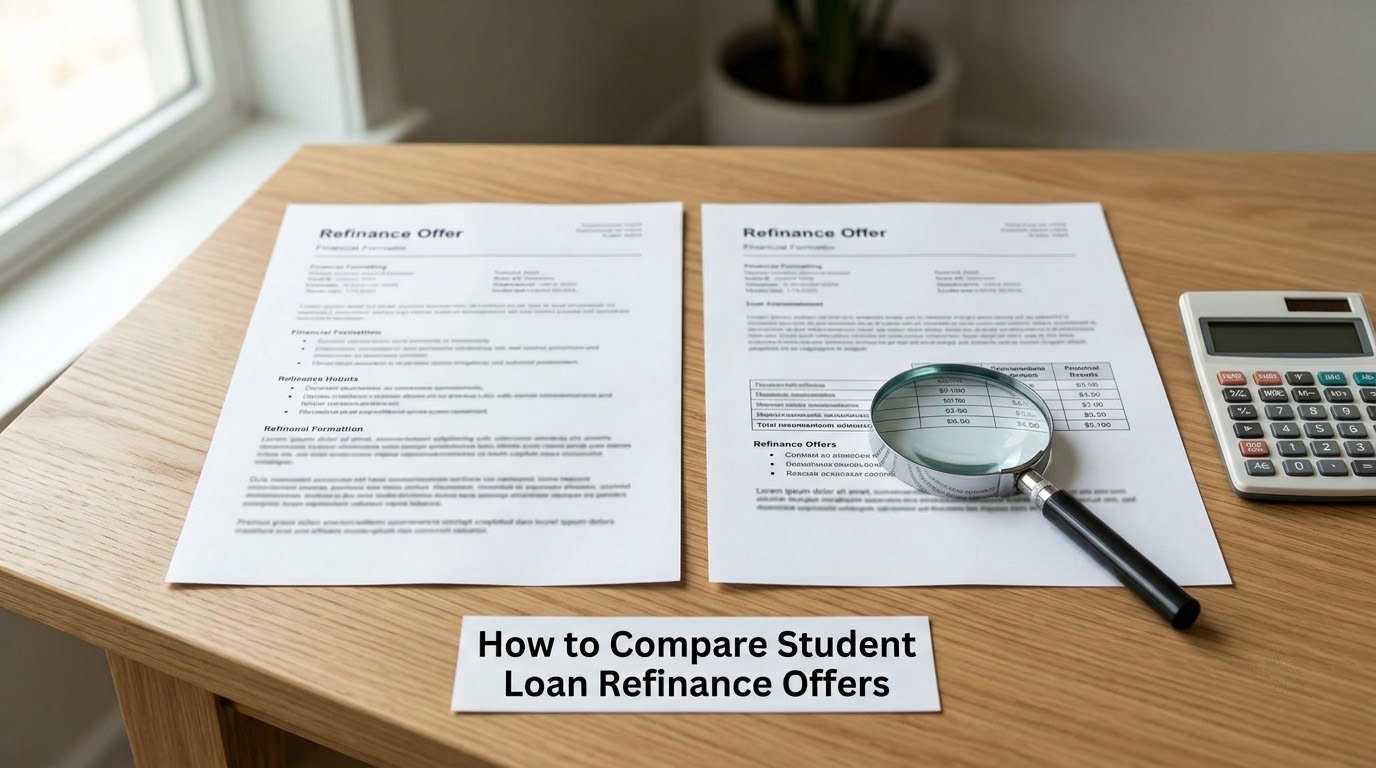
Get quotes the same week, in writing, and compare these fields on every one.
Fixed rate and APR. APR includes fees, so it is the honest comparison. A 4.5 percent rate with a 2 percent fee is not a 4.5 percent loan.
Monthly payment and total repayment. Ask for the total repayment figure in dollars. A lender showing only the payment is steering you.
Term length. Compare at the same term first, then decide whether the longer term is worth its extra interest.
Credit pull type. Prequalification uses a soft pull and many lenders advertise no hard pull to check rates. The hard inquiry happens at formal application. Submit several applications within a 14-day window so the inquiries count as one for scoring purposes, since most scoring models treat that window as a single event.
Prepayment and cosigner terms. Confirm no prepayment penalty and note whether you can release a co-signer later.
Federal treatment. Confirm the payoff process, how accrued interest is handled, and the exact date old payments stop and new ones start. That date is where people get hurt.
Run the rate-shopping window deliberately. Check rates, compare APRs and terms, and only then apply to one lender.
Frequently Asked Questions
Is it better to refinance student loans for a lower monthly payment or a lower interest rate?
A lower rate is better whenever you can afford the payment it requires, because that is where the savings come from. A lower payment usually means a longer term, which can raise total interest even when the rate falls. Compare total repayment figures, not monthly bills, and treat a lower payment as purchased flexibility rather than savings.
Can I refinance federal student loans and keep income-driven repayment or forgiveness?
No. Refinancing a federal loan into a private loan permanently ends eligibility for income-driven repayment plans and Public Service Loan Forgiveness, along with federal deferment and forbearance. Federal Student Aid at studentaid.gov treats this as a one-way move. If you need any of those programs, keep the federal loans and address the payment problem another way.
Does refinancing student loans hurt your credit score?
Briefly, and usually not much. The hard inquiry and the new account lower your score a few points in the short term, then the lower balance and on-time history push it back up. Doing several prequalifications within about 14 days usually counts as one inquiry for scoring. The bigger risk is a missed payment during underwriting or the switchover period.
How long does it take to refinance student loans?
Most private refinances run from about three weeks to two months from application to funded loan, with payout sometimes taking a few extra days. Keep making payments on your old loans every month until the new lender confirms they are paid off, and leave a small buffer in case payoff figures shift with accrued interest.
Is refinancing student loans worth it if the new loan has a lower monthly payment?
Only if you are clear that you are buying flexibility, not savings. A lower payment achieved through a longer term often costs more total interest than your current loan. Run the break-even math on total interest minus fees before you sign, and ask what the same rate looks like over your current remaining term.
Conclusion
Should you refinance student loans? Only if three things are true at once: the rate gap is wide enough to clear your fees, the total repayment figure beats what you owe today, and nothing about your future needs federal protections. If any one of those fails, the answer is no, and consolidation, an income-driven plan, or simply paying the old loan down hard is the better move.
Start with the arithmetic. Write down your current total interest, your quote’s total interest, and every fee, then find the break-even date. After that, confirm what federal loans would give up. If the numbers favor you and the protections do not matter, shop rates inside a two-week window and pick on APR, term, and prepayment terms alone.