Knowing how to negotiate a salary offer comes down to five moves: thank the employer, get the full package in writing, research the market range for your role, decide the one or two things you actually want to move, and send one short email naming a specific number. Most candidates never do step four, which is why most candidates end up at the bottom of the band.
The whole process usually takes a few hours of preparation and two email exchanges spread over a week or so. It is uncomfortable the first time, then it becomes a routine you repeat at every offer for the rest of your career.
A note before we start: pay rules, ranges and what counts as negotiable change with the employer, the state and the industry, so treat any numbers below as realistic US ranges rather than promises. Nothing here is individual financial advice, and nobody should spend money on a negotiation coach before they have tried the process themselves at least once.
Table of Contents
- What You Need
- Step-by-Step
- 1. Confirm What You Are Negotiating
- 2. Research the Market Range
- 3. Decide Your Priority
- 4. Write a Concise Counteroffer Script
- 5. Present the Request and Pause
- 6. Evaluate the Revised Offer
- 7. Accept, Decline, or Keep Negotiating
- Common Mistakes
- Frequently Asked Questions
- How do you politely ask to negotiate salary?
- What is the number one rule of salary negotiation?
- How much can you realistically negotiate on a first job offer?
- When is the best time to negotiate salary?
- Can an employer rescind an offer after I negotiate?
- What if the recruiter says the offer is final?
- Conclusion
What You Need

You can negotiate from a short written offer, but you cannot negotiate from a verbal one. Ask for the whole package on paper: base salary, bonus target, equity grant with number of shares and vesting schedule, benefits, start date, and who approves compensation changes.
Then line up the rest. Pull the advertised range for the posting if there was one, or ask the recruiter for the band, since employers in many states and cities are now required to share it on request. Get two or three market sources for the same title, location and level, not just the one that flatters you best.
Before you respond, write down three numbers: the offer you will not go below, the number you will actually ask for, and the highest figure you would be happy to sign. Most people skip this and then discover mid-conversation that they have no idea whether a revised offer is good.
Finally, rank your priorities. Base salary is not always the lever with the most room, and for some candidates the thing that matters most is the title, the remote days or the start date. Decide which two matter and let the rest go.
Step-by-Step
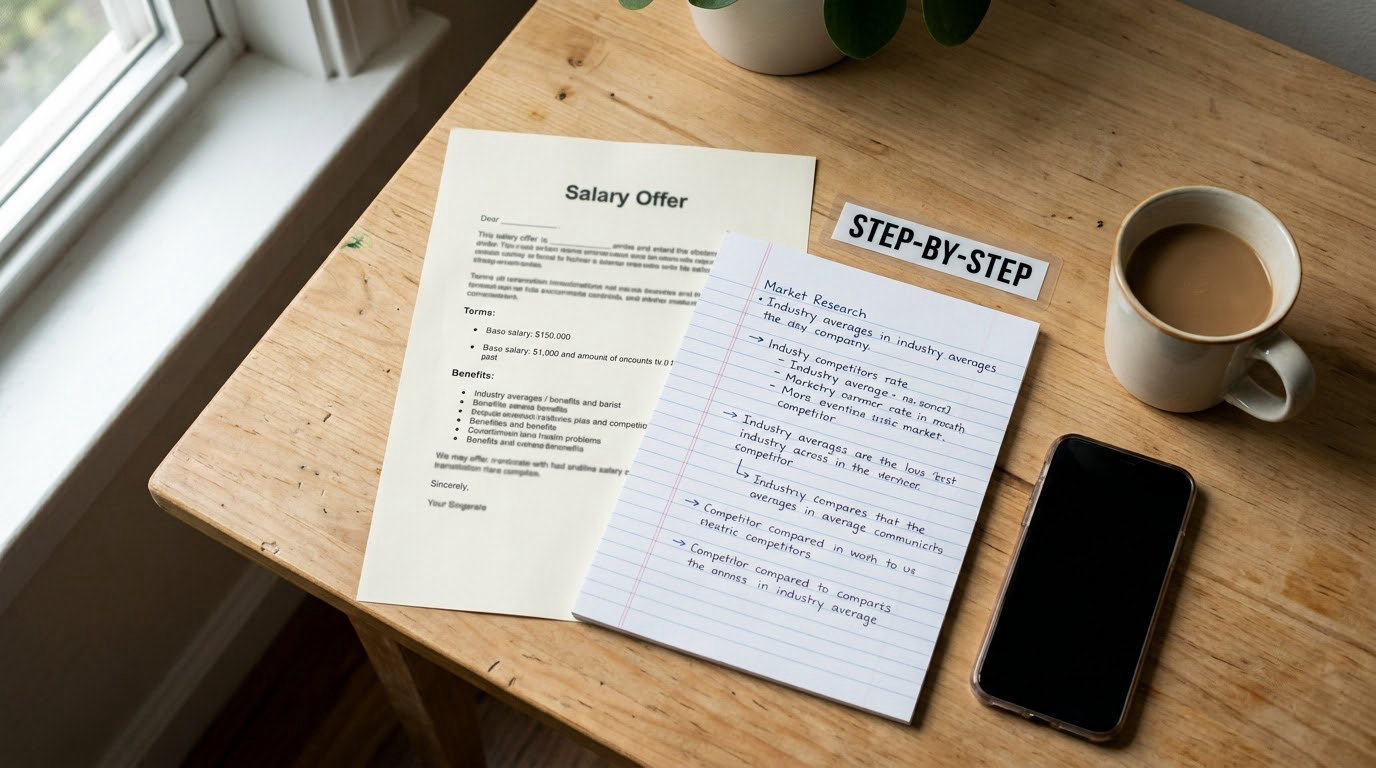
1. Confirm What You Are Negotiating
Read the offer letter line by line and separate base salary from everything else. A package of a base number, a percentage bonus, and a large equity grant looks impressive and can pay less in year one than a smaller number with a real bonus and cash.
Note what is fixed and what is flexible. Bonus targets are often set by policy and rarely move. Equity is usually approved by a compensation committee on a fixed schedule. Sign-on bonuses and start dates sit with the hiring manager, which means they move much more easily.
Your read is wrong if the letter promises things in vague language. Ask for clarification in writing before you negotiate about anything.
2. Research the Market Range
Build a range, not a single figure. Compare the same title at the same level in the same metro area, and adjust for the industry and the size of the company, because pay scales differ sharply between a 200-person firm and a large one.
Levels.fyi is strongest for tech and equity-heavy roles, Glassdoor and Payscale are broader, Salary.com is useful for a general band, and the Bureau of Labor Statistics gives you occupation-level medians for validating the bottom of your range. Two credible sources agreeing matters more than six that disagree.
Then pick your ask. Aiming 10 to 20 percent above the midpoint of your researched range is a normal first counter when the offer landed near the bottom of the band. Aiming at the very top is possible and gets you less often, but it costs nothing to try once.
3. Decide Your Priority
Sorting your priorities stops you from negotiating six things poorly and getting none of them. Base pay sets the floor that every future raise builds on, so it carries long-term weight, but the percentage movement available on it is usually the smallest of any lever.
Sign-on and relocation money typically have the most room, often 50 to 100 percent or more, because they come from a separate budget and don’t affect anyone’s salary band. Equity can move 15 to 50 percent, but only in a company that grants it. PTO, remote days, a title upgrade and a later start date are cheap for the employer and real for you.
Ask for two things well instead of six things vaguely.
4. Write a Concise Counteroffer Script
Keep the email under 150 words. Thank them, say you’re enthusiastic, give one market-based reason, name a specific figure, and invite a conversation.
Hi Dana, thank you for the offer, I’m genuinely excited about the role and the team. Based on market data for this position in the Boston area, I’m hoping we can start at USD 128,000 in base rather than USD 118,000. If there’s room on the equity grant or the sign-on bonus as well, I’d appreciate you taking a look. I’m available to talk anytime this week.
A second version works when you have a competing offer, and you should only use it if one genuinely exists:
Thank you for the offer. I have another offer on the table at USD 132,000 base, and I would rather stay here if we can close the gap. Would USD 128,000 be possible?
That last sentence is the honest test of whether the first offer was real.
5. Present the Request and Pause
Send the email, then stop typing. Recruiters often reply within a day with a softer version of the same number, and the temptation is to negotiate against yourself immediately. Wait for the response, take a day if you can, and reply once.
When you do talk, stay calm and brief. You do not need to justify your life, and you should expect one round of pushback before a real movement.
6. Evaluate the Revised Offer
Compare the new terms against your three numbers and your priorities, not against the old offer. Ask what the bonus target requires, whether the equity vests on a standard four-year schedule, and whether the sign-on bonus is paid in the first year or spread out.
If the employer says the offer is best and final, decide once whether you are at your walk-away number. If you are, accept. If you are not, make one last small ask, such as a later start date or extra PTO, then decide.
7. Accept, Decline, or Keep Negotiating
Accept by email, thank them by name, and confirm the start date. Decline in two short paragraphs if the number is too low, and keep the door open, because a company with an approved headcount open sometimes comes back.
Do not counter your current employer to stay. Counters from current managers tend to arrive with more responsibility, a short leash and an implicit message about loyalty, and they rarely fix a role you already wanted to leave.
Common Mistakes
These are the errors that cost candidates the most money, usually without any warning from the employer.
- Replying instantly. Speed signals that you have nowhere else to go. A day or two is normal and expected.
- Explaining your personal finances. Bills, student loans and a partner’s income give a recruiter nothing to work with internally. Market data and your value do.
- Saying “something better” or “competitive.” Vague asks get vague answers. Always attach a number.
- Bluffing a competing offer. It is the most common tactic online and the easiest one to catch. Recruiters ask for the other company, the recruiter’s name and the timeline.
- Comparing total compensation to a cash offer. Read the vesting schedule before you value an RSU-heavy package.
- Negotiating everything at once. A long list of asks reads as a demand. Two priorities, one email.
- Accepting a verbal revision. If the change is not in writing, it is not done.
Two habits fix most of these: research before you reply, and send one email rather than five messages. Bands, equity rules and pay-transparency requirements differ by employer and change over time, so check what applies to your specific offer.
Frequently Asked Questions
How do you politely ask to negotiate salary?
You thank the employer, say you are excited about the role, give one short market-based reason, and name a specific figure. Politeness comes from the format, not from hedging. Try: “Thank you for the offer, I’m excited about the role. Based on market data for this position locally, is there room to start at USD 125,000 rather than USD 115,000?” One email, one ask, no apologizing.
What is the number one rule of salary negotiation?
Anchor your number to market data and your own value, never to personal need. Recruiters can justify a market adjustment to a hiring manager and a compensation committee; they cannot justify your rent. Know your walk-away number, your target and your ceiling before the conversation starts, because a number you invent on the spot is the one you will regret.
How much can you realistically negotiate on a first job offer?
Base salary usually moves 5 to 15 percent, sign-on bonuses can double, and equity grants sometimes flex 15 to 50 percent depending on the company’s policy. If the offer landed at the bottom of the advertised range, asking for the midpoint is reasonable. First-time candidates without competing offers often do better by negotiating a sign-on bonus or start date than by swinging hard on base.
When is the best time to negotiate salary?
Ask for the pay band during the recruiter screen, then make the formal counter after the written offer arrives, not during the verbal call. Never negotiate against a live conversation where the recruiter feels pressured. After you send the counter, give them two to three business days before following up, and expect one round of pushback before anything moves.
Can an employer rescind an offer after I negotiate?
Rescission is unusual and most companies avoid it because they have already spent recruiting money and filled a pipeline. What does happen is an offer quietly drifting toward finality, or a slower start date. Negotiating in writing with market reasoning keeps you on solid ground, since a documented, professional counter is far harder to act against than a phone conversation.
What if the recruiter says the offer is final?
Accept the answer if you are at your walk-away number, and ask once for something small such as extra PTO or a later start date. If you are still meaningfully short, say so plainly and ask what would need to change, such as a re-evaluation at six months or a higher equity grant. Then decide, and do not spend another week on an offer that has already closed.
Conclusion
Negotiating an offer is preparation, one email, one follow-up and a decision. Research the market range tonight, write down your three numbers and your two priorities, then send a single thank-you with a specific counter attached.
That is genuinely all of it. Most people who ask get something, and the ones who usually do not are the ones who never asked.