
Knowing how savings account interest is calculated takes one formula: take your balance, multiply it by the account’s annual interest rate, divide by the number of days (or compounding periods) in the year, and credit the result to your account. Most banks accrue that amount every single day and pay the accumulated total out once a month or once a quarter, so the number on your statement is the sum of hundreds of tiny daily calculations.
The advertised annual percentage yield, or APY, is the honest way to compare accounts because it already folds in how often the interest gets added back into the balance. Below is the arithmetic behind that number, plus worked examples you can run with a pocket calculator.
Table of Contents
- What Is Savings Account Interest?
- How Savings Account Interest Is Calculated
- What Is APY, and Why Does It Matter?
- How Daily, Weekly, and Monthly Compounding Work
- How savings account interest is calculated day by day
- How Interest Is Calculated on Tiered or Minimum-Balance Accounts
- Worked Example: Calculating Interest on a 10,000 Dollar Balance
- What Changes Your Interest Earnings?
- Frequently Asked Questions
- Is savings account interest calculated on the balance at the end of the month or every day?
- What is the difference between an account’s interest rate and its APY?
- Do savings account interest payments get taxed in the US?
- Does a savings account compound interest automatically?
- Why did my interest payment change even though my deposit stayed the same?
- Is a high APY always better for a savings account?
- Conclusion
What Is Savings Account Interest?
Interest is the amount a bank pays you for letting it hold your deposit. The bank takes what you earn on the loan side of its balance sheet and pays you a smaller share of it, keeping the difference as its margin. You get a return, the bank gets funding, and the exchange happens under terms spelled out in your account agreement.
That return is different from a few other things people lump in with it:
- Dividends come from a company’s profits and can rise or fall every quarter. Savings interest is set by contract and changes only when the bank changes it.
- Fees go the other direction. A monthly maintenance charge is a cost to you, and it can be larger than the interest your balance earned.
- Investment returns from stocks or funds can be negative in a bad year. Savings interest is contractually positive, and the deposits are generally insured up to statutory limits per depositor, per insured bank, per ownership category.
One more distinction worth stating early: savings interest is taxable income in the US, not tax-free money. It shows up on Form 1099-INT and is reported as ordinary income on your return.
How Savings Account Interest Is Calculated
The mechanics of how savings account interest is calculated are small enough to write on an envelope. The bank takes the balance, applies the annual rate divided by the number of periods in a year, and multiplies by the number of periods elapsed.
Daily interest on a balance = balance × (annual interest rate ÷ number of days in the year)
Every piece of that formula earns its place:
- Principal — the money sitting in the account. It changes daily as you deposit and withdraw.
- Annual interest rate — the bank’s stated rate, expressed as a decimal (4% is 0.04).
- Compounding periods — how many times a year the accrued interest gets added to the balance and starts earning interest itself. Daily is 365, monthly is 12, quarterly is 4, annually is 1.
- Time — how long the money stays put.
When interest is compounded, the full formula is the one most calculators use: A = P(1 + r/n)^(n×t), where A is the final balance, P is the principal, r is the annual rate as a decimal, n is the number of compounding periods per year, and t is the number of years.
Simple interest, by contrast, only pays on the original principal. It is the interest formula P × r × t, and it is what a savings account pays only during its very first stretch before the first compounding happens.
| Balance of 10,000 dollars at 4% over 5 years | Simple interest | Compound interest, monthly | Difference |
|---|---|---|---|
| Total interest earned | 2,000.00 dollars | 2,166.53 dollars | 166.53 dollars |
| Ending balance | 12,000.00 dollars | 12,166.53 dollars | 166.53 dollars |
The gap looks modest over five years at one rate, and that is the honest part of it. Compounding earns far more over decades or across repeated deposits than it does inside a single five-year window.
What Is APY, and Why Does It Matter?
The APY is the effective one-year return after compounding, and it is the only number you need when comparing two accounts. The interest rate is the base rate before compounding; the APY is what your money actually becomes in a year.
The conversion runs like this: APY = (1 + r/n)^n − 1, where r is the nominal annual rate and n is the number of compounding periods.
Work it through with a 4.00% rate compounded monthly and n equals 12. The APY comes out at 4.07%, which tells you the account earns slightly more per year than 4.00% suggests. A bank can legally advertise both numbers on the same page as long as the base rate is stated too, and most disclosure sheets show them together.
This is exactly the confusion people hit on savings forums. A poster on r/PersonalFinanceCanada described a promotional rate and a standard rate appearing side by side and no way to tell which one applied to their balance. Answering that correctly starts with finding the rate your account is actually paying, not the headline number on the bank’s marketing page.
When you compare accounts, line up three things: the APY, whether the rate is variable or fixed, and what the minimum balance requirement does to your effective rate.
How Daily, Weekly, and Monthly Compounding Work
Compounding frequency decides how many times a year interest lands back in the balance. More frequent compounding means your money earns a little more, and the difference grows the longer you leave it alone.
Here is the same 4.00% rate on a 10,000 dollar balance, calculated four ways.
| Compounding frequency | Periods per year | Effective APY | Interest in one year |
|---|---|---|---|
| Annually | 1 | 4.0000% | 400.00 dollars |
| Quarterly | 4 | 4.0401% | 406.04 dollars |
| Monthly | 12 | 4.0741% | 407.41 dollars |
| Weekly | 52 | 4.0794% | 407.94 dollars |
| Daily | 365 | 4.0808% | 408.08 dollars |
Switching from annual to daily compounding at this rate adds 8.08 dollars a year on 10,000. Notice the returns flatten as frequency climbs, which is why daily compounding sounds much better than it is in practice.
How savings account interest is calculated day by day
Here is the mechanism most US banks use. Interest accrues daily on your closing balance, at one 365th of the annual rate, and the accumulated amount posts to your account at the end of the statement period. An expert on the MoneySavingExpert forum described it in exactly those terms, adding that money generally has to be in the account overnight to earn that day’s accrual.
That overnight detail matters because of cut-off times. If a transfer lands after the bank’s daily cut-off, you start accruing from the following day. One MoneySavingExpert warning worth remembering: some accounts quietly drop you into a much lower rate if you pull money out, so the interest you forfeit can be larger than the interest you earn.
A common version of this puzzle comes up on r/personalfinance: someone deposited money near the start of the month and still received less interest than the prior month. The deposit timing was not the problem. The balance on day one is what accrues for day one, and the number of days in each month changes, so two months at 4% with identical starting balances do not produce identical payments.
Average daily balance is the other method you will see, and it answers the same question differently. Instead of using one day’s balance, the bank totals your balance at the end of every day in the period, divides by the number of days, and applies the rate to that average. It gives roughly the same result as daily compounding on a steady balance, and a lower one on a balance that climbed through the month.
How Interest Is Calculated on Tiered or Minimum-Balance Accounts
Tiered accounts pay a different rate depending on where your balance sits, and the break points are where the math gets interesting. Some banks apply the top tier rate to your entire balance once you cross the threshold. Others apply the higher rate only to the portion above the threshold. Same balance, same headline rate, noticeably different interest.
Under the second approach, an account paying 0.50% below 10,000 dollars and 3.00% at 10,000 dollars and above would pay roughly 150.00 dollars of interest on a 12,000 dollar balance, and only 120.00 dollars if the balance were 9,900 dollars, because no dollars qualify for the top tier. Read your agreement for the word “portion” or “incremental” — that word tells you which version you have.
Minimum-balance accounts add a fee on top. A monthly maintenance charge of 10 dollars on a 3,000 dollar balance at 4% means your annual interest of about 120.00 dollars is erased by fees before you get anywhere. Below the minimum, some accounts waive the interest entirely rather than just the fee, which is why a small balance can produce nothing at all.
One r/PersonalFinanceCanada user described a promotional rate of 5% paired with a balance of 9.02 dollars and a single cent of interest in a month. The rate was real and so was the balance, but the dollar amounts involved are so small that a cent is simply what a fraction of a penny per day rounds up to.
Promotional and variable rates stack in ways that are hard to predict. An r/AusFinance user had a standard variable rate of 2.60% plus a bonus variable rate of 2.40%, and could not work out whether the payout matched either number. Both apply, the bonus usually expires on a schedule, and the standard rate can move whenever the bank changes it.
Worked Example: Calculating Interest on a 10,000 Dollar Balance
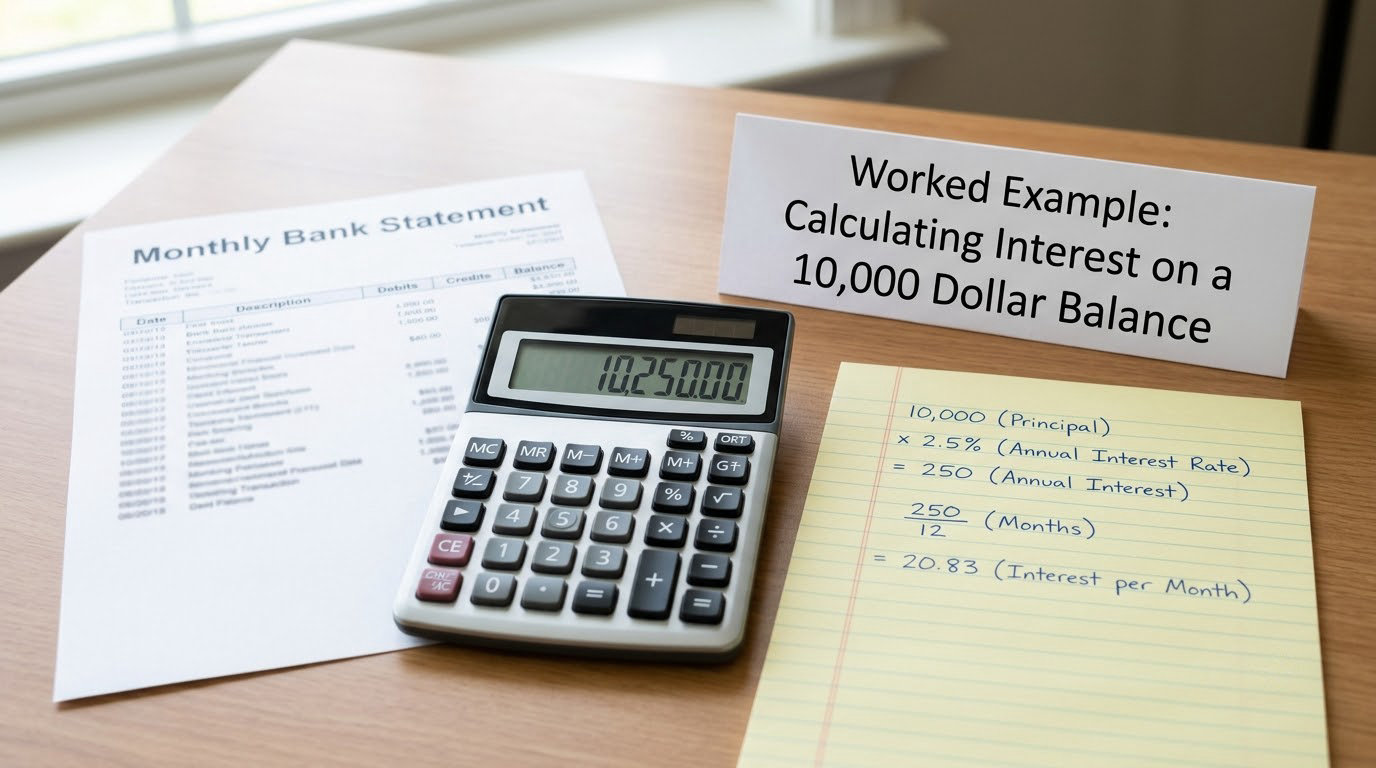
Let’s run the whole thing end to end on a 10,000 dollar balance earning 4% APY, credited monthly.
Step 1 — Find the daily rate. Take 4% and divide by 365: 0.04 ÷ 365 equals 0.0001096 per day. Applied to 10,000 dollars, that is 1.0959 dollars of interest for one day.
Step 2 — Multiply by the days in the month. A 31-day month gives 1.0959 × 31, or 33.97 dollars. A 30-day month gives 32.88 dollars. A 28-day February gives 30.68 dollars. Same balance, same rate, three different payments.
Step 3 — Add it up for a full year. 365 days × 1.0959 dollars gives 400.00 dollars before any compounding is credited back into the balance. With monthly compounding, the account ends the year at 10,407.41 dollars instead.
Step 4 — Adjust for tax. At a 22% marginal federal bracket, 400.00 dollars of interest leaves about 312.00 dollars after tax. That is the number to plan against, not the pre-tax figure.
Now scale it. The table below shows what 10,000 dollars earns at several yields over one, five, and ten years, with interest compounded monthly.
| APY | Interest in 1 year | Interest in 5 years | Interest in 10 years |
|---|---|---|---|
| 1% | 100.00 dollars | 510.10 dollars | 1,046.22 dollars |
| 2% | 200.00 dollars | 1,040.81 dollars | 2,189.94 dollars |
| 4% | 400.00 dollars | 2,166.53 dollars | 4,802.44 dollars |
| 5% | 500.00 dollars | 2,762.82 dollars | 6,288.95 dollars |
The same exercise at 100,000 dollars is where the gap between accounts gets uncomfortable.
| APY | Interest in 1 year | Interest in 5 years | Interest in 10 years |
|---|---|---|---|
| 3% | 3,000.00 dollars | 15,927.42 dollars | 34,391.63 dollars |
| 4% | 4,000.00 dollars | 21,665.29 dollars | 48,024.43 dollars |
| 4.5% | 4,500.00 dollars | 24,618.21 dollars | 55,296.94 dollars |
| 5% | 5,000.00 dollars | 27,628.22 dollars | 62,889.46 dollars |
Half a percentage point is 500.00 dollars a year at 100,000 dollars, and 5,272.73 dollars over ten years without touching the balance. Rates change over time, so treat any of these as a snapshot rather than a promise.
What Changes Your Interest Earnings?
Six things move the number, and most of them are not about the rate at all.
- Your average balance — interest accrues on money actually present, day by day. A large deposit made on the 28th earns two days of interest.
- Daily balance changes — on daily-accrual accounts the closing balance each day is what counts, so a withdrawal reduces that day’s interest permanently.
- The number of days in the period — 28, 30, and 31-day months hand you different interest payments on an unchanged balance.
- Rate changes — variable accounts reprice when the bank adjusts its rate, which in practice tracks the wider rate environment. The APY disclosed in your agreement is the one that applies today, and it can be different from the one you saw last month.
- Fees — maintenance charges and overdrafts are deducted after interest is calculated, and a below-minimum balance can zero the payout.
- Compounding frequency — daily, weekly, and monthly differ, though less than most advertising suggests.
If your monthly interest payment moves around even though your deposits did not, one of these caused it. The usual suspects, in order of frequency: a promotional rate that expired or stepped down, a tier break point you crossed in either direction, a month with a different number of days, a fee deduction, or a rate adjustment by the bank.
To verify any of it yourself, divide your interest payment by your average daily balance and multiply by 365. The result should land close to the stated rate. If it lands far away, check the fee line first, then the tier rule, then the promotional terms. Where rules vary by bank, product, and state, your account agreement is the document that settles it.
One more practical point about shopping. A rate near 7% APY sits well above what most national banks pay, and any offer that high is usually promotional, capped at a balance, or paired with conditions. Check the rate that applies after the promo ends, since that is the one you will still be living with in a few months.
Frequently Asked Questions
Is savings account interest calculated on the balance at the end of the month or every day?
Both, in sequence. Most US banks accrue interest every day on your closing balance at one 365th of the annual rate, add up the daily amounts, and credit the total at the end of the statement period. So the end-of-month payment is the sum of daily accruals, not a calculation run once on the closing balance. Money usually needs to be present before the bank’s daily cut-off to earn that day.
What is the difference between an account’s interest rate and its APY?
The interest rate is the base rate before compounding, stated as a percentage. The APY, or annual percentage yield, is the effective one-year return after compounding is applied. On a 4.00% rate compounded monthly, the APY is 4.07%. When comparing accounts, use the APY, because it is the figure that reflects what your balance actually becomes over twelve months.
Do savings account interest payments get taxed in the US?
Yes. Interest from a personal savings account is taxable ordinary income at your marginal federal rate, and the bank reports it on Form 1099-INT once you cross the reporting threshold. It is not taxed as capital gains. The interest is added to your account fully, and the tax comes due when you file your return, so set aside a portion of each payment if you expect to owe.
Does a savings account compound interest automatically?
Yes, on most accounts. Once the accrued interest is credited at the end of the statement period, it becomes part of your balance and starts earning interest on the next accrual cycle. No action is required from you. The exception is an account that pays simple interest, which calculates on the original principal only. Check your disclosure sheet to confirm which one you have.
Why did my interest payment change even though my deposit stayed the same?
Several things can shift it. Months have 28, 30, or 31 days, and a balance that changed during the period changes the accrual every day. Promotional rates expire or step down, tiered rates reset when you cross a balance threshold, maintenance fees are deducted after interest is calculated, and variable rates get adjusted by the bank. A quarter with more days in it genuinely pays a little more.
Is a high APY always better for a savings account?
Not always. A very high APY is often promotional, capped at a balance, or conditional on keeping the account open for a set period. The number that matters is the rate after the promotion ends, minus any maintenance fees and minimum-balance requirements. Two accounts with similar APYs can produce very different results once you account for fees, so compare on what you keep, not what the headline advertises.
Conclusion
How savings account interest is calculated comes down to one line: balance × daily rate × days, with each credited payment joining the balance and starting to earn interest of its own. The rest is knowing which rate applies to your dollars and what the bank takes back in fees.
Your first move is simple. Find the APY for your account, divide your last interest payment by your average daily balance and multiply by 365, and see whether the two agree. If they do not, the fee line and the tier rule usually explain it. If they do, you already know your account is paying what it claims, and the only question left is whether a different account pays more.