
A CD ladder strategy explained in one line: you split a lump sum of cash across several certificates of deposit with staggered maturity dates, so part of your money becomes available every few months or every year instead of all at once. It is a scheduling technique, not a product — the yield comes from ordinary CDs you can open at almost any US bank or credit union.
Ladders exist because of one uncomfortable fact: CD rates move. Locking everything into a single long term means you either freeze a rate you wish you had taken years ago, or freeze one you cannot escape. Staggering maturities turns one awkward decision into five small ones.
The practical version of that idea, repeated constantly on r/personalfinance and r/Bogleheads, is blunt: keep emergency money somewhere you can reach today, and only ladder money you will not need for a while.
Table of Contents
- What Is a CD Ladder Strategy?
- A CD ladder strategy explained in three steps
- How Does a CD Ladder Work?
- CD Ladder Strategy Explained: A 10,000 USD Worked Example
- What Are the Benefits of a CD Ladder?
- How to Build a CD Ladder Step by Step
- How Many CD Ladder Rungs Should You Choose?
- What Happens When a CD Matures?
- CD Ladder vs. Savings Account: Which Is Better?
- CD Ladder Risks and Common Mistakes
- Frequently Asked Questions
- Is a CD ladder worth it?
- Which is better for me, a CD ladder or a HYSA?
- How much will a 10,000 USD CD make in one year?
- How do I break a CD early?
- How safe are CDs and does the FDIC insure every rung?
- How many rungs should a CD ladder have?
- Conclusion
What Is a CD Ladder Strategy?
A CD ladder strategy explained: you divide one sum of money across several certificates of deposit, each with a different term length, so they mature on different dates. Each certificate in the group is called a rung. Rather than one five-year CD, you might hold a one-year, a two-year and a four-year CD.
A certificate of deposit is a fixed-term deposit. You hand a bank your money for a set period, the bank pays interest at the stated annual percentage yield, and the account is insured by the FDIC at a bank or the NCUA at a credit union. Withdraw before the term ends and you usually pay an early withdrawal penalty.
A CD is not an investment in the way a stock or bond fund is. There is no share price and no market risk. The return is whatever rate the bank quotes on the day you open the account, and that quote moves as the Federal Reserve changes policy and as competition between banks shifts.
A CD ladder strategy explained in three steps
- Divide the money. Split your target amount into equal or weighted portions, one per rung.
- Stagger the maturities. Give each portion a different term, commonly 3, 6, 12, 24, 36, 48 and 60 months, so something matures regularly.
- Reinvest or withdraw. Each time a rung matures, either roll it into a new CD or take the money for whatever it was saved for.
That third step is the whole point. A ladder forces a decision on a schedule instead of a panic, and that is where most of the value sits — the returns are ordinary CD returns.
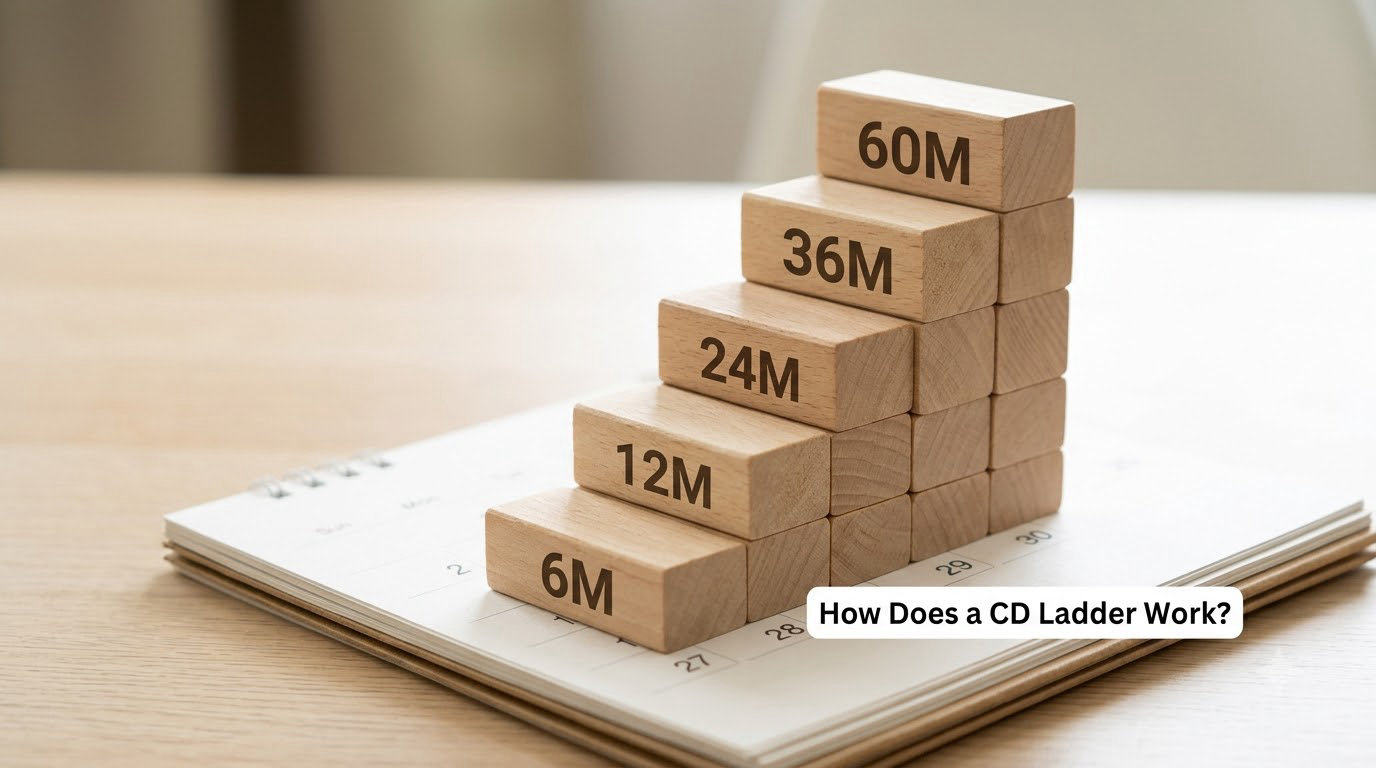
How Does a CD Ladder Work?
You open one account per rung, usually in a single afternoon. If you have 30,000 USD and want a five-rung ladder, you open five CDs of 6,000 USD each — one at 6 months, one at 12, one at 24, one at 36, one at 60.
After that, the ladder largely runs itself. Six months in, the short rung matures and your money is back in your hands, earning nothing until you place it somewhere. Twelve months in, the second rung does the same, and so on down the line.
Terms, minimum balances and rates are set by each institution and change over time. A bank may also cap how many open CDs you can hold, which matters more than most guides admit. Read the current disclosure before you deposit rather than trusting a rate quoted in an article months ago.
CD Ladder Strategy Explained: A 10,000 USD Worked Example
Split 10,000 USD into five equal rungs of 2,000 USD and give each a different term. The table below uses round illustrative yields, not live bank quotes, to show how the arithmetic works.
| Rung | Deposit | Term | Illustrative APY | Interest at maturity |
|---|---|---|---|---|
| 1 | 2,000 USD | 6 months | 4.00% | 40 USD |
| 2 | 2,000 USD | 12 months | 4.10% | 82 USD |
| 3 | 2,000 USD | 24 months | 4.00% | 160 USD |
| 4 | 2,000 USD | 36 months | 3.90% | 234 USD |
| 5 | 2,000 USD | 60 months | 3.80% | 380 USD |
| Total | 10,000 USD | — | — | 896 USD |
Over five years that illustrative schedule earns about 896 USD before tax. It is an illustration of timing, not a rate quote — yields change as the Federal Reserve moves, and your actual returns will differ. The useful part of the table is the last column: notice that you get a slice of money back every six months in year one, which is what the shorter rungs are paying you.
What Are the Benefits of a CD Ladder?
The upside is mostly about control rather than yield.
- Scheduled access. Some portion of your balance becomes available on a known date rather than all at once at some unknown future point.
- Rate diversification across the curve. Long rungs lock in more, short rungs let you move when conditions change. You hold a spread rather than a single bet.
- Fewer bad decisions. Reinvestment happens monthly or quarterly on a calendar, not in a week when markets are frightening.
- Longer terms without total lock-up. You capture the higher rates that come with 3, 4 or 5 year terms on part of the balance.
- Deposit insurance. Rungs held at insured institutions carry FDIC or NCUA coverage within its limits.
A ladder fits best when you have a dated goal two to five years out — a down payment, tuition, a car, a wedding. It fits badly when you need the money on demand, when your horizon is ten years or more, or when the whole point is to chase the highest posted rate this week.
How to Build a CD Ladder Step by Step
- Name the goal and the date. A ladder without a target date is just several accounts you will forget about.
- Set the emergency cushion aside first. Keep money you might need this month in a liquid high-yield savings account, outside the ladder entirely.
- Choose the total and the number of rungs. Divide by the goal date, then split into equal or weighted portions.
- Shop the annual percentage yield, not the headline rate. APY includes compounding; a promotional rate is not the rate you will get at renewal. Online banks and credit unions frequently pay more than a branch institution.
- Spread for insurance when it matters. FDIC coverage runs to 250,000 USD per depositor, per insured bank, per ownership category. Dividing a larger balance across two or more institutions is the simplest way to stay inside that limit — though savers who tried it describe it as tedious and easy to lose track of.
- Read the penalty and renewal terms before you deposit. Find the early withdrawal penalty length, whether maturity rolls over automatically, and what rate a renewal actually pays.
- Put every maturity on a calendar. Set a reminder about 30 days before each one, long enough to compare rates without rushing.
Bank account caps are the detail that trips people up. Some institutions limit the number of open CDs a customer can hold, which breaks a six-rung ladder overnight. Ask before you build rather than after.
This is general education about how deposit products work, not individual financial advice. Your own goals, tax position and account terms decide what is right for you.
How Many CD Ladder Rungs Should You Choose?
The right number depends entirely on how often you need access and how precisely you know your goal date. Four structures cover most savers.
| Structure | How the rungs are arranged | Best for | Trade-off |
|---|---|---|---|
| Equal-weight | Same amount in each term, often one year through five | Balanced access across a multi-year goal | Nothing is especially long-term or short-term |
| Mini ladder | All short terms, 3 to 12 months | A near-term goal or a buffer fund | Little rate protection if rates rise |
| Barbell | A short group and a long group, nothing in the middle | Hedging when you cannot guess the rate path | A gap in maturities in the middle years |
| Bullet | One large rung timed to a specific date | College tuition or a known payment in year four | A single maturity date, so a single rate decision |
A one-year goal does not need five rungs. Two or three short ones are enough, and a larger ladder mostly adds paperwork. Longer goals need fewer, bigger rungs pointing at the date the money is actually spent.
What Happens When a CD Matures?
You have four choices at each maturity, and taking none is also a choice.
- Roll into the same term and rebuild the ladder exactly as it was.
- Choose a new term, usually longer, to lock in more rate for longer.
- Move the money out to savings, a brokerage account, or the goal it was saved for.
- Redistribute across the whole ladder so the rungs stay even.
Plenty of banks do not renew automatically; plenty of others do, and drop you into a standard rate that can be far below the promotional one you had. Savers who complained about exactly this on r/HighYieldSavings all describe the same surprise: a good 5 percent rate became 0.5 percent overnight. Find out what your institution does before the date, not after.
A simple repeatable rule helps: at every maturity, compare the new rate available on your longest term against the rate you would get on a short term. If the long-term rate is clearly better and your goal date allows it, extend that rung. Otherwise keep the term short and stay flexible.
CD Ladder vs. Savings Account: Which Is Better?
Neither wins outright. They trade access against rate, and the right answer depends on how firm your dates are.
| Factor | CD ladder | High-yield savings account |
|---|---|---|
| Access to money | Locked until a maturity date, or penalised | Any time, usually with a small number of free transfers |
| Rate | Often higher for terms of a year or more | Lower, but adjustable by the bank at any time |
| Rate stability | Fixed until maturity, then a new decision | Floating; the bank can cut it |
| Insurance | FDIC or NCUA within limits | FDIC or NCUA within limits |
| Best use | Money with a known date two to five years out | Emergency funds and money you may need sooner |
The cleanest arrangement most people land on is both: liquid savings for the near term, a ladder for the part with a real date attached. Savers report the split is what finally stops the argument in their own heads about which account is better.
CD Ladder Risks and Common Mistakes
Putting money you might need into a penalised rung. Early withdrawal penalties are commonly three to six months of interest, calculated on a 60 to 180 day basis depending on the CD’s term. Keep a genuine cash buffer outside the ladder, and remember a penalty taken in a year of high income is taxed as ordinary income in that year.
Ignoring the reinvestment rate. A ladder built entirely in one rate environment locks you into it. Mix short terms in so you have flexibility if the Federal Reserve cuts.
Concentrating every rung at one bank. Safe within the insurance limit, risky past it. Spread larger balances across separate institutions and keep a record of where each rung lives.
Confusing APY with the payout. APY already includes compounding. The rate on the account disclosure is the number to compare across banks, not the headline rate in an advertisement.
Letting rungs pile up at a bank that caps accounts. Ask about per-customer CD limits before you open seven accounts at the same institution.
Forgetting the tax. CD interest is ordinary income, reported on a 1099-INT in the year it is credited even on a five-year deposit. A large year of maturities can create a tax bill that arrives months before you planned for it.
Frequently Asked Questions
Is a CD ladder worth it?
A CD ladder is worth it when you have money with a known date two to five years out and you want a fixed rate plus a scheduled point where the money comes back. It is not worth it for emergency funds, money you may need within months, or a horizon of ten years or more. The return is an ordinary CD rate; what you gain is control over timing.
Which is better for me, a CD ladder or a HYSA?
A high-yield savings account is better for anything you might need quickly, because funds are available daily with no penalty. A CD ladder is better for a dated goal, because longer terms often pay more and the rate is fixed until maturity. Many savers use both: liquid savings for the near term, a ladder for the part with a firm date.
How much will a 10,000 USD CD make in one year?
It depends on the rate you are offered. At an annual percentage yield of 4 percent, 10,000 USD earns roughly 400 USD over twelve months. APY already accounts for compounding, so a rate quoted monthly compounds a little more than a simple calculation suggests. Use your bank’s current quote, since rates change as the Federal Reserve moves.
How do I break a CD early?
You can usually withdraw, but you will normally pay an early withdrawal penalty, commonly three to six months of interest calculated on a 60 to 180 day basis depending on the term. Some institutions sell brokered CDs in the secondary market at a price that may be above or below what you paid. A no-penalty CD avoids the charge entirely, so read the terms before you deposit.
How safe are CDs and does the FDIC insure every rung?
Deposits at a bank are insured by the FDIC, and deposits at a credit union by the NCUA, up to 250,000 USD per depositor, per insured institution, per ownership category. A ladder is no safer or riskier than any single CD at the same bank. Above that limit, spreading rungs across separate institutions is what keeps the money fully insured.
How many rungs should a CD ladder have?
Match the rungs to your goal date. Two or three short rungs suit money needed within a year, while a goal five years out can use fewer, longer rungs pointing at the spending date. More rungs mean more frequent access and more administration, so there is no reward for adding rungs beyond what your dates require.
Conclusion
Start with one action: put a date on the money you want to ladder, move everything you might need this month into liquid savings, then compare the current APY and early withdrawal terms at several insured institutions before you open the first rung. Rates change as the Federal Reserve moves and banks reprice constantly, so treat any figure you read, including the examples here, as illustrative and check the bank’s current terms on the day you open an account.