
A Roth conversion moves money from a pre-tax retirement account into a Roth IRA. You pay ordinary income tax on the amount you convert that year, and in exchange the money grows tax-free and comes out tax-free later, with no required minimum distributions during your lifetime. It pays off when your tax bracket is lower now than it will be when you withdraw.
This guide walks through how a Roth conversion works and when it makes sense for a U.S. retirement account, including the tax mechanics, the rules nobody explains well, and the situations where converting actually backfires. Nothing here is individualized advice. Tax rules change, and a conversation with a CPA or CFP is worth having before you move money that is hard to move back.
Table of Contents
- What Is a Roth Conversion?
- How a Roth Conversion Works
- How a Roth Conversion Works Step by Step
- What Tax Comes From Converting to a Roth?
- Roth Conversion Limits and Eligibility Rules
- When a Roth Conversion Can Make Sense
- How a Roth Conversion Works and When It Makes Sense for Different Goals
- How to Calculate the Cost of a Roth Conversion
- What Can You Convert From?
- When a Roth Conversion May Not Be Worth It
- How to Decide Whether to Convert
- Frequently Asked Questions
- Can I undo a Roth conversion?
- When does the five-year waiting period for a Roth conversion start?
- Does converting to a Roth trigger a 10% early withdrawal penalty?
- How does a Roth conversion affect Social Security benefits and Medicare premiums?
- What happens if the market falls after I convert dollars to a Roth?
- Conclusion
What Is a Roth Conversion?
A Roth conversion is the transfer of eligible money from a pre-tax retirement account into a Roth IRA. The usual source accounts are a Traditional IRA, SEP IRA, SIMPLE IRA, 401(k), 403(b), or Thrift Savings Plan balance.
That transfer is a taxable event. The amount you convert is added to your taxable income for the year and taxed at your marginal rate, not your average rate. The money that lands in the Roth then grows without annual tax and comes out free of tax if the distribution qualifies.
It is not the same as a Roth contribution. A contribution uses after-tax money you earned and deposited, and it has an annual cap plus income limits. A conversion moves money you already put away in a pre-tax account, and it has neither. Forums like r/tax and r/RothIRA get more questions on this one distinction than on anything else in retirement planning.
How a Roth Conversion Works
Mechanically it is simpler than most people expect. You choose an amount, tell your custodian to move it, the transfer is valued on a set date, and the tax shows up on your return for that tax year. There is no sale, no commission, and no cap on how much you convert in a year.
You can convert cash or move investments in kind. An in-kind conversion sends shares or funds straight from the old account to the Roth, which avoids triggering capital gains. Most custodians accept either, and most allow the conversion to be split across a 401(k) and an IRA, as long as the total stays inside one tax year.
Two timing details matter. First, a conversion is not a trade you can reverse. Once the money is in the Roth, taking it back out usually means paying tax again. Second, the deadline for a conversion to count in a given tax year is December 31, but the tax is based on the value on the date the custodian processes it, not the date you clicked the button. Busy mid-December is a common mistake.
| Transaction | What moves | Taxable event in the year it happens |
|---|---|---|
| Rollover | Pre-tax IRA or workplace plan into another pre-tax account | No |
| Direct transfer | One IRA custodian to another | No |
| Conversion to a Roth | Pre-tax account into a Roth IRA | Yes, taxed as ordinary income |
| Roth contribution | After-tax money you earned into a Roth IRA | No, already after tax |
| Backdoor Roth | Nondeductible traditional contribution followed by a conversion | Yes, and the pro-rata rule applies |
How a Roth Conversion Works Step by Step
Here is the sequence, start to finish. Most of the work happens before you contact the custodian.
- Model the tax first. Pull your current-year taxable income, add your wages and any other conversions, and see how far up the bracket scale you land before you convert.
- Set the amount, not the maximum. Most successful conversions are partial and bracket-targeted. r/tax users repeatedly report that filling available room at a lower rate beats one giant conversion.
- Pick the accounts. Decide which traditional IRA, 401(k), or plan holds the money, and confirm your custodian allows in-kind transfers if you want to keep specific investments.
- Pay the tax from outside funds. Having cash set aside avoids shrinking the conversion and avoids the shortcut of withholding from the account, which is legal but almost never a good idea.
- Complete the transaction before December 31. Give the custodian several business days. The conversion is reported on Form 8606 with the value as of the transfer date.
- Pay the bill by the filing deadline. Estimates are due in April, though the IRS will not penalize you if you pay enough by January 15 and file by the normal date. Q4 estimated payments are due in January.
- Check the paperwork when the forms arrive. Verify the conversion amount and date on Form 8606, and confirm the Roth shows the right opening balance.
Transfers commonly take 60 to 90 days from request to completed, so planning a conversion in mid-December is a coin flip. r/Bogleheads members who have done this more than once all say the same thing: start sooner rather than waiting for a perfect market window.
What Tax Comes From Converting to a Roth?
The conversion amount is added to your gross income and taxed at ordinary rates for federal income tax. After that first year of tax, qualified distributions from the Roth are completely free. A qualified distribution generally requires the account to be five years old and you to be 59 and a half or older. Each conversion carries its own five-year clock starting in the year of that conversion.
Three complications catch people out. First, the pro-rata rule: if you hold any pretax, SEP, or SIMPLE IRA balances on December 31 of the conversion year, the withdrawal is treated proportionally across all of them, so part of what you convert is tax-free basis and part is taxed. Form 8606 tracks this. Second, converting lowers your future balance, and your future required minimum distributions are calculated on what is left, not on what you started with. Third, state tax follows the federal treatment in most cases, so a conversion can cost you twice for one transfer.
Roth Conversion Limits and Eligibility Rules
The most useful rule to remember: there is no annual dollar limit on conversions. You can convert an amount as large as your balance allows, as many times as you want, in any tax year. The caps that people hear about apply to contributions, not conversions.
| Rule | Applies to conversions? | What it actually limits |
|---|---|---|
| Annual contribution limit | No | New money going into a traditional or Roth IRA, set by statute and adjusted for inflation |
| Roth contribution income phase-out | No | Direct Roth contributions only, based on modified adjusted gross income and filing status |
| Annual conversion limit | None | No maximum amount or number of conversions per year |
| Annual additions limit | No | Amounts going into workplace plans in a year |
| Traditional IRA deduction | No | The ability to deduct contributions, which phases out for higher earners with workplace plan access |
| Early withdrawal penalty | Conditionally | Applies to conversions you take out before 59 and a half, and to conversion earnings in the first five years |
Every figure moves. Bracket thresholds, contribution limits, and RMD ages have all changed within the last few years, and Congress has repeatedly debated larger senior deductions that would change how retirement income is taxed. Verify current numbers on IRS.gov or with your preparer before you act on a threshold quoted anywhere, including here.
When a Roth Conversion Can Make Sense
A Roth conversion tends to pay off when your current marginal rate is lower than the rate you expect to face when you withdraw the money. In practice that happens in a handful of recognizable situations.
- You are in a low-income year. A year between jobs, a sabbatical, a student year, or an unpaid gap in work. r/personalfinance users describe converting nearly an entire traditional IRA in a year when almost none of it was taxed at a high rate.
- You are in the early retirement window. The years before Social Security and before required minimum distributions begin can be the lowest-income years of your retirement. Laddering small conversions across those years fills low brackets one at a time.
- You expect higher taxes later. Not a certainty, but a reasonable read on where federal rates and your own income are headed.
- You want tax-free withdrawals for flexibility. After-tax qualified Roth withdrawals do not raise taxable income, which helps in years of high medical costs or a big purchase year.
- You want to grow a legacy asset. Roth balances are not subject to required minimum distributions during your life, and the SECURE Act 10-year rule means non-spousal heirs can often stretch them. Roth IRA assets also sit outside the estate-tax picture, so the balance passes through more cleanly.
- You want to shrink future RMD pressure. Converting does not reduce the RMD you already owe this year, but every dollar converted lowers the future base, and the first RMD year after a big conversion is easier to manage.
- You give away appreciated assets. The one situation where a conversion clearly loses: if you were planning a qualified charitable distribution from appreciated shares inside an IRA, converting first wipes out that benefit. Convert only what you will keep.
How a Roth Conversion Works and When It Makes Sense for Different Goals
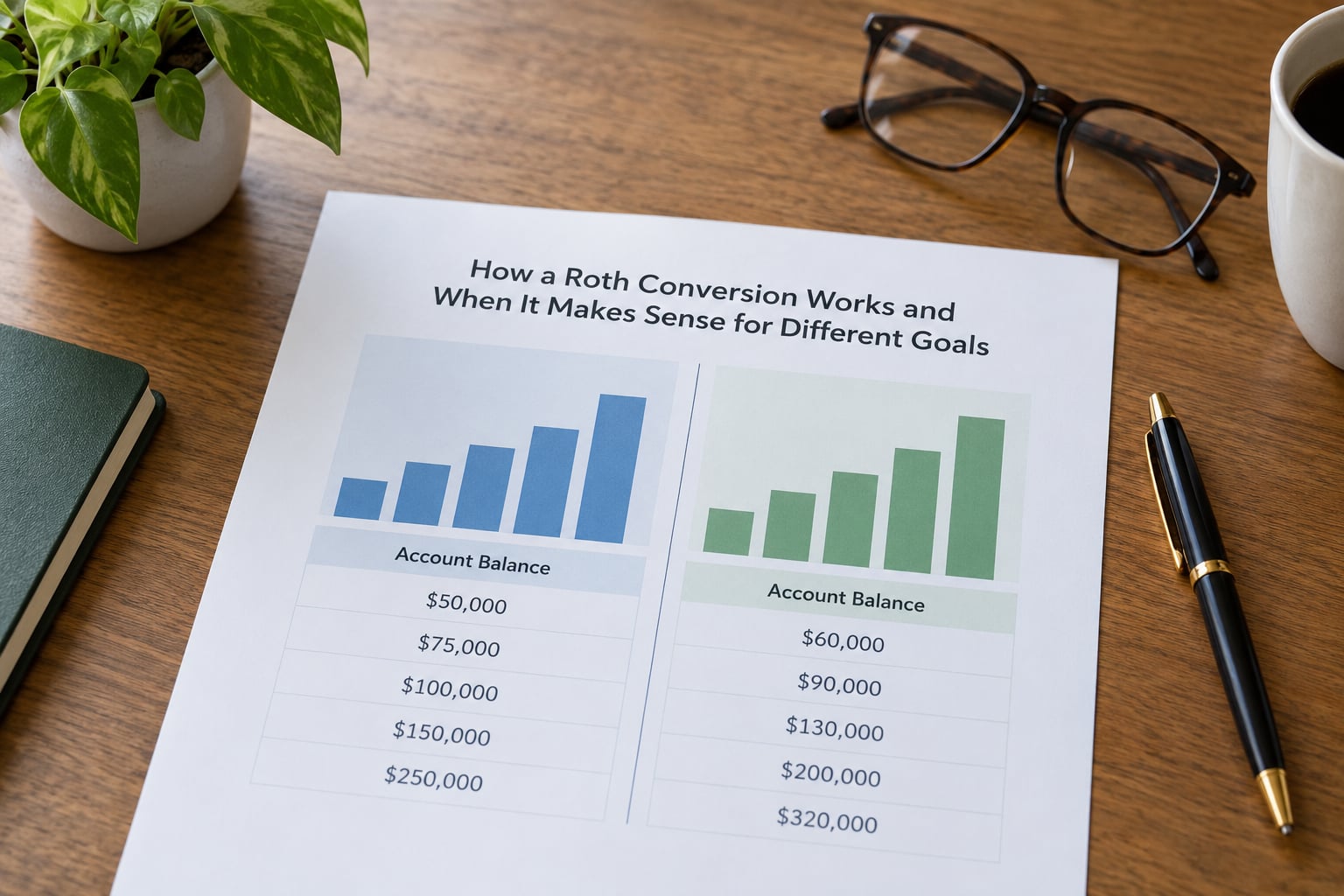
The same mechanics serve very different goals, and the tradeoffs differ with each. Here is the short version.
| Your goal | Why it helps | The tradeoff to weigh |
|---|---|---|
| Flexible retirement income | Qualified Roth withdrawals add no taxable income, so you can control your bracket year to year | You already paid tax on the dollars, and a taxable withdrawal plus a Roth withdrawal can push you into a higher bracket |
| Legacy planning | No lifetime RMDs and a cleaner transfer to heirs, who may stretch under the 10-year rule | Inherited Roth balances face their own rules, and eligible heirs may still owe income tax on distributions |
| Saving for a lower bracket later | Locks in today’s rate on money you may withdraw in a lower-income retirement year | If rates fall or your heirs face higher rates, you paid more than you had to |
| Covering healthcare expenses | Extra taxable income from the conversion can increase the deduction older filers take for qualified medical costs | The deduction only helps if you itemize and have enough unreimbursed costs to use it |
| Reducing future RMDs | Lower future balance means smaller required minimum distributions in the RMD years | Conversion does not reduce or satisfy the RMD for the year you convert |
| Getting more from Social Security | Keeping taxable income lower can leave more of your benefit untaxed | The benefit amount itself is fixed; the tax treatment depends on combined income in retirement |
How to Calculate the Cost of a Roth Conversion
Do the arithmetic before you commit to an amount. Fill this in on paper and then check it against a tax projection.
- Conversion amount. The pre-tax dollars you are moving this year.
- Current marginal rate. The rate that applies to the last dollar of conversion income, based on your taxable income plus the conversion.
- Federal tax. Conversion amount multiplied by your marginal rate. This is the number most people underestimate, because they use their average rate instead.
- State tax. Add the state rate for filers in states that tax retirement income. States without income tax add nothing.
- After-tax value. Conversion amount minus the federal and state tax. Compare that to the after-tax value of leaving the money in the pretax account, where growth is untaxed but withdrawals will be taxed later at whatever rate applies then.
- Break-even. Compare the tax you paid now with the tax you would likely pay later. If the future rate is lower than today’s, the conversion costs you money over time. That calculation is the whole decision.
Three secondary effects belong in the model. Social Security is taxed on up to 85 percent of the benefit once combined income passes a threshold, so conversion income can increase the taxed portion. Medicare premiums rise through the Income-Related Monthly Adjustment Amount, which is based on modified adjusted gross income and applies two years later, so a big conversion can hit your Part B and Part D premiums in your first year of retirement. And if you are under 65, Roth conversion income counts for Affordable Care Act premium tax credits on the Marketplace, which can be a large dollar swing for early retirees.
One more timing note. Because IRMAA looks back two years, the strategy for a retiree is often to convert in the two years before retiring, when the premium does not yet bite, and to keep taxable income low once Medicare kicks in.
What Can You Convert From?
| Source | Can it be converted? | Notes |
|---|---|---|
| Traditional IRA | Yes | The standard source; no dollar cap |
| SEP IRA | Yes | Same rules as a traditional IRA, subject to the pro-rata rule |
| SIMPLE IRA | Yes | Convertible after the statutory waiting period for employer contributions |
| 401(k) | Yes | To a Roth or to another eligible retirement plan, depending on plan rules |
| 403(b) or TSP | Yes | Allowed to a Roth IRA, subject to any outstanding loan issues |
| 457(b) | Yes, with care | Non-governmental 457(b) funds are deferred compensation rather than a qualified trust, which changes both the tax treatment and the RMD picture |
| Existing Roth IRA | No | Already tax-free; nothing to convert |
| Cash or taxable brokerage | Yes | You can fund a Roth with new money, which is a contribution and runs into contribution limits, not a conversion |
| Borrowed money | Yes, with a warning | A “contribution of borrowed funds” can raise qualified-plan issues, and the 10 percent early distribution penalty can apply. Avoid it unless a professional clears it in writing |
When a Roth Conversion May Not Be Worth It
The honest cases against converting are just as important as the cases for it.
- You have no reason to expect lower future rates. If your retirement income will be taxed at the same rate or higher later, converting is a cost with no offsetting benefit.
- Your marginal rate is high right now. Converting during peak earnings pays the top bracket rate to avoid a rate you may never face in retirement.
- You already have a large pretax balance. With enough pretax dollars, ordinary withdrawals alone fill your brackets for decades. Adding Roth money first may never be the efficient order.
- You are uncertain about your spending. Roth contributions are limited and a conversion is one-way. Hedging with a taxable brokerage account is more flexible.
- You plan to give the IRA to charity. A qualified charitable distribution is untaxed. Converting first converts that generosity into an ordinary income tax bill.
- You are starting from a high-income year with no cash to pay the tax. Withholding from the conversion reduces what you actually put into the Roth, which can make the whole exercise pointless.
- You are focused on the heirs’ tax rate instead of your own. The 10-year rule already gave non-spousal heirs room to stretch, so converting an estate-tax-driven balance is often redundant.
Timing regret deserves its own mention. People who converted into a dip that fell another 15 to 20 percent afterward often second-guess the decision, and forums are full of those posts. The market recovers, but the recovery may not arrive inside your five-year clock, and taking money out before the window closes can trigger the extra penalty and income tax.
How to Decide Whether to Convert
Run through these before you move anything. If several answers are unclear, that is the signal to model the numbers properly or get help.
- Compare your marginal rate today with the rate you expect in retirement. The gap is the entire opportunity.
- Project your withdrawals and required minimum distributions for the next 15 years, and find the years where pretax income sits below your target bracket.
- Model the premium knock-on effects: IRMAA two years out, the taxable portion of Social Security, and Marketplace subsidies if you are under 65.
- Check your state. Converting in a no-income-tax state, or in a year before a move, can remove a meaningful slice of the cost.
- Confirm the conversion fees. Most custodians charge nothing for a conversion, but some workplace plans charge exit penalties of 5 to 15 percent that can wipe out the benefit.
- Make sure cash for the tax sits outside the retirement accounts. If it does not, reduce the amount you convert.
- Count down to your own five-year and 59-and-a-half dates. Converting large amounts with a near-term need for cash is the most common early-retirement mistake.
- Have a CPA or CFP run the projection. One hour of professional time is cheap against a tax bill on an account you cannot unwind.
Frequently Asked Questions
Can I undo a Roth conversion?
No. Once a conversion is complete, moving the money back to a traditional IRA is generally treated as a new contribution, and contributions are limited and often closed to you. Recharacterization used to work for this and was eliminated by the Tax Cuts and Jobs Act. If you converted by mistake or the market fell right after, the only clean option is to leave the money in the Roth and let it recover. Some custodians do not allow in-kind or back-and-forth transfers, so confirm before you convert.
When does the five-year waiting period for a Roth conversion start?
Each conversion has its own five-year clock, and it starts on January 1 of the year the conversion happened. It does not run from the date you clicked the button, and it does not restart when the money is invested. Within that window, the conversion earnings can be subject to the 10 percent early withdrawal penalty and are always added to your taxable income. Contributions you make separately to the same Roth IRA start their own separate five-year periods.
Does converting to a Roth trigger a 10% early withdrawal penalty?
The conversion itself never triggers the penalty. It only applies if you take money out of the Roth too early, meaning before age 59 and a half, or within five years of that conversion. In that case, the conversion earnings are taxed as ordinary income and can carry the 10 percent additional tax. Contribution earnings from regular Roth contributions have their own five-year clock and their own rule. Taking money out of a Roth you funded by conversion after the window has passed costs nothing.
How does a Roth conversion affect Social Security benefits and Medicare premiums?
Both are driven by taxable income, so a conversion can raise both. Medicare premiums use IRMAA, which keys off modified adjusted gross income and applies two years after the conversion year, so the increase shows up in your first two years of retirement. Social Security taxation kicks in once your combined taxable income exceeds a threshold, and up to 85 percent of the benefit can be taxed. The common tactic is to convert in the two years before retiring and keep taxable income low once Medicare starts.
What happens if the market falls after I convert dollars to a Roth?
The tax you paid is based on the value on the conversion date, so a later market drop does not reduce it or create a refund. The Roth balance simply shrinks along with everything else, and you keep paying tax on dollars that are worth less. If you withdraw inside the five-year window or before 59 and a half, you owe ordinary income tax plus the 10 percent penalty on the conversion earnings. If you were invested in equities, many people split the conversion across several months so they are not forced to convert a single day’s value.
Conclusion
A Roth conversion pays you ordinary income tax today in exchange for tax-free growth and tax-free qualified withdrawals later, with no lifetime required minimum distributions. It is tax timing, not tax avoidance, so the whole decision rests on one comparison: the rate you pay now against the rate you would pay later.
Start there. Model the current cost at your marginal rate, check the IRMAA, Social Security, and state tax knock-on effects, and see whether your retirement spending plans create low-bracket years you could fill. If the gap is wide, a partial conversion sized to fit the bracket is usually the move most people are happy with.
That is how a Roth conversion works and when it makes sense in practice: not as a one-time event but as a repeatable annual decision. Work out the current tax cost against expected future taxation, then review the tradeoffs with a tax professional before you submit anything.