
Growth stocks vs value stocks comes down to what you are paying for. Growth stocks are priced for future expansion, while value stocks are priced below what careful buyers think they are worth. Neither style wins reliably, so the useful question is which one fits your time horizon, your tolerance for a rough ride, and whether you need income from the portfolio.
This is general education, not investment advice, and no style is a promise of returns. Past performance does not predict future results, and index rules, tax law and fund lineups all change. Read the definitions, then decide.
Table of Contents
- Growth Stocks vs Value Stocks at a Glance
- What Are Growth Stocks?
- What growth stocks look like on a screen
- What Are Value Stocks?
- What a value trap actually is
- Returns: Which Style Can Perform Better?
- Risk: Which Style Involves More Uncertainty?
- Valuation: How Investors Compare Price and Worth
- How to calculate a P/E ratio
- The other multiples worth knowing
- Is growth just quality in disguise?
- Interest Rates and Economic Conditions
- The four phases of the market cycle
- Growth Stocks vs Value Stocks: Which Fits Your Goal?
- How to tell growth stocks vs value stocks in practice
- Which Should You Choose?
- How to Build a Balanced Investment Approach
- Frequently Asked Questions
- Are value stocks better than growth stocks over the long term?
- Will value stocks outperform growth stocks in 2026?
- What is a value trap and how do I avoid one?
- Do growth stocks pay dividends?
- Is Warren Buffett a value or growth investor?
- Should I combine growth and value stocks in my portfolio?
- Conclusion
Growth Stocks vs Value Stocks at a Glance
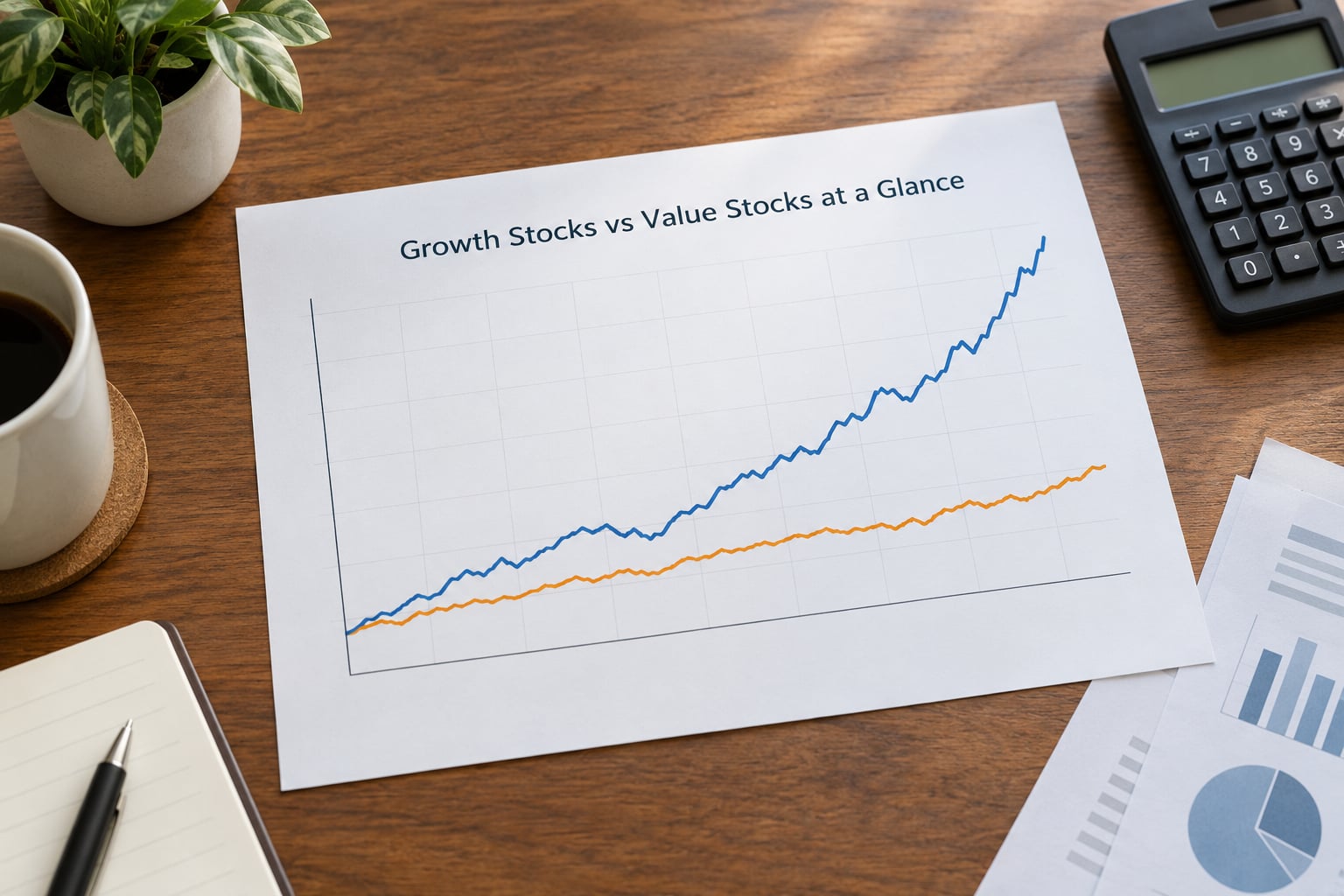
The table below sorts the two styles by the criteria investors actually argue about. Treat every row as a tendency rather than a rule, because individual companies break the pattern often.
| Criterion | Growth style | Value style |
|---|---|---|
| What it is | A company reinvesting profits to expand sales and earnings quickly | A company trading below the value careful buyers put on its business |
| Main earnings driver | Revenue growth and operating leverage | Existing cash flow, buybacks and dividends |
| Price-to-earnings | High, often well above the market average | Low, usually at or below the market average |
| Price-to-book | Often high, because intangible assets sit off the balance sheet | Often near or below one for banks and asset-heavy firms |
| Profit distribution | Little or no dividend, cash is reinvested | Regular dividends and buybacks |
| Volatility | Higher, expectations move the price more | Lower in calm markets, but drawdowns last longer |
| Common sectors | Technology, healthcare, consumer growth names | Financials, energy, industrials, telecom, some staples |
| Interest-rate sensitivity | High, since more of the price sits far out on the future | Lower direct sensitivity, but tied to the economy |
| Main danger | Paying too much for a story that slows down | A value trap where cheap reflects real decline |
| Better fit for | Long horizons and room for volatility | Income needs, shorter horizons, value for money |
One line captures the difference: you are paying a high price today for growth that has not arrived yet, or a low price today for a business that is not getting the credit it deserves.
What Are Growth Stocks?
A growth stock is a company whose value depends mostly on how fast its sales and earnings are expected to expand. It reinvests most of its profits back into the business rather than paying them out, and its share price reflects that expectation.
Typically these companies run thin margins while they scale, so even a small rise in revenue produces a much bigger rise in profit. That operating leverage is the whole engine, and it works in reverse just as fast when growth slows.
What growth stocks look like on a screen
- Revenue and earnings growth well above the market over at least three years, not one good quarter.
- A high price-to-earnings ratio, because the market is paying for future profit rather than current profit.
- A low or zero dividend payout ratio, with cash going back into product, capacity and hiring.
- A large addressable market big enough that growth can continue for years without the company running out of customers.
- A management team that has turned spending into revenue before, which is the part investors can actually check in the filings.
Well-known technology and healthcare companies are the usual examples, and the label is attached by data providers rather than by a company announcing itself. One caveat worth carrying into the rest of this guide: a growth stock can stop being one. As a business matures, growth slows, margins expand and the multiple falls, and the same company can start screening as value without anything fundamental changing overnight.
What Are Value Stocks?
A value stock is a mature, usually profitable company trading at a lower multiple than its business arguably deserves. The investor’s job is to estimate what the business can earn over a long stretch and decide whether today’s price is below that figure.
The idea runs straight back to Benjamin Graham’s margin of safety, the practice of demanding a gap between price and estimated worth so that a wrong forecast does not sink you. Warren Buffett’s record is the most famous example of that approach, though he has also bought plenty of businesses with strong growth, so he does not fit neatly into a single style.
The classic value profile is a steady cash flow, a dividend that has survived several recessions, a business that can be understood with a few pages of notes, and a price that looks dull. In practice, the same screen that finds value also finds trouble, which is where value traps come in.
What a value trap actually is
A value trap is a low multiple that is telling the truth. The company is cheap because its earnings are about to fall, its debt is about to be repriced, or its business model is being disrupted, and a shrinking denominator keeps the P/E low even as the stock declines. Screens cannot tell you which is which.
That is the single biggest practical risk in value investing, and it is the reason cheapness on its own is not an investment case. Banks, energy producers and industrial suppliers hit with structural problems are where traps cluster, because their assets are priced against a commodity or a credit cycle that no longer exists.
Returns: Which Style Can Perform Better?
Neither one, reliably. The honest answer to which style performs better is that it depends entirely on the window you measure, and the two styles have taken turns leading for stretches that last years.
Value led through much of the 2000s, when cheap financials, energy and commodity names were recovering from a decade of pessimism. Growth led through much of the 2010s, driven by a long run of near-zero interest rates and a small group of enormous technology companies whose earnings compounded faster than the market. Each style looked obviously right to investors who owned it, and painfully wrong to the other camp.
Returns also arrive through different engines. Growth stocks return most of their gains through price appreciation, which depends entirely on the multiple expanding or earnings catching up. Value stocks can add a dividend yield on top of appreciation, so a flat price is not the same total return for the two styles.
Forum readers are honest about how uncomfortable that is. On r/Bogleheads, one long-horizon index investor put it plainly: I can’t find a single article that indicates that Value stocks will outperform Growth stocks. That is the right instinct. Anyone claiming a reliable winner is selling something.
Risk: Which Style Involves More Uncertainty?
Growth stocks carry more day-to-day volatility because the price is mostly a guess about the future, and guesses reprice fast. Value stocks tend to be steadier in a rising market, but their risk does not disappear. It shows up as drawdowns that take years to recover rather than dips that bounce back in weeks.
The risks are also different in kind:
- Execution risk dominates growth. The business can do everything right and still fall short of a forecast the price already assumed.
- Economic sensitivity dominates value, since many value names are tied to industrial activity, credit conditions or commodity prices.
- Concentration risk hides in growth portfolios, where a handful of mega-cap names drive a large share of the index return.
- Duration of underperformance is the value trap risk. Cheap can get cheaper, and a fund manager holding a laggard for a decade is a real scenario, not a hypothetical one.
- Valuation compression hits both, but growth suffers more when a discount rate rises, because more of its value sits far in the future.
There is no universally safer category here. Near the end of a long bull market, defensive value names have been the ones getting hit hardest, and that is exactly when most people decide they want them.
Valuation: How Investors Compare Price and Worth
Valuation is where the two styles actually differ, and where a beginner can learn the most. The core question is always the same: what are you paying for each dollar of earnings or each dollar of assets?
How to calculate a P/E ratio
Divide the share price by earnings per share. A stock priced at 100 with earnings of 5 per share has a P/E of 20, meaning you pay 20 dollars for every dollar of annual profit. A stock priced at 60 with the same 5 in earnings has a P/E of 12. Nothing else explains the difference except what the market expects next.
The other multiples worth knowing
- Price-to-book compares price with accounting equity and is most useful for banks, insurers and industrial firms where assets are visible.
- PEG divides the P/E by the growth rate, so a P/E of 40 with 30 percent growth looks different from a P/E of 40 with 5 percent growth.
- Free cash flow is the profit that actually survives capital spending, and it is a more honest lens on growth companies than reported earnings.
- Debt and interest coverage decide whether a cheap multiple is an opportunity or a countdown.
A low multiple can signal a real opportunity or a value trap, and a high multiple can be justified by durable growth or by optimism that will disappoint. The ratio never interprets itself.
Is growth just quality in disguise?
This is the strongest challenge to the whole debate, and it comes from investors who focus on quality rather than style. Their argument is that durable growth, high returns on equity and a clean balance sheet are what actually produce long-run returns, and you can own those qualities at any price. The practical implication is worth sitting with: many of the most profitable growth companies are also perfectly reasonable value buys once you stop looking only at the multiple.
Interest Rates and Economic Conditions
Interest rates are the strongest single force on these two styles, because a rate change moves the value of future profits. When rates fall, money parked in cash pays less, and distant earnings are worth more in today’s dollars. That is a direct tailwind to growth stocks and part of the reason they led for so long.
When rates rise, the reverse happens, and the effect shows up as multiple compression rather than collapsing sales. Value stocks feel rates less directly, but they lean on the economy, so a credit-driven slowdown hits them through defaults, order books and commodity demand.
The four phases of the market cycle
- Accumulation: sentiment is poor and nobody wants the style that just fell. Value is where the patient money tends to go.
- Markup: prices recover, and the beaten-down style usually leads first because the starting valuations are lower.
- Distribution: late-cycle enthusiasm builds and the highest-growth names attract the most new money.
- Markdown: both styles fall, and the growth names tend to fall harder because the multiple was doing more of the work.
This cycle is a tendency, not a schedule. Inflation, recessions and expansions each favour different corners of the market, and no reasonable person can time the turns from a calendar. Nobody, including the people who write this, can tell you with confidence which style leads in 2026, and anyone who says otherwise is guessing with your money.
Growth Stocks vs Value Stocks: Which Fits Your Goal?
The right style is the one that matches the job the money has to do. Here is how the decision usually breaks down by situation rather than by opinion.
| Your situation | Closer fit | Why |
|---|---|---|
| Twenty years or more before you need the money | Growth tilt | Time absorbs volatility, and compounding needs room to work |
| Five years or less, or a near-term goal | Value tilt | Large, single-year drawdowns can wreck a short horizon |
| You need income from the portfolio | Value tilt | Dividends and buybacks produce cash regardless of the multiple |
| You check your balance daily | Value tilt | Growth multiples swing on news and get under your skin |
| You want a single core holding and no analysis | Neither on its own | Broad market exposure already holds both styles |
| You are new to investing | Blend, defaulted | Style tilts are a second decision, not a first one |
How to tell growth stocks vs value stocks in practice
Start with the multiple, then check whether the earnings behind it are shrinking. Classification is a snapshot, not a permanent identity, and the same company can move between labels as its growth rate and margins change. Amazon was screened as a growth name for most of two decades, and whether a given provider calls it growth or value today depends on the thresholds they use and the quarter they measured. Ask for the inputs, not the label.
Two further checks matter. First, look for style drift in funds, since a fund marketed as value can hold growth names for years as the market moves and managers change, which is why a stated style is a starting point rather than a description of current holdings. Second, remember that many quality companies do both, paying a modest dividend while compounding revenue, so treating dividends and growth as mutually exclusive costs you good candidates.
Which Should You Choose?
Choose growth when your horizon is long, you can sit through a 40 percent drawdown without selling, and you would rather own a small number of businesses with a wide margin to grow.
Choose value when you want income, when a bad year could genuinely derail a goal, or when you have the patience to research a business closely enough to tell a real discount from a falling knife.
Choose a blend when you cannot pick a side honestly. A 50/50 split across broad style indexes captures most of each style’s decade, gives up some of the best stretch for either, and removes the need to make one correct timing call you have no edge on. If you want a middle path, a broad-market index fund already holds hundreds of each style, which is why it remains the default holding for most people’s first and largest position.
Individual securities are not suitable for everyone, and neither style is a safer bet for your particular finances. The honest answer is that your goal, horizon and temperament decide this, not the last ten years of returns.
How to Build a Balanced Investment Approach
If you have decided the two styles both belong in your portfolio, here is a process that works for almost anyone and keeps the guessing to a minimum.
- Write the goal down first. A retirement date and a monthly amount beat any style label. The style follows the job.
- Put your core money into broad exposure. A total-market index fund already holds growth and value in roughly their market weights, so it is a finished answer rather than the start of a research project.
- Add a style tilt only if you have a reason. A modest tilt toward the style matching your time horizon is defensible. A large tilt is a bet on timing that most people lose.
- Check the price of the fund, not just its idea. Annual costs, tracking difference and trading costs quietly decide your net return over decades. Compare a low-cost index option against any active fund before you buy.
- Spread it out. Sector tilts, individual stocks and a home bias are all the same bet wearing different clothes. Name your concentration and make it deliberate.
- Rebalance on a schedule, not on headlines. Once or twice a year, move back to your target percentages and stop looking in between.
- Where you hold it affects the after-tax result. In a taxable account, general-market funds are usually more tax-efficient than sector funds or high-turnover strategies, and dividends and long-term capital gains are taxed differently.
- Revisit the assumptions annually. Rules, fees and fund lineups change, and so might your goals. Review on a calendar, not after a market move.
Keep written notes on why you hold each position. When the price moves against you, the reasoning you wrote six months ago is worth more than whatever the market is telling you that day.
Frequently Asked Questions
Are value stocks better than growth stocks over the long term?
Long-run evidence leans toward value on a very long horizon, but the lead has swapped many times in between, including a long stretch where growth dominated. Any comparison depends on the exact window, the index used and whether dividends are counted. Treat the historical edge as a tilt worth considering, not a forecast you can rely on for the years ahead.
Will value stocks outperform growth stocks in 2026?
Nobody can answer that honestly, and anyone who says otherwise is guessing with your money. Style leadership turns on interest rates, earnings revisions and sentiment, and it can flip within a quarter. Use the current period as a reminder that last period’s leader is often this period’s laggard, then check where your own assumptions sit before changing anything.
What is a value trap and how do I avoid one?
A value trap is a low multiple that reflects real decline rather than a mispricing, and the cheapness keeps looking cheaper as the earnings fall. The usual causes are structural: debt repricing, a lost customer, technology replacing the product, or a commodity price that no longer returns. You avoid it by checking whether the business still has a durable competitive position, not by trusting the low multiple.
Do growth stocks pay dividends?
Some do, and the assumption that growth companies never pay income is wrong. A mature business with a durable franchise can reinvest most of its profit and still pay a modest dividend. Low payout ratios are common in younger companies that would rather fund expansion internally. Refusing to own any dividend-paying growth company narrows your options for no good reason.
Is Warren Buffett a value or growth investor?
He is usually described as a value investor because of the Graham tradition, the margin of safety and his preference for a bargain price. In practice much of his record came from businesses with durable growth, which is a growth-at-a-reasonable-price approach. The cleaner lesson is that price matters, but so does the quality of the business you are buying.
Should I combine growth and value stocks in my portfolio?
For most people, yes, and a broad-market index fund already does it for you. Combining the two styles spreads risk across a wider set of economic outcomes and removes the need to time which style leads. The main cost is that a blend gives up some of the best stretch for either style. Decide the split for your goal and risk tolerance, then rebalance on a schedule rather than on news.
Conclusion
Growth pays a high price for expansion, value buys a business at a discount to what it earns, and the two styles have led in alternating stretches for as long as anyone has measured. The decision matters far less than the goal behind it, so do three things before you pick a side: write down what the money is for, decide honestly how much volatility you can sit through, and start with broad diversified exposure instead of choosing a style based on the last few years of returns.