
How to rebalance your portfolio comes down to four moves: list every holding, work out what percentage of the total each one represents, compare those weights with the mix you actually want, then close the gap with new contributions, dividends, or trades. Most people can do the whole thing in an afternoon, once a year, and never need to sell anything to get there.
The reason to bother is that markets move unevenly. A year of strong growth in one part of your portfolio quietly shifts your risk level even though you never touched a thing, and that drift is what rebalancing undoes. It is a risk-control tool, not a return-boosting trick, and understanding that difference keeps you from making trades that feel clever and cost you money.
Below is the process I would walk any portfolio through, including the tax questions that make people hesitate and the mistakes that turn a tidy exercise into an expensive afternoon. Rules and tax rates differ by state and country and change over time, so treat the specifics here as general education rather than personal advice, and check with a tax professional before acting on anything that triggers a bill.
Table of Contents
- What You Need Before You Rebalance
- Step-by-Step: How to Rebalance Your Portfolio
- Step 1: Review Your Current Portfolio
- Step 2: Define Your Target Allocation
- Step 3: Set Rebalancing Bands and Dates
- Step 4: Use New Contributions to Close the Gap
- Step 5: Sell or Buy to Reach the Target
- Step 6: Check and Document the Result
- A Rebalancing Example You Can Follow
- Common Mistakes When You Rebalance Your Portfolio
- Rebalancing Too Often or for the Wrong Reason
- Ignoring Taxes, Accounts, and Investment-Level Drift
- Changing the Target Allocation After a Market Move
- Tips for Staying Disciplined
- Frequently Asked Questions
- How often should I rebalance my portfolio?
- Should I rebalance before or after paying taxes?
- Can I rebalance my portfolio by investing my paycheck?
- What is the 5/25 rule for portfolio rebalancing?
- Should I rebalance an employer stock plan?
- What if my investments have losses when it is time to rebalance?
- Conclusion
What You Need Before You Rebalance
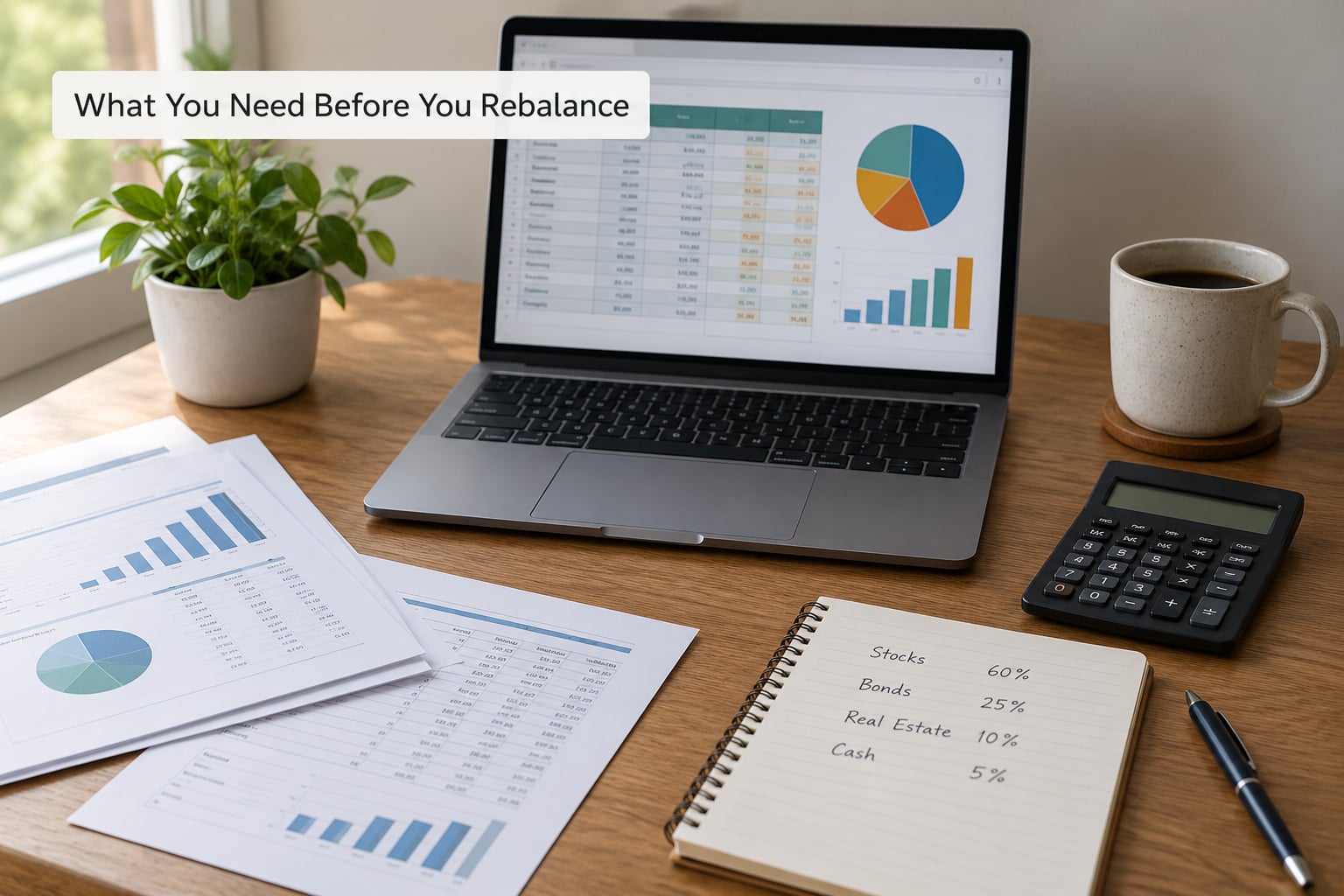
You need four things before you touch anything: an accurate inventory of every account, current market values, a written target allocation, and a rule for when you will act. Without the last two, “rebalancing” becomes a reaction to whatever the market did last week.
The account inventory. Every taxable brokerage account, traditional IRA, Roth IRA, 401(k), 529 plan, and HSA that holds your investable assets. Write each one down with its account type and value, because the account type decides which trades are cheap.
Current market values by holding. Not share counts. A brokerage statement gives you the current value of each position, and that is the number you divide by the total. Do not use what you paid for it. Cost basis matters for taxes, but the current value determines the weight.
Your target allocation. The percentage you want in each asset class: US stocks, international stocks, bonds, cash, maybe real estate or a small allocation to something else. This should come from your time horizon and ability to stomach a drawdown, not from what did well last year.
A rebalancing rule. A date, a threshold, or both. Pick it now, while nothing is happening, because that is when you can think clearly.
The difference between target and current allocation is where all the work happens. Target allocation is the mix on your written plan. Current allocation is the mix your accounts hold today. When they match, you do nothing. When they differ by more than you decided to tolerate, you act.
One more thing worth having: a one-page investment policy statement. Regulars on the Bogleheads forum keep pointing at the same thing — a short written document with your target mix, your rebalancing rule, and your account locations removes the need to make a decision in the moment. When a headline makes you twitch, you read the policy instead of the news.
Step-by-Step: How to Rebalance Your Portfolio
Step 1: Review Your Current Portfolio
Export or screenshot every account and total them up. Then divide each holding’s current value by the total and multiply by 100 to get its weight.
A worked example, because numbers make this clearer than words. Start with a household portfolio worth 200,000 across a taxable brokerage account and a traditional IRA, targeting 60 percent stocks and 40 percent bonds.
| Holding | Current value | Weight | Target weight | Gap |
|---|---|---|---|---|
| US stock index fund | 92,000 | 46% | 45% | +1% |
| International stock index fund | 46,000 | 23% | 15% | +8% |
| Bond fund | 58,000 | 29% | 38% | −9% |
| Cash | 4,000 | 2% | 2% | 0% |
International stocks ran hard and bonds did not, so the portfolio drifted from 60/40 to 69/31 without a single trade. The plan is intact; the mix is not. That gap between the two is portfolio drift, and it is what you are correcting.
Step 2: Define Your Target Allocation
Your target is the mix your plan calls for, expressed in percentages that add to 100. If you have never written one down, you have been running on autopilot, and rebalancing by autopilot is how people end up with 80 percent of their savings in a single company’s stock.
Three inputs decide the number. Your time horizon: money you will not need for 20 years can carry more volatility than money you will need in three. Your ability to tolerate a drawdown, judged by what you would actually do, not by a questionnaire. And the job the money has to do.
A 60/40 stock-and-bond split is the most common starting point, and plenty of investors nudge the stock side toward 70/30 while they still have a long horizon ahead. Treat either number as the beginning of a conversation rather than a rule — what matters is your time horizon and how a drawdown would actually make you behave, not the ratio you inherited from someone else.
Then decide where each asset class lives. The usual setup puts tax-inefficient assets like high-turnover stock funds in tax-advantaged accounts first, and lets the taxable account hold what you actually want to own, including the loss-harvesting candidates. Asset location and rebalancing are the same decision viewed twice.
Step 3: Set Rebalancing Bands and Dates
Write down when you will check and what will make you act. There are three common approaches, and most people end up blending the first two.
| Approach | How it works | Effort | Best for |
|---|---|---|---|
| Calendar | Rebalance on a fixed date, usually once a year or twice a year | Low, predictable | Simple portfolios, people who will not check in between |
| Threshold | Rebalance when any asset class drifts a set distance from target, often 5 percentage points or one quarter of its target | Requires attention | Active investors who check monthly |
| Hybrid | Check on a date, act only if something is outside the band | Moderate | Most households |
The 5/25 rule is a threshold variation some investors use: rebalance an asset class when it reaches 5 percent above or below its target weight, or when it has moved 25 percent away from that target, whichever happens first. On a 60 percent stock position the first trigger is 63 percent, on a 10 percent bond position it is 12.5 percent. Small positions get corrected earlier, which keeps them from disappearing.
Whichever you pick, put it in the policy statement with a date. A written rule is the difference between a plan and a mood.
Step 4: Use New Contributions to Close the Gap
New money is the cheapest way to rebalance, because selling triggers capital gains taxes while buying does not. Direct contributions to the underweight asset classes first, and keep doing it until the gap closes.
Back to the example: the bond fund is 9 percentage points light, which is 18,000 of a 200,000 portfolio. Someone contributing 2,000 a month to bonds closes the gap in nine months without a single sale. That is the approach most people on the Bogleheads forum and r/Fire recommend, and it works because it costs nothing but patience.
Three variations of the same idea. Send dividends to the underweight asset instead of reinvesting them into whatever paid them, and turn off automatic reinvestment on the overweight side. When you withdraw, take the dollars from bonds or cash rather than selling shares. And if your employer stock has grown past a sensible share of your portfolio, redirect future salary deferrals and bonuses toward cash or bonds.
If the gap is large enough that new money cannot close it in a reasonable time, you will have to trade. Knowing that in advance makes the decision calmer when it comes.
Step 5: Sell or Buy to Reach the Target
When contributions are not enough, sell from the overweight positions and buy the underweight ones. There is an important constraint here: how to rebalance your portfolio across multiple accounts means rebalancing the household total, not every account separately.
Taxable brokerage accounts are the flexible ones. Selling appreciated positions there creates capital gains taxed at your ordinary income rate, short-term gains at your marginal rate; positions held more than a year are taxed at long-term rates. Tax-advantaged accounts have no annual tax on internal trades, so moving money between a 401(k) and a taxable account can be tax-free, with the trade-off that withdrawals and RMDs in those accounts are generally taxable.
Choose lots carefully when you sell. Selling specific tax lots in a taxable account lets you pick the ones with the smallest gain, or take a small loss and offset gains elsewhere, which is the basic move behind tax-loss harvesting.
Keep turnover low. Each round trip costs spread, bid-ask, and in taxable accounts another tax event, so selling everything and buying everything back when nothing has drifted far enough is pure cost. Work out the dollar gap for each position, then trade the smallest set that gets every holding inside its band.
Document what you did. The trade date, the dollar amount, the reason, and where the new money came from. A note in your policy statement file turns this into a two-minute job next time.
Step 6: Check and Document the Result
Recalculate the weights after the trades settle and confirm every holding sits inside the band you set in Step 3. If something is still outside, decide whether one more small trade fixes it or whether you let the date approach instead.
Then write down the next review date and stop. Resist the urge to fine-tune. Overtrading is the most common way rebalancing turns into a drag, and a portfolio that is 2 percentage points off target is not a problem worth trading commissions and tax bills to solve.
A Rebalancing Example You Can Follow
Same portfolio, different outcome. Because the bond position was far under its target and a large contribution just landed, the investor directs the entire contribution to bonds, sells the 46,000 international position down to its 30,000 target, and the mix moves from 69/31 to roughly 60/40 with one trim of 16,000.
Compare that with the no-sale version: the same 16,000 trimmed from a position with a 30 percent unrealized gain produces a tax bill, while directing contributions takes three to four years. Both end at the target. One is faster, the other is cheaper. That trade-off is the whole conversation, and it changes as the person approaches retirement, when tax rates usually drop.
Common Mistakes When You Rebalance Your Portfolio
Rebalancing Too Often or for the Wrong Reason
The classic error is rebalancing every time a weight moves by one percentage point, or worse, rebalancing because a headline made you nervous. Every trade has a cost, and in a taxable account the cost includes the tax on gains that you may have no reason to realize.
The fix is the written band. Set the threshold, then act only when a holding crosses it. If the band is 5 percentage points and your bonds sit 3 points under target, do nothing and route contributions there instead.
Related mistake: treating rebalancing as a way to earn more. It is not. Rebalancing sells some of what has been working to buy what has been lagging, which is exactly backwards if you think you know which is which. On the Bogleheads forum the framing comes up constantly — rebalancing brings a portfolio back in line with your risk tolerance, and that is the entire claim.
Ignoring Taxes, Accounts, and Investment-Level Drift
Most people check the portfolio, see it is off target, and sell in the wrong account. Start with the taxable account for anything that requires a sale, and use the tax-advantaged accounts for the assets that belong there anyway.
Watch for overlapping funds. Investors assembling a portfolio over years often end up with three or four broad index funds from different providers that hold nearly the same 500 companies, which looks diversified and is not. Consolidating first, then rebalancing, avoids paying twice for the same exposure.
And remember that your allocation is measured at the position level, not just the account level. A single stock that has run up inside your IRA can be a quarter of your household savings while your account totals still look balanced.
For retirees, required minimum distributions from traditional accounts can fund part of the rebalance for free, since the withdrawal is already happening. If you are younger than the current RMD age and taking money from a traditional IRA, you can usually make an after-tax contribution back in, keeping the money invested and avoiding a second tax bill.
Changing the Target Allocation After a Market Move
The most expensive mistake is abandoning the plan because one asset class just had a great run. Stocks have doubled and you want more of them, so you raise the target from 60 to 80 percent exactly when stocks are expensive. That is market timing with extra steps.
The fix is deciding in advance what changes a target: a change in your time horizon, a change in income, a change in your ability to handle a drawdown, or a change in the job the money has to do. A price move is not on that list.
Early retirement is the legitimate exception. Moving from 100 percent stocks to something with bonds and cash five years out is a change in horizon, not a bet on the market. Write the new target down, note why you changed it, and move on.
Tips for Staying Disciplined
- Write the policy before the market tests it. Target mix, bands, review date, and account roles on one page.
- Automate the boring half. Automatic dividend reinvestment, scheduled contributions, and alerts on allocation drift take the discipline work out of your hands.
- Use a robo-advisor or target date fund if you will not do it yourself. These hold the target mix internally and rebalance without selling or buying outside the fund, which sidesteps capital gains entirely.
- Rebalance before a big purchase when possible. Selling appreciated holdings in a losing year means realizing less gain, or a harvestable loss.
- Ignore the day-to-day. Check quarterly against your bands and take no action between.
Frequently Asked Questions
How often should I rebalance my portfolio?
Once a year is a reasonable default for most investors, and twice a year works for larger or more volatile portfolios. If your assets are tax-inefficient or you have a short time horizon, a threshold rule checked monthly can work better because it trades only when something has drifted meaningfully. The exact schedule matters less than having one written down before you need it, since the schedule is what stops rebalancing from becoming a reaction to whatever the market did last week.
Should I rebalance before or after paying taxes?
Rebalance any time, because buying an asset inside a tax-advantaged account is not a taxable event, so ordering relative to a tax payment rarely matters. Where timing does matter is within a taxable brokerage account, where a short-term gain realized near year end is taxed at your marginal rate. Selling appreciated positions in a down year realizes less gain, or a loss you can offset, so many investors coordinate their trades with the loss-harvesting window in the final months of the year.
Can I rebalance my portfolio by investing my paycheck?
Yes, and it is usually the cheapest route. Every contribution you direct to an underweight asset class moves the portfolio back toward target without a sale and without a tax bill. If you have an automatic contribution schedule, split it across the underweight holdings and skip the overweight ones, or route the whole amount to the least funded asset class until the gap closes. Most gaps close within a few years this way.
What is the 5/25 rule for portfolio rebalancing?
It is a threshold rule with two triggers. Rebalance an asset class when it drifts 5 percentage points above or below its target weight, or when it moves 25 percent away from that target, whichever happens first. On a 60 percent stock position the first trigger is 63 percent; on a 10 percent bond position it is 12.5 percent. The effect is that small positions get corrected sooner, before they shrink toward nothing.
Should I rebalance an employer stock plan?
Usually yes, because employee stock can become a large share of your portfolio quickly when it performs well, and that concentration is a real risk even while the company pays you. Most plans let you redirect future contributions to other investments inside the plan, which you can start with your next paycheck. Diversifying existing holdings may require selling shares, which can conflict with trading restrictions or trigger taxes, so check your plan rules first.
What if my investments have losses when it is time to rebalance?
Rebalance anyway. An underweight bond position stays underweight whether you buy new bonds or sell stock to buy them, and waiting for prices to recover is a bet that rarely plays out cleanly. Selling a losing position in a taxable account also creates a capital loss you can offset against gains, which can reduce or cancel the tax on other sales in the same year. Trade inside tax-advantaged accounts where possible to keep the transaction tax-free.
Conclusion
The first move in learning how to rebalance your portfolio is writing down three things today: your target allocation in percentages, what each holding currently weighs, and the date or threshold that will make you act. That single page is the part most people skip, and it is the part that makes every later decision faster and cheaper.
Then rebalance with contributions wherever you can, sell only when the gap or the tax math says to, and let the schedule do the reminding. Rebalancing manages risk, so if you cannot describe how much risk you want, do not trade yet.