A strong dollar lowers the dollar value of your foreign holdings, cuts the overseas earnings US companies report, and makes dollar-priced commodities cheaper for everyone else. It also raises what borrowers outside the US pay on dollar-denominated debt. None of that is automatic, though. Stocks and the dollar move together sometimes and in opposite directions other times.
If you want the mechanics rather than the headline, here is the short version:
- Currency translation cuts both ways: it shaves points off foreign returns when the dollar rises and adds them when it falls.
- US multinationals earn roughly 40% of S&P 500 revenue overseas, so translation hits their reported profit before it hits anything domestic.
- Gold, oil and most commodities are priced in dollars, so a rising dollar usually pressures their dollar price.
- Emerging markets borrow heavily in dollars, which makes dollar strength a genuine financial tightening for them.
- A strong dollar does not reliably mean falling US stocks. The 1990s saw the dollar rise 33.9% inside a massive equity bull market.
The rest of this guide breaks that down asset by asset, then gets to the part people actually need: what to check in your own accounts.
Table of Contents
- What Does a Strong US Dollar Mean?
- What actually moves the dollar
- How strong is the dollar right now?
- How a Strong Dollar Affects Your Investments
- Why Currency Values Influence Global Returns
- How a strong dollar affects your total return
- US Stocks and the Dollar
- Does a strong dollar hurt US stocks?
- International Stocks, Bonds, and Emerging Markets
- Commodities, Gold, and Other Defensive Assets
- Cash, Bond Yields, and Your Portfolio
- What Should Investors Do When the Dollar Is Strong?
- Common Misunderstandings About Dollar Strength
- Frequently Asked Questions
- Is a strong dollar good for US stocks?
- Who benefits from a stronger dollar?
- Does a weak dollar help international stocks?
- What does a strong dollar mean for gold?
- What is currency hedging and how does it manage risk?
- Is the dollar getting stronger or weaker?
- Conclusion
What Does a Strong US Dollar Mean?
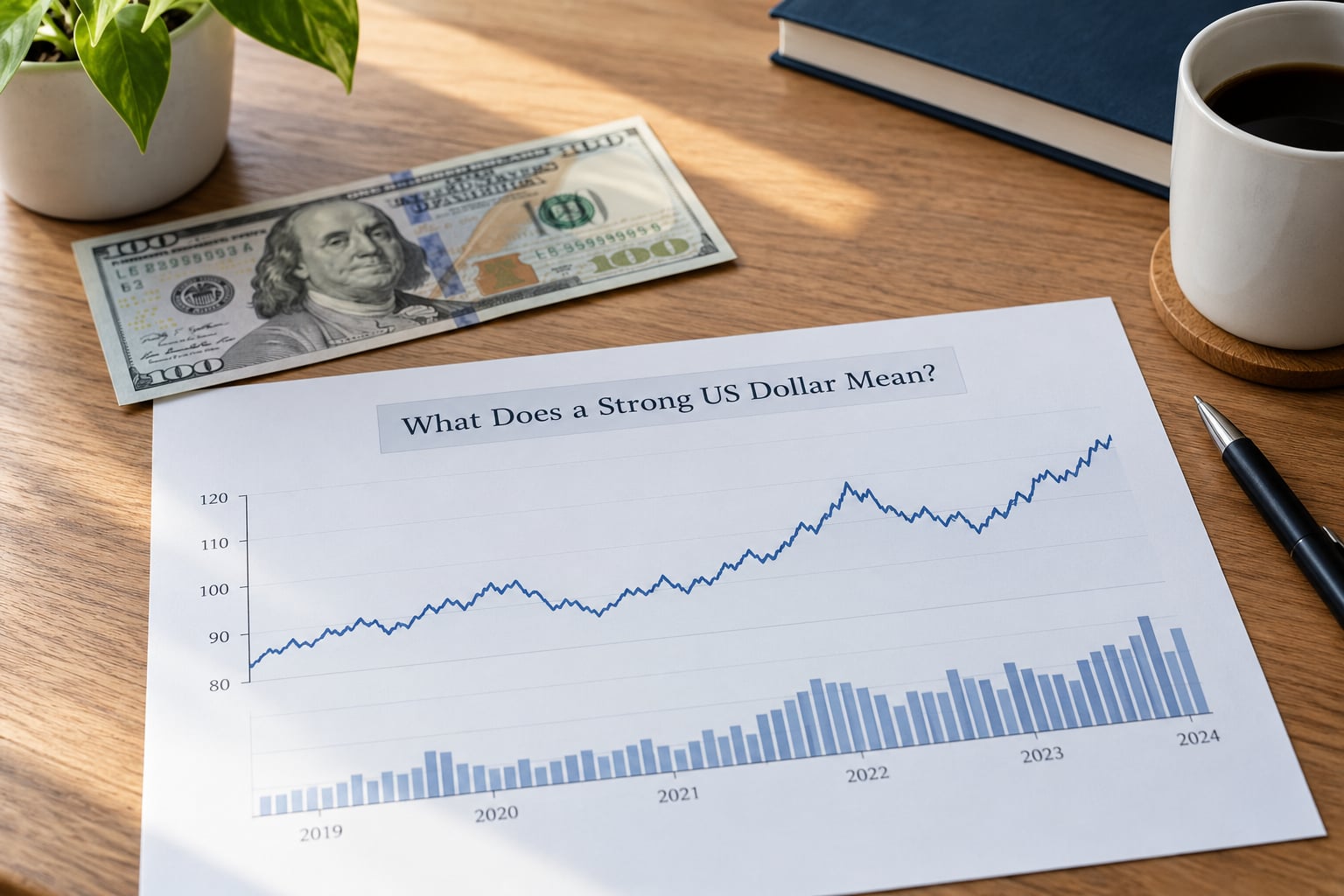
A strong dollar means one US dollar buys more foreign currency than it used to. The standard measure is the trade-weighted broad dollar index, which tracks how much the dollar buys against a basket of major trading-partner currencies, not just the euro. The other number you will see quoted is DXY, a narrower index weighted heavily to the euro.
What actually moves the dollar
Four things drive most of the movement. Interest rate differentials matter most: when US yields sit well above yields in Europe or Japan, capital flows toward dollar assets. Safe-haven flows come next, as investors buy dollars during periods of stress. Relative growth expectations shift the price of US assets against everyone else’s. Trade and tariff policy changes the cost of imports and exports, which changes trade balances and currency demand.
One thing people consistently get wrong is that currency strength only makes sense relative to a specific pair. The dollar can rise against the euro and fall against the yen in the same month, which is why British investors saw the 2022 dollar surge partly as a sterling story and Japanese investors saw it as a yen story.
How strong is the dollar right now?
The honest answer changes week to week, and I would not build a plan on any single reading. What is clear from the data is that the last few years have included a large dollar surge in 2022 followed by a multi-year decline running through 2025 and into 2026. Most commentary still describes the surge and very little of it describes the fade, which is exactly the gap worth knowing about.
To check for yourself, watch the Fed’s trade-weighted broad dollar index and DXY side by side. If they disagree sharply, you are looking at one dominant currency move rather than broad dollar strength.
How a Strong Dollar Affects Your Investments
The honest summary is that a strong dollar is a headwind for unhedged foreign assets, a mixed bag for US companies, and a deflationary force for global prices. The table below shows the usual direction and the conditions that flip it.
| Asset class | Usual effect of a stronger dollar | Why | What reverses it |
|---|---|---|---|
| US multinational stocks | Mildly negative | Overseas revenue translates into fewer dollars | Stronger local earnings abroad, cheaper imported inputs, a weaker yen helping exporters |
| US small and mid-cap stocks | Mostly neutral | Revenue is domestic, little translation effect | Higher borrowing costs and tighter credit |
| Developed international stocks | Negative for US-based holders | Currency translation drag on returns | Local share prices rising enough to offset the currency move |
| Emerging market equities | Negative | Currency weakness plus tighter dollar liquidity | Domestic reform, commodity strength, a credible rate-cut cycle |
| Emerging market dollar debt | Negative | Local currency falls, so dollar debt service rises | Commodity export earnings, reserves, capital controls |
| Foreign government bonds | Negative for unhedged holders | Translation drag plus lower local yields | Local yields spiking, currency recovering |
| US Treasuries | Positive | Safe-haven demand and lower imported inflation | Fiscal concerns, rising inflation, currency manipulation accusations |
| Gold | Negative | Gold is priced in dollars, so a stronger dollar lowers it | Central bank buying, geopolitical risk, falling real yields |
| Oil and industrial commodities | Negative | Same dollar-pricing mechanism as gold | Supply shocks, OPEC cuts, demand surges |
| Cash and money market | Mildly positive | Higher US yields, less need for currency hedging in holdings | Faster Fed cuts pulling yields down |
Read the last column before the first one. Currency effects are tendencies, not rules, and the exceptions are where most of the actual money was made.
Why Currency Values Influence Global Returns
Because a US investor ends up with dollars. When you buy a Japanese fund, the fund holds yen, the fund’s shares are priced in dollars, and the return you receive is the Japanese return minus whatever the yen did against the dollar. Two returns get stacked into one number, and only the second one is the currency.
How a strong dollar affects your total return
Here is a worked example. Your international fund rises 12% in its home currency over a year. During that same year, the dollar appreciates 10% against that currency. Your dollar return is not 12%. Divide 1.12 by 1.10 and you get roughly 1.018, so about 1.8% in dollars.
That gap between 12% and 1.8% is the currency translation effect, and it is entirely mechanical. If the currency had been flat, you would have kept the whole 12%. Trustnet’s illustration of an emerging markets fund is the same arithmetic in a different costume: 12.8% in pounds against 12.3% in dollars, where the difference is sterling, not the portfolio.
The converse matters just as much. A flat or falling foreign market can still hand you a decent dollar return when the currency rallies. This is why investors on r/stocks discovered the mechanism during the 2022 surge and why a lot of them now check the local-currency number before drawing conclusions.
Roughly speaking, a 10% dollar move translates into close to a 10% hit or boost to unhedged international equity returns, before any local price change. Bond funds are less dramatic because local yields move too, but the direction holds.
US Stocks and the Dollar
About 40% of S&P 500 revenue comes from outside the US, a figure CFRA’s Sam Stovall has cited in mainstream coverage. When the dollar strengthens 10%, those same euros, yen and pounds convert into roughly 10% fewer dollars if local prices and share volumes hold steady.
That is the earnings translation headwind, and it shows up in guidance before it shows up in results. It also cuts both ways for individual companies. A US manufacturer buying parts in Europe or Japan pays less in dollars for the same input. A US software firm with European staff sees its dollar costs fall alongside its revenue, which softens the hit.
The offsetting forces are real too. A strong dollar makes American products more expensive abroad, which competes with foreign exporters. Japanese automakers in particular have been helped by yen weakness, and the Nikkei 225 has repeatedly rallied on exactly that translation. Firms carrying meaningful debt also get a small break when dollar funding costs ease, though most large US companies issue in dollars already, so this matters less than people assume.
Sector exposure tells you more than the index label. Companies with mostly domestic customers, most small and mid-cap names, and many regional banks have little translation exposure at all, which is one reason domestic-heavy segments can hold up while megacap multinationals absorb the drag.
Does a strong dollar hurt US stocks?
It is a headwind, not a cause of decline. Fisher Investments laid out the counter-evidence clearly: in 2022 the trade-weighted dollar rose 11.0% while the S&P 500 fell 24.5%, but across the 1990s the dollar gained 33.9% during a bull market that delivered enormous returns, and from 1982 to 1987 it did much the same. In 2007 and 2008 the dollar fell 9.5% while the S&P 500 fell 12.3%.
The dollar and equities are both liquid markets that pre-price information, so a currency move is usually a symptom of the same macro news moving both, not an independent cause. Experienced investors have grown tired of the simple strong-dollar-bad-for-stocks line for good reason.
International Stocks, Bonds, and Emerging Markets
Foreign assets face the arithmetic above twice over, once through the exchange rate and once through the local economy. A stronger dollar tightens financial conditions worldwide: it raises the local-currency cost of servicing dollar debt, makes US assets expensive for foreign buyers, and pulls liquidity toward US markets. This is the disinflationary impulse that helps US households and hurts everyone else’s cost of capital.
Bonds behave differently from stocks because yields move. When the Fed holds rates high and other central banks cut, US yields stay elevated and foreign yields fall, which drags down local bond prices at the same time the currency is moving against you. A currency-hedged bond fund takes the currency out of the equation, which is why advisors such as Dimensional and WisdomTree argue hedging matters most precisely for fixed income.
Emerging markets are the sharpest case. Dollar-denominated debt has to be repaid in dollars, so a 10% currency depreciation raises the local-currency cost of that debt by roughly the same amount. When dollar strength coincides with a commodity slump or a risk-off move, the pressure compounds. Trustnet’s framing of the Triffin dilemma is worth sitting with: the world’s reserve currency has to flow outward to fund global growth, so a structurally strong dollar tightens that flow.
Anyone spending money in another currency needs to think about this differently from a portfolio question. Retirees and expatriates planning to live in Mexico, Portugal or Japan face a translation problem with their own future spending power, and no allocation change fully solves it. Forum threads on r/ExpatFIRE and r/Fire keep circling this: the money question is not which fund wins but how many currencies your plan assumes you will need over the next thirty years.
Commodities, Gold, and Other Defensive Assets
Gold, oil, copper and most industrial commodities are quoted in dollars, so a stronger dollar mechanically lowers their dollar price unless supply or demand moves at the same time. That inverse relationship is the reason gold and commodity funds are sometimes described as a hedge against dollar debasement, and also why they disappoint in some strong-dollar periods.
The exceptions are just as important as the rule. A supply shock, an OPEC production cut, or a geopolitical closure can push oil up even as the dollar climbs. Central bank buying has given gold a bid that is largely independent of the exchange rate, and a sharp risk-off episode sends money toward hard assets and the dollar simultaneously. Trustnet’s charts of emerging market equities and commodities against the dollar show the inverse pattern clearly, but they describe a tendency over long windows, not a daily hedge.
Cash, Bond Yields, and Your Portfolio
Dollar strength and interest rates are related but separate. The dollar often rises precisely because US yields are higher than everyone else’s, so cash and money market returns tend to improve alongside it. But cash yields are set by the Federal Reserve and by inflation expectations, not by the dollar index. If the Fed cuts while the dollar is still firm, short-term yields fall anyway, and a 2008-style scramble can push both yields and the dollar up at once.
For bonds, existing versus new matters. Higher US yields after a dollar-strengthening period push prices of existing bonds down; buying new bonds at those yields locks in a higher income stream. Foreign bonds have the opposite problem when the dollar is strong, since currency losses can easily outweigh a decent local yield.
One useful distinction: nominal versus real. A 5% yield sounds strong until you strip out inflation. A rising dollar is part of what lowers imported inflation for US buyers, which means the real return on your cash is not simply the headline rate.
What Should Investors Do When the Dollar Is Strong?
Start by finding out what you actually own. Most statements list a single blended line like total international equity, and it rarely tells you that currency is 30% of your total return risk. Pulling your holdings apart into US and non-US is the first useful step.
Then compare local and dollar returns where you can. If a fund fell 4% in dollars but rose 6% in its home currency, the portfolio did its job and the currency took the difference. That one habit removes most of the confusion people report about unhedged funds falling.
Next, check for home bias. A portfolio that is 95% US assets is implicitly short the dollar, and a lot of investors discover that only after a currency move. Adding international exposure is a long-term allocation decision, not a currency trade, so decide the size against your diversification plan rather than the dollar’s direction this quarter.
On hedging, be honest about the trade-off. A currency-hedged share class uses forward contracts or currency swaps to lock the exchange rate, which returns the fund’s dollar performance closer to its local performance. The cost shows up as a slightly lower expected return because you have given away the currency upside, and it works best for bond funds where currency swings dominate. Investors on r/Bogleheads and r/singaporefi split on whether that cost is worth paying, and the honest answer is that it depends on your horizon and whether you plan to spend in dollars.
| Unhedged international fund | Currency-hedged share class | |
|---|---|---|
| What you hold | The underlying securities plus the local currency | The securities plus a forward contract offsetting the currency |
| Return when the dollar rises | Drops, translation drag included | Holds close to the local-currency return |
| Return when the dollar falls | Rises more than the local return | Captures the local return only |
| Cost | Usually the lower expense ratio | Higher expense ratio, plus hedge roll cost |
| Best fit | Long horizons, diversified investors who want the currency exposure | Bond-heavy allocations, near-term goals, dollar spending needs |
Avoid reacting to the headline. Dollar stories are contradictory by design, because the dollar moves against six other major currencies at once. Rebalance on the schedule you set in advance, not on a morning when a currency headline made the news.
Common Misunderstandings About Dollar Strength
The first error is assuming a strong dollar means everything US rises. It lowers translated overseas profit, but US stocks have gone up during strong-dollar periods, including the 1990s run of 33.9% dollar appreciation and the 1982 to 1987 advance Fisher cites.
The second is assuming international holdings always lose. Currency translation is a drag in one direction and a tailwind in the other, and a currency rally can rescue a weak local market for a dollar-based investor.
The third is treating hedging as a free win. Hedging lowers volatility and costs you return, and whether that trade suits you depends on your horizon and your spending currency. Advisors who present it as a no-brainer are selling a share class.
The fourth is trying to forecast the dollar from a single headline. Rates, growth, trade policy and risk appetite all push at once, and the same news event routinely sends the dollar and equities in the same direction.
Frequently Asked Questions
Is a strong dollar good for US stocks?
Usually a mild headwind rather than a disaster. About 40% of Su0026amp;P 500 revenue is earned overseas, so translation trims reported profit when the dollar rises. History is not on the simple side, though: the dollar gained 33.9% during the 1990s bull market, and in 2022 it rose 11.0% while the index fell 24.5%, which is a correlation, not a rule.
Who benefits from a stronger dollar?
US importers and travelers, since goods, components and holidays cost less in dollars. Domestic-focused US companies with little foreign revenue see little translation effect. Foreign buyers of dollar-priced commodities and any borrower paying down dollar-denominated debt also benefit. Everyone holding unhedged foreign assets generally does not.
Does a weak dollar help international stocks?
It usually does for a US-based holder, and the mechanism is arithmetic rather than opinion. Add the currency gain to the local return and you get the dollar return. That is why a falling dollar tends to lift total international returns above what the underlying foreign markets delivered, and why the reverse happens when the dollar climbs.
What does a strong dollar mean for gold?
Gold is priced in dollars, so a rising dollar normally pushes its dollar price down, which is why gold and commodity funds often act as an inverse dollar trade. The relationship breaks when something else dominates: central bank buying, a geopolitical shock, or a sharp drop in real yields can lift gold while the dollar is still firm.
What is currency hedging and how does it manage risk?
A currency-hedged fund holds forward contracts or swaps that offset moves in the fund’s local currency, so its dollar return stays close to the return of the underlying securities. The trade-off is cost: the hedge usually carries a higher expense ratio and gives up the currency upside. Advisors say it matters most for bond-heavy allocations.
Is the dollar getting stronger or weaker?
It depends on the window and the pair, which is why the same week can carry conflicting headlines. The trade-weighted broad dollar index surged through 2022 and then declined across 2025 and into this year. Watch the broad index alongside DXY and check whether they agree, because a euro-driven move does not tell you much about the yen.
Conclusion
How a strong dollar affects your investments comes down to three things: less dollar value on foreign assets, less reported overseas profit for US companies with big international revenue, and cheaper dollar-priced commodities. Everything else, from gold to emerging market debt, runs through those same three channels or through interest rates.
Start by opening your statements and sorting holdings into US and non-US, then check whether the currency helped or hurt you over the past year. After that, decide anything else based on your diversification plan and time horizon rather than on where the dollar goes next. This is general information about currency mechanics, not individual investment advice.