
Emerging markets investing risks explained in plain terms start in three places: the country you invest in, the currency it is priced in, and the rules you have to trade and own under. On top of those sit ordinary equity volatility and the specific mechanics of the fund you buy. None of that makes emerging markets a bad idea, and none of it makes them a safe one.
This guide walks through each risk category, shows what actually triggers it, and gives you a checklist for judging whether an emerging markets fund belongs in your portfolio at all. It is general information, not investment advice.
Table of Contents
- What Are Emerging Markets, and Why Do Investors Use Them?
- Emerging Markets Investing Risks Explained
- Emerging Markets Investing Risks Explained by Category
- How Country Risk Can Affect Your Investment
- Why Currency Risk Matters to US Investors
- What Political and Regulatory Risks Should You Consider?
- How Market, Inflation, and Valuation Risks Differ
- Why Liquidity and Fund-Structure Risks Are Easy to Miss
- How Much Emerging-Market Exposure Is Appropriate?
- How to Evaluate an Emerging Markets Fund or ETF
- How Can You Reduce Emerging Markets Risk?
- What Signs Should You Monitor After Investing?
- Frequently Asked Questions
- Are emerging markets riskier than developed markets?
- What is the biggest risk when investing in emerging markets?
- Should US investors choose a currency-hedged emerging markets fund?
- Can diversification eliminate emerging markets investing risks?
- How can I tell whether an emerging markets ETF is suitable for my portfolio?
- Conclusion: Start With a Risk Check, Not a Return Forecast
What Are Emerging Markets, and Why Do Investors Use Them?
Emerging markets are developing economies with stock markets liquid and open enough to be tracked and traded by large international investors. MSCI, the index provider that most broad emerging markets funds follow, classifies 24 countries as emerging markets. Emerging markets represent roughly 11% to 12% of the market capitalization of the MSCI All Country World Index.
The defining feature is not poverty. China, Taiwan, South Korea, India, Brazil, South Africa and Saudi Arabia sit in that group, and several have larger economies than plenty of developed countries. What they share is a shorter track record of modern financial institutions, less predictable policy, and currencies that move more freely than those in developed economies.
It helps to know three neighbouring terms. An emerging economy is a country still industrialising, which is a broader label than emerging markets. Least-developed countries are a UN classification used for very small economies with very low income. Frontier markets are the investable markets too small or too illiquid for the main emerging markets indices, which makes them riskier, not safer.
Countries can also be removed. Russia was dropped from MSCI’s emerging markets classification in 2022 after the invasion of Ukraine. That episode is a useful reminder: index membership is a practical label, not a promise about political safety.
Investors use emerging markets for two reasons. The first is that these economies contribute a large share of global economic growth, so a portfolio holding only US and Western European shares is concentrated in older, slower-growing economies. The second is diversification, and here the honest version is more complicated than the brochure.
A widely held global or all-world fund already contains emerging markets exposure, often around one tenth of it. Adding a dedicated emerging markets fund on top makes your true weight considerably higher than the label suggests, and if you hold a US-dominant 401(k), that gap can be large. Investors who add emerging markets on top of a home-biased portfolio usually discover this later than they should.
Finally, investing is not speculating. Speculating is trying to identify the next big mover before the market does. Investing in emerging markets means accepting a permanent, deliberate allocation to a group of countries you cannot influence and holding it through decades. If your plan depends on picking the right country or the right year, you are speculating regardless of what the fund is called.
Emerging Markets Investing Risks Explained
Emerging markets investing risks fall into five broad families: country risk, currency risk, political and regulatory risk, market risk, and fund-level risk. The table below is the map for the rest of this article.
| Risk category | What triggers it | Most exposed asset | How a US investor can monitor it |
|---|---|---|---|
| Country or sovereign risk | Debt stress, recession, policy shifts, trade restrictions | Local government bonds, the country’s equity market | Ratings actions, credit spreads, growth and inflation data |
| Currency risk | Local currency falls against the US dollar | Unhedged funds and local bonds | Exchange rate moves and central bank rate decisions |
| Political and regulatory risk | Election swings, conflict, sanctions, capital controls, expropriation | Direct holdings and local bonds | Policy announcements, election calendars, capital control rules |
| Market risk | Rising global rates, falling risk appetite, earnings downgrades | All equities, emerging markets included | Valuation multiples, earnings revisions, fund performance vs its index |
| Liquidity and fund risk | Thin trading, market closures, fund closure, wide spreads | Single-country funds and niche products | Average daily volume, fund assets, bid-ask spread, tracking difference |
Two things are worth saying about this framework. First, these risks overlap: a capital control is a political decision that shows up as a currency loss and a liquidity problem at the same time. Second, emerging markets risk is not a separate species of risk sitting next to ordinary equity risk. It is ordinary equity risk with more country, currency and plumbing attached to it.
Emerging Markets Investing Risks Explained by Category
Country risk is the risk that a nation’s economic or financial policy damages the value of what you hold there, through recession, debt default, sudden policy reversal or loss of market access.
Currency risk is the risk that the local currency weakens against your home currency, so a gain in local terms turns into a loss in dollar terms.
Inflation risk is the risk that rising local prices eat the real value of local returns, and force a central bank into higher interest rates that pressure banks, property and long-duration equities.
Political risk is the risk that elections, conflict, sanctions, corruption or public disorder interrupt commerce or ownership in ways that are not reflected in a company’s reported results.
Regulatory risk is the risk that a government changes the rules for foreign investors after you have invested, through capital controls, exchange controls, tax changes, ownership limits or abrupt regulatory changes.
Liquidity risk is the risk that you cannot sell when you want to, or must sell at a much worse price than the last quoted price, because the market is thin or closed.
Market risk is the ordinary risk of owning equities: falling prices, rising rates, shrinking valuations and disappointing earnings, regardless of where the company is listed.
Valuation risk is the risk that a low price reflects genuine problems rather than an opportunity. A cheap market can keep getting cheaper for years.
Concentration risk is the risk that a fund you assumed was diversified is not. Broad emerging markets indices carry large single-country weights, so buying a “diversified” fund may add concentrated exposure to one economy.
Governance risk sits alongside all of these: weaker shareholder protections, less reliable disclosure, and audited accounts that carry more assumptions than a developed-market equivalent.
How Country Risk Can Affect Your Investment
Country risk is the part of emerging markets investing risks you cannot diversify away inside a single-country position, and only partly diversify away with a broad fund. It starts with the economy.
Consider a hypothetical emerging market with a commodity-dependent economy. The central bank raises rates to defend its currency. Growth stalls, and the government borrows more to cover the shortfall. Foreign investors grow nervous about repayment and sell local bonds. The currency weakens further, which raises the local cost of servicing foreign-currency debt, which pushes the currency weaker again.
In that sequence, a local stock market can fall even if company earnings look fine, because the discount rate investors demand rises and the currency translation drops. Local government bonds take the direct hit. A US-listed fund holding that country takes a slower version of the same hit, through the weight of those holdings in its net asset value.
Trade restrictions are another common trigger. Tariffs, export bans or import limits can cut revenue for companies that looked healthy six months earlier. Investors tend to price the possibility of these policies into emerging markets valuations ahead of time, which is one reason those markets can look cheap even when the news is not.
Institutional weakness is the quieter version. If statistics are unreliable, if policy changes without notice, or if a regulator applies rules unevenly, the market applies a discount. That discount is a real cost to you, expressed as a permanently lower valuation rather than a one-time loss.
The counter-argument deserves a hearing. Some investors argue that developed markets carry their own political risk, pointing to war, sanctions, sovereign debt and industrial policy in large economies. That is not a bad argument. It is also not an argument that emerging markets risk is zero, and treating the two as opposites oversimplifies both. Developed markets have deeper institutions and more predictable courts, and that is precisely why their policy surprises tend to be gradual rather than sudden.
Emerging markets investing risks have shown up in named episodes rather than in theory. The 1997 to 1998 Asian financial crisis, the 2008 global financial crisis, the 2015 Chinese currency devaluation, the 2020 pandemic sell-off and the 2022 rate and currency shock each produced deep, fast declines in emerging markets. The pattern repeated: the currency and the equity market fell together, which is the specific risk that diversification by country alone does not fix.
Why Currency Risk Matters to US Investors
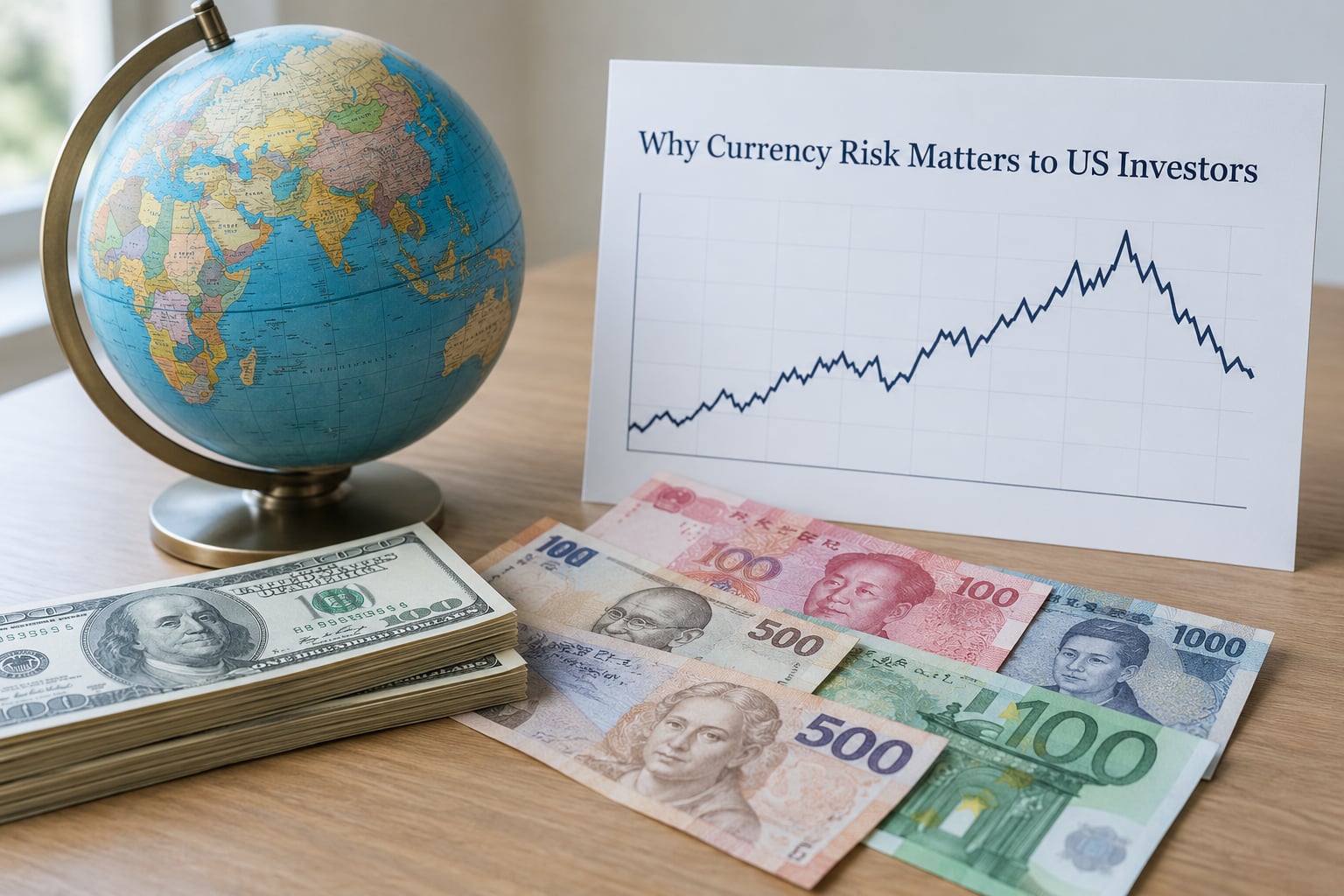
Currency risk is the difference between what an investment earns and what it earns in your money. This is called translation risk, and for a US investor it is not a secondary effect. It regularly dominates the outcome.
Say a local share price rises 15% over a year while the local currency falls 20% against the dollar. Your return in dollars is negative, even though the company did well. If the currency recovers, the arithmetic reverses. That two-way effect is the practical reason currency exposure gets treated as a risk category rather than noise.
US-listed funds generally fall into two share classes. Unhedged classes leave currency exposure in place and let the exchange rate move with the holdings. Hedged classes use forward contracts to offset a large share of that exposure, so the fund tracks local-market returns more closely. Hedging is not free: it has a cost that appears in the expense ratio or in a tracking difference, and it removes the currency gain as well as the currency loss.
Which one suits you depends on what you actually want. A long-horizon investor who believes in the local market and is saving in dollars may prefer unhedged exposure and accept the swings. A retiree drawing income in dollars and worried about purchasing power has a reasonable argument for hedged exposure. What nobody should do is pick a class without knowing which one their holding is.
What Political and Regulatory Risks Should You Consider?

Political risk covers elections, conflict, sanctions and civil disorder. It is hard to forecast and easy to overstate: most elections in emerging markets change nothing dramatic for investors, and outright expropriation of a listed company is rare.
The more common political risk is regulatory. A government changes a rule after you have committed money, and you cannot appeal it quickly. Capital controls restrict the movement of money out of a country. Exchange controls restrict the conversion of the local currency. Ownership limits restrict how much of a company a foreigner may hold. Tax rules can change retroactively, and local brokers can go out of business with client money.
Policy credibility is the thread running through all of this. When investors believe a government will do what it said it would do, borrowing costs fall and equity valuations rise. When that belief breaks, both can move sharply against you at once.
Being inside an index does not protect you from any of this. Index inclusion means a company is liquid and investable enough to be tracked. It says nothing about whether the currency can be converted, whether dividends can be repatriated, or whether the rules will stay the same.
Conflict and sanctions deserve their own mention because they can remove an entire country from an index within days, as happened with Russia in 2022. Investors who held Russian assets through a de-listing faced an asset that still existed but could no longer be sold to most foreign buyers.
How Market, Inflation, and Valuation Risks Differ
Market risk is the risk you accept by owning any share, anywhere. Prices fall, earnings disappoint, and multiples compress. It has nothing to do with the country and cannot be avoided by leaving developed markets.
Inflation risk operates through interest rates. When local inflation is high, a central bank raises rates. Higher rates raise the cost of borrowing for banks, developers and companies with thin margins, and they make future profits worth less today. A market with heavy bank and property weightings feels this faster than a market weighted toward exporters and commodity producers.
Valuation risk is the one that trips up careful investors. A market trading at a large discount to developed markets can stay at that discount for a decade while earnings grow slowly, currency weakens and policy disappoints. Cheap is not the same as mispriced.
The combination matters more than any single risk. A weak currency, high inflation and a stretched multiple can all point the same way, which is why drawdowns in emerging markets have historically been far larger than in developed markets.
Investors should also understand the limits of GDP growth as an argument. Faster economic growth does not automatically produce faster share returns. Share prices already discount expected growth, and companies that grow fastest in GDP terms are sometimes the least profitable for outside shareholders.
Equity and debt in emerging markets are not the same bet, and confusing them is a common mistake. Local government bonds carry direct default and inflation risk, which is why local-currency debt is often described as a currency bet with interest attached. Bonds denominated in US dollars or euros remove the currency element but add default risk, since the local government still earns in its own currency and must convert at whatever rate exists when it repays.
Local equities sit in between. They do not default, and a company can survive a currency collapse, but earnings fall in dollar terms and valuations compress. The relative safety of stocks only holds over long periods, and only if the underlying institutions continue to function.
Concentration is the last structural point. A broad emerging markets index is not evenly spread. Large economies such as China and Taiwan carry weights far above any single developed market’s weight in a global index. Investors who buy a “diversified” emerging markets fund expecting broad diversification are partly making a concentrated bet on a few countries, and that concentration is set by index construction, not by their preference.
Why Liquidity and Fund-Structure Risks Are Easy to Miss
Liquidity risk is the risk that you cannot exit when you want to. Local markets in emerging markets can close earlier than US trading hours, so your order sits unfilled overnight with no price discovery. Bid-ask spreads on less-traded names are wide, and a sale can move the price against you before it executes.
Some companies are traded only over the counter in the United States rather than on a national exchange. These listings are thinner still, and quotes can be misleading. Investors trading them are usually advised to use limit orders, which means setting the worst price you will accept rather than taking whatever is offered.
Fund-level risks are separate from market risks and easier to overlook. A fund with small assets under management can close, and closure forces a taxable sale at an inconvenient moment. Small funds also tend to charge higher fees and trade less of their own holdings, which widens the gap between what the fund reports and what it delivers.
Watch the tracking difference: the gap between the fund’s return and its index’s return over time. A large and widening gap means the costs are real. Also check whether the fund uses derivatives or borrowed money, whether its holdings are genuinely diversified or concentrated in one or two countries, and what happens to dividends and withholding tax.
Tax treatment deserves a note rather than an answer, because rules vary by country and change. US investors may face withholding tax on dividends from emerging markets, and cross-border investors face an extra layer in local law and estate rules. Read the fund’s tax documents and check the current treatment before assuming a net return.
How Much Emerging-Market Exposure Is Appropriate?
There is no correct percentage, and anyone giving you one is describing their own portfolio. The useful question is whether a given allocation fits your time horizon, your cash position and your ability to sit through a large decline without selling.
Start with the basics. If emergency savings are thin or consumer debt is outstanding, volatile international exposure is not where the next dollar should go. If a goal has a fixed date inside the next five years, the money in that goal does not belong in emerging markets equities at all.
Then measure what you already have. Look across every account, including the default fund in your workplace plan, for holdings in global or all-world funds. Add up the emerging markets weight inside each. That number, not the size of the emerging markets ticket, is your real exposure.
Common allocations among investors who hold emerging markets deliberately sit somewhere in the low single digits to the low teens of a diversified portfolio. Treat that range as an illustration of what people do, not as a target. A 10% position inside a mostly domestic portfolio can be a large bet. A 5% position inside a genuinely global portfolio is a very different thing.
Two questions do most of the work. How long is your horizon, and could you hold this position through a 50% decline without changing your plan? If either answer is uncomfortable, the allocation is too large, whatever the research says about the region.
It is worth naming who should skip this entirely. If you are within roughly five years of retirement, or of any goal with a hard date, emerging markets equities are usually a poor fit because the drawdowns cluster exactly in the years you cannot afford to be selling. If a large portion of your income, your job and your property already sit in one emerging market, you have that exposure whether you buy a fund or not.
Investors who describe emerging markets as behaving like small-cap value report the same experience from both directions: long stretches of going nowhere, punctuated by short periods of strong outperformance. That is a workable pattern for a patient allocator and a miserable one for someone who needs a reliable return in a specific year. Know which one you are before you buy, not after a flat decade.
How to Evaluate an Emerging Markets Fund or ETF
Before you buy, work through this checklist. It takes about twenty minutes and catches most of the problems readers regret later.
- Read the holdings, not just the name. Check the top ten country weights and ask whether the fund is really diversified or a single-country fund in disguise. Some products marketed as emerging markets exposure are concentrated bets on one or two economies.
- Identify the index it tracks and whether the provider rebalances or reclassifies countries often. Index rules drive what you actually own.
- Decide whether you want hedged or unhedged exposure, and check which share class you hold. This is the single most misunderstood feature on most fund pages.
- Compare the expense ratio with a broad alternative, and add the cost of any currency hedging on top.
- Check total assets and average daily trading volume. Very small or very thinly traded funds carry closure and spread risk.
- Compare the fund’s return with its index over at least a full market cycle. A persistent gap is a cost, not a market view.
- Confirm what happens on closure, and whether the fund distributes or reinvests dividends.
- Read the prospectus risk section. Most serious documents list currency, political, liquidity and tracking risks explicitly, which tells you what the fund provider itself considers material.
- Check the tax documents for withholding on dividends before estimating your net return.
- Compare the fund with the emerging markets exposure already sitting inside your global fund, so you are not paying twice for the same holdings.
If a fund cannot tell you its country weights, its hedging status and its index, that is information in itself.
How Can You Reduce Emerging Markets Risk?
The honest answer is that you can reduce some risks and accept the rest. No technique removes country risk or currency risk from a position that is genuinely exposed to it.
Spread across countries rather than picking one. A broad emerging markets fund dilutes the damage any single government can do. Single-country funds add concentration on top of the concentration you already have in your day job, your house and your salary.
Count your total foreign exposure. If you hold an all-world fund, an international developed markets fund and a small emerging markets fund, your real emerging markets weight is the sum, not the smallest number.
Size the position so that a large drawdown does not damage the rest of your plan. If a 50% fall would push you to sell, the position was too big before the fall, not after.
Choose hedging deliberately, knowing the cost. Hedging reduces currency swings and also removes currency-driven gains.
Rebalance on a schedule rather than on emotion. Set a target and a review date in advance. Rebalancing sells what has grown and buys what has lagged, which feels uncomfortable exactly when it matters most.
Prefer low-cost broad exposure where it fits, and check periodically whether the fund still matches its stated mandate. Fund mandates change, and index composition changes with them.
Diversification is the main lever, and it has a real limit. When global markets sell off together, correlations rise, and holdings that looked independent start moving as one. Investors describe this on forums as diversification that disappears precisely when it is needed. Nothing in a fund structure prevents that.
What Signs Should You Monitor After Investing?
Deciding in advance what you will watch makes it easier to review rather than react. These are the signals worth keeping an eye on.
- Inflation and central bank rates in the countries with the largest fund weights, since these drive currency and valuation pressure.
- Exchange rate moves against the dollar, especially sharp moves that accompany policy surprises.
- Any new exchange control, capital control or foreign ownership rule.
- Sovereign credit ratings and credit spreads in markets where you hold local bonds.
- Fund assets under management and trading volume, which tell you whether closure or wide-spread risk has increased.
- Tracking difference versus the index, which shows whether costs have crept up.
- Regulatory or policy shifts affecting sectors you hold, including state ownership in strategic industries.
- Your own circumstances: a change in job, a move abroad, a new goal with a date, or a change in how much risk you can tolerate.
The distinction to hold onto is between a review trigger and a sell trigger. A currency falling does not by itself mean you made a mistake. If your allocation was right for a fifteen-year horizon and your plan still works, a lower price is a lower entry point for the same allocation.
Selling because a headline frightens you usually converts a managed risk into an unmanaged one. Review first, then decide with the same framework you used before you bought.
Frequently Asked Questions
Are emerging markets riskier than developed markets?
Yes, for most retail investors they carry more total risk, though the reasons differ from what people expect. The extra risk comes mostly from currency swings, political and regulatory change, and thinner markets, rather than from business risk. Note that a global fund already holds emerging markets, so your exposure may be larger than you think before adding a dedicated fund.
What is the biggest risk when investing in emerging markets?
For most long-term investors the answer is country and currency risk acting together. A policy shift can weaken the local currency and the local market at the same time, and neither is diversifiable inside a single-country holding. Over a full cycle, currency translation has often mattered more to dollar-based returns than local stock picking.
Should US investors choose a currency-hedged emerging markets fund?
It depends on your currency risk and your purpose. Hedged funds offset much of the exchange rate effect, so they track local-market returns more closely, which some retirees drawing income in dollars prefer. The cost is a higher expense ratio or tracking difference, and hedging also removes currency gains. Check which share class you already hold before deciding.
Can diversification eliminate emerging markets investing risks?
No. Diversification reduces the damage any single government, company or currency can cause, and a broad emerging markets fund does that well. It cannot remove country risk or currency risk from the exposure itself, and in a global sell-off correlations rise, so holdings that looked independent move together. Diversification changes the size of the loss, not the possibility of one.
How can I tell whether an emerging markets ETF is suitable for my portfolio?
Add up the emerging markets exposure you already hold inside any global or all-world fund, then compare the new position against that total. Check the fund’s top country weights, hedging status and expense ratio. Finally, ask whether you could hold it through a 50% decline without changing your plan. If the answer is no, the allocation is too large.
Conclusion: Start With a Risk Check, Not a Return Forecast
Emerging markets investing risks are understandable once you split them apart: country and currency decisions you cannot control, political and regulatory change, ordinary equity volatility, and the practical mechanics of trading and owning through funds. Each has a monitoring signal and, to a degree, a mitigation.
Before adding exposure, run the checks that matter. Confirm your emergency savings and near-term goals are covered, total up the emerging markets weight inside every global fund you own, decide whether you want currency exposure and can accept the hedging cost, read the holdings and country weights of the specific fund, and be honest about whether you could hold through a 50% decline without changing your plan.
If those answers hold up, emerging markets can be a reasonable part of a long-horizon, globally diversified portfolio. If they do not, a fund that holds the whole world is a perfectly sensible place to stop.
This article is general educational information about investing risks. It is not investment, tax or legal advice, and rules, fund terms and market conditions change, so check current details with a qualified professional before you invest.