
Student loan interest is a percentage charged on the money you borrowed, calculated each day on your unpaid principal balance. Understanding how student loan interest works means knowing three things: the daily rate is your annual rate divided by 365, unpaid interest can be added to your principal at set events, and every payment clears accrued interest before it touches the balance.
Most US federal student loans use simple daily interest rather than compounding. That distinction matters more than borrowers expect, because the events that turn unpaid interest into principal can add thousands to a balance. Rules, rates and program details change, so treat the examples here as a working model and confirm the numbers on your own statement or with your servicer.
Table of Contents
- What Is Student Loan Interest?
- How Student Loan Interest Works From Day One
- The Main Factors That Change Your Interest
- Simple vs Daily Interest Formulas
- How student loan interest works day by day at 6.25%
- Why simple and compound interest are not the same thing
- Fixed and Variable Student Loan Interest Rates
- When Student Loan Interest Is Charged or Capitalized
- Federal vs Private Student Loan Interest
- Grace Periods, Deferment, and Forbearance
- How Interest Affects Your Monthly Payment
- Ways to Reduce Student Loan Interest
- 1. Pay on time, every month
- 2. Direct extra dollars at principal
- 3. Keep the timeline short
- 4. Avoid unnecessary capitalization
- 5. Compare refinancing costs carefully
- 6. Order payoff when you hold several loans
- Frequently Asked Questions
- Does student loan interest start immediately?
- Is student loan interest simple or compound?
- Does making extra student loan payments reduce interest?
- Can unpaid student loan interest be capitalized?
- Do student loans accrue interest during a grace period?
- Does paying off one student loan early improve my credit?
- Conclusion
What Is Student Loan Interest?
Interest is the cost of borrowing, charged as a percentage of the balance you still owe. You repay two things: the principal you borrowed and the interest the lender charges for letting you hold that money over time.
Borrowing 20,000 and repaying 26,950 means interest added roughly 6,950 over ten years. Nobody sends you a bill for that amount. It accrues quietly each day and gets collected through your payments.
The rate printed on a statement is the annual interest rate, sometimes shown with additional disclosure about fees that are folded into a broader cost measure. For accrual math, what matters is the rate attached to that specific loan, the outstanding principal, and the day count.
How Student Loan Interest Works From Day One
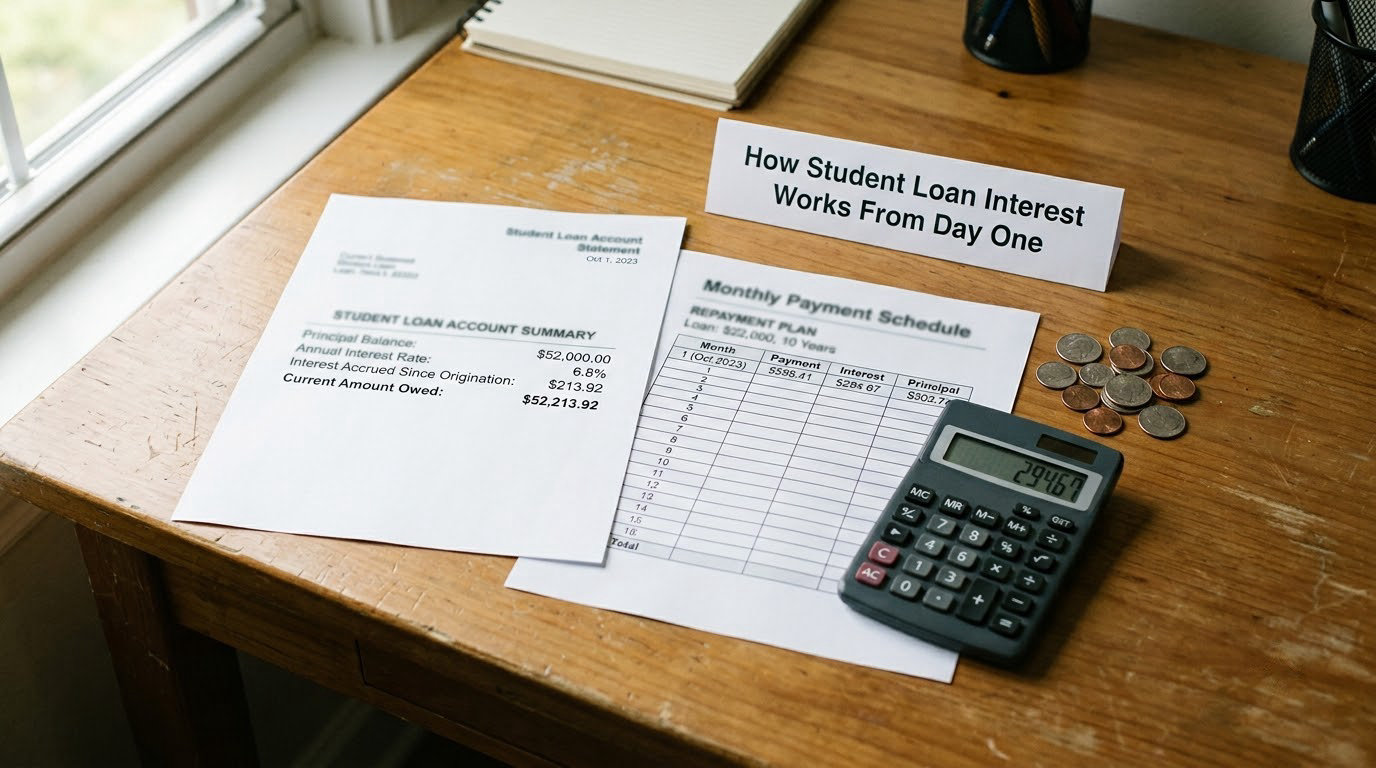
Interest accrues daily, not monthly. Each morning your servicer multiplies yesterday’s principal balance by the daily rate and adds the result to accrued interest. Nothing is billed at that moment, but the number is already on the ledger.
The lifecycle runs like this. Money is disbursed to your school and the balance starts accruing, or the interest is deferred on some loans. You leave school or the enrollment status changes, which often opens a grace period or triggers a change in who pays. Repayment begins, payments clear interest first, unpaid interest may capitalize at specific events, and the balance eventually reaches zero.
Borrowers on r/StudentLoans describe checking the accrual on their servicer portal almost daily, and noticing that a balance can creep up during a stretch when payments fall short or a deferment is active. The accrual never stops just because you are not looking at it.
The Main Factors That Change Your Interest
Five inputs drive the number: the principal balance, the interest rate, the loan type, whether the rate is fixed or variable, and how long the balance stays outstanding. Change any one of them and the total cost moves. How student loan interest works day to day comes down to those five, and nothing else.
Here is the same 20,000 balance at three rates, with nothing else changed.
| Annual rate | Interest per day | One year | Three years | Five years |
|---|---|---|---|---|
| 5.00% | 2.74 | 1,000 | 3,000 | 5,000 |
| 6.25% | 3.42 | 1,250 | 3,750 | 6,250 |
| 8.00% | 4.38 | 1,600 | 4,800 | 8,000 |
A rate difference of three percentage points on 20,000 is 1,600 a year. That is why a private loan priced on credit can cost more than a federal one even when the monthly payment looks manageable.
Simple vs Daily Interest Formulas
How student loan interest works day by day at 6.25%
The formula is short: daily interest equals principal balance multiplied by the annual interest rate, divided by 365.
For a 20,000 balance at 6.25 percent, the annual figure is 1,250. Divide that by 365 and you get 3.42 a day, or roughly 103 across a 30-day month. A 10,000 balance at 5 percent accrues 1.37 a day, the figure most servicer help pages quote.
Here is the rate factor table, so you can work it yourself without a calculator app. The daily factor is the annual rate expressed as a percentage divided by 365.
| Annual rate | Daily factor | Per day on 10,000 | Approx. per month on 10,000 |
|---|---|---|---|
| 3.00% | 0.008219% | 0.82 | 24.66 |
| 4.00% | 0.010959% | 1.10 | 32.88 |
| 5.00% | 0.013699% | 1.37 | 41.10 |
| 6.00% | 0.016438% | 1.64 | 49.32 |
| 6.25% | 0.017123% | 1.71 | 51.37 |
| 7.00% | 0.019178% | 1.92 | 57.53 |
| 8.00% | 0.021918% | 2.19 | 65.75 |
| 9.00% | 0.024658% | 2.47 | 73.97 |
Why simple and compound interest are not the same thing
Simple interest charges you only on the principal you originally borrowed. Compounding charges you on principal plus previously accumulated interest, so the growth accelerates.
On 10,000 at 5 percent, simple interest for one full year is exactly 500. If the same balance compounded daily, the growth factor rises slightly and the year comes to about 512.74. The gap is real, but it is far smaller than people assume when they hear the word compound.
What actually hurts is capitalization. When unpaid interest is folded into principal, the next day’s accrual is calculated on a bigger base. That is the compounding effect borrowers notice on their statements, and it happens at specific moments rather than continuously.
Fixed and Variable Student Loan Interest Rates
A fixed rate stays the same for the life of the loan, so your payment stays predictable and extra principal shortens the schedule quickly. A variable rate resets on a schedule tied to an index, so the balance and the payment can move either way.
Federal Direct Subsidized and Direct Unsubsidized Loans for undergraduates and graduates carry fixed rates. Federal Parent PLUS and Graduate PLUS Loans also carry fixed rates for the life of the loan. Private student loans are the main place borrowers meet variable structures, and borrowers on those loans report rate resets they did not anticipate.
Payments on a fixed-rate loan are still not fixed in a useful sense once you pay extra. The rate is fixed; the timeline is yours to change.
When Student Loan Interest Is Charged or Capitalized
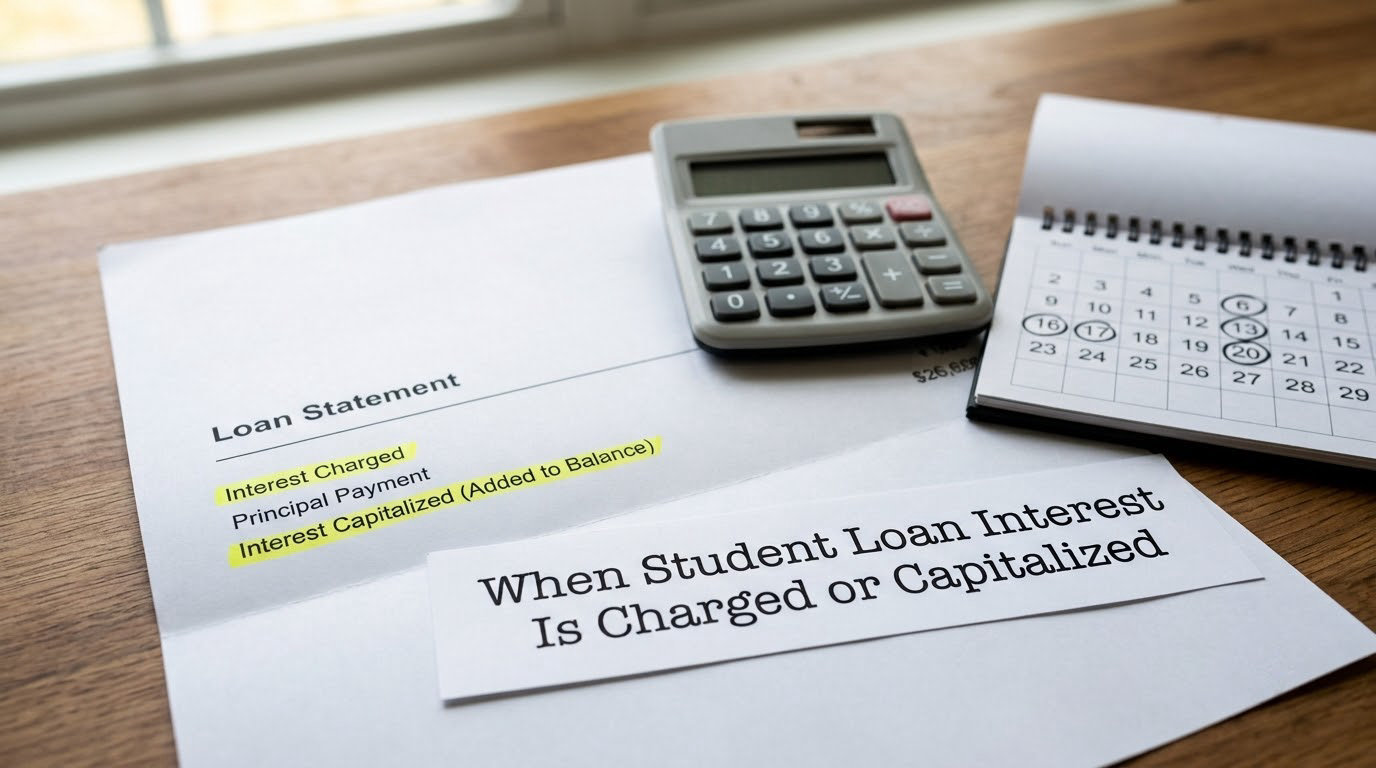
Accrual and charging are different steps. Accrual happens every day. Billing or capitalization happens at defined moments, and delinquency happens when a payment is missed.
The usual federal capitalization triggers are recognizable: the end of a deferment or forbearance, the end of a grace period, a change in repayment plan, and consolidation. Borrowers on r/StudentLoans describe the end of the grace period as the moment that surprised them most, because the balance jumped with no new borrowing.
Payment order is why progress can feel slow. A payment is applied to accrued interest first, and only the remainder reduces principal. If you pay exactly what the interest costs, the balance never moves. Interest you leave unpaid at a capitalization event is no longer an expense; it becomes part of the amount you owe.
Federal vs Private Student Loan Interest
Federal loan rates are set by statute and published on a schedule, and the Department of Education sets the rates for new loans each year. They do not depend on your credit history. Annual borrowing limits also apply to Direct Loans, so the rate and the amount are both capped in ways a private lender does not have to follow.
Federal loans also carry protections: fixed-rate structures, deferment and forbearance options, income-driven repayment plans, and discharge for qualifying circumstances. Private loans are priced on credit and offered outside those programs, with terms set by the lender and often variable.
Both types report interest paid to the IRS on Form 1098-E, which feeds the student loan interest deduction on your return. The deduction is limited and phases out at higher modified adjusted gross income, so the amount you can claim is not simply everything you paid. Current limits and thresholds are published by the IRS and should be checked for the tax year in question.
Grace Periods, Deferment, and Forbearance
Accrual can pause, and which rule applies depends on the loan and the event. On federal loans, the government pays the interest on subsidized loans during specified in-school periods. Unsubsidized loans keep accruing for the borrower, and interest from that period can capitalize later.
After a qualifying event, some loans have a short post-period where interest does not capitalize for certain borrowers, while others continue to accrue. Deferment and forbearance are not the same thing: deferment is usually tied to an eligible condition such as enrollment, and interest on subsidized loans may be covered during it, while forbearance is a hardship-based pause that typically leaves interest accumulating.
Programs such as income-driven repayment and the SAVE plan can subsidize some or all of the interest a borrower would otherwise owe, and the rules for who qualifies and how unpaid interest is handled have changed more than once. Verify current treatment with your servicer and official federal resources rather than assuming interest has stopped. The forum advice repeats the same warning: a pause in payments is not automatically a pause in interest.
How Interest Affects Your Monthly Payment
Take 20,000 at 6.25 percent repaid over ten years. The standard monthly payment is about 225. In the first month, interest on 20,000 is 104.17, and the remaining 120.83 reduces principal. The balance becomes 19,879.17. That split is how student loan interest works inside a single payment.
That split is the whole story of slow progress. Early on, a large share of each payment is servicing the daily accrual, and the balance declines gently. Later payments cross over and start shrinking the balance faster, which is why early extra principal payments have more leverage.
Add 10 a month and the payment becomes 235. The payoff date shortens by roughly seven months, and total interest drops by a few hundred dollars. That is a modest return, and it is one reason borrowers chase larger rate reductions later in the life of a loan rather than small payment bumps at the start.
Ways to Reduce Student Loan Interest
1. Pay on time, every month
A missed payment can move a loan into delinquency, and past-due interest can add up fast. Automatic payments are the boring way to avoid this. Some lenders also offer a small interest rate reduction for enrollment in autopay, and it is worth asking whether your servicer does.
2. Direct extra dollars at principal
A payment above the minimum is applied to accrued interest first, then to principal. Send the extra amount straight to the loan with the highest rate, and tell the servicer in writing to route it to principal. It is the simplest lever you control.
3. Keep the timeline short
Interest is charged on time as much as on dollars. A loan paid off in five years costs far less than the same loan paid over twenty, and a shorter term with a higher monthly payment is not the same as a lower rate.
4. Avoid unnecessary capitalization
Watch the calendar around deferment, forbearance and plan changes. If you have a way to cover accruing interest during a pause, you avoid having it folded into principal. Borrowers who entered a pause without tracking the date often met the capitalization step unprepared.
5. Compare refinancing costs carefully
Refinancing can lower a rate, extend the term, reset a variable rate or remove a federal protection. Extending the term lowers the payment and usually raises total interest, so run the numbers on total cost rather than monthly cost. Private refinancing usually requires a credit check and may not qualify for income-driven plans later.
6. Order payoff when you hold several loans
Two common orders: the avalanche method targets the highest rate first to cut total interest, and the snowball method targets the smallest balance first for a quicker visible win. Avalanche usually costs less over the full run, and the difference depends on your balances and rates.
None of this is individualized advice, and no step guarantees a saving. Rate structures, servicer rules and relief or repayment programs shift, so check the current published terms for the plan you hold before you act.
Frequently Asked Questions
Does student loan interest start immediately?
On most federal student loans, interest starts accruing from the disbursement date, though the government covers it on subsidized loans during in-school periods. Unsubsidized loans start adding unpaid interest to the borrower right away. After graduation or a change in enrollment, a post-school period may apply before full accrual resumes.
Is student loan interest simple or compound?
Most student loans, including federal Direct Loans, use simple daily interest calculated on the outstanding principal. True daily compounding is uncommon. The effect people mistake for compounding is capitalization, where unpaid interest is added to principal at set events, so future accrual is calculated on the larger balance.
Does making extra student loan payments reduce interest?
Yes. Interest accrues daily on the principal that remains, so a payment above the minimum reduces principal sooner and lowers the base for every following day of accrual. Send the extra amount to principal rather than letting it sit as a future payment buffer, and tell the servicer in writing how to allocate it.
Can unpaid student loan interest be capitalized?
It can. Common federal triggers include the end of a deferment or forbearance, the end of a post-school period, a change in repayment plan, and consolidation. Once capitalized, that interest is treated as principal, so it accrues interest in future periods and is no longer deductible as an expense on your tax return.
Do student loans accrue interest during a grace period?
It depends on the loan and the event. Some federal loans have a short post-school period when certain borrowers are not charged, while others keep accruing. Interest on subsidized loans may be covered during a deferment, but forbearance typically leaves interest accumulating. Confirm the current rule for your loan with your servicer.
Does paying off one student loan early improve my credit?
Rarely, and the effect is usually small. There is no credit score bonus for a zero balance on a student loan, since installment loans carry no utilization penalty once closed. The main financial gain is the interest you stop paying. A paid-off loan stays on your credit report for years, which is neutral rather than harmful.
Conclusion
Start by pulling five numbers from your statement or servicer account: the current principal balance, the interest rate and whether it is fixed or variable, the loan type, the repayment plan you are on, and the next due date. Those five answers let you calculate the daily accrual yourself in about ten seconds, which is the fastest way to grasp how student loan interest works on your own account.
The part most people miss: interest is charged on time, not only on dollars. Reducing how long you carry a balance, and keeping unpaid interest from becoming principal, does more for the total cost than any small rate tweak. Rates and program rules change, so check the current terms for your own loan before you act on any of this.